

Percentages of Amounts GCSE Maths Explained
Percentages of amounts GCSE maths explained with clear methods, worked examples, common mistakes and exam-style questions for confident GCSE revision today.
Percentages of amounts GCSE maths questions often look simple. That is precisely why mistakes feel so frustrating. You know that percentage means “out of one hundred”, but the calculator answer still seems to arrive without a clear reason.
Imagine a student called Sam. Sam tries to find 15%15\%15% of 240240240 by typing several combinations into a calculator. One produces 363636, another produces 160016001600, and neither method feels dependable. The breakthrough comes when Sam stops treating percentages as a collection of button presses and sees one consistent idea:
To find a percentage of an amount, convert the percentage into a decimal and multiply it by the amount.
This method works for awkward percentages, amounts involving money and percentages greater than 100%100\%100%. It is the method to remember when the numbers are not friendly enough for mental maths.
The percentages of amounts checklist
Before looking at the worked examples, keep this short process beside you:
- Identify the percentage you need to find.
- Divide the percentage by 100100100 to convert it into a decimal.
- Multiply that decimal by the original amount.
- Check whether the answer is a sensible size.
- Include the correct unit, such as pounds, kilograms or people.
In one line, the method is:
percentage of an amount=percentage100×amount\text{percentage of an amount}=\frac{\text{percentage}}{100}\times\text{amount}percentage of an amount=100percentage×amountFor a guided version of the same process, work through the MathsGenie Percentages Lesson. It builds the skill towards the form in which you may meet it in an exam.
Why the decimal method works
A percentage is a number of parts per hundred. Therefore,
15%=15100=0.1515\%=\frac{15}{100}=0.1515%=10015=0.15Finding 15%15\%15% of an amount means taking 0.150.150.15 of that amount. In mathematics, the word “of” usually tells you to multiply:
15% of 240=0.15×24015\%\text{ of }240=0.15\times24015% of 240=0.15×240This is not a calculator trick. It is the meaning of percentage written efficiently.
There are also useful mental links:
- 50%50\%50% means one half.
- 25%25\%25% means one quarter.
- 10%10\%10% means divide by 101010.
- 5%5\%5% is half of 10%10\%10%.
- 1%1\%1% means divide by 100100100.
Mental methods are helpful when the numbers cooperate. The decimal multiplier is more general and gives Sam one reliable approach instead of several disconnected rules.
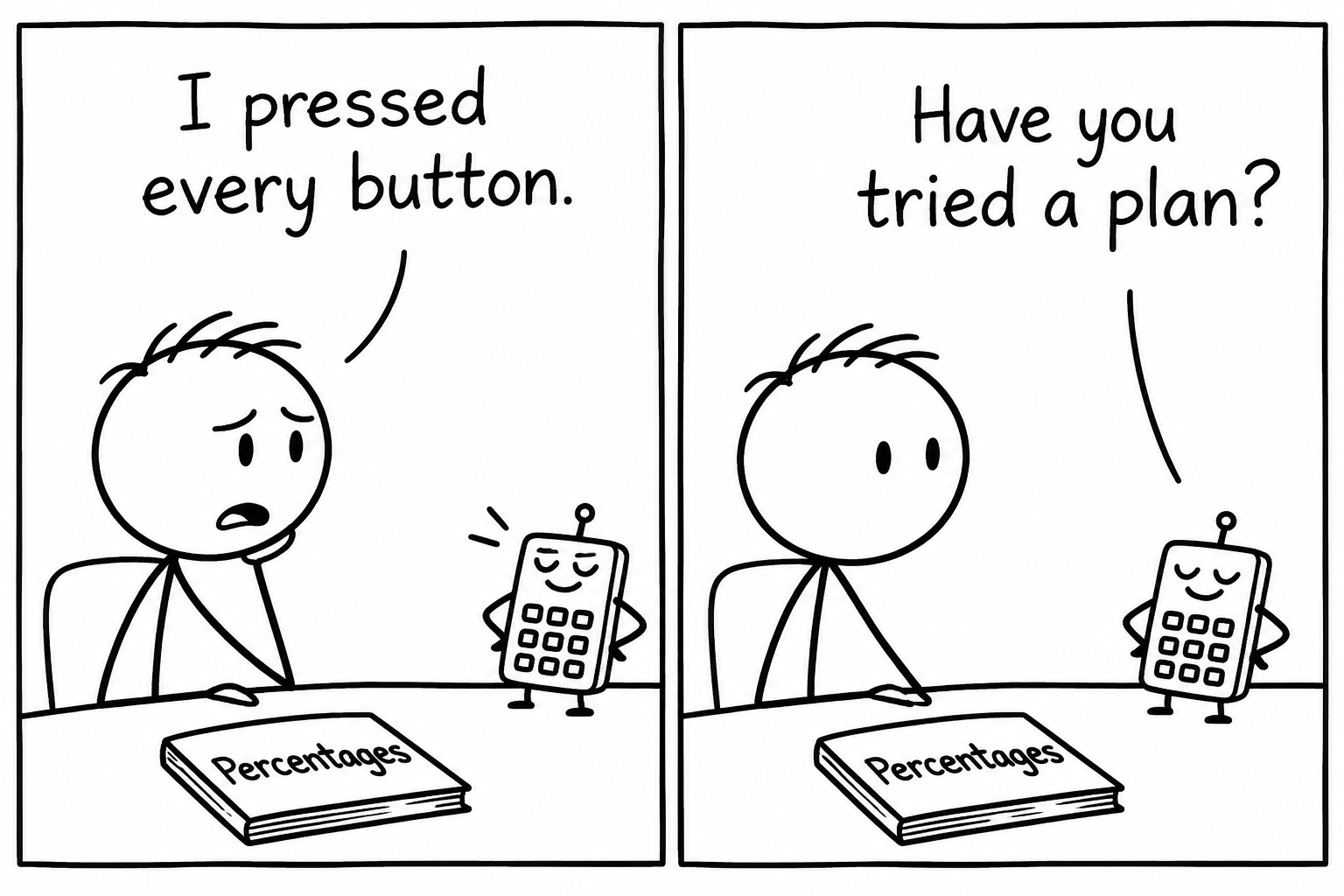 A GCSE student discovers that a calculator works better with a plan
Percentages of amounts worked examples
Finding a percentage using a decimal
Find 15%15\%15% of 240240240.
First, convert 15%15\%15% into a decimal:
15%=15100=0.1515\% = \frac{15}{100}=0.1515%=10015=0.15Then multiply by the amount:
0.15×240=360.15\times240=360.15×240=36Therefore,
15% of 240=3615\%\text{ of }240=3615% of 240=36Sam can check this without repeating the full calculation. Since 10%10\%10% of 240240240 is 242424 and 5%5\%5% is 121212, the answer should be:
24+12=3624+12=3624+12=36The two methods agree.
Finding a percentage of money
A coat costs £68\pounds 68£68. Find 35%35\%35% of its price.
Convert the percentage:
35%=0.3535\%=0.3535%=0.35Multiply by the original price:
0.35×68=23.80.35\times68=23.80.35×68=23.8Money should be written to two decimal places, so the answer is:
£23.80\pounds 23.80£23.80The question asks for the percentage of the price, not the price after a discount. If it had asked for the cost after a 35%35\%35% reduction, one more subtraction would be required.
Finding more than one hundred per cent
Find 125%125\%125% of 646464.
Convert the percentage into a decimal:
125%=1.25125\%=1.25125%=1.25Then multiply:
1.25×64=801.25\times64=801.25×64=80So,
125% of 64=80125\%\text{ of }64=80125% of 64=80An answer greater than 646464 is sensible because 125%125\%125% is greater than the whole amount. This is an important estimate. Percentages greater than 100%100\%100% are part of GCSE percentage work, so the answer does not always have to be smaller than the original.
You now have the complete method; use the MathsGenie Percentages Lesson and its Question Bank when you want to practise it without setting up your own sequence of questions.
Choosing between mental maths and a multiplier
Both methods are valid. The better choice is the one that is clear, efficient and easy to check.
For example, to find 30%30\%30% of 909090, mental maths is quick:
10% of 90=910\%\text{ of }90=910% of 90=9Therefore,
30% of 90=3×9=2730\%\text{ of }90=3\times9=2730% of 90=3×9=27The multiplier method reaches the same result:
0.30×90=270.30\times90=270.30×90=27For 17%17\%17% of 235235235, the multiplier is likely to be easier:
0.17×235=39.950.17\times235=39.950.17×235=39.95The calculator does the arithmetic, but you still need to choose the calculation. Sam's improvement comes from writing the multiplier before touching the calculator. That small pause separates mathematical thinking from button pressing.
You can recap the underlying connections on the Fractions, Decimals and Percentages revision page, then develop the wider topic through the Edexcel Percentages revision resources or AQA Percentages revision resources.
Common mistakes with percentages of amounts
Dividing the amount by the percentage
A student might calculate:
240÷15240\div15240÷15But finding 15%15\%15% of 240240240 requires multiplication by 0.150.150.15:
240×0.15240\times0.15240×0.15Write the percentage as a decimal first. This makes the required operation easier to see.
Using the percentage as a whole number
Calculating 15×24015\times24015×240 treats 15%15\%15% as 151515, rather than 0.150.150.15. Remember:
15%=0.1515\%=0.1515%=0.15The division by 100100100 is essential.
Finding the discount but giving it as the final price
If a question asks for 20%20\%20% of £50\pounds 50£50, the answer is:
0.20×50=100.20\times50=100.20×50=10If it asks for the price after a 20%20\%20% discount, subtract the discount:
50−10=4050-10=4050−10=40Read the final sentence of the question again before writing your answer.
Ignoring whether the answer is sensible
If you find 8%8\%8% of 500500500 and obtain 625062506250, something has gone wrong. Since 8%8\%8% is less than 10%10\%10%, the result must be less than 505050.
A rough estimate can catch an incorrect calculator entry before it costs a mark.
Forgetting units or money notation
An answer of 12.512.512.5 may be numerically correct, but the context could require 12.512.512.5 kilograms, 12.512.512.5 metres or £12.50\pounds 12.50£12.50. Carry the unit into your final answer.
Percentages of amounts questions for exam practice
Try these without looking at the answers first. Write down the multiplier in each case, even if you use a calculator.
- Find 18%18\%18% of 350350350.
- Find 7%7\%7% of £84\pounds 84£84.
- A school has 720720720 students. Altogether, 45%45\%45% travel by bus. Work out how many students travel by bus.
- Find 135%135\%135% of 260260260.
- A television costs £540\pounds 540£540. A shop offers a discount of 15%15\%15%. Work out the value of the discount.
Answers
For question one:
0.18×350=630.18\times350=630.18×350=63For question two:
0.07×84=5.880.07\times84=5.880.07×84=5.88The answer is £5.88\pounds 5.88£5.88.
For question three:
0.45×720=3240.45\times720=3240.45×720=324Therefore, 324324324 students travel by bus.
For question four:
1.35×260=3511.35\times260=3511.35×260=351For question five:
0.15×540=810.15\times540=810.15×540=81The discount is £81\pounds 81£81. The question does not ask for the new price.
Once these feel secure, attempt a MathsGenie exam-style percentages question. Compare your working with the worked solution and mark scheme rather than checking only the final number.
Make the method stick
Sam did not improve by memorising more buttons. The change came from using the same three thoughts every time: convert, multiply and check. Knowing that sequence is the first step; following it under exam pressure requires focused practice.
Your turn. Build confidence with percentages of amounts by opening the MathsGenie Percentages Lesson and Question Bank and working from the explanation into exam-style questions.















