Parallel Lines Exam Questions: GCSE Worked Guide
Parallel lines exam questions explained with three GCSE examples, angle rules, method marks, common mistakes and focused exam-style practice for revision.
Parallel lines questions often look easier than they feel. The diagram appears simple, yet an unfamiliar angle or algebraic expression can make the route disappear.
The reliable way to answer parallel lines exam questions is to identify the angle relationship, write the relevant fact, calculate carefully, and give a geometrical reason when requested. This guide follows a hypothetical student, Maya, through three questions, showing how to make each stage visible to the examiner.
For teaching and practice, use MathsGenie's Angles in Parallel Lines lesson.
The parallel lines checklist
Before calculating, Maya checks:
- Are the lines marked or stated to be parallel?
- Which line is the transversal crossing them?
- Are the angles corresponding, alternate or co-interior?
- Are straight-line, vertically opposite or triangle angle facts needed?
- Does the question require an equation or a reason?
The three core facts are:
| Angle relationship | Rule |
|---|---|
| Corresponding angles | Corresponding angles are equal. |
| Alternate angles | Alternate angles are equal. |
| Co-interior angles | Co-interior angles add to 180∘180^\circ180∘. |
F, Z and C shapes can help you recognise these relationships, but diagrams can be rotated. Relative position matters more than the direction the picture faces.
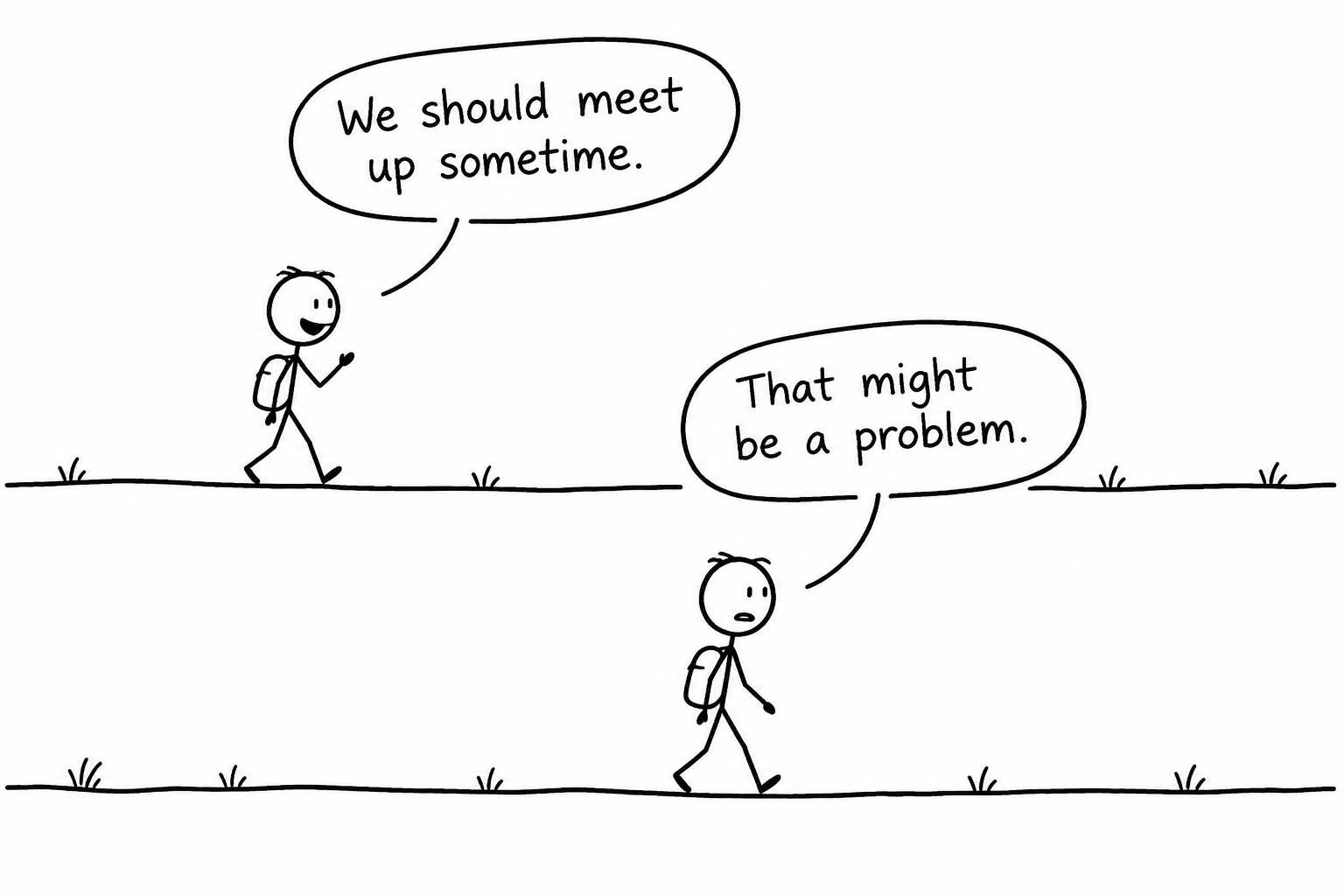 Two students discover the social difficulty of walking on parallel paths
How to read an unfamiliar parallel lines diagram
In an exam, spend a few seconds reading the diagram before reaching for a rule. Mark the two parallel lines, then trace the transversal through both intersections. Next, circle the angle you know and the angle you need. This prevents a common error: comparing two angles that are connected visually but do not form a standard parallel-line pair.
If the required angle is not directly related to the given angle, look for a bridge. A vertically opposite angle may copy the value across an intersection. An adjacent angle may complete a straight line. Only then might corresponding, alternate or co-interior angles carry the information to the other parallel line.
For algebraic labels, decide the relationship before forming an equation. Equal angles produce an equation such as A=BA=BA=B, while co-interior angles produce A+B=180∘A+B=180^\circA+B=180∘. The geometry chooses the algebra, not the other way round.
Finally, keep reasons beside the line of working they justify. A neat chain lets an examiner follow your thinking and makes your own checking faster. If a later answer looks impossible, you can return to the exact fact that created it.
Question one: recognising equal angles
Exam-style question
Two parallel lines are crossed by a transversal. One angle is 68∘68^\circ68∘. Angle aaa occupies the corresponding position at the other intersection. Find aaa and give a reason.
Step-by-step answer
The angles occupy the same relative position, so they are corresponding angles.
a=68∘a=68^\circa=68∘Reason: corresponding angles in parallel lines are equal.
A short question might award a mark for the value and another for the reason. Exact allocations vary, so check the relevant mark scheme.
Maya's decision was to recognise the relationship, not invent an unnecessary calculation. If the vocabulary feels uncertain, revisit the GCSE Angles exam booklet before attempting more complicated diagrams.
Question two: parallel lines with algebra
Exam-style question
Two alternate angles between parallel lines are labelled (5x+7)∘(5x+7)^\circ(5x+7)∘ and (3x+35)∘(3x+35)^\circ(3x+35)∘. Find xxx and calculate each angle.
Step-by-step answer
Alternate angles are equal, so Maya writes:
5x+7=3x+355x+7=3x+355x+7=3x+35Subtract 3x3x3x from both sides:
2x+7=352x+7=352x+7=35Subtract 777, then divide by 222:
2x=282x=282x=28 x=14x=14x=14Substitute into the first expression:
5(14)+7=775(14)+7=775(14)+7=77Each angle is therefore 77∘77^\circ77∘. Check the other expression:
3(14)+35=773(14)+35=773(14)+35=77An illustrative allocation could reward the correct equation, the value of xxx and the angle. Writing the equation may demonstrate a valid method even if later arithmetic goes wrong. These are possible marking stages, not a guaranteed allocation.
Use the Edexcel GCSE Maths exam booklets to practise recognising these relationships alongside other topics.
Question three: a multi-step problem
Harder parallel lines questions often combine several familiar facts. The challenge is choosing their order.
Exam-style question
Two horizontal lines are parallel. A sloping side of a triangle crosses both. An angle at the upper intersection is 118∘118^\circ118∘. Its corresponding angle at the lower intersection is exterior to the triangle and forms a straight line with the left base angle. The right base angle is 47∘47^\circ47∘. Find the top angle yyy.
Step-by-step answer
First, corresponding angles are equal, so the exterior angle at the lower intersection is 118∘118^\circ118∘.
Angles on a straight line add to 180∘180^\circ180∘:
left base angle=180∘−118∘=62∘\text{left base angle}=180^\circ-118^\circ=62^\circleft base angle=180∘−118∘=62∘The angles in a triangle also add to 180∘180^\circ180∘:
y+62∘+47∘=180∘y+62^\circ+47^\circ=180^\circy+62∘+47∘=180∘Therefore:
y=180∘−62∘−47∘=71∘y=180^\circ-62^\circ-47^\circ=71^\circy=180∘−62∘−47∘=71∘Depending on the mark scheme, credit may recognise the corresponding angle, the straight-line calculation, the triangle method and the final answer.
Maya writes each angle onto the diagram immediately. This turns a crowded problem into small, checkable statements rather than a memory test. The Angles in Parallel Lines revision guide offers further topic support.
Reviewing parallel lines past paper questions
After completing a question, check more than the final answer:
- Did you use the parallel markings rather than appearances?
- Did you name the correct relationship?
- Is each calculation or equation visible?
- Did you answer every part of the instruction?
A method mark often rewards a valid approach; an accuracy mark usually rewards a correct value, sometimes dependent on earlier working. Precise conditions vary, so consult the paper's own mark scheme.
When an answer is wrong, identify the first incorrect step. A mistaken angle relationship needs different revision from a subtraction error. Correct that step, then attempt a fresh question without notes.
The Edexcel GCSE Maths revision hub provides topic lessons and exam practice. The guide to common GCSE Maths question types helps place angle work within wider revision.
Common mistakes with parallel lines
Assuming lines are parallel
Use matching arrow markings or the question's wording. Appearance alone is not evidence.
Confusing equal and supplementary angles
Corresponding and alternate angles are equal. Co-interior angles add to 180∘180^\circ180∘. Write the rule before choosing an operation.
Giving a vague reason
“Alternate angles are equal” identifies a fact. “Because of parallel lines” does not explain which relationship you used.
Finding xxx but not the angle
Re-read the instruction after solving. Substitution may still be needed.
Trusting the diagram's appearance
Diagrams are not always drawn accurately. Use labels and proven facts rather than estimating angles by sight.
Turn the method into marks
Maya's routine is simple: identify one relationship, write one reason and complete one calculation before moving on. Practising that sequence makes unfamiliar diagrams more manageable.
Start the Angles in Parallel Lines question bank, check your working carefully, and revisit any rule you could not confidently explain.