

Order of Operations Exam Questions: GCSE Guide
Order of operations exam questions explained through three GCSE examples, with clear working, method-mark advice, common mistakes and practice tips.

A calculation can contain only familiar numbers and still feel strangely uncertain. You know how to add, subtract, multiply and divide. The difficulty is deciding what to do first.
That is the purpose of order of operations exam questions. Examiners are testing whether you can follow a calculation in the correct sequence, usually remembered as BIDMAS. The reliable method is simple: deal with brackets and indices first, then multiplication and division from left to right, followed by addition and subtraction from left to right.
In this guide, we will follow a hypothetical student, Sam, through three GCSE exam-style questions of rising difficulty. Each example shows the working an examiner could reward, rather than relying on one jump to the answer.
The order of operations checklist
BIDMAS stands for:
- Brackets
- Indices
- Division and multiplication
- Addition and subtraction
Two details matter more than the acronym suggests.
First, multiplication does not always come before division. They have equal priority, so you work from left to right. The same applies to addition and subtraction.
Second, a fraction bar acts like brackets. The entire numerator and denominator must be calculated before the division is completed.
Before starting any question, use this routine:
- Scan the whole expression before calculating.
- Identify brackets and powers.
- Simplify one stage at a time.
- Keep the rest of the expression unchanged.
- Write enough working for the method to be visible.
- Check whether your calculator entry matches the written expression.
The Maths Genie BIDMAS revision guide gives the same rule in a compact form for quick revision.
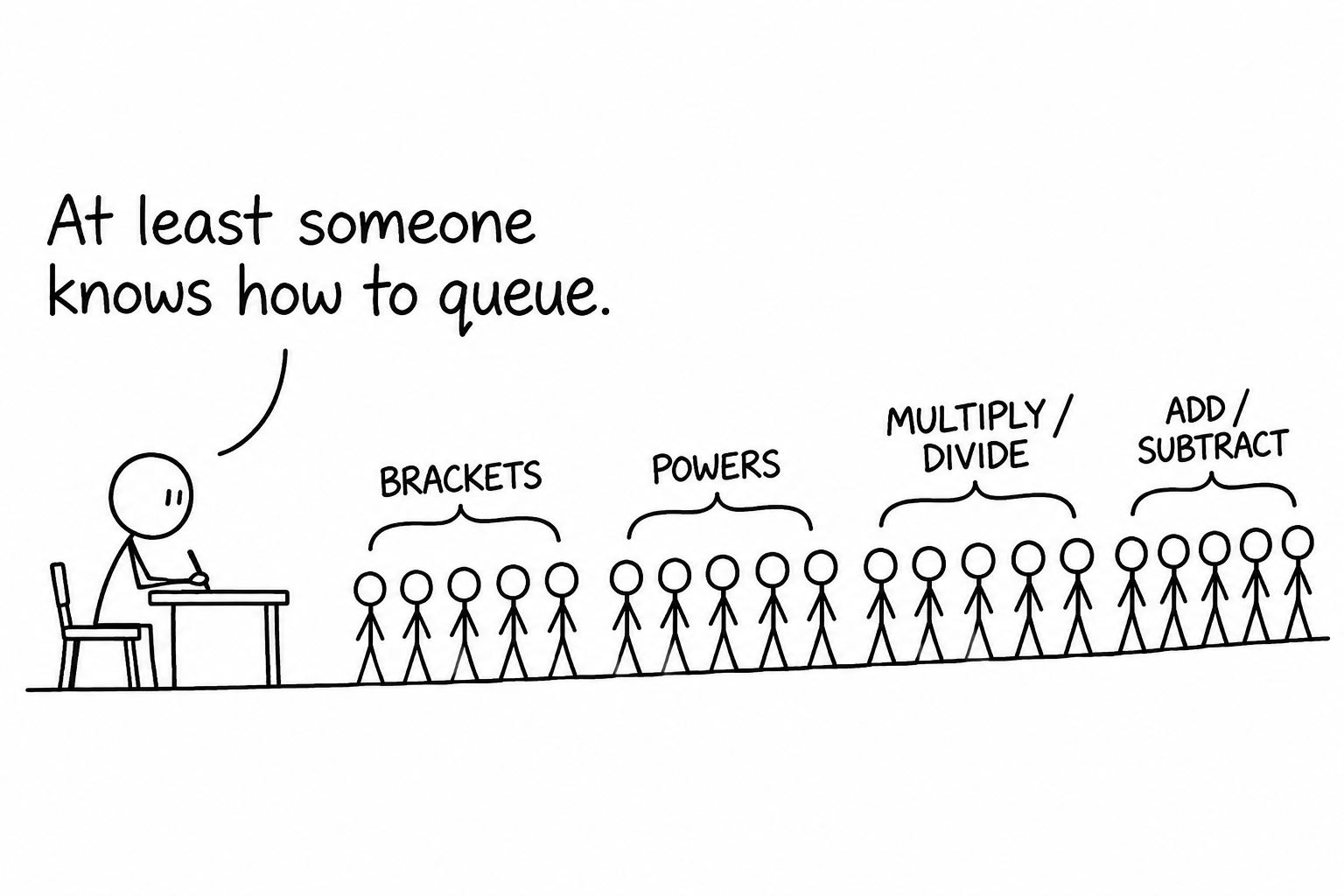 A student watches brackets, powers and operations queue patiently beside a revision desk
Question one: multiplication before subtraction
Sam begins with a short question:
Work out 18−3×418-3\times418−3×4.
The tempting move is to read from left to right and calculate 18−318-318−3 first. But multiplication has priority over subtraction.
Step-by-step solution
First calculate the multiplication:
3×4=123\times4=123×4=12Then subtract:
18−12=618-12=618−12=6Therefore:
6\boxed{6}6For an exam-style question worth perhaps two marks, an illustrative allocation could reward the correct multiplication or a valid intermediate expression, followed by the accurate final answer. Exact mark schemes vary, so the important habit is to show:
18−3×4=18−12=618-3\times4=18-12=618−3×4=18−12=6Sam notices something useful here. Writing one extra line takes only seconds, but it separates the method from the arithmetic. If the final subtraction went wrong, the examiner could still see that the correct operation was completed first.
Question two: brackets and an index
The next question introduces two higher-priority features:
Work out 3+23(7−5)3+2^3(7-5)3+23(7−5).
A number beside a bracket means multiplication, so this expression is equivalent to:
3+23×(7−5)3+2^3\times(7-5)3+23×(7−5)Step-by-step solution
Sam starts with the bracket and the index:
7−5=27-5=27−5=2and
23=82^3=823=8The expression becomes:
3+8×23+8\times23+8×2Now complete the multiplication:
8×2=168\times2=168×2=16Finally, add:
3+16=193+16=193+16=19Therefore:
19\boxed{19}19An illustrative three-mark structure might reward correct simplification of the bracket and index, correct multiplication, and the final answer. On a real paper, however, marks depend on that question's published mark scheme.
This is where organised layout matters. Sam does not try to write every calculation mentally and record only 191919. Each line shows what changed while preserving everything else:
3+23(7−5)3+2^3(7-5)3+23(7−5) =3+8×2=3+8\times2=3+8×2 =3+16=3+16=3+16 =19=19=19You can build this habit with the BIDMAS step-by-step lesson, then move directly into exam-style questions in the Maths Genie BIDMAS topic area.
Once you can follow this one-change-per-line method, use the Maths Genie Lessons and Question Bank to practise it until choosing the first operation feels automatic.
Question three: a fraction with several operations
Sam's final question looks more demanding because a fraction divides the expression into two separate calculations:
>24−2(32−5)2+2+3>> \frac{24-2(3^2-5)}{2+2}+3 > >2+224−2(32−5)+3>Work out
The fraction bar groups the numerator and denominator. Sam decides to simplify each one separately before dividing.
Step-by-step solution
Start with the index inside the bracket:
32=93^2=932=9Then simplify the bracket:
9−5=49-5=49−5=4The numerator is now:
24−2×424-2\times424−2×4Complete the multiplication before the subtraction:
24−8=1624-8=1624−8=16The denominator is:
2+2=42+2=42+2=4The original expression has therefore become:
164+3\frac{16}{4}+3416+3Now divide, then add:
4+3=74+3=74+3=7Therefore:
7\boxed{7}7A possible four-stage marking approach could recognise the inner bracket and index, the correct numerator, the correct division, and the final answer. This is not a promise of how a particular exam board will allocate marks, but it illustrates why visible intermediate values matter.
Sam's working also makes checking easier. There is no mysterious leap from the original fraction to 777. If an error appears, it can be traced to a particular line.
How to approach an order of operations GCSE exam
These questions may appear on calculator or non-calculator papers. A calculator can carry out the operations, but it cannot decide whether you entered the intended expression.
For example, entering a fraction without suitable brackets may change its meaning. For
24−82+2\frac{24-8}{2+2}2+224−8a safe calculator entry is based on:
(24−8)÷(2+2)(24-8)\div(2+2)(24−8)÷(2+2)On paper, keep the fraction structure visible. On a calculator, use brackets to reproduce that structure.
When practising order of operations past paper questions, do not merely mark each answer right or wrong. Ask three better questions:
- Did I choose the correct first operation?
- Did I preserve the unchanged parts of the expression?
- Could an examiner follow my method?
The printable BIDMAS exam booklet is useful for practising directly on a question page. You can also place this topic within wider revision using the Edexcel GCSE Maths revision hub.
Common mistakes in order of operations exam questions
Working from left to right automatically
In 18−3×418-3\times418−3×4, subtracting first ignores the priority of multiplication. Scan for higher-priority operations before beginning.
Treating BIDMAS as six completely separate levels
Division and multiplication share a level. Addition and subtraction also share a level. Within each pair, work from left to right.
For example:
24÷6×2=4×2=824\div6\times2=4\times2=824÷6×2=4×2=8It is not correct to multiply 6×26\times26×2 first merely because multiplication appears in the acronym.
Forgetting implied multiplication
In 2(3+4)2(3+4)2(3+4), the number touching the bracket means:
2×(3+4)2\times(3+4)2×(3+4)Squaring the wrong value
The expressions −32-3^2−32 and (−3)2(-3)^2(−3)2 are different:
−32=−(32)=−9-3^2=-(3^2)=-9−32=−(32)=−9but
(−3)2=9(-3)^2=9(−3)2=9Brackets determine whether the negative sign is included in the value being squared.
Entering fractions carelessly
A fraction bar groups its numerator and denominator. Without brackets, a calculator may interpret the entry differently from the printed question.
Showing no working
A correct answer earns the available answer marks, but a wrong answer with no working gives the examiner little method to assess. Write one meaningful simplification per line, especially when brackets, indices or fractions are involved.
Turn the method into reliable exam marks
Sam has not learned a shortcut. Instead, the questions have become manageable because each one is reduced in a controlled sequence. Knowing BIDMAS is the first step; applying it accurately under exam pressure comes from deliberate practice.
Your next move is to complete the matching lesson, then answer questions without looking back at the examples. Build that exam habit now: start the Maths Genie BIDMAS Lessons and Question Bank.















