A One-Week IGCSE Maths Revision Plan
A one-week IGCSE maths revision plan for Edexcel or Cambridge students, with daily topics, past-paper practice and a realistic timetable for focused revision.
An approaching exam can make a week feel alarmingly short. A useful one-week IGCSE maths revision plan starts with diagnosis, then targets weak topics, builds towards timed practice and leaves time for corrections. The aim is not to relearn everything. It is to use the remaining days deliberately.
This plan suits Edexcel and Cambridge students, but questions must match your current specification and entry. Confirm these with your school. The GCSE and IGCSE Maths comparison explains the broader differences.
Your one-week plan at a glance
- Day 1: identify strengths and weaknesses.
- Day 2: repair number and algebra.
- Day 3: revise geometry and measures.
- Day 4: cover graphs, statistics and probability.
- Day 5: practise mixed questions.
- Day 6: complete and review a timed paper.
- Day 7: consolidate and prepare.
Aim for two or three focused sessions rather than an exhausting block. Try 454545 minutes of work followed by a break, adjusting around school, other subjects and sleep. The GCSE Maths revision timetable guide offers advice for balancing a longer revision period.
Day 1: find where marks are being lost
Starting at the first page of a textbook feels organised. Unfortunately, it gives familiar topics the same attention as questions you cannot start.
Instead, attempt mixed exam questions without notes, then mark them honestly. Sort topics into three groups:
| Category | What it means |
|---|---|
| Secure | You answer independently and understand the method |
| Uncertain | You need prompts or make repeated errors |
| Priority | You cannot start or choose the wrong method |
Record why marks were lost: missing knowledge, weak algebra, misreading or insufficient working. A score tells you where you are; these explanations tell you what to do next.
Use the Edexcel IGCSE Maths revision hub for relevant lessons, practice questions and papers. Cambridge students should select questions matching their current syllabus and Core or Extended entry.
Days 2-4: repair topics in focused groups
Let your diagnosis decide the workload. The topic groups below organise the week, but they should not override your actual weaknesses.
Day 2: number and algebra
Choose two or three priorities, such as fractions, percentages, indices, equations, sequences or inequalities.
Review a short lesson, answer questions independently and mark them promptly. Redo incorrect questions from a blank page, then attempt an unfamiliar question testing the same skill.
Recognising a solution is not the same as producing it. Close the explanation before testing yourself. If you still cannot begin, identify the missing step rather than repeatedly watching the whole lesson.
Day 3: geometry and measures
Target relevant areas such as angles, transformations, similarity, area, volume, vectors or trigonometry.
Before calculating, label diagrams and identify the required length, angle or measurement. Write the relationship you need before substituting values. For Pythagoras' theorem,
a2+b2=c2a^2+b^2=c^2a2+b2=c2where ccc is the hypotenuse. Use the IGCSE Pythagoras revision resources if this is a weakness. For exact-value work, the surds revision questions provide another focused option where relevant to your specification.
Day 4: graphs, statistics and probability
Practise interpreting information as well as calculating answers. Explain what a gradient, estimate or probability means in context, and check graph scales before reading values.
A probability must satisfy
0≤P(A)≤1.0\leq P(A)\leq 1.0≤P(A)≤1.An answer outside this interval signals an error. Use the IGCSE probability lesson and questions for targeted practice before returning to mixed work.
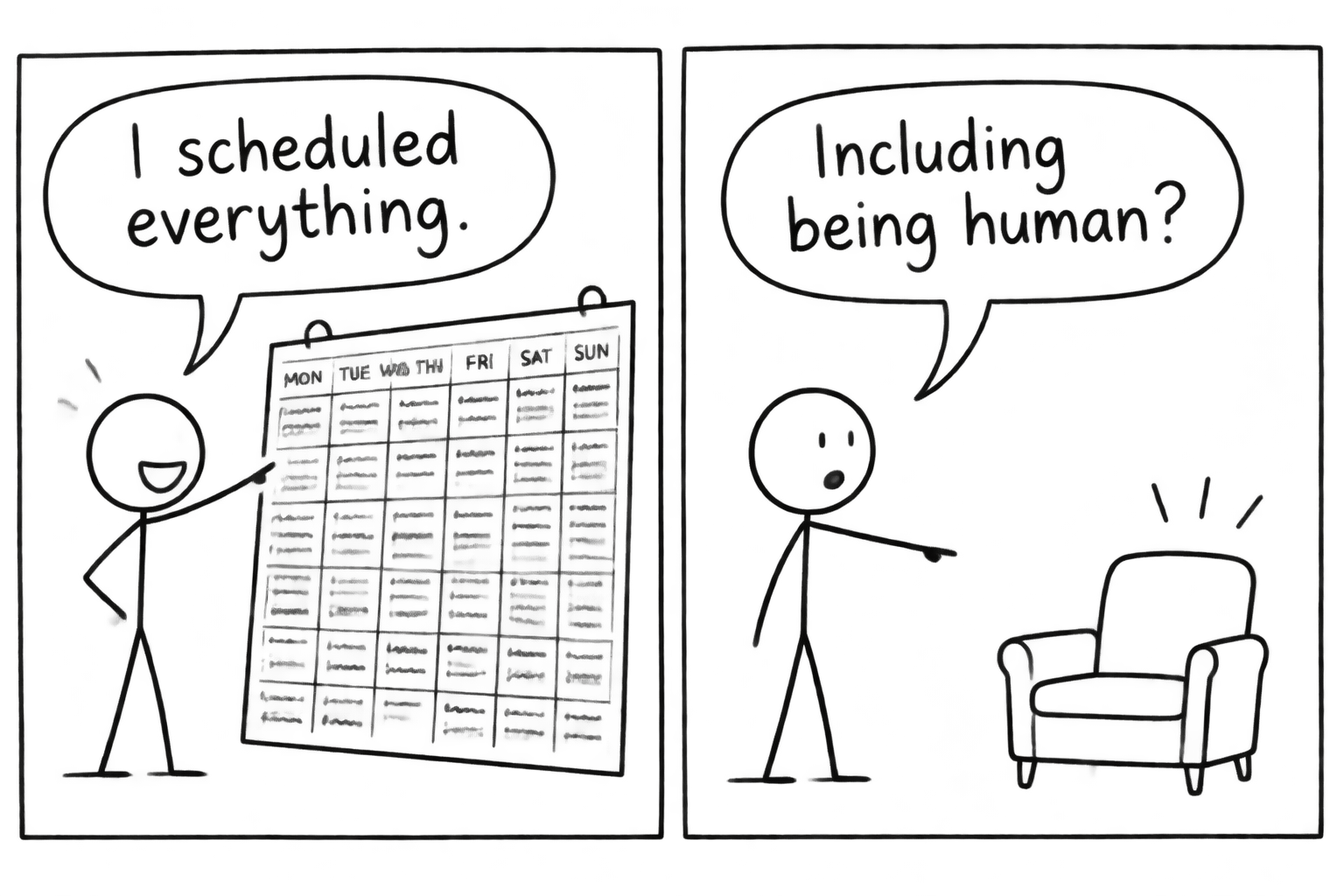 XKCD-style comic about an overambitious revision timetable forgetting that students need rest
Day 5: switch to mixed questions
Topic practice tells you which method to use. Mixed questions test whether you can recognise it yourself.
Combine number, algebra, geometry and data questions. Keep an error log recording the topic, mistake, correct approach and a retry date. Replace vague labels such as “careless” with the precise action that went wrong.
Include non-calculator practice if your examination route assesses those skills. Practise fractions, estimation and written arithmetic without automatically reaching for a calculator. Follow your current specification's requirements.
Day 6: rehearse the exam and review it
Choose a past paper matching your board and entry. Follow its official time allowance, use only permitted equipment and work without notes or answer checks.
A timed paper tests pacing and concentration as well as knowledge. If you get stuck, move on and return later rather than allowing one question to consume the session.
Mark what you actually wrote, not what you intended. Separate lost marks into knowledge gaps, method errors, arithmetic slips and misread questions.
Then correct the most useful errors. Another paper is not automatically better than repairing the first. The guide to using Edexcel Maths past papers properly explains this review process further.
Day 7: consolidate rather than cram
Retry selected errors without copying earlier solutions. Recall essential formulae and methods, then attempt a short mini test or mixed question set.
Keep this day lighter. Prepare permitted equipment, check school examination arrangements and protect your sleep. Avoid opening a large unfamiliar topic simply because the approaching exam makes it feel urgent.
Common mistakes to avoid
- Giving every topic equal time: maintain secure skills, but prioritise weaknesses identified by your questions.
- Watching without practising: revision lessons and video solutions should lead to independent attempts.
- Ignoring corrections: use mark schemes to understand lost marks, then retry questions later.
- Overloading the timetable: leave space for meals, interruptions and other subjects.
- Mixing examination routes: overlapping content does not make paper structures or requirements interchangeable.
Turn priorities into a realistic schedule
A useful week ends with fewer repeated mistakes, not simply more completed pages. Keep the cycle simple: attempt, check, repair and retry.
Use MathsGenie's free revision lessons, practice questions and mark schemes to support those steps. Then build your schedule in the MathsGenie Revision Planner, giving each session a clear purpose and enough room to finish it.