Old Textbook GCSE Sociology: Is It Still Useful?
Old textbook GCSE Sociology advice: check whether its theories, studies and exam guidance still match the current AQA or Eduqas specification.
The hand-me-down textbook looks useful. The chapters seem familiar, the key words are highlighted, and someone has already done the expensive part of buying it. But there is an uncomfortable question behind its battered cover: will it prepare you for the exam you are actually sitting?
The short answer is yes, an old textbook for GCSE Sociology can still be useful, but it should not be your only revision source. A book written for the current GCSE introduced for teaching from 2017 is likely to remain broadly relevant. A pre-2017 book may still explain core theories well, but its content, named studies, question styles and assessment advice may no longer match your specification.
The age of the book matters less than its alignment with your exam board.
The quick textbook checklist
Before relying on any sociology textbook, check:
- your exam board and specification code
- the specification or teaching year printed in the book
- whether every current topic appears in the contents
- whether required sociologists, theories and research are covered
- whether its exam questions resemble recent papers
- whether statistics and contemporary examples need updating
- whether your teacher has identified omitted or unnecessary material
If the book passes most of these checks, keep it. If it fails several, use it as a reference rather than as your revision plan.
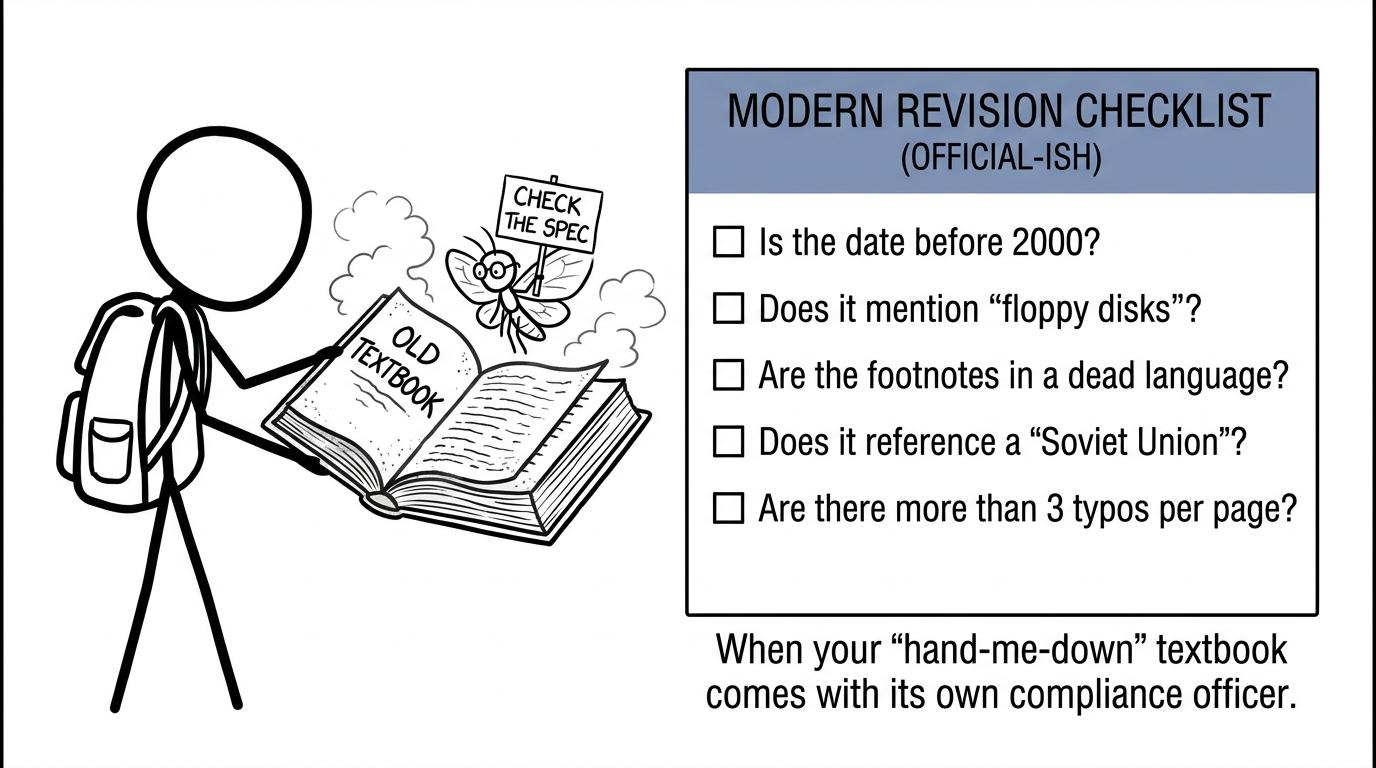 A student and a scholarly moth discover that an old textbook needs a specification check
How much has GCSE Sociology changed recently?
The present GCSE Sociology framework in England is not a brand-new course. The Department for Education published the reformed subject content in 2016 for teaching from 2017, and the current AQA and Eduqas qualifications began teaching in September 2017, with first awards in 2019.
That creates an important dividing line.
A textbook written for the current specification
If your book clearly says that it supports AQA 8192 or the current Eduqas GCSE introduced for teaching from 2017, its main theoretical content should still hold up. Core areas such as families, education, crime and deviance, social stratification, sociological theory and research methods remain central.
The official information available at the time of writing does not indicate a wholesale recent replacement of those qualifications. That does not mean every page of an older current-specification book is equally fresh. Social statistics, legislation, examples and references to public policy can age quickly even when the underlying theory remains useful.
A textbook written before the reform
A pre-2017 textbook is a different proposition. It may have been designed around an earlier qualification, assessment structure or grading system. It might refer to letter grades rather than grades 999-111, organise topics differently, or train you for questions that no longer appear in the same form.
The sociology itself has not suddenly become worthless. Explanations of Marxism, functionalism, feminism, interactionism, socialisation, sampling or primary and secondary data may still be valuable. The risk is coverage: the book may teach some relevant ideas while quietly missing content that your current examiner expects.
Think of it as an old map. Many roads remain, but you would not want to discover the missing junction during the exam.
Your exam board matters more than the publication date
AQA and Eduqas do not package GCSE Sociology in exactly the same way. Their courses overlap because both must follow national subject requirements, but topic organisation and assessment differ.
AQA 8192 is a linear qualification with two written papers. Paper 1 covers families and education; Paper 2 covers crime and deviance and social stratification. Each paper lasts 111 hour 454545 minutes, carries 100100100 marks and contributes 50%50\%50% of the qualification. Relevant theory and research methods are assessed through the topic areas.
Eduqas also uses two written components worth 50%50\%50% each, but it organises the course as Understanding Social Processes and Understanding Social Structures. Its arrangement of cultural transmission, families, education, research methods, stratification, crime and applied methods is not identical to AQA's.
This is why a textbook can be recent and still be wrong for you. An Eduqas book is not automatically a safe substitute for an AQA book, or vice versa. Students following WJEC in Wales should likewise check the precise qualification information supplied by their school.
The same principle applies in maths. A topic may be mathematically valid while the paper structure differs between boards. MathsGenie's GCSE maths topics by exam board and tier guide shows why specification matching should come before resource collecting.
What remains useful in an older sociology textbook?
The strongest parts of an older book are usually the parts least dependent on the calendar.
Core theories and concepts
Clear explanations of consensus, conflict, socialisation, norms, values, identity, power and inequality can remain useful for years. Classical contributions associated with sociologists such as Marx, Durkheim and Weber do not expire because a book has an old cover.
However, verify that the depth and selection match your specification. A fascinating page is not necessarily an examinable page.
Research methods
Much of the foundation of research methods remains stable: questionnaires, interviews, observations, sampling, ethics, validity, reliability and qualitative or quantitative data. Yet your board may assess these ideas in particular contexts or through a particular question structure. Learn the concept from the book, then practise applying it through current material.
Explanations that make difficult ideas click
Sometimes an older explanation is simply better for you. Keep it. Revision is not a loyalty test between resources. The sensible approach is to use the clearest explanation available, while allowing the current specification and recent assessment material to decide what must be learnt.
That is also the logic behind MathsGenie's GCSE Maths revision hub: learn a method clearly, practise it, and then test whether it survives an exam question.
What is most likely to be out of date?
An old textbook becomes risky when it presents changing evidence as if it were permanent.
Statistics about family patterns, educational achievement, poverty, crime, employment or social mobility may now describe a much earlier period. They can still illustrate how sociologists use evidence, but you should not automatically present them as current facts.
Law and government policy can also change. The same is true of terminology and public debates. Your teacher's materials may provide newer examples that make an argument more precise and relevant.
Exam technique is another weak point. Old mark allocations, command words and model answers may train you to write the wrong amount or use an outdated structure. For AQA, current assessment places weight on knowledge and understanding, application, and analysis and evaluation. A good answer must do more than reproduce a memorised paragraph.
Recent papers are the reality check. In maths, students can compare their preparation with AQA GCSE Maths past papers, Edexcel GCSE Maths past papers or the OCR GCSE Maths revision collection. For sociology, use the current papers and mark schemes supplied by your teacher or exam board in the same diagnostic way.
 One student builds a fortress of old notes while another carries a current-specification folder
How to audit a hand-me-down textbook
Do not reread the entire book hoping to notice what is missing. Compare it systematically.
Confirm its identity
Look at the cover, title page and copyright page. Find the exam board, specification code, publication date and stated teaching year. Phrases such as "new GCSE" mean little without a date.
Then confirm your own board with your teacher or exam centre. Do not infer it from a friend's course.
Turn the specification into a tracker
List the current specification headings and mark each one:
- Covered well: the book contains accurate, sufficient detail
- Covered partly: useful explanation, but additions are needed
- Missing: use current class notes or another source
- Possibly outdated: verify statistics, policy or examples
For AQA students, pay particular attention to the named content and research referenced in the specification and its appendices. Similar-sounding chapters are not proof of complete coverage.
Test the book against recent questions
Choose a recent question and ask whether the textbook gives you enough to plan a focused response. Can you define the relevant concept, apply it to the item or context, compare explanations, use evidence and reach a reasoned judgement?
If not, diagnose the gap. It may be missing knowledge, weak application or insufficient evaluation. That is more useful than merely deciding that the whole book is "bad".
This attempt, mark, repair cycle is equally effective across subjects. MathsGenie's guide to turning GCSE notes into active recall explains how to replace passive rereading with questions, retrieval and checking.
Build a revision system around the book
A textbook is a source, not a timetable. A better system has four parts:
- Specification: decides what you need to know
- Textbook and lessons: explain the content
- Retrieval: checks whether you can recall and connect it
- Current questions and mark schemes: reveal what earns marks
Use the old book for concise reading, then close it. Reconstruct the argument, define the key terms, list supporting evidence and identify a criticism from memory. Finally, compare your response with current notes or assessment guidance.
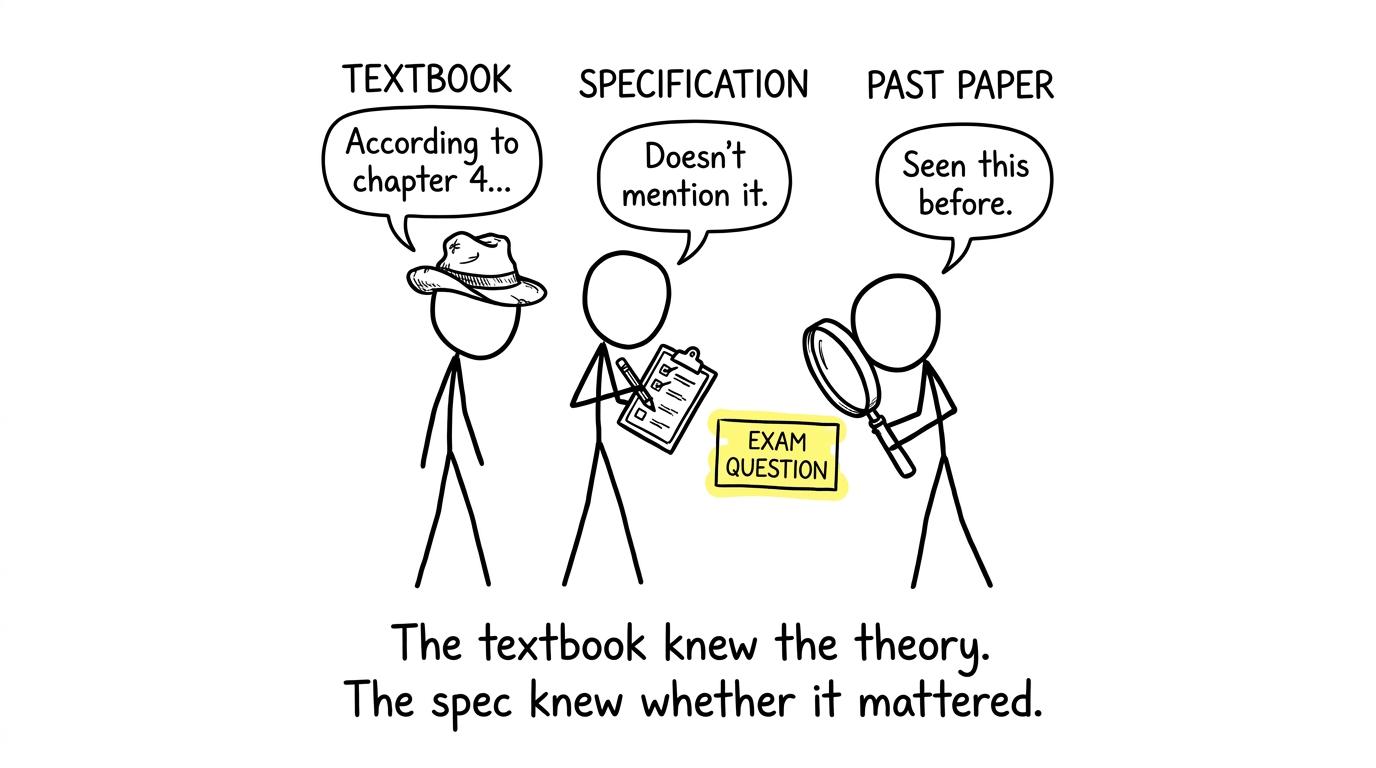 A textbook, specification and past paper form a detective team around an exam question
If sociology and maths are competing for the same evenings, plan both deliberately. The GCSE maths revision timetable offers a practical model: short topic sessions, immediate checking and regular timed practice. Nearer the maths exams, use Edexcel predicted papers to reveal remaining gaps rather than trying to predict questions with certainty.
Common mistakes when using an old textbook
Assuming old means useless. Established theories and research-method principles may remain excellent. Judge each section by accuracy and specification coverage.
Assuming current-looking means current. A clean cover cannot confirm alignment. Check the board, code and teaching year.
Using another board's book without a comparison. Overlap can hide important differences in organisation, required content and question style.
Memorising outdated statistics as present-day evidence. Record the year and context of data, and use newer teacher-provided evidence where required.
Learning everything in the book. Extra content consumes time and can blur the precise argument needed by the question.
Ignoring current papers and mark schemes. Knowing sociology is not quite the same as demonstrating it under the assessment objectives.
Keep the useful pages, replace the risky ones
A hand-me-down GCSE Sociology textbook can absolutely earn a place on your desk. If it was written for the current 2017-onwards specification and matches your board, it is likely to remain a sound foundation. If it predates the reform, keep its clearest theory and methods explanations, but audit every chapter against the current course and replace outdated evidence or exam advice.
The broader lesson is simple: resources do not create progress by existing. They create progress when you check them, retrieve from them, practise and correct your mistakes.
For maths revision, make that process easy with MathsGenie's free revision lessons, practice questions, mini tests, past papers, predicted papers, mark schemes and video solutions. Open the GCSE Maths revision hub, choose your board and tier, and let current exam material show you what to work on next.