

Non-Calculator Mock Paper Tips for GCSE Maths
Non-calculator mock paper tips for GCSE Maths, covering revision, written methods, timing, checking and targeted practice before your mocks.
November has a way of making mocks feel suddenly real. One week they are a date on the school calendar; the next, a Year 10 or 11 student is opening a GCSE Maths paper without a calculator beside them.
The most useful non-calculator mock paper tips are simple: know your written methods, show every important step, keep exact values where required, manage your time and use mistakes to choose what to practise next. Above all, remember that a mock is a diagnostic, not a verdict. Its job is to reveal what deserves attention before the real GCSE.
Your non-calculator mock checklist
Before December arrives, aim to be able to:
- recall key number facts, square numbers and fraction rules;
- use reliable written methods for arithmetic;
- estimate before calculating and check afterwards;
- show enough working to make your method clear;
- distinguish exact answers from decimal approximations;
- move past a difficult question and return later;
- analyse completed papers using the mark scheme;
- build targeted practice around the topics costing you marks.
These habits matter across GCSE exam boards, although the precise format of your mock depends on your school's exam board, tier and chosen papers. Check those details with your teacher rather than assuming that every paper is arranged in the same way.
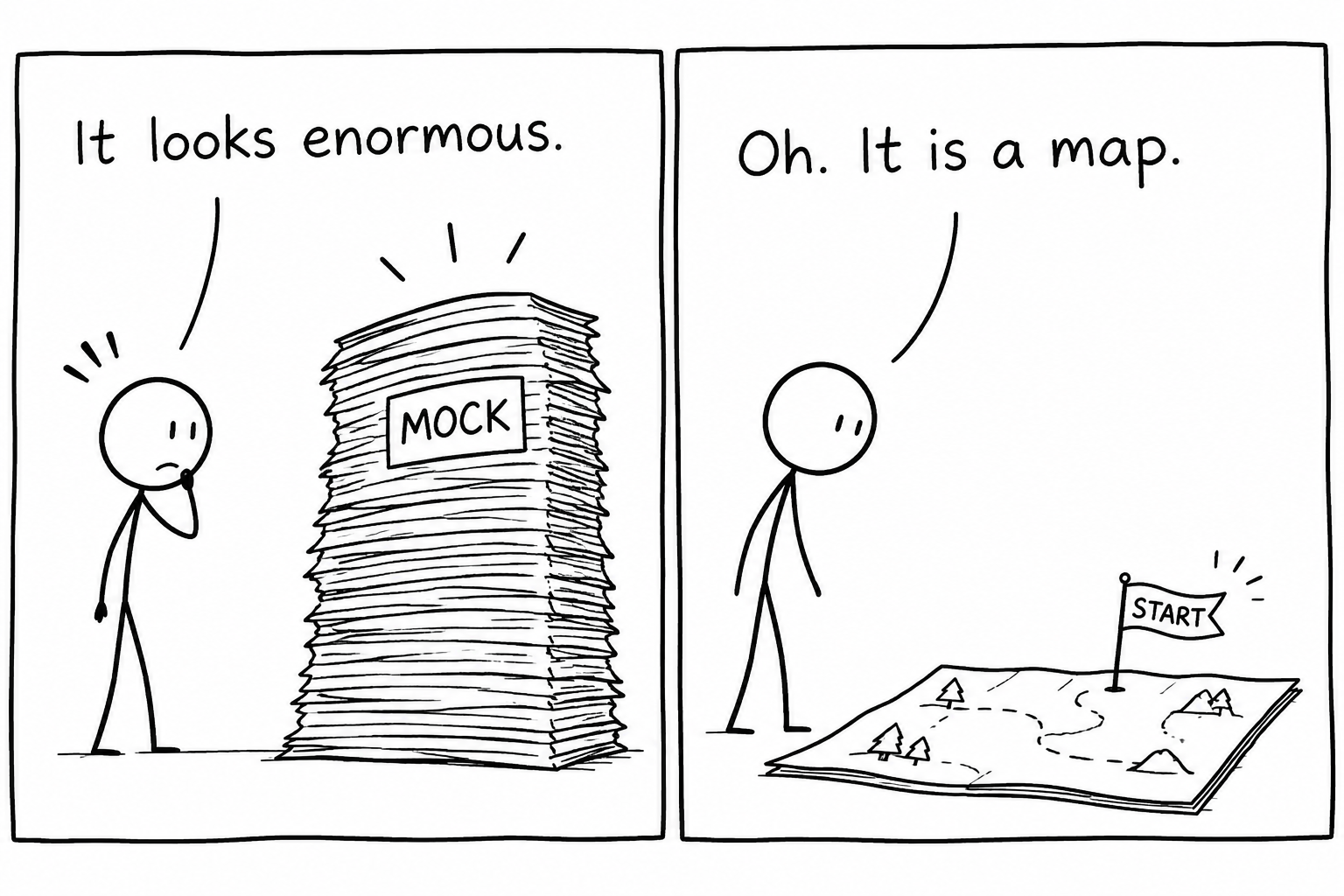 A nervous student discovers that a mock paper is a map rather than a monster
Treat the November paper as information
Imagine a student completing their first timed non-calculator paper in November. They lose marks on fractions, a percentage problem and an algebra question. The initial reaction might be, “I am bad at non-calculator maths.” But that conclusion is much larger than the evidence.
The paper has actually provided three useful signals.
First, the student needs more fluent fraction arithmetic. Second, they need a secure method for percentages without relying on calculator buttons. Third, they may understand algebra but need to write the intermediate steps more carefully.
That is a revision plan, not a judgement.
After marking a paper, sort each lost mark into one of four categories:
| Type of mistake | What to do next |
|---|---|
| Knowledge gap | Relearn the topic through a revision lesson |
| Method error | Practise the correct written method slowly |
| Misread question | Underline instructions and identify the required form |
| Careless slip | Add a specific check, such as substitution or estimation |
MathsGenie's GCSE Maths revision resources organise topics by grade and include videos and exam-style questions. This makes it easier to turn a broad concern into one manageable task.
Secure the arithmetic you cannot outsource
A calculator can hide uncertainty. A non-calculator paper exposes it. That is not cruel; it is useful, because arithmetic fluency supports almost every later topic.
Practise written addition, subtraction, multiplication and division until the layout feels familiar. Revisit operations with negative numbers, fractions, decimals and percentages. You should also know common square numbers and simple fraction-decimal-percentage equivalents.
For instance, recognising that
14=0.25=25%\frac{1}{4}=0.25=25\%41=0.25=25%is faster and safer than rebuilding the relationship every time.
Estimation is equally valuable. If a calculation involves numbers close to 505050 and 202020, an answer of roughly 1,0001{,}0001,000 may be plausible after multiplication. An answer of 10,00010{,}00010,000 should trigger a check. Estimation does not replace an exact calculation, but it gives you an early-warning system.
Use MathsGenie's Foundation GCSE past papers or Higher GCSE past papers to see arithmetic inside complete exam questions rather than only as isolated drills.
Show working that can earn marks
In December, the student tries another paper. This time, they resist the urge to compress four thoughts into one line.
Clear working has two benefits. It reduces the chance of losing your place, and it allows a marker to see the method you used. On multi-step questions, a correct method may be important even if a later arithmetic slip affects the final answer. Exactly how marks are awarded depends on the question and its mark scheme, so never assume that an unexplained answer will communicate enough.
Write one logical stage per line. For a fraction calculation, show the common denominator. For algebra, show the operation applied to each side. For a geometric problem, write the formula before substituting values.
Do not fill the page with unrelated calculations. Good working is visible reasoning, not mathematical clutter.
When reviewing practice, compare your solution with the official mark scheme. MathsGenie's collections of Edexcel GCSE Maths past papers, AQA GCSE Maths past papers and OCR GCSE Maths past papers help you practise in the style of your exam board.
Know when an answer must stay exact
Non-calculator questions often reward a form that preserves the exact value. If a question asks for an exact answer, do not replace a fraction, surd or multiple of π\piπ with a rounded decimal.
For example,
712\frac{7}{12}127is exact, whereas a shortened decimal version would only be an approximation. Similarly, an area such as
36π cm236\pi\text{ cm}^236π cm2should remain in terms of π\piπ if an exact answer is required.
Read the command carefully. “Give an exact answer”, “write as a fraction” and “give your answer in terms of π\piπ” each tell you something important about the expected form.
Use a calm timing strategy
One difficult question should not be allowed to consume the time available for several accessible ones.
At the start, note the total marks and time shown on your paper. Work steadily rather than trying to create a universal seconds-per-mark rule, because papers and students differ. If you become stuck, write down any relevant formula or valid first step, mark the question clearly and move on. Return after collecting the marks you can reach elsewhere.
Near the end, check deliberately:
- Have you answered every question you can?
- Did you include units where required?
- Is a length positive and an estimated answer sensible?
- Did you simplify fractions or algebraic expressions when asked?
- Have you copied values correctly from tables and diagrams?
Checking should be active. Repeating the same calculation in the same way can reproduce the same mistake. Instead, use an alternative check such as estimation, substitution or reversing an operation.
Turn December results into targeted practice
The most productive moment may come after the mock. Record the topic behind every avoidable lost mark, then rank the list.
Begin with topics that appear frequently or unlock other work. Fractions, ratio, percentages, negative numbers and algebraic manipulation often support several parts of the course. Use a short revision lesson, complete practice questions without notes, mark them and revisit anything that remains uncertain.
MathsGenie's GCSE Maths predicted papers can provide further exam-style practice when appropriate. Topic questions and mini tests are better when one weakness needs focused attention, while full papers develop timing, concentration and decisions across mixed topics.
For the clearest next step, use the MathsGenie Mock Exam Builder to create a targeted practice paper from the areas your mock exposed. A paper built around your actual gaps is more valuable than repeatedly practising topics you already find comfortable.
Common non-calculator mock mistakes
Doing everything mentally
Mental methods are useful, but complicated calculations become fragile when no steps are recorded. Write enough to preserve your reasoning.
Turning exact values into decimals
Keep fractions, surds and expressions involving π\piπ exact when the question requires it.
Ignoring signs
Negative-number mistakes often occur when a correct method is rushed. Check every operation involving a negative value.
Spending too long on one problem
A stubborn question can feel important simply because it is difficult. Leave space, move on and return later.
Looking only at the final score
A score tells you what happened. Error analysis tells you what to do next. The second is what improves the next paper.
From mock season to a better plan
By December, our hypothetical student may not have eliminated every weakness. That was never the realistic goal. The progress is more valuable: they now know which written methods are secure, where exact answers matter, how to manage a difficult question and which topics deserve the next revision session.
That is what GCSE maths mocks can do when treated properly. They convert uncertainty into a list of actions.
Start with one timed paper, mark it honestly and classify the lost marks. Then visit MathsGenie's free revision lessons, practice questions, past papers, predicted papers, mark schemes and video solutions. Finally, build a targeted practice paper in the Mock Exam Builder so your next session responds directly to the evidence. A mock is not the final word on your grade. It is an early draft of your revision plan.















