

Negative Numbers GCSE Maths: Rules and Examples
Negative numbers GCSE maths made clear with simple rules, worked examples, common mistakes and exam-style practice using free Maths Genie lessons today.
Negative numbers often feel manageable until two signs appear together. A student sees 6−(−4)6-(-4)6−(−4), remembers something about two negatives making a positive, and hopes the remembered rule applies. Sometimes it does. Sometimes it does not.
For negative numbers GCSE maths, the dependable approach is to understand what each operation means, then use a small set of rules. In short: use direction for addition and subtraction, sign rules for multiplication and division, and BIDMAS when operations are combined.
Imagine a student called Sam. This is a hypothetical student, but the problem is familiar. Sam keeps losing marks because every minus sign looks as though it is doing the same job. The breakthrough comes when Sam starts separating negative numbers from subtraction signs.
Your negative numbers checklist
Before answering a question, ask:
- Is the minus sign part of a number, such as −7-7−7?
- Is it an instruction to subtract, as in 10−710-710−7?
- Am I adding or subtracting?
- Am I multiplying or dividing?
- Are there brackets or several operations requiring BIDMAS?
- Does my answer make sense on a number line?
That checklist matters because there is no single rule saying that every pair of minus signs becomes positive. The correct rule depends on the operation.
What is a negative number?
A negative number is less than zero. On a number line, negative values lie to the left of zero and positive values lie to the right.
For example:
−8<−3<0<5-8<-3<0<5−8<−3<0<5Although 888 is larger than 333, the order changes when both values are negative:
−8<−3-8<-3−8<−3This makes sense on a number line because −8-8−8 is further left. It can also help to think about temperature. A temperature of −8∘C-8^\circ\text{C}−8∘C is colder than −3∘C-3^\circ\text{C}−3∘C.
Sam's first useful habit is to picture zero. Instead of treating negative numbers as mysterious symbols, Sam sees them as positions and movements.
Adding negative numbers
When adding, think about direction.
- Adding a positive number moves to the right.
- Adding a negative number moves to the left.
Worked example: adding two negative numbers
Calculate:
−7+(−5)-7+(-5)−7+(−5)Start at −7-7−7. Adding −5-5−5 means moving 555 places left:
−7+(−5)=−12-7+(-5)=-12−7+(−5)=−12You can also add the magnitudes, 7+5=127+5=127+5=12, and keep the negative sign because both numbers are negative.
Worked example: adding numbers with different signs
Calculate:
−9+14-9+14−9+14The signs differ, so find the difference between the magnitudes:
14−9=514-9=514−9=5The larger magnitude belongs to 141414, which is positive. Therefore:
−9+14=5-9+14=5−9+14=5The rule is useful, but the number line explains why it works. Starting at −9-9−9 and moving 141414 places right takes you to 555.
Subtracting negative numbers
Subtraction becomes easier when you rewrite it as adding the opposite:
a−b=a+(−b)a-b=a+(-b)a−b=a+(−b)For example, subtracting −4-4−4 means adding its opposite, 444.
Worked example: subtracting a negative
Calculate:
6−(−4)6-(-4)6−(−4)Change subtraction into addition and change the sign of the number being subtracted:
6−(−4)=6+46-(-4)=6+46−(−4)=6+4Therefore:
6−(−4)=106-(-4)=106−(−4)=10This is the situation in which two adjacent negative signs produce an addition. It is not a rule for every expression containing two negatives.
Worked example: subtracting a positive
Calculate:
−3−8-3-8−3−8Rewrite the subtraction:
−3−8=−3+(−8)-3-8=-3+(-8)−3−8=−3+(−8)Both numbers are negative, so add their magnitudes and keep the negative sign:
−3−8=−11-3-8=-11−3−8=−11At this point, Sam stops chanting rules and starts translating each subtraction into addition. There is one consistent method rather than several guesses.
You can follow the same method through the Negative Numbers Lessons, then use the GCSE Maths Question Bank to practise it in exam-style questions.
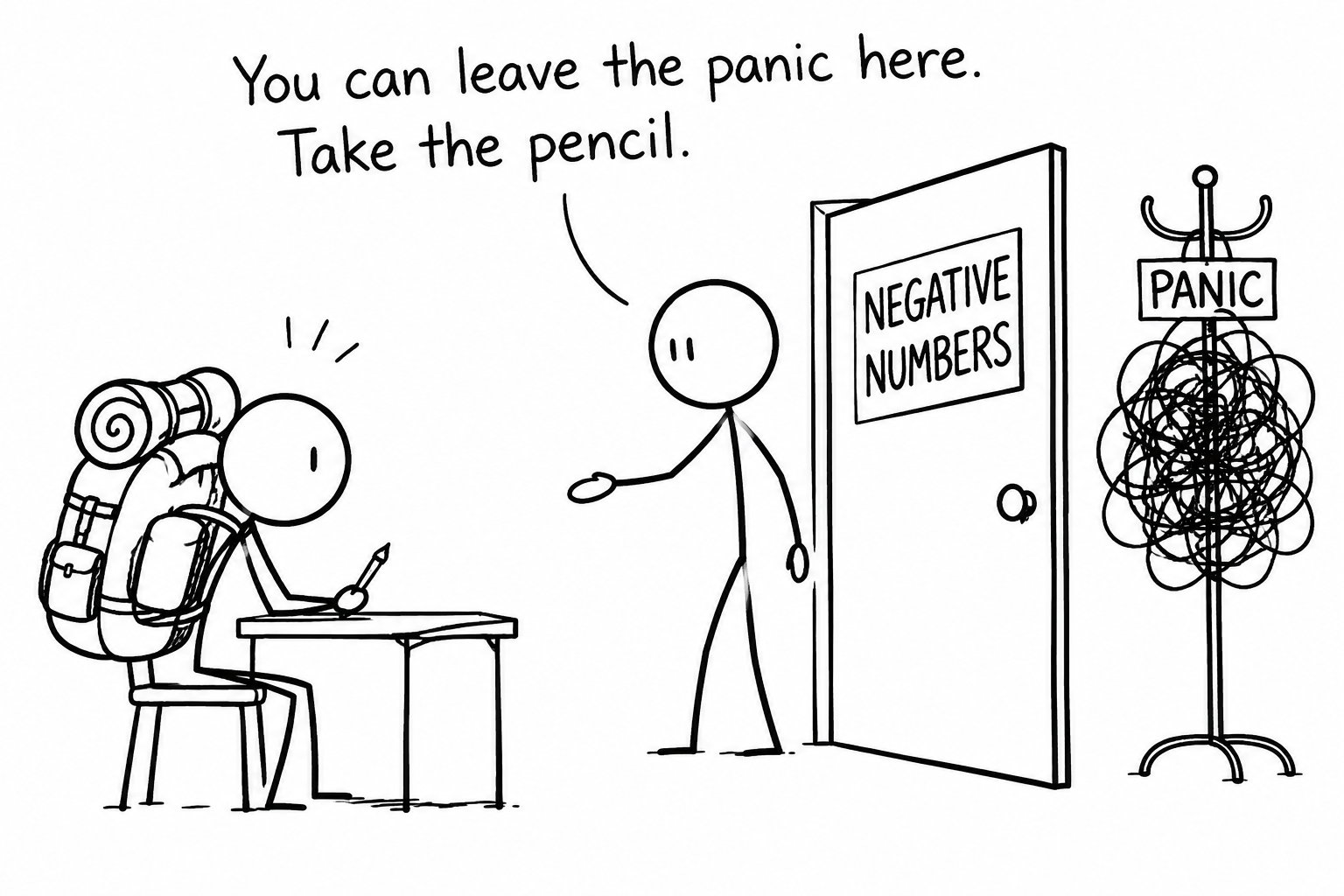 A student leaves a tangled cloud of negative-number panic at the door and takes only a pencil
Multiplying and dividing negative numbers
Multiplication and division use matching sign rules:
- Same signs give a positive answer.
- Different signs give a negative answer.
The numerical calculation stays the same. Decide the sign separately.
Worked example: multiplying two negatives
Calculate:
(−6)×(−4)(-6)\times(-4)(−6)×(−4)First calculate the magnitudes:
6×4=246\times4=246×4=24The signs are the same, so the answer is positive:
(−6)×(−4)=24(-6)\times(-4)=24(−6)×(−4)=24Worked example: dividing with different signs
Calculate:
35÷(−7)35\div(-7)35÷(−7)First calculate:
35÷7=535\div7=535÷7=5The signs differ, so the answer is negative:
35÷(−7)=−535\div(-7)=-535÷(−7)=−5Brackets help show that the negative sign belongs to the number. They do not automatically mean multiplication unless another number or algebraic term appears directly beside them.
Negative numbers with BIDMAS
In a multi-step calculation, use BIDMAS before applying addition or subtraction from left to right.
Calculate:
18−3×(−4)18-3\times(-4)18−3×(−4)Multiplication comes before subtraction:
3×(−4)=−123\times(-4)=-123×(−4)=−12Substitute that result into the expression:
18−(−12)18-(-12)18−(−12)Subtracting a negative becomes addition:
18+12=3018+12=3018+12=30Therefore:
18−3×(−4)=3018-3\times(-4)=3018−3×(−4)=30A common incorrect answer is −84-84−84, produced by subtracting first. Writing one operation on each line makes the order visible and gives an examiner a method to follow.
A real-world negative numbers example
A temperature is −3∘C-3^\circ\text{C}−3∘C and rises by 8∘C8^\circ\text{C}8∘C. The calculation is:
−3+8=5-3+8=5−3+8=5The new temperature is 5∘C5^\circ\text{C}5∘C.
If the temperature instead falls by 8∘C8^\circ\text{C}8∘C, the calculation becomes:
−3−8=−11-3-8=-11−3−8=−11The new temperature is −11∘C-11^\circ\text{C}−11∘C.
Words such as rises, falls, gain, loss, above and below indicate direction, but always read the full context before choosing an operation.
Common mistakes with negative numbers
Assuming two negatives always make a positive
Compare:
(−3)×(−2)=6(-3)\times(-2)=6(−3)×(−2)=6but:
−3+(−2)=−5-3+(-2)=-5−3+(−2)=−5The operation determines the rule. Two negative factors give a positive product, while adding two negative values moves further below zero.
Thinking the larger digit means the larger negative number
It is incorrect to say −9>−4-9>-4−9>−4. On the number line, −9-9−9 lies further left, so:
−9<−4-9<-4−9<−4Ignoring brackets
In 7−(−3)7-(-3)7−(−3), the first minus sign means subtract and the second belongs to the number −3-3−3. Rewriting the calculation makes the structure clear:
7−(−3)=7+3=107-(-3)=7+3=107−(−3)=7+3=10Forgetting BIDMAS
For 5+2×(−6)5+2\times(-6)5+2×(−6), multiply first:
5+2×(−6)=5+(−12)=−75+2\times(-6)=5+(-12)=-75+2×(−6)=5+(−12)=−7Do not add 5+25+25+2 before multiplying.
Exam-style negative numbers questions
Try these without looking at the answers:
- Work out −8+3-8+3−8+3.
- Work out 4−(−7)4-(-7)4−(−7).
- Work out −5−9-5-9−5−9.
- Work out (−8)×(−3)(-8)\times(-3)(−8)×(−3).
- Work out 42÷(−6)42\div(-6)42÷(−6).
- Work out 10−2×(−5)10-2\times(-5)10−2×(−5).
Answers
- −5-5−5
- 111111
- −14-14−14
- 242424
- −7-7−7
- 202020
For more negative numbers worked examples and practice, use the topic page for your specification. Maths Genie has dedicated resources for Edexcel negative numbers, AQA negative numbers and Eduqas negative numbers. You can also find wider Edexcel GCSE Maths lessons and AQA GCSE revision resources, including practice materials and mark schemes.
Turn the rules into reliable marks
Sam's improvement begins when each minus sign gets a job: it either belongs to a number or tells Sam to subtract. Knowing that method is the first step, but following it under exam pressure requires focused practice. Start the Maths Genie Negative Numbers Lessons, then complete the matching Question Bank questions.















