

Negative Numbers Exam Questions: GCSE Guide
Negative numbers exam questions explained through three GCSE examples, with sign rules, method marks, common mistakes and focused practice advice.
A negative sign is small enough to miss and powerful enough to change an entire answer. That is why negative numbers exam questions can feel disproportionately difficult. The arithmetic is often manageable; the real challenge is deciding what the signs mean, choosing the correct operation and recording enough working to earn the available marks.
The reliable approach is simple: identify the calculation, separate the signs from the number facts, show each important step and check whether the final sign makes sense. In this guide, we follow a student through three exam-style questions of rising difficulty and examine where method marks may be earned.
Mark allocations and marking approaches vary between papers and exam boards. The method-mark comments below illustrate the kind of valid working that is commonly rewarded, rather than reproducing a particular mark scheme.
Your negative numbers checklist
Before attempting a negative numbers GCSE exam question, ask:
- Is the question about temperature, money, height, a number line or a calculation?
- Am I adding, subtracting, multiplying or dividing?
- Have I written an intermediate step rather than trying to do everything mentally?
- If I am multiplying or dividing, are the signs the same or different?
- Is the size and sign of my answer reasonable?
The core rules are:
- Adding a positive number moves to the right on a number line.
- Adding a negative number moves to the left.
- Subtracting a negative is equivalent to adding a positive.
- When multiplying or dividing, equal signs give a positive answer and different signs give a negative answer.
It helps to treat addition and subtraction differently from multiplication and division. The familiar rule about two negative signs producing a positive result applies in contexts such as −(−a)-(-a)−(−a) and (−a)×(−b)(-a)\times(-b)(−a)×(−b). It does not mean that any two negative numbers automatically produce a positive answer. For example, −3+−4=−7-3+-4=-7−3+−4=−7.
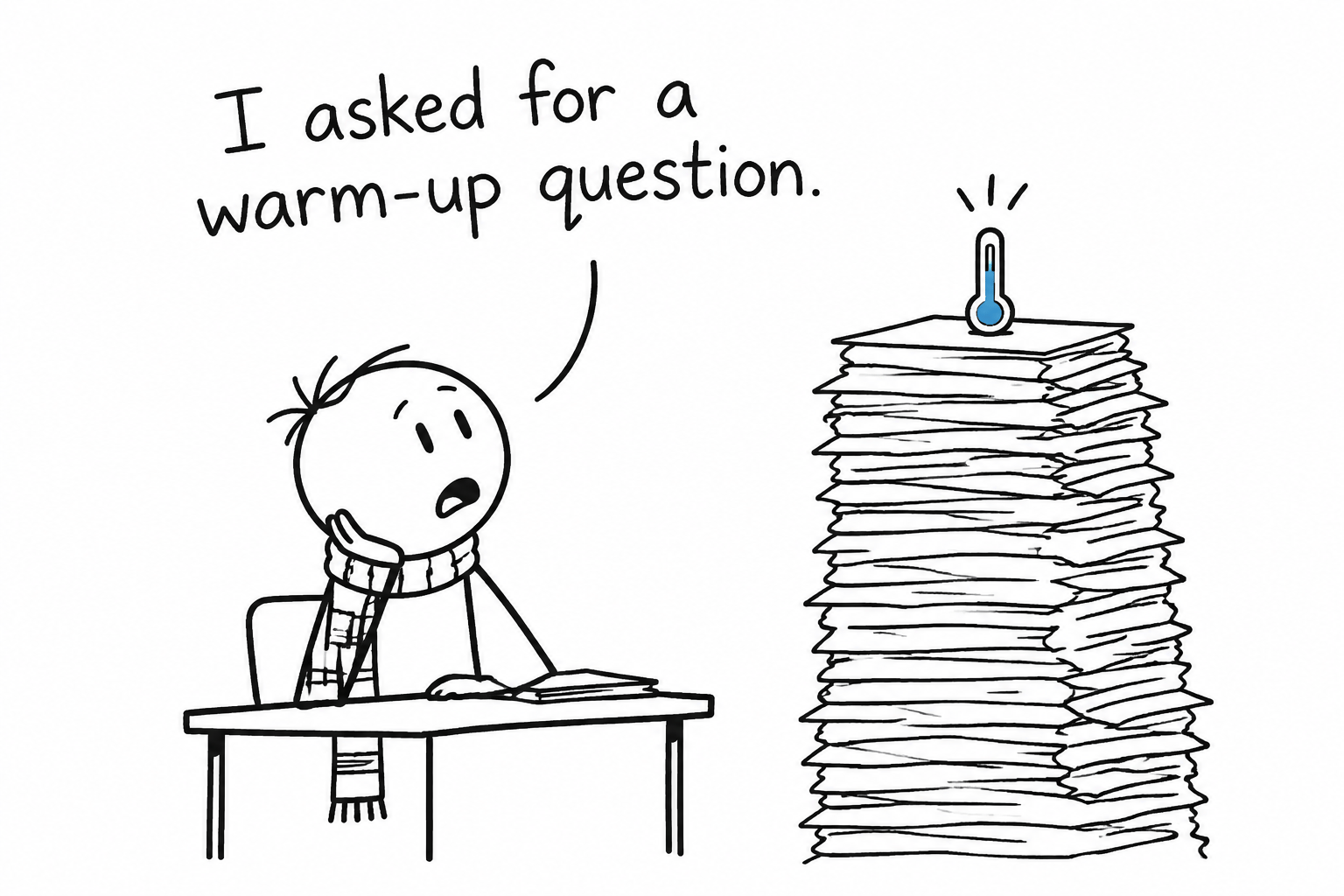 A student asks for a warm-up question beside a tiny thermometer and an intimidating pile of revision
Question one: a change in temperature
A student, whom we will call Sam, begins with a one-step context question.
Exam-style question: At noon, the temperature is −4∘C-4^\circ\text{C}−4∘C. By evening, it has fallen by 7∘C7^\circ\text{C}7∘C. Work out the evening temperature.
Sam notices that fallen means subtract. The required calculation is:
−4−7-4-7−4−7Starting at −4-4−4 and moving 777 units lower gives:
−4−7=−11-4-7=-11−4−7=−11So the evening temperature is:
−11∘C\boxed{-11^\circ\text{C}}−11∘CWhere the marks may come from
On a short question, the final answer may carry the mark. Writing −4−7-4-7−4−7 is still useful because it records Sam's interpretation of the context. If the answer goes wrong because of a small arithmetic slip, visible working gives the examiner something meaningful to assess where the mark scheme permits it.
Sam also performs a sense check. A temperature that falls from below zero must become more negative. An answer of 3∘C3^\circ\text{C}3∘C would describe a rise, not a fall.
Question two: subtracting a negative number
The next question looks more abstract.
Exam-style question: Work out:
8−(−13)8-(-13)8−(−13)Sam pauses instead of entering the expression into a calculator immediately. Subtracting a negative number reverses the effect of the subtraction:
8−(−13)=8+138-(-13)=8+138−(−13)=8+13Then:
8+13=218+13=218+13=21Therefore:
21\boxed{21}21Where the marks may come from
For a question with more than one mark, the conversion
8−(−13)=8+138-(-13)=8+138−(−13)=8+13is the key method. It shows understanding of the negative sign outside the brackets. The accurate final calculation then completes the solution.
Brackets matter here. The expression does not say 8−138-138−13. It says that the negative number −13-13−13 is being subtracted. One useful verbal translation is: “Take away negative thirteen.” That is equivalent to moving 131313 places in the positive direction.
You now have the basic method in hand; use the Maths Genie negative numbers lesson and its Question Bank practice to repeat it until the sign change feels routine.
Question three: a multi-step calculation
Sam's final question combines several ideas.
Exam-style question: Work out:
−6+3×(−5)−(−4)-6+3\times(-5)-(-4)−6+3×(−5)−(−4)Give full working.
This question tests negative numbers and the order of operations. Multiplication must be completed before addition and subtraction.
Sam begins with:
3×(−5)=−153\times(-5)=-153×(−5)=−15The original expression becomes:
−6+(−15)−(−4)-6+(-15)-(-4)−6+(−15)−(−4)Now simplify the double sign:
−6−15+4-6-15+4−6−15+4Work from left to right:
−21+4=−17-21+4=-17−21+4=−17Therefore:
−17\boxed{-17}−17Where the marks may come from
A typical multi-mark structure could reward:
- correctly evaluating 3×(−5)3\times(-5)3×(−5) as −15-15−15;
- correctly changing −(−4)-(-4)−(−4) to +4+4+4 and combining the terms;
- reaching the accurate final answer of −17-17−17.
The exact allocation depends on the paper's mark scheme, but the lesson is consistent: write the intermediate line. If Sam writes only −17-17−17, the answer can earn full credit when correct, but there is no visible method to consider if a single sign error changes the result.
This is also why “full working” is not an invitation to fill the page. It means showing the decisions that carry mathematical value.
A practical method for any question
Use this four-stage routine in a negative numbers GCSE exam.
Translate
Turn words into operations. A fall, loss or decrease usually suggests subtraction. A rise, deposit or increase usually suggests addition, although the starting value may still be negative.
Isolate
Complete one operation at a time. For a longer expression, apply the order of operations. Multiplication and division come before addition and subtraction unless brackets change the order.
Record
Write the changed line, especially when you:
- subtract a negative;
- multiply or divide signed numbers;
- substitute a negative value into a formula;
- move between a worded context and a calculation.
Check
Ask what direction the answer should move. Also estimate its size. For instance, adding two negative numbers must produce a negative total with a greater distance from zero than either starting value.
Common mistakes in negative numbers past paper questions
Applying one sign rule everywhere
Students sometimes learn “two negatives make a positive” without learning its limits. Compare:
(−4)×(−3)=12(-4)\times(-3)=12(−4)×(−3)=12but
−4+(−3)=−7-4+(-3)=-7−4+(−3)=−7The operation determines the rule.
Ignoring the order of operations
In the third question, adding −6-6−6 and 333 first would change the expression incorrectly. Complete multiplication and division before addition and subtraction.
Losing brackets during substitution
If x=−3x=-3x=−3, then x2x^2x2 should be written as:
(−3)2=9(-3)^2=9(−3)2=9Without brackets, −32-3^2−32 means:
−(32)=−9-(3^2)=-9−(32)=−9Those are different expressions.
Treating “below zero” as positive
A magnitude and a position are not the same. A temperature 6∘C6^\circ\text{C}6∘C below zero is −6∘C-6^\circ\text{C}−6∘C, not 6∘C6^\circ\text{C}6∘C.
Doing every step mentally
Mental fluency is useful, but invisible reasoning cannot demonstrate a method. Write the line where the sign changes, even when the arithmetic feels straightforward.
How to practise exam-style questions
Reading sign rules creates familiarity. Answering questions creates control. Use this short practice cycle:
- Complete a small set without notes.
- Mark every answer, including correct ones.
- Label each error as interpretation, operation, sign, order or arithmetic.
- Redo incorrect questions from a blank page.
- Return to them after a gap and check whether the method has stuck.
Mix pure calculations with temperature, finance, elevation and substitution problems. Then include negative numbers past paper questions, where the skill may be hidden inside algebra, coordinates or probability rather than named directly.
You can also use Maths Genie GCSE revision resources to place negative numbers alongside the other skills that appear in full papers. This matters because the real exam will not announce which rule to use. Recognition is part of the question.
Turn the method into marks
Sam's progress did not depend on a clever shortcut. It came from slowing down at the sign, writing the important intermediate line and checking whether the answer fitted the context. Knowing that routine is the first step; applying it consistently under exam pressure is the gap you now need to close.
Start the Maths Genie negative numbers lesson, then answer the matching Question Bank questions using the four-stage method: translate, isolate, record and check.















