

Moving Schools GCSE French: Stay on Track
Moving schools GCSE French? Compare specifications, identify topic gaps, protect speaking practice and balance language learning with GCSE maths revision.

Changing schools midway through a GCSE can make familiar lessons feel strangely uncertain. Your new class may use another textbook, teach topics in a different order or even follow a different exam board. If you are moving schools GCSE French does not need to become a lost cause. The immediate answer is to confirm your specification, tier and assessment arrangements, compare the two courses, then close only the gaps that genuinely exist.
That last point matters. A change of school creates administrative noise, but it does not erase what you already know. French grammar, vocabulary and communication skills travel with you. Your task is not to restart the course. It is to build a reliable bridge between two versions of it.
Your moving-school checklist
In your first few days, ask your French teacher or exams officer to confirm:
- the full name and code of your new GCSE French specification;
- whether the school uses AQA, Pearson Edexcel or Eduqas;
- whether you are following foundation or higher tier;
- which topics and grammar have already been taught;
- how the speaking assessment is organised;
- which vocabulary list and textbook the class uses;
- whether your exam entry has already been made;
- whether access arrangements need to be transferred or reapplied for;
- the dates of internal assessments, mocks and speaking preparation.
Ask your former school for your topic list, assessment results, exercise books and any speaking materials you are allowed to retain. Your new teacher needs evidence, not a vague feeling that the courses were “quite different”.
 A student discovers that navigating a new school is harder than revising directions
Confirm exactly which French course you are joining
“GCSE French” is not quite specific enough. Exam boards follow national subject requirements, but they can organise vocabulary, contexts, papers and task formats differently. Your first useful question is therefore not, “Am I behind?” It is, “Behind on what?”
In England, revised GCSE French specifications were first taught from September 2024, with first examinations in summer 2026. The revised national content places defined emphasis on prescribed vocabulary, grammar and sound-symbol correspondence. It also includes activities such as dictation, reading aloud, role-play and interaction around a visual stimulus.
Your exact assessment structure still comes from your exam board’s current specification. Students taking a legacy resit, or studying elsewhere in the UK, may be following different arrangements. Always check your cohort and specification rather than relying on a classmate’s older revision guide.
Check the tier rather than assuming it transfers
GCSE French uses foundation and higher tiers. Your new school should review your current attainment before deciding the appropriate entry, and the tier normally applies across the relevant assessment components. Do not assume that being in a particular set automatically guarantees a particular tier.
Ask what evidence will be used: previous assessments, a baseline task, teacher judgement or an upcoming mock. If you hope to change tier, discuss it early enough for teaching and exam-entry decisions to be handled properly.
There is a useful parallel with maths. A student can move between schools and discover that the subject is familiar but the route through it is different. MathsGenie’s guide to GCSE maths topics by exam board and tier shows why checking the exact course is more useful than guessing from a textbook cover.
Build a French gap audit
Do not copy the new specification into a notebook and label every line a weakness. That produces a large list but very little information.
Instead, compare what your former school covered with what the new class has completed. Sort each area into one of four categories:
| Status | What it means | Next action |
|---|---|---|
| Secure | You can understand and use it without notes | Keep it active through short retrieval |
| Familiar | You recognise it but cannot produce it reliably | Schedule focused practice |
| Missing | The new class has covered it but you have not | Ask for the lesson materials and priority tasks |
| Later | Neither course expects it yet | Leave it in the normal teaching sequence |
Run this check across vocabulary, grammar, listening, speaking, reading, writing and translation. Be precise. “Tenses” is too broad; “forming the perfect tense with irregular past participles” gives your teacher something actionable.
The same diagnostic habit can protect your maths revision. Begin with the GCSE Maths revision hub, select your board and tier, and identify any topics your new maths class has already completed. If your new school follows AQA, use the AQA GCSE Maths revision area. For OCR maths, use the OCR GCSE Maths revision area.
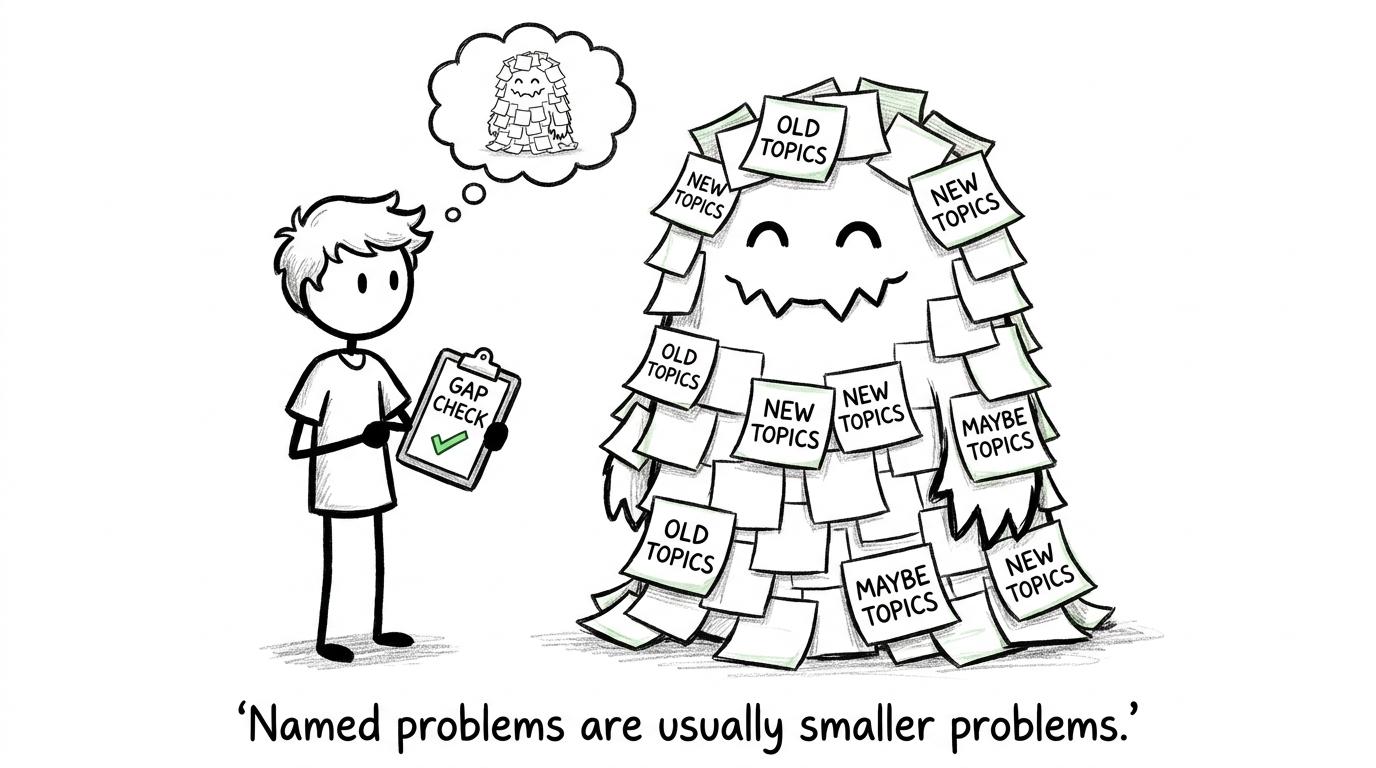 A gap check makes a monster built from topic lists much smaller
Close gaps without trying to relearn everything
A school move already consumes attention. New rooms, names and routines compete for the same mental space as revision. An ambitious catch-up timetable can therefore fail precisely because it asks too much.
Choose two or three French priorities for each week. A sensible session has three parts:
- retrieve vocabulary or grammar without notes;
- complete one short listening, reading, speaking or writing task;
- check the response and record one correction to revisit.
Alternate receptive work, where you understand French, with productive work, where you must speak or write it. Recognising a phrase in a reading passage does not guarantee that you can produce it under pressure.
Keep a compact correction log. Useful entries include a recurring gender error, an inaccurate verb ending, a word you misheard or a sound you cannot yet pronounce confidently. Review the error through a fresh sentence or task rather than repeatedly reading the correction.
Protect speaking and listening practice
Speaking is often the area that worries transferring students most. Different classes may have prepared different themes or used different routines, and speaking can feel more exposed than completing a worksheet.
Ask your new teacher for the current speaking format and the school’s preparation schedule. Under the revised requirements in England, students may encounter reading aloud followed by interaction, role-play and discussion connected to visual material. However, the precise timings and administration depend on the specification, tier and exam series.
Practise speaking little and often. Useful activities include:
- reading a short passage aloud and checking difficult sound patterns;
- answering an unfamiliar question without scripting every word;
- recording a brief response, then listening for clarity and verb accuracy;
- changing the time frame or opinion in a familiar response;
- practising how to recover when you do not understand immediately.
For listening, use material aligned with your current specification. Start by identifying the main message, then listen again for details, negatives, time references and changes of opinion. If dictation is part of your course, spelling and sound-symbol knowledge require deliberate practice rather than passive exposure.
Speak to the exams officer early
If you move before entries are made, your new centre will usually manage your eventual entry. If you move after entries, the situation can be more complicated. JCQ arrangements may allow certain timetabled examinations to be taken at a host centre in exceptional circumstances, but non-examined components are not automatically covered by transferred-candidate arrangements.
You do not need to interpret these rules alone. Ask the exams officer at your new school to communicate with your former centre and the awarding body. Confirm in writing:
- which centre is entering you;
- your exam board, specification and tier;
- where each assessment will take place;
- whether any completed component remains usable;
- who will receive your results and certificate.
If you use access arrangements, contact the new school’s SENCO promptly. Current JCQ guidance says arrangements must reflect your current need and normal way of working at the new centre. Existing evidence may sometimes be reusable, but the new centre must check it and submit the required application. Do not wait until the speaking test or written examinations are close.
Balance French catch-up with GCSE maths revision
French should not absorb every available revision hour simply because the school move has made it feel urgent. Urgency and importance are related, but they are not identical.
Plan a weekly minimum for each subject. French benefits from frequent, shorter contact because vocabulary, listening and speaking weaken when ignored. Maths also needs regular question practice, not occasional rereading.
A balanced week might contain several brief French retrieval sessions, one longer French skills task, two focused maths topic sessions and one mixed maths test. Adjust this around homework, mocks and identified gaps rather than copying somebody else’s timetable.
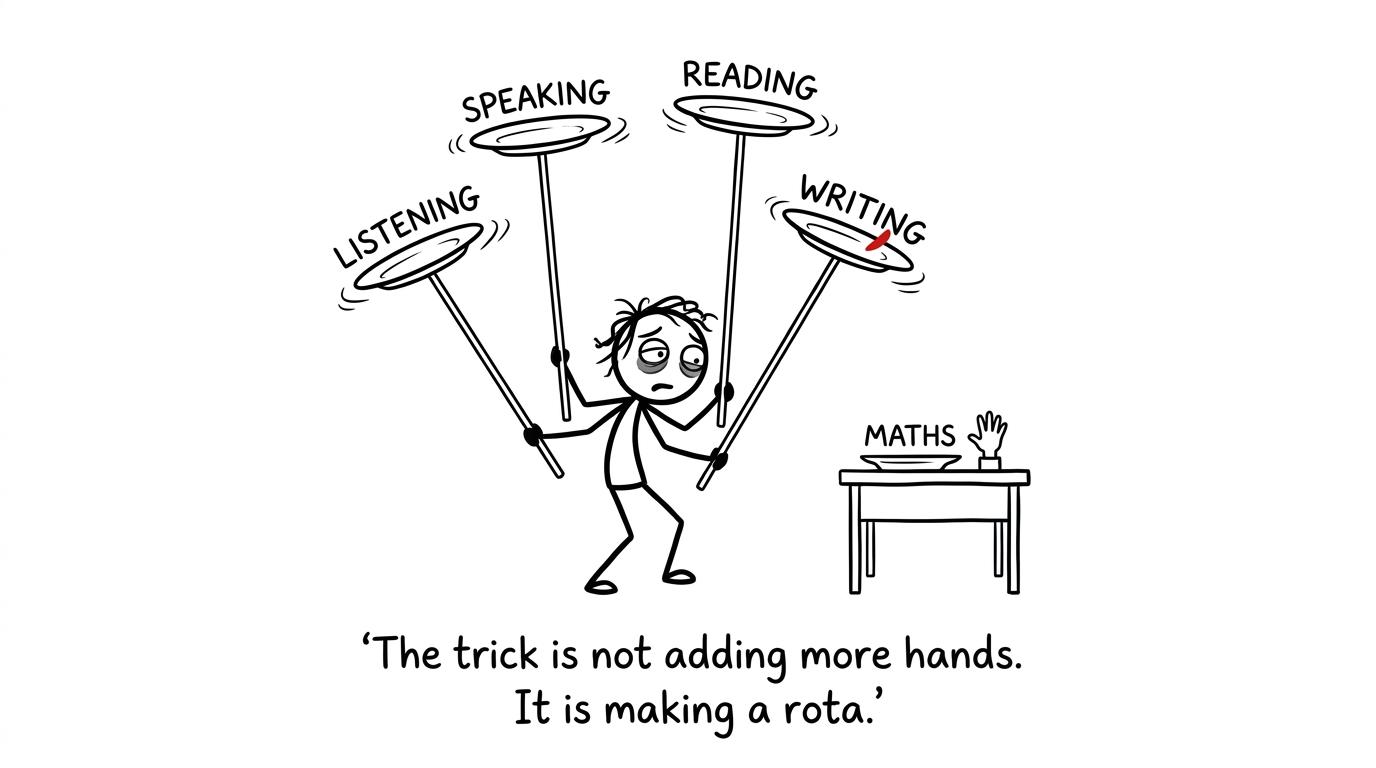 A student balances four French skills while maths waits patiently for its place in the rota
MathsGenie’s one-month GCSE maths revision plan provides a useful structure when the move has disrupted your routine. If you follow Edexcel maths, the guide to stopping forgotten GCSE maths content explains how retrieval, spaced practice and mixed questions can keep earlier topics alive.
Nearer the examinations, use full papers selectively. Edexcel GCSE Maths predicted papers can expose remaining maths gaps, but they work best after topic practice rather than as a replacement for it.
Common mistakes after changing schools
Waiting to see whether the gap disappears
A missing topic rarely repairs itself. Complete the comparison early and show it to your teacher. A small gap found now is easier to manage than the same gap discovered during a mock.
Assuming identical topic names mean identical coverage
Two courses may use similar headings while expecting different vocabulary or task formats. Compare the current specifications and teaching checklists, not just chapter titles.
Memorising perfect speaking scripts
A polished paragraph can feel safe, but an unexpected question may expose whether you can actually manipulate the language. Learn flexible structures, opinions, reasons and time frames, then practise adapting them.
Spending all your time on vocabulary
Vocabulary matters, but GCSE French also tests comprehension, grammar, pronunciation and the ability to respond. Divide catch-up work across the skills your assessment requires.
Neglecting maths because French feels more disrupted
A school move can create gaps in more than one subject. Use MathsGenie revision lessons, practice questions and mini tests to check your maths course systematically rather than waiting for the next mock to reveal the problem.
A school move changes the route, not the destination
The calmest response to moving schools is not heroic catch-up. It is accurate diagnosis followed by small, repeated action. Confirm the course. Map the gaps. Protect speaking and listening. Resolve exam administration early. Then keep French and maths moving together.
For your maths preparation, make MathsGenie’s free GCSE revision hub your stable base while everything else changes. Use revision lessons to rebuild a method, practice questions and mark schemes to expose errors, mini tests to check recall, and past papers, predicted papers and video solutions to prepare for exam conditions. Start with one uncertain topic today and turn it into a clear next step.










