Miss GCSE Bengali Exam Through Illness? What Happens
Miss GCSE Bengali exam illness: what to do immediately, how special consideration works, and when completed papers may still support your final GCSE grade.
Missing an exam can feel irreversible. One moment you are preparing for GCSE Bengali; the next, illness has reduced the day to phone calls, thermometers and uncertainty. If you searched for miss GCSE Bengali exam illness, the short answer is reassuring: genuine temporary illness may be an acceptable reason for absence, and your school can apply to the exam board for special consideration.
That does not guarantee a particular mark or grade. You must normally have completed enough of the qualification for the exam board to judge your attainment, and the application must be supported by your school or exam centre. Your first action is therefore simple: contact the exams officer immediately and follow the centre's instructions.
This guide reflects the JCQ and Ofqual rules applying to GCSE examinations in the 2025-26 academic year. Exam regulations can change, so your exams officer remains the final source of advice for your entry.
The immediate checklist
If you are too ill to attend GCSE Bengali:
- Tell your school or exam centre as early as possible, preferably before the examination begins.
- Ask to speak to the exams officer if you can.
- Explain your symptoms honestly and when they began.
- Follow the centre's instructions about self-certification or other supporting evidence.
- Ask whether the missed assessment can be rearranged; this may be possible for a speaking test within its permitted window.
- Confirm whether the centre will submit a special consideration application.
- Keep preparing for later Bengali papers and your other GCSEs when you are well enough.
Do not assume that a parent reporting the absence automatically creates an application. The centre must decide whether it can support your case and submit the correct information to the awarding organisation.
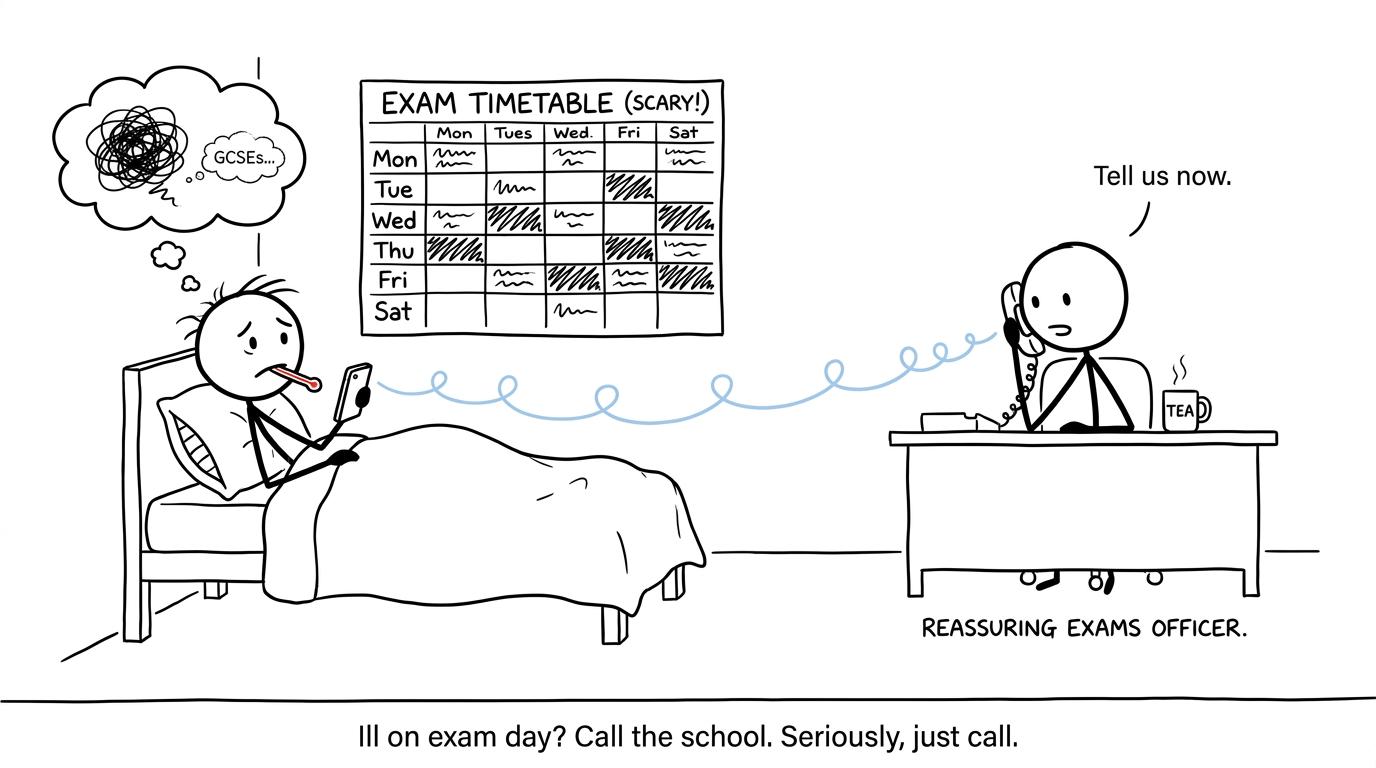 A sick GCSE student calling the exams officer rather than arguing with a giant timetable
What special consideration actually means
Special consideration is a post-assessment adjustment for a student whose ability to take an assessment, or demonstrate their usual attainment, was materially affected by a temporary illness, injury or another event outside their control.
There are two relevant situations.
You miss the Bengali assessment completely
If your illness is an acceptable reason for absence, the centre can submit an absent-candidate application. Where the eligibility conditions are met, the exam board may calculate a mark for the missing component using your performance in completed components and the performance of the national cohort.
AQA describes this standardised calculation as a z-score process. In broad terms, it considers how strongly you performed on the papers you completed relative to other students and uses that evidence for the missing assessment. It is not simply your mock grade, your teacher's prediction or an automatic average of your other marks.
You attend but illness affects your performance
If you sit the paper while ill, tell an invigilator immediately. The centre may apply for a mark adjustment if it believes your performance was materially affected.
Under JCQ guidance, these adjustments range from 0%0\%0% to a maximum of 5%5\%5% of the raw marks available for the affected component. The maximum is reserved for the most exceptional cases. It is not a promise of a 5%5\%5% increase, nor does it mean adding five percentage points to your final GCSE grade.
Special consideration can reduce the effect of an adverse event, but it cannot recreate the exact paper you might have produced while healthy.
How GCSE Bengali is assessed
The current AQA GCSE Bengali qualification has four components:
- listening;
- speaking;
- reading;
- writing.
Each component contributes 25%25\%25% of the qualification, so the complete assessment weighting is
25%+25%+25%+25%=100%.25\% + 25\% + 25\% + 25\% = 100\%.25%+25%+25%+25%=100%.JCQ's general minimum for an absent candidate receiving an award in a linear GCSE is normally one completed whole component worth at least 15%15\%15% of the total assessment. Because each AQA Bengali component is worth 25%25\%25%, completing one whole component would exceed that general threshold.
However, meeting the minimum does not automatically secure special consideration. You must also have been fully prepared, covered the course and missed the assessment for an acceptable reason. Your centre must support the application, and the awarding organisation makes the final decision.
If you miss every Bengali component, the board has no completed assessment evidence from which to award the qualification. Ofqual's guidance states that a student must have completed at least one component to be eligible for a qualification award through this form of special consideration.
What happens after you report the illness
The process mostly happens behind the scenes, but knowing the sequence makes it less frightening.
Your centre records the circumstances
The exams officer will note the affected component, the timing of the illness and why you could not attend or perform normally. JCQ requires applications to be considered individually rather than granted automatically to everyone reporting the same broad problem.
Evidence is considered
You should follow your centre's instructions rather than assuming that a doctor's letter is always required. Under current JCQ guidance, formal medical evidence is not necessarily needed when the centre already knows about an ongoing condition that can cause sudden absence, knew you were unwell before the examination, or saw that you arrived unwell and sent you home.
In other circumstances, the centre may ask for a signed self-certification form or appropriate supporting information. It must retain evidence and may be asked to provide it to the awarding organisation for quality assurance.
The exams officer applies
Students and parents do not apply directly. The school, college or private candidate's examination centre submits the application through the relevant exam board's online system. A separate application is normally required for each written examination missed through acceptable absence.
For summer 2026 GCSE examinations, the common deadline for centres was 1 July 2026. If that deadline has passed, contact the centre immediately: JCQ says late applications after results are published are accepted only in the most exceptional circumstances and require compelling evidence.
The exam board decides
The board checks eligibility and either accepts or rejects the request. If it accepts an absence application and enough assessment has been completed, it calculates the missing result using the approved statistical method. Your final grade is then determined through the normal awarding process.
Missing the Bengali speaking test can be different
The speaking assessment is not always fixed to one national morning or afternoon. AQA provides a speaking-test window in which centres schedule individual candidates. For summer 2026, the GCSE modern foreign language window ran from 7 April to 15 May, with centres permitted to test during five weeks of that period.
If illness prevents you attending your allocated appointment, contact the centre immediately. It may be able to place you in another session while the permitted window remains open and the confidential assessment materials can still be used correctly.
That is not guaranteed. It depends on the remaining dates, staffing, confidentiality rules and AQA's instructions. Once the window has closed, simply arranging an informal later test is not an option. The centre must seek guidance and consider the special consideration process instead.
Written listening, reading and writing papers operate to national timetables. There is not normally an individual make-up sitting a few days later simply because one candidate was ill.
Illness that qualifies and illness that does not
Temporary illness at the time of an assessment can qualify when it has a material effect on your ability to attend or perform. The important ideas are timing, severity and evidence.
Special consideration is not designed to compensate for lost revision time, ordinary examination nerves or incomplete course preparation. JCQ also excludes reasons such as misreading the timetable, attending the wrong place, holidays and conflicting personal arrangements.
Long-term medical conditions need careful handling. JCQ's special consideration rules do not generally compensate for learning missed across a course. Depending on the condition and your normal way of working, access arrangements or reasonable adjustments may need to be organised before the examinations. A sudden, temporary worsening at assessment time may still need separate consideration, but your SENCo and exams officer must deal with the circumstances correctly.
Most importantly, do not ask an online article whether you are medically fit to sit an examination. Speak to a parent or carer, your school and an appropriate healthcare professional where necessary. In cases of serious illness, JCQ requires centres to seek medical advice about fitness to take the examination.
Protecting your remaining GCSE revision
An unresolved exam problem can occupy more attention than the exam itself. Once you have reported the absence and supplied what the centre requests, let the exams officer manage the administrative process. Your useful task is recovery followed by a calm return to the papers still ahead.
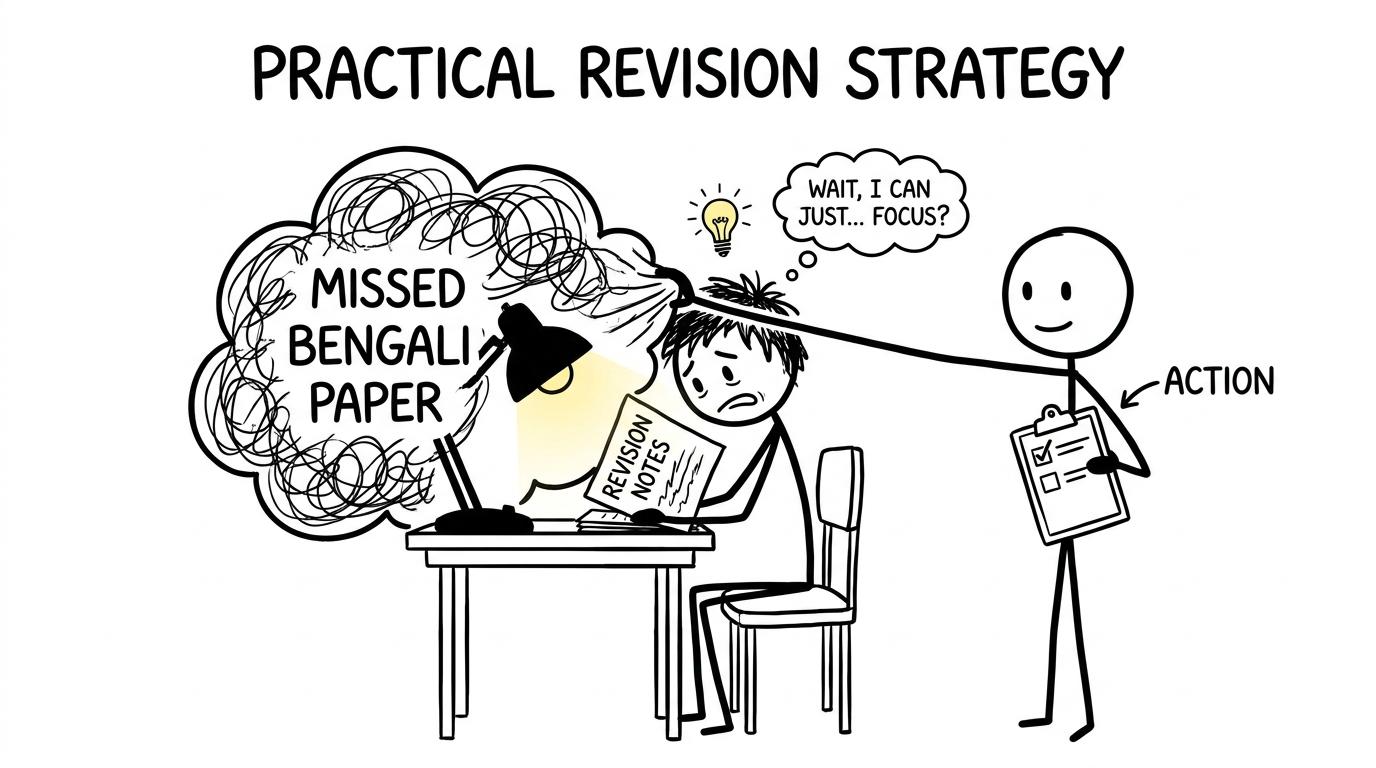 A checklist moving a worry cloud so a student can see their revision desk again
For maths, restart with something small. The GCSE Maths revision hub brings together free lessons, practice questions, worksheets and papers for foundation and higher tier. A short GCSE mini test can restore momentum without demanding a full examination session while you are recovering.
Then return to board-specific practice. MathsGenie provides Edexcel GCSE Maths past papers, AQA GCSE Maths past papers and an OCR GCSE Maths revision hub, with mark schemes and solutions available across the relevant resources.
If illness has disrupted your timetable more broadly, use the GCSE one-month maths revision plan to rebuild priorities. The GCSE maths night-before plan is also useful when the next examination is close and doing everything is no longer realistic.
Common mistakes after missing an exam
Waiting until results day
Report illness immediately. Delaying can make evidence harder to establish and may cause the centre to miss the application deadline.
Contacting the exam board yourself
Your school or exam centre submits the application. Keep communication with the exams officer clear and retain copies of anything requested.
Assuming a predicted grade will be used
A predicted grade or mock result does not simply replace the missed paper. Where an award is possible, the board uses approved evidence and statistical procedures based on completed components.
Believing special consideration guarantees extra marks
An application can be rejected, accepted with no mark increase, or result in an adjustment appropriate to the circumstances. For absence, the process is different from adding a small percentage to a paper you sat.
Stopping revision for every remaining subject
One missed assessment does not decide the rest of the examination series. Recover properly, complete the administrative steps, then return to a manageable routine.
Take the next clear step
If illness means you miss GCSE Bengali, the situation is serious but not automatically disastrous. Tell your centre immediately, provide the information it requests and ask whether it will apply for special consideration. If you have completed at least one Bengali component, the exam board may have enough assessed evidence to consider an award, although approval and the final calculation remain its decision.
Then bring your attention back to what you can still influence. MathsGenie gives you free revision lessons, practice questions, mini tests, past papers, predicted papers, mark schemes and video solutions to prepare for the maths examinations ahead. Choose one small task, complete it carefully, and allow a difficult day to remain one day, not the whole exam season.