Miss GCSE Art and Design Coursework Deadline?
Miss GCSE art and design coursework deadline? Learn what your school may still do and how to protect maths revision while resolving the problem calmly.
Missing an Art deadline can feel strangely final. One unfinished sketchbook starts to look like a failed subject, a ruined results day and several weeks of lost maths revision all at once. If you miss GCSE Art and Design coursework deadline dates, however, the outcome depends on which deadline you missed, what you submitted and why the work was incomplete.
The short answer is this: missing a school deadline does not automatically mean failing GCSE Art and Design. Your teacher may still have time to assess permitted work or arrange an appropriate next step. But once work has been submitted for final assessment, you cannot normally improve it, and your school cannot simply ignore the awarding body's requirements.
Speak to your Art teacher or exams officer immediately. The earlier the school knows, the more accurately it can explain your options.
What to do immediately
Use this checklist rather than trying to solve the problem alone:
- Tell your Art teacher what is unfinished.
- Ask whether you missed an internal school deadline or the final assessment deadline.
- Confirm whether your work has already been submitted for final assessment.
- Explain any illness, injury or serious personal circumstances honestly.
- Keep relevant evidence, such as medical documentation or dated school correspondence.
- Ask what work can still be accepted under your exam board's rules.
- Protect a small, regular block of maths revision instead of abandoning every other subject.
Do not secretly add pages after final submission, invent a reason for the delay or assume silence will buy more time. It usually does the opposite.
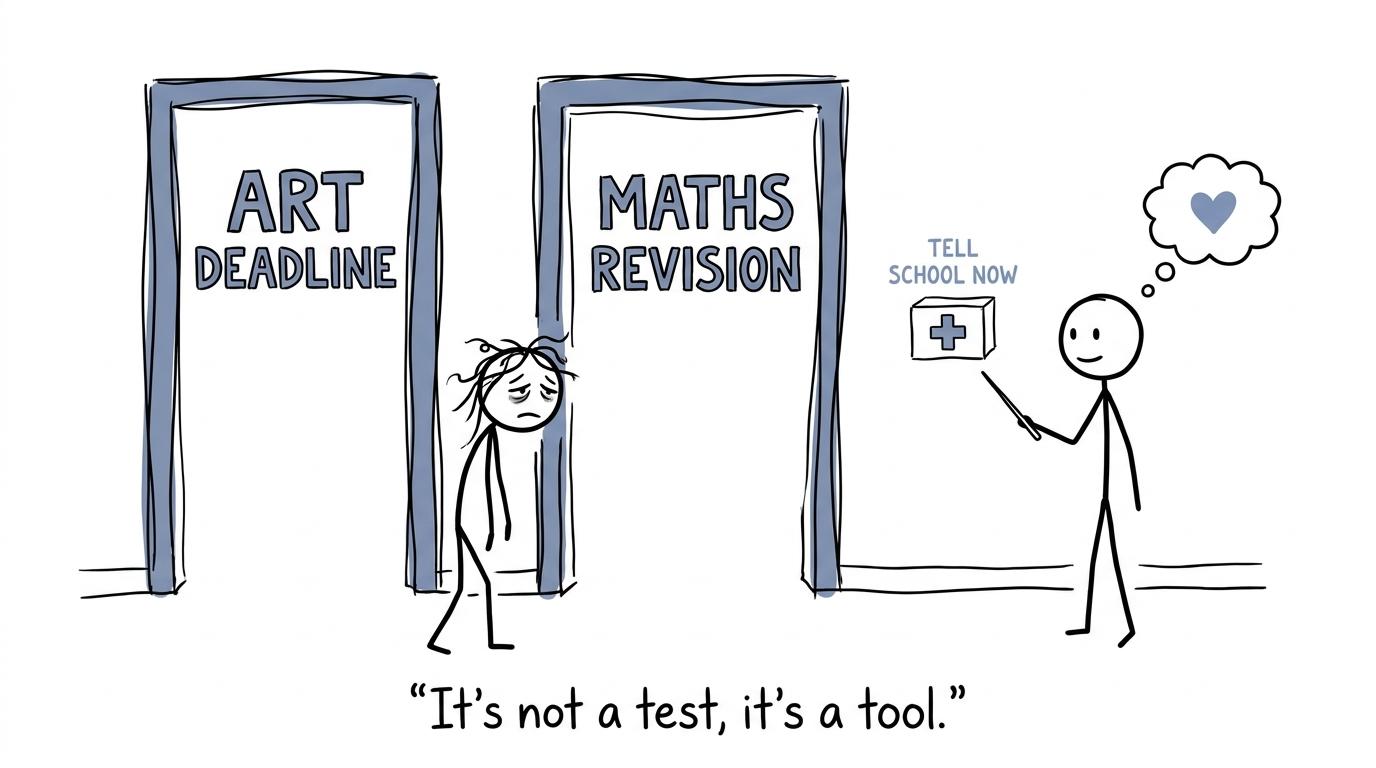 A student choosing between an art deadline and maths revision while a teacher points towards asking for help
First identify which deadline you missed
Schools often set Art deadlines earlier than the awarding body's administrative deadline. They need time to authenticate work, mark it, conduct any internal review process, prepare moderation samples and submit marks correctly.
That means there are several possible situations.
You missed a classroom checkpoint
A checkpoint might cover artist research, development pages, experiments or a particular outcome. Missing it can affect the quality and completeness of your portfolio, but it is not necessarily the final submission date.
Your teacher may ask you to complete permitted work by a revised internal date. Whether that is possible depends on the assessment stage, school policy and specification rules.
You missed the school's final portfolio deadline
This is more serious. The school may already be marking and authenticating portfolios. You must ask whether late material can lawfully be accepted before final assessment.
JCQ guidance says candidates must meet deadlines set by teachers. It also draws a firm line around final submission: once coursework has been submitted for final assessment, adding or removing material can constitute malpractice.
You missed supervised time for the externally set component
GCSE Art and Design includes an externally set component, although its exact name varies. AQA and Pearson Edexcel use terms including externally set assignment, while OCR uses externally set task. Eduqas also has an externally set assignment.
The final timed sessions operate under controlled conditions. They are not the same as an ordinary homework deadline. If you missed supervised time because of an unexpected absence, the school must follow the relevant JCQ and awarding-body rules. Do not assume you can recreate that time at home.
What actually happens to your grade?
There is no single automatic penalty called a “late coursework deduction”. The practical result depends on the evidence available for assessment.
If incomplete work is accepted for assessment, it can only earn marks for what it demonstrates against the assessment objectives. A polished final piece cannot always compensate for missing research, experimentation, refinement or recorded development. Art rewards the journey as well as the destination.
JCQ coursework rules generally say that where several distinct pieces are assessed separately, completed tasks should receive the marks they earn unless the specification states otherwise. Incomplete evidence may therefore reduce your marks without automatically producing zero for the entire qualification.
If no work is submitted for a component, the school must normally record the candidate as absent for that component rather than simply awarding a mark of zero. In a qualification containing multiple components, this can lead to a partially absent result. The precise certification outcome is determined by the awarding body, so only your school can confirm what applies to your entry.
Missing one deadline also does not mean that a teacher can estimate the marks you might have achieved. Teachers must assess the permitted evidence actually available and cannot casually adjust marks to make up for unfinished work.
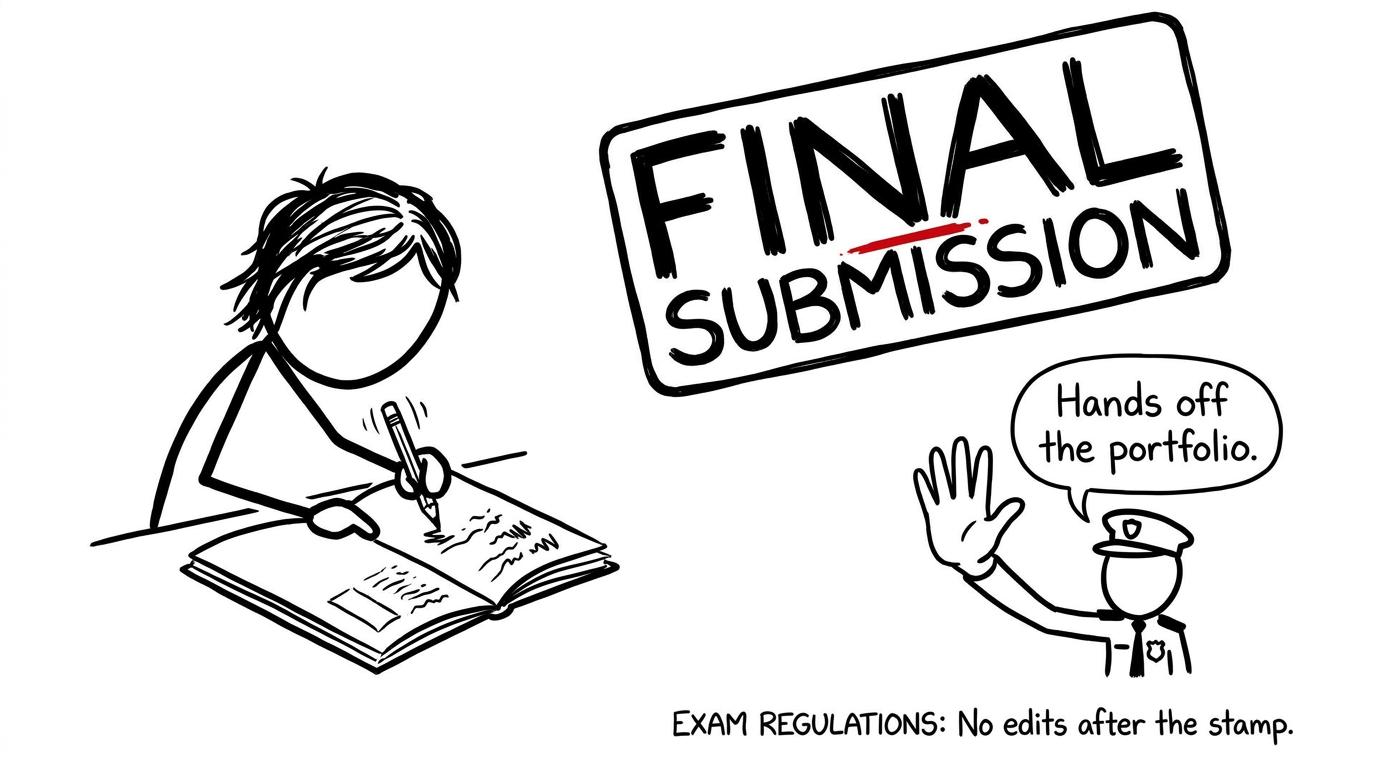 A student being stopped from changing an art portfolio after a final-submission stamp
Is there a way to fix unfinished Art coursework?
Possibly, but the solution must come through your school rather than an informal private arrangement.
Ask whether completion is still permitted
If final assessment has not begun, your teacher may be able to tell you which tasks can still be completed and where they must be done. Follow that instruction exactly. More work is not automatically better: prioritise the evidence your teacher identifies rather than decorating already strong pages.
Establish what has already been authenticated
Art teachers must be satisfied that submitted work is your own. Last-minute material created without the required supervision or evidence of development may raise authentication concerns. Keep drafts, photographs and process evidence where your teacher requests them.
Get the decision in writing
After speaking to your teacher, write down the agreed deadline, location, permitted materials and tasks. A short email confirmation can prevent misunderstandings when everyone is busy.
Do not alter finally submitted work
Once the portfolio has been presented for final assessment, leave it alone unless your school explicitly tells you otherwise. Adding a “quick extra page” may feel helpful, but it can create a malpractice issue.
Ask about the next assessment opportunity
If the component cannot be completed in the current series, your school can explain whether a later entry is available and practical. This is not an instant extension, and availability depends on the qualification, awarding body and centre arrangements.
When special consideration may apply
Special consideration is intended for adverse circumstances that materially affect a candidate's ability to complete or perform in an assessment. It is not normally available simply because work was left too late, revision was poorly organised or a student misunderstood a deadline.
A school may consider an application where a fully prepared candidate was unable to finish because of a qualifying temporary illness, injury or other serious unforeseen misfortune. JCQ guidance indicates that accepting a reduced quantity of work may be possible in some subjects and circumstances, but all assessment objectives must have been covered at least once. It is not guaranteed.
The school submits the application to AQA, Pearson Edexcel, OCR or WJEC/Eduqas and supplies the required evidence. Students and parents cannot award special consideration themselves. Tell the school promptly because applications and supporting processes have deadlines too.
How to stop the crisis consuming maths revision
The hidden cost of a missed coursework deadline is often not confined to Art. Panic expands to fill every available evening, and structured maths practice disappears precisely when GCSE exams are approaching.
Start by separating urgent Art actions from ongoing maths preparation. Contacting your teacher is urgent. Repeatedly worrying about an answer only the school can provide is not productive.
Use the free GCSE Maths revision hub to choose one manageable topic each day. A short revision lesson followed by focused practice questions keeps mathematical skills moving without demanding an entire evening.
If your timetable has collapsed, rebuild it using the principles in the GCSE maths revision timetable guide. Leave catch-up space rather than planning every minute. Art deadlines, school meetings and ordinary tiredness all need somewhere to go.
When concentration is limited, mini tests and shorter timed sections are more realistic than forcing a complete paper. Once the immediate Art issue is controlled, the guide to starting GCSE past papers can help you move back towards full papers, mark schemes and video solutions.
Predicted papers can sharpen final preparation, but they should not replace broad specification coverage. The explanation of how to use predicted GCSE topics sensibly shows how to combine predictions with topic revision and past-paper review.
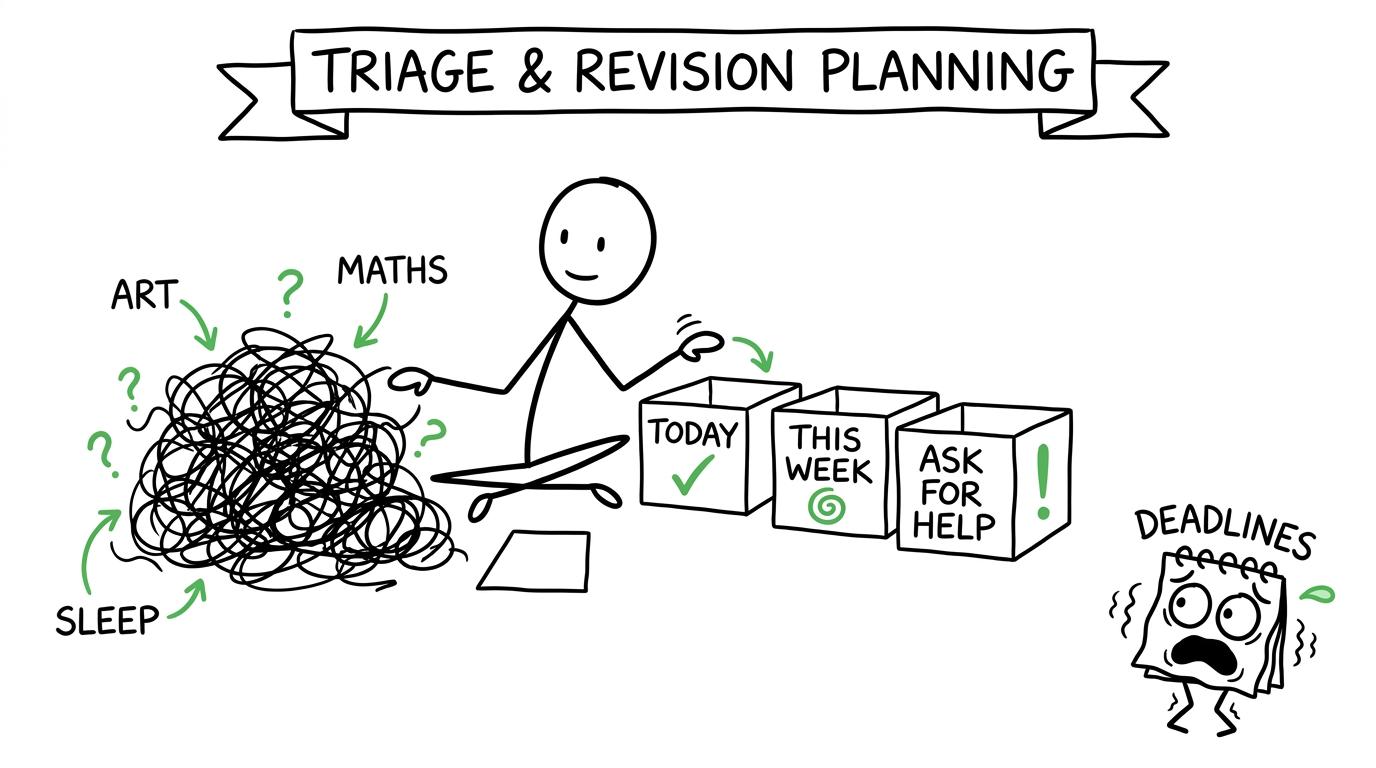 A student sorting art, maths and sleep into manageable boxes while a calendar monster shrinks
Common mistakes after missing the deadline
Waiting because you are embarrassed
Silence removes options. Teachers can only explain permitted solutions when they know what happened.
Assuming every deadline is flexible
A classroom checkpoint, final portfolio submission and supervised externally set session have different consequences. Ask which one applies.
Continuing after final submission
Changing assessed work can breach JCQ rules. Never assume that an unnoticed addition is harmless.
Expecting special consideration for poor time management
Special consideration normally requires circumstances outside your control and supporting evidence. It is not a general late-work policy.
Sacrificing every other GCSE
An Art problem needs a focused response, not the abandonment of maths, English and science. The MathsGenie approach to efficient Edexcel revision is useful even if you take another board: diagnose a weakness, practise it, mark it and retest it.
A calm next step is better than a dramatic plan
A missed deadline matters, but guessing about its consequences wastes the time in which something useful might still be done. Find out what deadline passed, what evidence can legally be assessed and whether your circumstances need to be referred to the exams officer. Then follow the school's instructions precisely.
Meanwhile, keep maths revision alive in small, repeatable sessions. Visit MathsGenie for free revision lessons, practice questions, mini tests, past papers, predicted papers, mark schemes and video solutions. One difficult subject deadline does not have to take control of the rest of your GCSE preparation.