A May Half-Term IGCSE Maths Revision Plan
A May half-term IGCSE Maths revision plan with a practical seven-day timetable for Edexcel or Cambridge, past-paper practice, marking, review and rest.
May half-term can feel less like a holiday and more like a warning. Exams are close, the specification looks enormous, and every unfinished topic suddenly seems urgent. A May half-term IGCSE Maths revision plan solves that problem by giving the week a clear purpose: diagnose your gaps, repair the most important ones, practise under exam conditions and leave enough energy for the actual papers.
The aim is not to cover the entire course in seven days. It is to make the remaining time count. This plan works for students taking Pearson Edexcel International GCSE Mathematics A or Cambridge IGCSE Mathematics, provided you choose resources that match your exact specification, tier and paper format.
Your half-term checklist
Before the week begins, collect:
- your confirmed exam board, syllabus code and tier
- the dates and formats of your remaining papers
- one appropriate past paper and its mark scheme
- your latest mock or class assessment
- a short list of weak topics
- a calculator and normal examination equipment
- somewhere to record errors and corrected methods
Use the broader GCSE maths revision timetable guide as the pillar guide for planning revision around your other subjects. You can also browse free IGCSE revision guides and select the correct subject and exam board before starting.
Check your Edexcel or Cambridge paper structure
A sensible IGCSE revision timetable begins with the examination you will actually sit.
For Pearson Edexcel International GCSE Mathematics A, check whether you are entered for Foundation or Higher tier. The linear qualification uses two papers, with each contributing half of the qualification. MathsGenie's Edexcel IGCSE Maths revision hub organises topic resources for this course.
Cambridge students should check the syllabus code on their statement of entry. For Cambridge IGCSE Mathematics, this may be syllabus 058005800580, while other Cambridge mathematics qualifications use different codes. Core and Extended candidates also sit different papers. The current Cambridge 058005800580 syllabus distinguishes between non-calculator and calculator assessment, so your practice must match the paper ahead.
Do not rely on what a friend is revising. Check your own entry, official timetable and current specification. A beautifully organised plan for the wrong paper is still the wrong plan.
A seven-day May half-term plan
Imagine a student called Sam. Sam has an Edexcel Higher paper approaching, although the same planning method would work for a Cambridge Extended candidate. Sam's first instinct is to write “revise algebra” across three afternoons. That sounds productive but gives no finish line.
Instead, Sam creates the following seven-day structure.
Day one: diagnose
Complete a substantial section of a past paper in timed conditions. If you have enough uninterrupted time, sit the full paper. Use the appropriate collection of IGCSE past papers, or go directly to the Edexcel IGCSE Maths past papers.
Mark it carefully. Sort each lost mark into one of three categories:
- Knowledge: you did not know the fact, formula or method.
- Application: you knew the method but did not recognise when to use it.
- Accuracy: you made an arithmetic, algebraic, rounding or calculator error.
Choose three priority topics from this evidence. Do not choose ten.
Days two and three: repair weak topics
Spend each day on one or two priorities. A useful session has four parts:
- recall the method without notes
- use a revision lesson or video solution to clarify it
- answer focused practice questions
- mark the work and redo errors without copying
If algebraic fractions are weak, for example, “read algebra notes” is too vague. A better task is “review the method, complete a focused question set, mark it, then redo every incorrect question”. The task creates evidence that the weakness is changing.
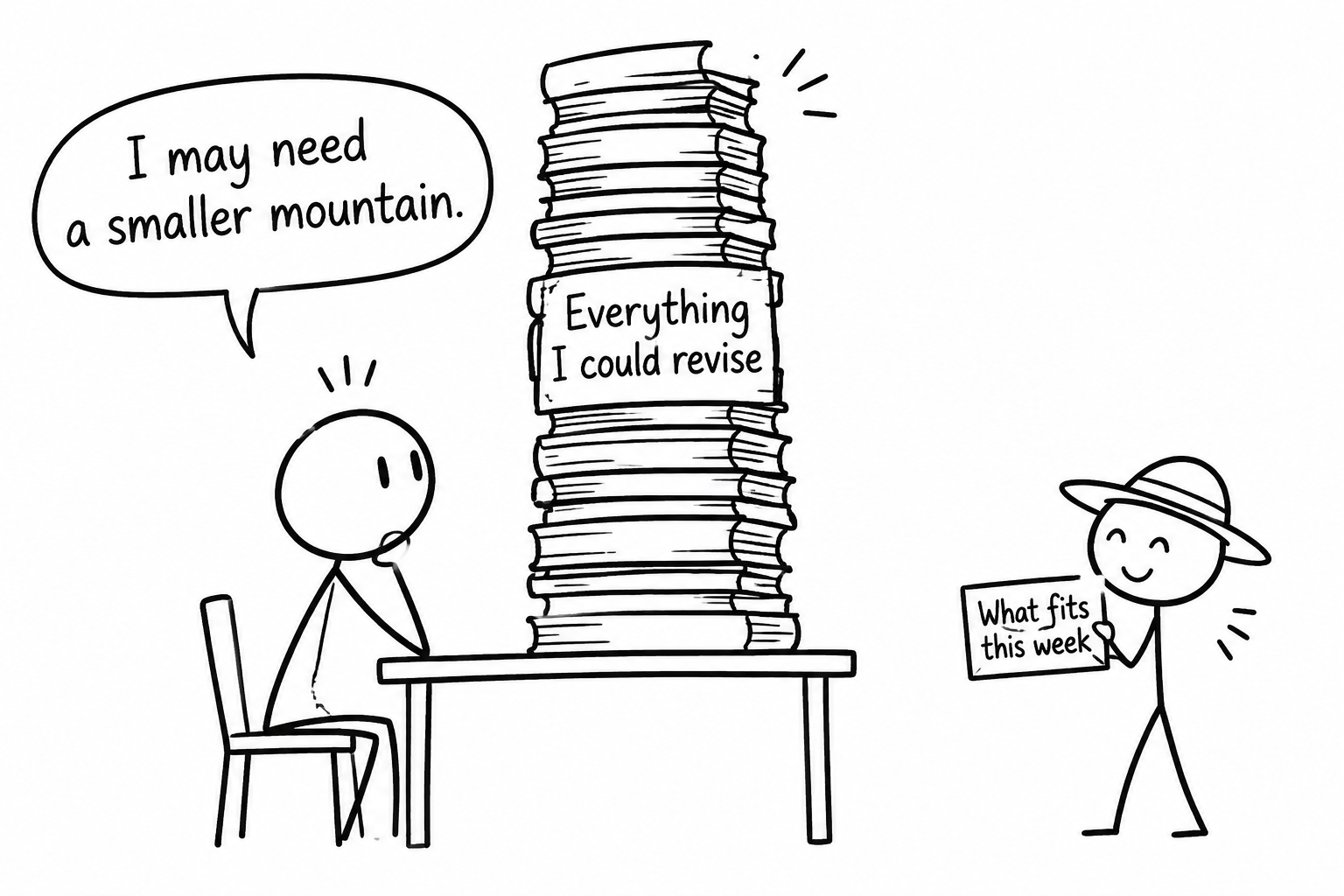 A student choosing a manageable revision mountain during May half-term
Day four: mixed practice
Now mix topics together. Real papers do not announce which chapter each question belongs to, so you must practise selecting methods as well as carrying them out.
Use exam-style questions, a mini test or part of an unused paper. Work without notes at first. Afterwards, use mark schemes and video solutions where available to understand why marks were lost. Predicted papers can provide extra practice when they match your board and specification, but they should complement real past papers rather than replace them.
Day five: timed paper
Sit a complete paper under realistic conditions. Use the correct calculator rules and official time limit for your paper. Put your phone away, prepare your equipment in advance and continue through difficult questions rather than checking answers immediately.
This session is not only about your total mark. Notice whether you spend too long on early questions, abandon working when stuck or fail to return to skipped questions. Timing is a mathematical skill because it affects how much of your knowledge reaches the page.
Day six: mark, correct and retest
Mark the paper using the official mark scheme. For each error, write a brief cause and correction. Then answer the question again on blank paper.
Reading the mark scheme and thinking “I understand now” is not enough. Recognition can feel like knowledge even when you cannot reproduce the method. The guide to using past papers effectively explains how to turn errors into a fix list and reattempt questions properly.
Finish by retesting several questions from days two and three. If the same errors return, keep those topics on next week's list.
Day seven: light review and reset
Use the final day for a shorter session. Review formulas, calculator settings, common command words and your error log. Complete a few questions from the topics that still feel uncertain, then stop.
Rest belongs in the plan. Half-term revision that leaves you exhausted on the first day back has borrowed concentration from the wrong week.
You now have the structure; if setting up every session feels like another task, build your day-by-day schedule in the Revision Planner instead of drawing the whole week by hand.
How long should each revision session be?
There is no single perfect session length. A focused block of roughly forty-five to sixty minutes is often more useful than an unfocused afternoon. Take a proper break, then begin another clearly defined task if your wider timetable allows.
Protect some flexibility. If a timed paper takes longer than a topic session, let it. If you have other IGCSE subjects to revise, use one strong maths block rather than trying to occupy every free hour.
At the end of each session, record:
- what you completed
- what you got wrong
- what needs another attempt
- the next specific task
That final line makes tomorrow easier to begin.
Common mistakes in IGCSE maths revision
Revising everything equally
Strong topics feel comfortable, so students often return to them. Half-term is more valuable when time follows evidence. Prioritise weaknesses that appear repeatedly in assessments, while keeping a small amount of mixed practice for stronger areas.
Treating marking as the end
A mark tells you where you are. Correction changes where you are going. Reattempt each missed question and schedule a later retest. The article on revision mistakes that waste time explores why passive review can create activity without reliable progress.
Using the wrong resources
Edexcel, Cambridge and UK GCSE papers are not interchangeable. Some content overlaps, but paper structures, calculator rules and specification details can differ. Match every paper and worksheet to your current qualification.
Making an impossible timetable
A plan with no breaks, meals or room for other subjects usually collapses after one disrupted morning. A useful plan is not the fullest one. It is the one you can still follow on Thursday.
Turn half-term intentions into a schedule
Sam's week improved when each broad intention became a dated task. Your challenge is the same: knowing what good revision looks like is easier than deciding exactly when each paper, correction and retest will happen. Exams have fixed dates, so each unplanned week reduces the time available to act on your mistakes.