

Maths Mock Timing Strategies That Work
Maths mock timing strategies for GCSE students: plan each paper, avoid getting stuck and use mock results to build focused December revision.
November can make a maths mock feel larger than it really is. A Year 11 student opens the paper, spends too long wrestling with one question and suddenly notices that twenty minutes have disappeared.
The best maths mock timing strategies prevent that spiral. Know your paper's duration and total marks, calculate a rough pace, move on when a question stops being productive, and reserve time to return and check. Most importantly, treat the result as a diagnostic, not a verdict on your final GCSE grade.
Your mock timing checklist
Before each of your GCSE maths mocks:
- confirm the paper length, total marks and calculator rules with your school;
- turn the time and marks into a rough pace;
- practise starting with the questions you can answer steadily;
- set a limit for unproductive thinking;
- show working before moving on;
- reserve a checking window;
- analyse unfinished questions after the mock;
- use the findings to create targeted practice.
Different exam boards and school mock papers can use different formats, so do not copy somebody else's timings without checking your own paper. Your plan should be based on the instructions your school gives you.
November: build a timing plan before the mock
Imagine a student called Sam. Sam is hypothetical, but the problem is familiar. In early November, revision means answering questions until they are finished. There is no clock and no decision about when to move on.
That feels thorough. It does not rehearse the decisions required in an exam.
Calculate a rough pace
If a paper has MMM marks and lasts TTT minutes, its average time per mark is:
TM\frac{T}{M}MTFor a paper lasting 909090 minutes with 808080 marks, the raw average is:
9080=1.125\frac{90}{80}=1.1258090=1.125That is about 1.11.11.1 minutes per mark. If Sam reserves 101010 minutes for checking, the working pace becomes:
8080=1\frac{80}{80}=18080=1So a useful rough guide would be about one minute per mark during the main pass.
This is a guide, not a countdown for every question. A one-mark fact may take seconds. A multi-step problem can justifiably take longer. The calculation simply tells Sam when the overall pace is drifting.
Create checkpoints
A clock becomes more useful when it is linked to progress. For the example above, Sam might aim to have attempted roughly a quarter of the available marks after a quarter of the working time.
Write two or three checkpoints before the paper begins. Keep them simple. Checking the time after every question often creates more anxiety than control.
A checkpoint is also not a reason to abandon a nearly completed solution. It is a prompt to ask, "Am I making sensible progress?"
During the mock: use a two-pass method
The strongest mock exam tips are often decision rules rather than clever shortcuts. A two-pass approach gives students a rule for what to do when they become stuck.
First pass: collect accessible marks
On the first pass:
- answer questions you understand;
- show each important stage of working;
- circle or flag questions that need another attempt;
- move on when you are no longer making progress.
The goal is not to race. It is to avoid sacrificing several accessible questions for one stubborn problem.
A sensible moving-on rule might be: if you have reread the question, tried a relevant method and still have no productive next step, leave space and continue. Before moving, write down any useful formula, substitution or diagram. Method marks may be available even when the final answer is missing.
Second pass: return with fresh attention
Use the second pass for flagged questions. A difficult problem often looks different after the pressure of the first encounter has gone. Begin with the question where you can see the clearest next step, rather than automatically returning to the earliest blank.
If time is short, prioritise unfinished questions where partial working could earn marks. Writing random calculations is unlikely to help, but a valid equation, construction or first step can.
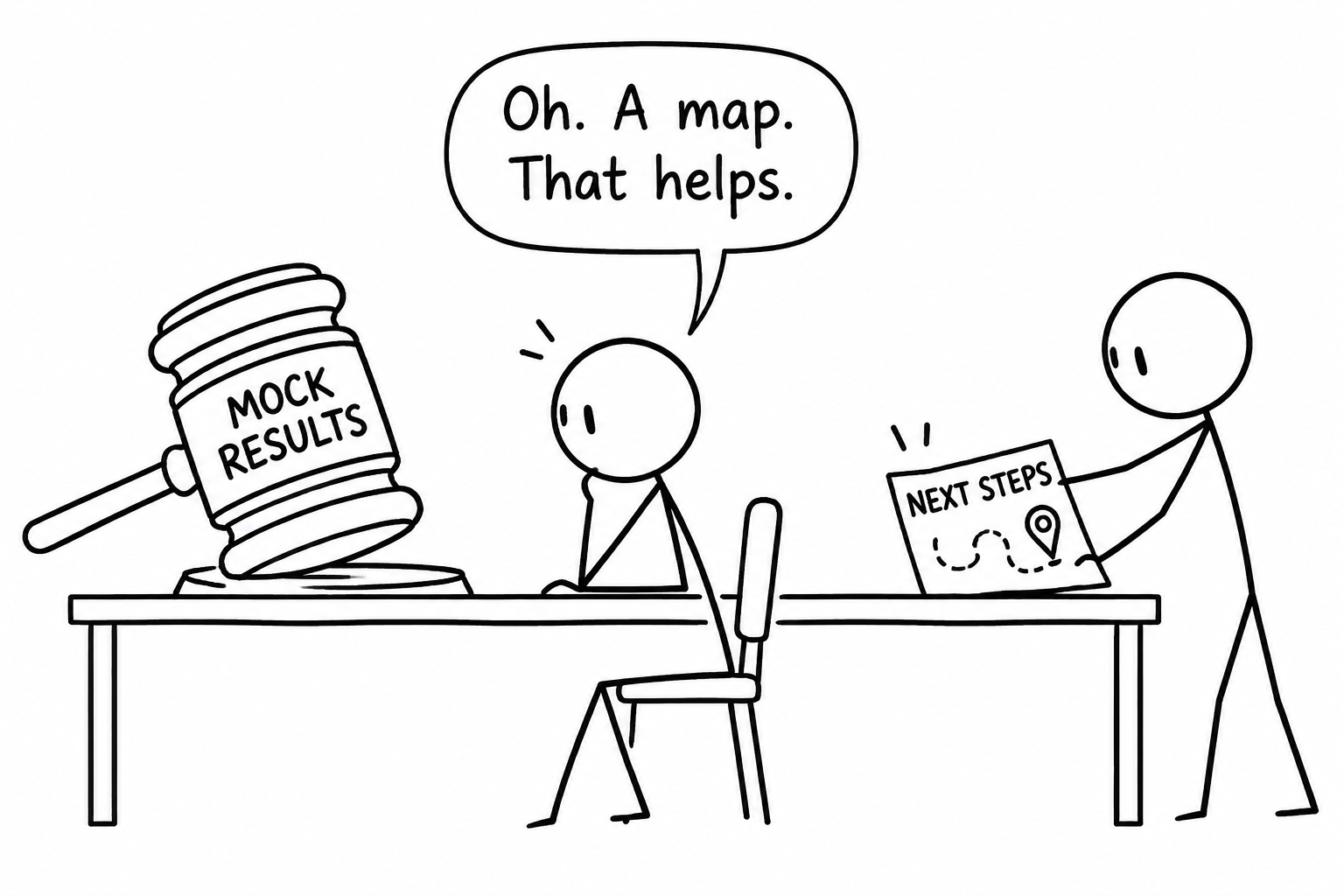 A mock result changes from a frightening verdict into a useful map of next steps
Protect time for checking
Checking does not mean staring at an answer and hoping to feel reassured. It means carrying out specific tests.
Use the final part of the paper to:
- complete any questions left blank;
- check that answers match what was requested;
- review signs, units, decimal places and rounding;
- estimate whether numerical answers are reasonable;
- substitute solutions back where appropriate;
- make sure calculator values were copied accurately;
- inspect any graph, scale or construction.
For example, if an answer to a length problem is negative, or a probability lies outside the interval 0≤p≤10\leq p\leq10≤p≤1, the result needs attention. A quick reasonableness check can recover marks without repeating the entire calculation.
December: turn the mock into a diagnostic
When Sam receives the marked paper in December, the grade is the most visible information. It is not necessarily the most useful.
A mock samples performance on particular topics, on one day, under a particular time limit. It cannot define what happens in the final GCSE. Its real value is that it exposes patterns while there is still time to change them.
Sort each lost mark into one of four categories:
| Category | What it might mean | Next action |
|---|---|---|
| Knowledge gap | The topic or method was unfamiliar | Revisit the revision lesson, then answer practice questions |
| Process error | The method was known, but a sign or calculation went wrong | Practise slowly and annotate each stage |
| Timing problem | A question was blank or rushed near the end | Rehearse checkpoints and the two-pass method |
| Exam-reading error | A command, unit or rounding instruction was missed | Underline the required form before solving |
This distinction matters. More revision will not automatically fix a timing problem, just as faster work will not repair a missing method.
MathsGenie's free resources make the response more precise. Use GCSE Maths Revision to revisit weak topics, then test the method with GCSE Maths Exam Questions. For realistic timed practice, choose papers for your course from the GCSE Maths Past Papers collection and compare your work with the provided mark schemes and video solutions.
You can also organise the weeks ahead with the MathsGenie Revision Planner, rather than repeatedly revising topics that already feel comfortable.
Common timing mistakes in GCSE maths mocks
Spending equal time on every mark
Questions are not equally demanding, but marks still provide a useful indication of expected work. Spending ten minutes on a low-mark question should trigger a decision to move on.
Rushing the opening pages
"Easy" questions still require accurate arithmetic and careful reading. The aim is controlled momentum, not speed for its own sake.
Leaving working until the end
Write working as you solve. You may not have time to reconstruct it later, and clear mathematical stages can matter in the mark scheme.
Refusing to leave a difficult question
Persistence is valuable in revision. In a timed paper, persistence needs a limit. Moving on protects the marks available elsewhere and allows you to return with a clearer head.
Practising only without a clock
Untimed practice develops methods. Timed practice develops selection, pace and recovery. Students need both.
Make the next paper more useful than the last
By December, Sam's mock has become something smaller and more useful than a verdict. It is a map. The unfinished final page suggests pacing practice. Repeated algebra errors suggest a topic review. A lost mark for missing units suggests a checking routine.
That is the quiet advantage of mocks: they reveal problems before the exam that matters most.
Choose one timing habit and one topic weakness for your next session. Then use MathsGenie's Mock Exam Builder to build a targeted practice paper around what the mock actually revealed. Complete it under controlled conditions, use the mark scheme and video support to review it, and adjust your plan. The goal is not merely to work faster. It is to spend your time where marks are most recoverable.















