Make Own GCSE English Literature Practice Questions?
Make own GCSE English Literature practice questions from your notes, match your exam board, target assessment objectives and revise with greater purpose.
A page of English Literature notes can look reassuringly complete. Themes are highlighted, quotations are boxed and context fills the margins. Yet close the notebook and a harder question appears: could you use that knowledge under exam conditions?
It is worth learning how to make own GCSE English Literature practice questions because creating a good question forces you to decide what matters, connect ideas across a text and think like an examiner. Writing questions should not replace official past papers, but it can turn passive notes into active revision.
For students balancing English with GCSE maths, the useful principle is the same in both subjects: learn the content, test it without support, check the result and repair the gap.
The short answer and your checklist
Yes, making your own questions is worthwhile when you:
- follow the format used by your exam board;
- build questions around the text, theme, character or relationship you need to revisit;
- consider the relevant assessment objectives;
- answer at least some questions under timed conditions;
- compare your response with an official mark scheme or teacher feedback;
- continue using official past and sample papers.
It is less useful if you spend an hour designing a beautiful question and no time answering it. Question-writing is a revision tool, not a craft project.
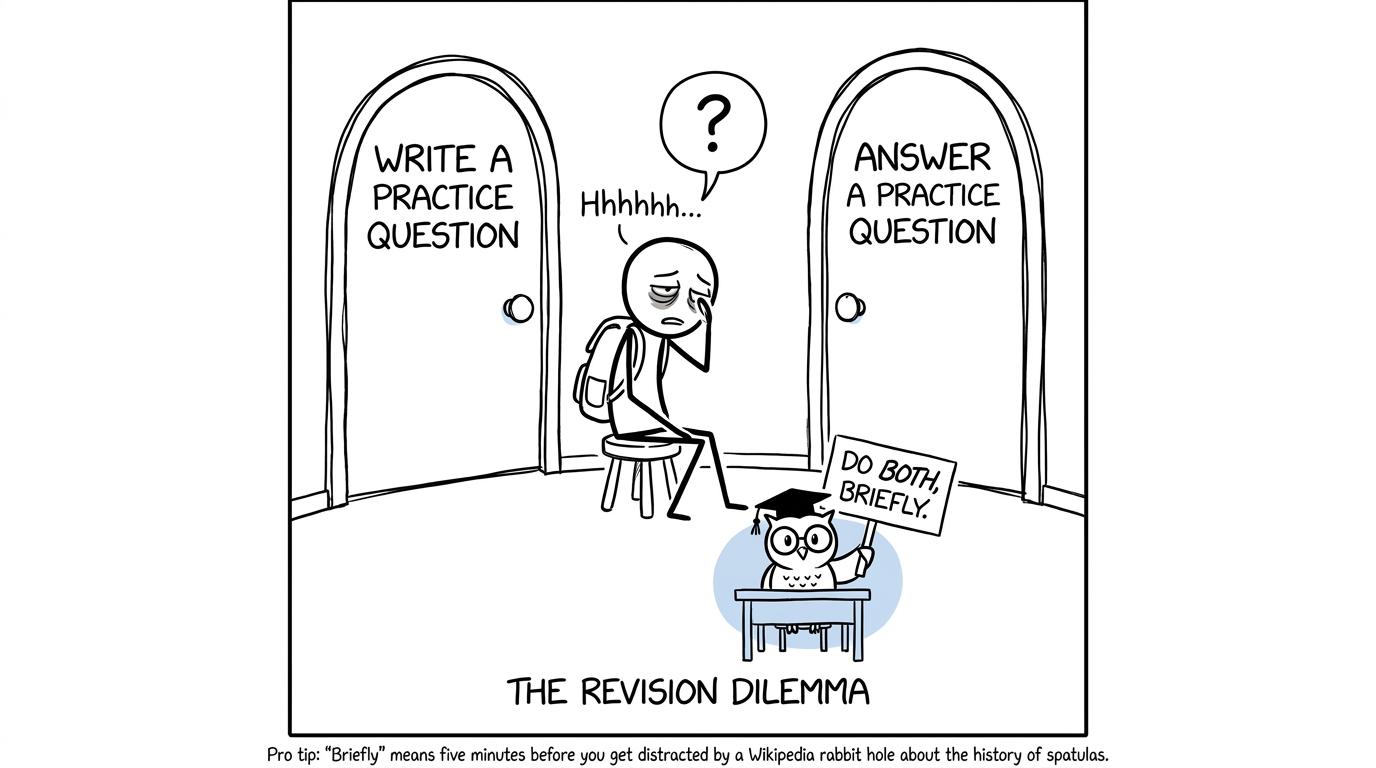 A GCSE student choosing between writing and answering practice questions
Why writing questions can teach you so much
Answering a question begins with a decision already made for you: somebody else has chosen the theme, character, extract or comparison. When you write the question, you must make that decision yourself.
That changes how you look at your notes. Instead of asking, “Have I highlighted this?”, you ask:
- Is this idea important enough to support an essay?
- Which moments elsewhere in the text connect to it?
- Which quotations would allow analysis rather than simple retelling?
- Does the topic create room for a personal interpretation?
- What might a strong response need to explain about language, form or structure?
This is valuable retrieval. You are reconstructing the text’s important relationships rather than merely recognising words on a page.
There is a second benefit. Creating several plausible questions reveals whether your notes are flexible. If every note only helps with one predicted theme, your knowledge may be too narrow. Strong revision material can usually support questions about character, theme, relationships, change, conflict and the writer’s methods.
Start with your exam board, not a generic essay title
AQA, Edexcel, OCR and Eduqas assess the same nationally defined GCSE English Literature assessment objectives, but their papers do not use identical structures. Some tasks provide extracts, some offer choices and some require comparison. The texts and the distribution of tasks also vary.
Before writing anything, check your current specification, a recent official paper and its mark scheme. Copy the shape of the question without copying its content. Notice:
- whether an extract is supplied;
- whether the response must address the extract and the whole text;
- whether students choose between questions;
- whether comparison is required;
- which assessment objectives apply;
- the mark total and suggested timing used by your school.
Do not assume that a question seen online matches your board or current specification. Exam-board documents can change, including prescribed texts, so use materials supplied by your school or the official board website.
This mirrors good maths revision. You would not deliberately practise the wrong tier or calculator conditions. The MathsGenie GCSE maths revision hub begins with choosing the correct exam board; your English practice should be equally precise.
Turn GCSE English Literature notes into questions
Sort each note by purpose
A notebook often mixes several kinds of knowledge together. Separate your material into:
- character and relationships: motives, changes, contrasts and conflicts;
- themes and ideas: where an idea appears, develops or becomes complicated;
- writer’s methods: language, form, structure, imagery, stagecraft or narrative choices;
- textual evidence: short quotations and precise references;
- context: information that genuinely illuminates the text;
- interpretations: defensible readings and possible alternatives.
This sorting stage exposes imbalance. Ten pages of historical context cannot compensate for weak knowledge of the text. Equally, a list of quotations without an understanding of who says them, when and why is difficult to use well.
Find a productive tension
The best practice questions are rarely built around a flat statement. They create room for argument.
Look through your notes for:
- a character who changes;
- a relationship containing both loyalty and conflict;
- a theme presented differently at separate points;
- a contrast between appearance and reality;
- a writer’s method whose effect develops across the text;
- two poems that approach a shared idea differently.
A productive question lets you agree, disagree or qualify an interpretation. It should not merely invite a plot summary.
Use an exam-shaped stem
Once you have a focus, use wording resembling your board’s official tasks. Useful generic stems include:
- How does the writer present...?
- Explore how the writer presents... in this extract and elsewhere in the text.
- How far do you agree that...?
- Compare how the poets present...?
- In what ways does the writer use... to show...?
These are templates, not universal exam formats. Adapt them only after checking your specification and recent papers.
Test the question before keeping it
A useful question should pass four checks:
- Text check: can it be answered using precise evidence from relevant parts of the text?
- Methods check: does it allow discussion of language, form or structure?
- Argument check: can a student develop an interpretation rather than list events?
- Specification check: does it resemble the task style used by the correct exam board?
If the answer to one of these is no, revise the question. The act of repairing it is part of the learning.
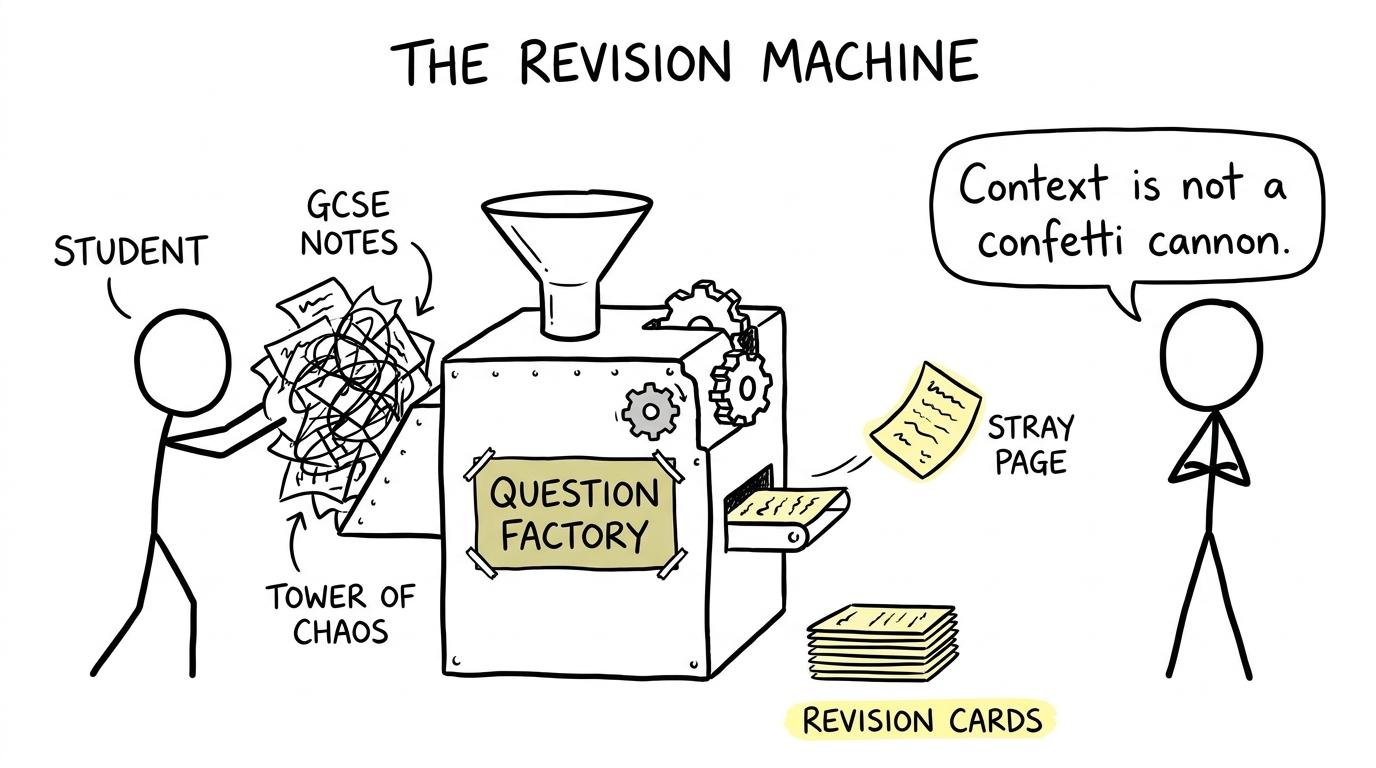 An untidy pile of notes passing through a humorous question factory
Build questions around the assessment objectives
Across GCSE English Literature specifications, the assessment objectives broadly require students to:
- AO1: respond critically and personally, supported by textual references;
- AO2: analyse how language, form and structure create meanings and effects;
- AO3: understand relationships between texts and their contexts;
- AO4: communicate accurately and effectively where it is assessed.
The nationally set weighting ranges place substantial emphasis on AO1 and AO2 across the qualification, but the objectives assessed on an individual task depend on the paper and board. Do not force every objective into every answer.
When designing a question, annotate it with the objectives that appear relevant. Then ask whether your notes could support them. A question about a character may test knowledge of the whole text, but it becomes stronger when it also permits analysis of how the writer constructs that character.
Context deserves particular care. AO3 does not mean attaching a memorised historical fact to every paragraph. A better question creates space to explain how contextual understanding shapes an interpretation of the text.
Use a question bank without avoiding real papers
Create a small bank divided by text and question type. You might include categories for characters, themes, relationships, extracts, poetry comparison and unseen texts. Label each question as:
- ready to answer;
- needs more knowledge;
- attempted;
- needs another attempt.
Then vary the task. Plan one question from memory, write one paragraph for another and complete a full timed response when appropriate. Not every revision session needs to become a complete essay.
However, self-written questions cannot show you every feature of an authentic examination. Official papers give you wording, mark totals, extracts and combinations of topics chosen by the awarding body. Use your questions for targeted repair and official papers for realism.
Maths students already meet this distinction. Topic questions strengthen one skill, while papers test selection and stamina. MathsGenie’s guide to starting GCSE past papers at the right time explains this progression, while the advice on using Edexcel GCSE maths past papers properly shows why marking and follow-up matter as much as completing the paper.
Fit English question-writing around maths revision
If you are preparing for maths exams, do not let making English materials consume every revision session. Set a boundary: create a few purposeful questions, then answer or plan them.
A balanced cycle could be:
- retrieve one section of English notes;
- turn it into one or two exam-shaped prompts;
- plan an answer without notes;
- identify missing quotations or ideas;
- return to the text and repair the gap.
Use the same discipline in maths: diagnose, practise, mark and retest. If you need short, focused maths sessions, the guidance on revision when you are stuck at a pass grade prioritises manageable topic practice. For broader planning, efficient Edexcel GCSE maths revision shows how lessons, questions and papers can work as one cycle.
Common mistakes when making literature questions
Predicting one narrow topic
A self-written question is practice, not a prediction. Prepare flexible knowledge across the specification rather than betting everything on one character or theme.
Writing questions that only test plot
“Describe what happens” may check recall, but it does not create enough room for critical analysis. Build prompts around presentation, change, contrast, methods or interpretation.
Making the wording unlike your board
A thoughtful question can still be poor exam preparation if its structure is wrong. Keep a recent official paper beside you while writing.
Adding context artificially
Do not design a question simply to empty a page of context notes. Context should sharpen understanding of the writer’s ideas and choices.
Creating questions but never answering them
Writing can reveal what matters, but producing a response tests whether you can retrieve, organise and explain it. Alternate creation with planning, timed writing and review.
Marking your own work too generously
Use the official mark scheme, but remember that level-based English marking requires judgement. Ask your teacher to review occasional responses, particularly when you are unsure whether analysis is developed or merely asserted.
Make question-writing part of a complete revision system
Making your own GCSE English Literature questions is worth the effort because it turns notes into decisions. You must choose what is significant, recognise connections and anticipate the evidence an argument would require. That thinking can teach you almost as much as the eventual answer.
But keep the method in proportion. Check your board, write a small number of useful questions, answer them and use official materials to test whether your practice transfers to the real format.
Then apply the same active cycle to maths. Start at the free MathsGenie GCSE revision hub, learn weak topics through revision lessons and practice questions, and test them with mini tests, mark schemes and video solutions. When you are ready for full-paper practice, use the Edexcel GCSE maths past papers, adding predicted-topic revision guidance near the final stage.
Good revision is not measured by how many pages you produce. It is measured by what those pages help you retrieve, explain and improve.