

Make Your Own GCSE Drama Practice Questions?
Make your own GCSE Drama practice questions from notes, match them to your exam board and use mark schemes to improve analysis, recall and exam technique.
A folder full of GCSE Drama notes can create a comforting illusion: everything you need is there. Yet close the folder and an uncomfortable question appears: could you actually use those ideas in an exam?
That is why it can be worth learning to make your own GCSE Drama practice questions. Writing a good question forces you to identify what matters, choose the correct command word and think about what a successful response would contain. In other words, question-writing can teach you almost as much as answering.
The short answer is yes, with one condition: your questions should supplement official past and specimen papers, not replace them. Exam-board materials provide the most reliable guide to wording, mark allocation and paper structure. Your own questions then help you target the gaps those papers reveal.
The quick checklist
Before writing a GCSE Drama question, check that it:
- matches your exam board and current specification;
- tests a clearly defined topic from your notes;
- uses an appropriate command word;
- focuses on performance, direction, design or live theatre as required;
- has a realistic number of marks;
- can be judged against a simple marking checklist;
- does not copy an official question too closely;
- will eventually be answered under timed conditions.
This is the same active revision principle used in maths: learn the content, retrieve it through questions, check the result and repair the weakness. Maths students can build that cycle through the free GCSE Maths revision hub, while Drama students can apply the method using their specification, class notes and official board materials.
 A student attempts to catch practice questions escaping from an enormous Drama notes folder
Why writing questions improves your revision
Rereading notes asks, “Does this look familiar?” Creating a question asks something harder: “What could an examiner reasonably ask me to do with this knowledge?”
That change matters. GCSE Drama is not assessed through recall alone. Across regulated specifications, the assessment objectives include creating and developing ideas, applying theatrical skills, demonstrating knowledge and understanding, and analysing and evaluating work. The precise paper format varies between AQA, Edexcel, OCR and Eduqas, so you must follow your own board.
When you turn a note into a question, you make several useful decisions:
- Which detail is central and which is background?
- Is this knowledge best tested through description, explanation, analysis or evaluation?
- What evidence would make an answer specific?
- How might a performer, director or designer communicate meaning?
- What would distinguish a developed response from a vague one?
These decisions expose shallow understanding quickly. It is easy to copy “lighting creates atmosphere” into a notebook. It is harder to design a precise question about how lighting could communicate a particular mood, relationship or change in a scene.
Start with your exam board, not a blank page
There is no single universal GCSE Drama paper. Different boards organise their written assessment differently, use different set texts and may divide marks between sections in different ways. Although GCSE Drama commonly includes set-text work and live theatre analysis, you should not assume that a question from another board matches your paper.
Before creating anything, collect:
- your current specification;
- a specimen or recent accessible paper;
- its mark scheme;
- any examiner guidance supplied by your teacher;
- the approved edition of your set text;
- your live theatre notes.
Look at the pattern rather than copying the content. Notice how questions introduce extracts, address performers or designers, use bullet-point prompts and allocate marks. Also check which materials you may use in the examination and whether questions are compulsory or offer choices.
Maths revision works in exactly the same way: students must select the correct board and tier before practising. The AQA GCSE Maths revision area and OCR GCSE Maths revision area, for example, keep practice aligned with the relevant course. The subject changes, but the rule survives: practise the assessment you will actually sit.
How to turn GCSE Drama notes into practice questions
Divide notes into examinable categories
Do not begin with an entire exercise book. Choose one narrow category, such as:
- set-text plot, context and character relationships;
- acting choices, including voice, movement and interaction;
- directing choices and staging intentions;
- set, costume, lighting or sound design;
- live theatre moments and their effect on an audience;
- theatre roles, terminology and stage configurations.
Then select one page of notes. A focused page is easier to convert into a focused question.
Find the decision hidden inside the note
Drama notes often record facts, but exam responses usually need choices and effects. If a note describes a character as isolated, the useful question is not merely whether you remember that description. It is how isolation could be communicated through voice, physicality, space, lighting or interaction.
Use this planning chain:
idea from notes → theatrical choice → intended meaning → audience effect
This is not a model answer. It is a question-design test. If your proposed question gives a student room to connect all four stages, it is likely to generate worthwhile practice.
Choose the command word carefully
Official command words define the job your answer must perform. In broad terms:
- Describe asks for relevant characteristics or details.
- Explain asks for purposes or reasons.
- Analyse asks you to break material down and interpret significant features.
- Evaluate asks for a judgement based on evidence.
A question about live theatre may require analysis and evaluation, while another section may ask for explanation of performance or design choices. Never swap command words casually: an excellent description is not automatically an evaluation.
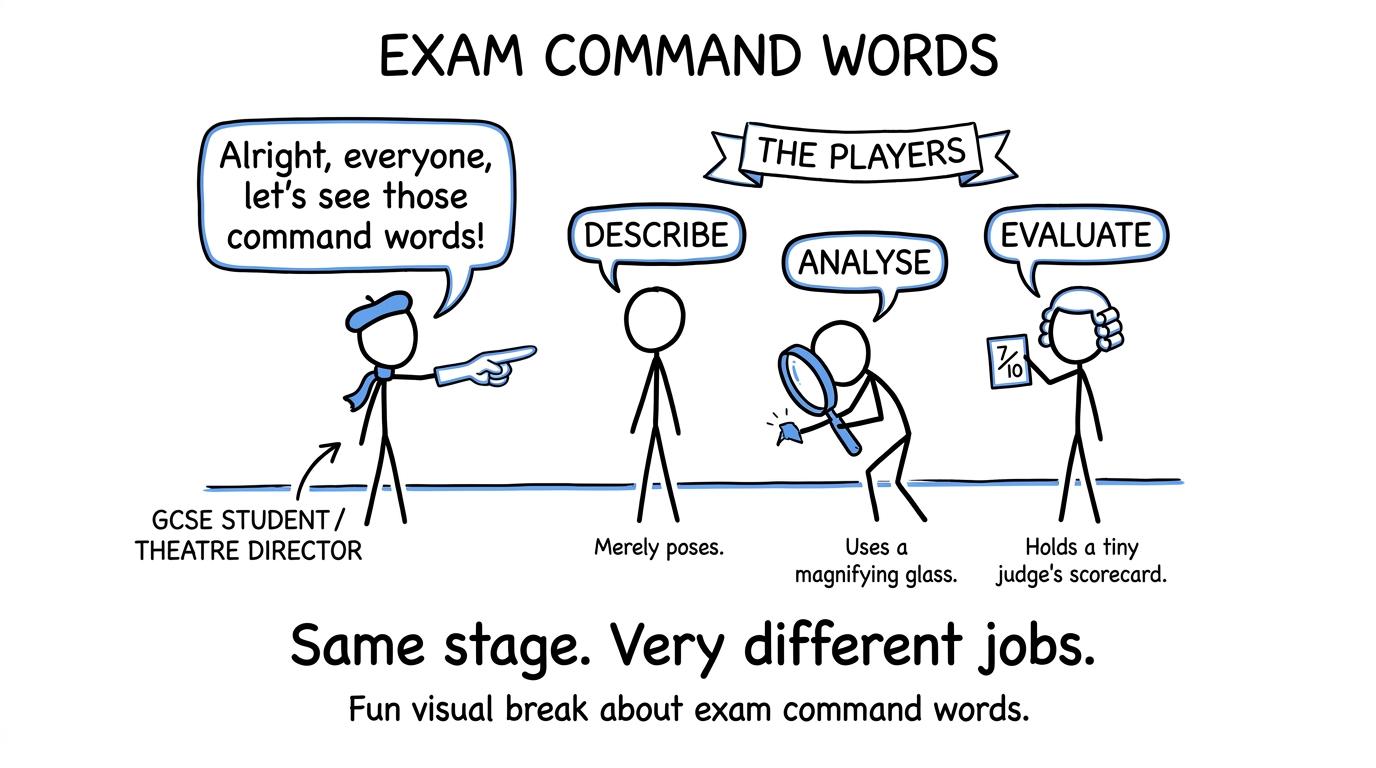 Describe, Analyse and Evaluate discover that they have very different jobs on the same stage
Build questions from reliable stems
Question stems give your ideas an exam-like shape without pretending to reproduce an official paper. Adapt stems such as:
- “Explain how you would use [performance skill] to communicate...”
- “As a designer, describe how you would use [design element] in this moment...”
- “Analyse how the performer communicated...”
- “Evaluate how successfully [theatrical element] affected the audience...”
- “How would you direct this section to show the relationship between...”
Add the specific character, moment, theme or production detail from your notes. Avoid making every question broad. A narrow question often reveals more because it prevents you from hiding behind memorised generalities.
Create a marking checklist before answering
The most valuable step is also the one students skip. Before answering, list what a strong response should probably include:
- direct focus on the question;
- accurate theatrical terminology;
- specific performance or design detail;
- reference to the relevant moment;
- explanation of intention or meaning;
- analysis of audience effect;
- a supported judgement where evaluation is required.
This is not an official mark scheme, and you should never award yourself a grade from it. It is a diagnostic checklist. Compare your final response with an official mark scheme and ask your teacher to review extended answers when possible.
Use a question ladder instead of one enormous essay
One difficult question can measure performance, but a sequence of smaller prompts can build it. Start with retrieval, progress to application, then finish with judgement.
For one section of your set text, your ladder might contain:
- a terminology or context prompt;
- a short question about a performance choice;
- a design or directing question;
- an analytical question about meaning;
- an evaluative question about effectiveness.
Write the first responses without notes. Check them immediately. Attempt the longer response later under time pressure. This separates two problems that students often confuse: not knowing the material and not expressing it effectively enough.
You can organise those sessions with the free MathsGenie revision planner. Although MathsGenie specialises in maths, the planner can help you place Drama retrieval, essay practice and feedback alongside your foundation or higher tier maths revision.
When homemade questions are most useful
Your own questions are particularly effective when your notes are specific to material that generic resources cannot know, including:
- the set text and scenes selected by your teacher;
- the live production you attended or watched;
- particular acting or design moments you recorded;
- weaknesses identified in a mock examination;
- terminology you repeatedly misuse;
- areas where you have too few official questions left unseen.
They are less useful for predicting the exact wording of the next paper. A self-written question is a learning tool, not a prediction. Keep at least some official material untouched for realistic timed practice.
This distinction matters in maths too. Edexcel GCSE Maths past papers provide authentic paper practice, while original topic questions help repair individual weaknesses. Both have a role, but they do different jobs.
How to answer and review your questions
Writing questions can become sophisticated procrastination if you never answer them. Use a simple cycle:
- Write a small set from one section of notes.
- Put the notes away.
- Answer one question under a sensible time limit.
- Compare the response with your checklist and official guidance.
- Highlight unsupported claims, vague terminology and missing effects.
- Rewrite only the weakest paragraph or plan.
- Return to a related question several days later.
Keep an error log with categories such as knowledge, terminology, evidence, analysis, evaluation and timing. The principle mirrors the method in finding your weakest GCSE topics: record why marks were lost, practise the specific weakness and then retest it.
 A student discovers that the homemade mark scheme is the real plot twist
Common mistakes when making GCSE Drama questions
Ignoring the specification
A thoughtful question can still be irrelevant. Check that its text, section, skill and format belong to your board's current course.
Writing questions that are too vague
“Write about the character” provides little direction. Identify a moment, relationship, theatrical skill, intention or audience effect.
Using the same command word repeatedly
If every question begins with “describe”, you will not practise analysis or evaluation. Build a deliberate mixture based on your paper.
Inventing an official-looking mark scheme
You can make a checklist, but you cannot know every acceptable response or apply level descriptors as reliably as an examiner. Use official mark schemes and teacher feedback to calibrate your judgement.
Making questions but avoiding answers
Question-writing feels productive because it produces a neat page. The learning becomes visible only when you retrieve, apply, mark and improve.
Replacing past papers completely
Homemade prompts target your notes; official papers test interpretation, timing and unfamiliar wording. Learn how to use GCSE past papers properly, then transfer the same attempt, mark, repair and retest discipline to Drama.
Turn your notes into something you can use
Your notes are raw material, not the finished performance. Turning them into questions makes you decide what matters and how knowledge becomes an examinable response. That is why writing the question can teach you nearly as much as answering it.
Begin modestly: choose one page, create three varied questions, draft a marking checklist and answer one without notes. Then verify your approach against your exam board's materials and teacher guidance.
For maths revision, let MathsGenie provide the questions rather than writing every one yourself. Start with free revision lessons and practice questions, then move through mini tests, past papers, predicted papers, mark schemes and video solutions. Use the GCSE Maths revision hub to choose your board and tier, and carry the same active habit into Drama: attempt, check, improve and return.











