Make Own GCSE Arabic Practice Questions: Worth It?
Make own GCSE Arabic practice questions that match your specification, expose weak vocabulary and turn lesson notes into active, exam-focused revision.
Revision notes can create a reassuring illusion: the page looks familiar, so the knowledge must be secure. Then a question asks for the same idea in an unfamiliar way, and the answer disappears.
If you want to make own GCSE Arabic practice questions, it is usually worth doing, provided those questions supplement official exam materials rather than replace them. Writing a question forces you to identify what matters, retrieve vocabulary, apply grammar and anticipate what a strong answer should contain. In other words, the writing itself becomes revision.
The best approach is simple: use your specification and official papers to understand the required format, turn small sections of your notes into focused questions, create answers or marking criteria, and test the questions after a gap.
A quick question-writing checklist
Before building a personal question bank, check that each question:
- matches your exact qualification, tier and skill;
- tests recall or application rather than copying;
- uses vocabulary and grammar you have been taught;
- includes a reliable answer or marking checklist;
- is clear enough to answer without guessing your intention;
- has been checked against official sample materials or past papers;
- is scheduled for another attempt later.
That final point matters. A homemade question left in a notebook is just another note. A question attempted from memory, marked and revisited becomes active revision.
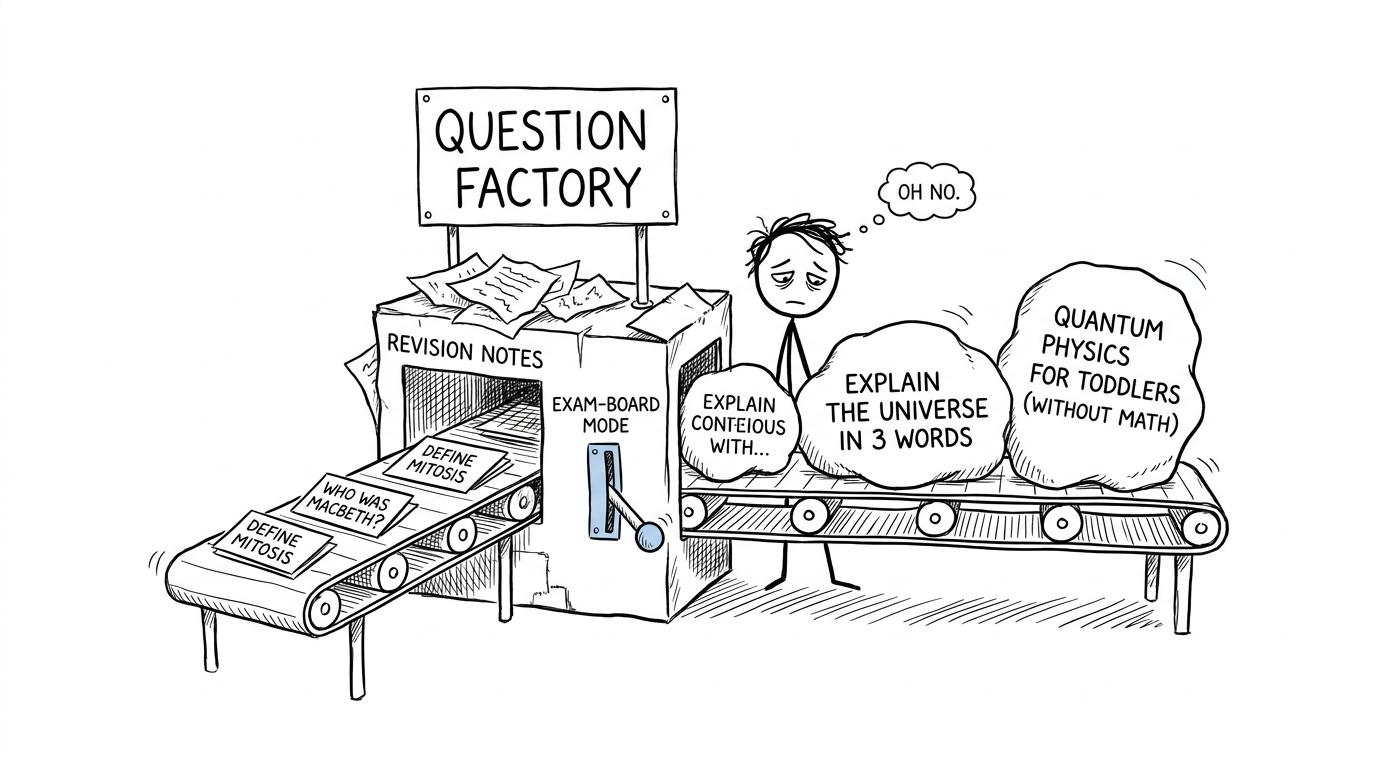 A student operating a slightly unpredictable GCSE question factory
Why writing questions can improve GCSE Arabic revision
Question writing changes your role. Instead of asking, “Do I recognise this?”, you ask, “What could an examiner test here?” That is a more demanding question.
Government guidance for modern foreign languages expects students to develop listening, speaking, reading and writing. The current Pearson Edexcel GCSE Arabic specification reflects those four skills through four externally assessed papers, with each skill contributing one quarter of the qualification. Students enter Foundation or Higher tier across the whole qualification, and dictionaries are not permitted in the assessments.
Your own practice therefore needs more than vocabulary flashcards. It should occasionally ask you to understand unfamiliar language, communicate an opinion, manipulate grammar, translate meaning or respond spontaneously.
Writing questions helps because it makes you:
- separate essential information from decoration;
- notice gaps in vocabulary and grammar;
- think about plausible wrong answers;
- retrieve language without immediately consulting notes;
- distinguish recognition from genuine production;
- consider what an acceptable response must communicate.
The principle transfers directly to maths. Reading a method feels easier than producing one under exam conditions. That is why MathsGenie's GCSE maths revision hub moves students from lessons into questions, papers, mark schemes and solutions. Knowledge becomes dependable when you have to use it.
How to turn GCSE Arabic notes into practice questions
Begin with the specification, not your imagination
First confirm that you are using the correct course. GCSE Arabic and International GCSE Arabic are different qualifications and can have different assessment structures. For Pearson Edexcel GCSE Arabic, your materials should reflect the themes, grammar, vocabulary and task formats in the current specification.
Look at official sample assessment materials and recent papers before imitating an exam style. Notice the wording of instructions, the length of source material, whether answers are required in English or Arabic, and the difference between Foundation and Higher demand.
Homemade questions should be exam-informed, not examiner impersonations. You do not need to predict a future paper. You need to practise the skills that the specification makes assessable.
Break one page of notes into small knowledge units
Do not turn an entire topic into one enormous task. Divide it into units such as:
- a group of related vocabulary;
- a verb pattern or grammatical structure;
- language for expressing and justifying opinions;
- a tense or time frame;
- a short cultural or thematic fact;
- a common translation difficulty;
- language for a role play or conversation.
Small units make weaknesses visible. If a question mixes too many skills, a wrong answer may not reveal whether the problem was vocabulary, grammar, comprehension or exam technique.
This is the same diagnostic idea used in MathsGenie's guide to finding weak GCSE topics: narrow the problem until the next action becomes obvious.
Choose the skill before writing the wording
Decide what the question is meant to test.
For reading, you might create a short text followed by a gist question, detail question, multiple-choice item or translation prompt. Keep the passage within language you can verify, but make the answer require understanding rather than word matching.
For writing, create a prompt with clear bullet points, a purpose and an audience. A useful task should encourage more than memorised sentences. It can invite different time frames, opinions, reasons and relevant detail while remaining appropriate to your tier.
For speaking, turn topic headings into role-play cues, picture-discussion prompts or follow-up questions. Avoid scripting every answer. The purpose is to practise retrieving and adapting language aloud.
For listening, use teacher-approved recordings where possible. You can record a short, checked script for personal retrieval practice, but your own voice cannot reproduce the range of speakers and delivery found in formal assessment. Homemade listening tasks are therefore most useful for targeted vocabulary or detail practice, not as perfect replicas of an exam paper.
Write the answer before polishing the question
This sounds backwards, but it prevents vague questions. Decide what knowledge or communication the task should reveal, then write wording that reaches it.
For a closed question, record the correct answer and why alternatives are wrong. For a writing or speaking prompt, create a marking checklist rather than a single model response. Your checklist might cover:
- whether every bullet point was addressed;
- whether the meaning was clear;
- whether vocabulary suited the topic;
- whether grammar supported the intended message;
- whether opinions were developed appropriately;
- whether the response used the requested language and format.
Do not invent an official marks tariff. Only an awarding organisation's published mark scheme can show how its real paper is assessed. Your checklist is a revision tool.
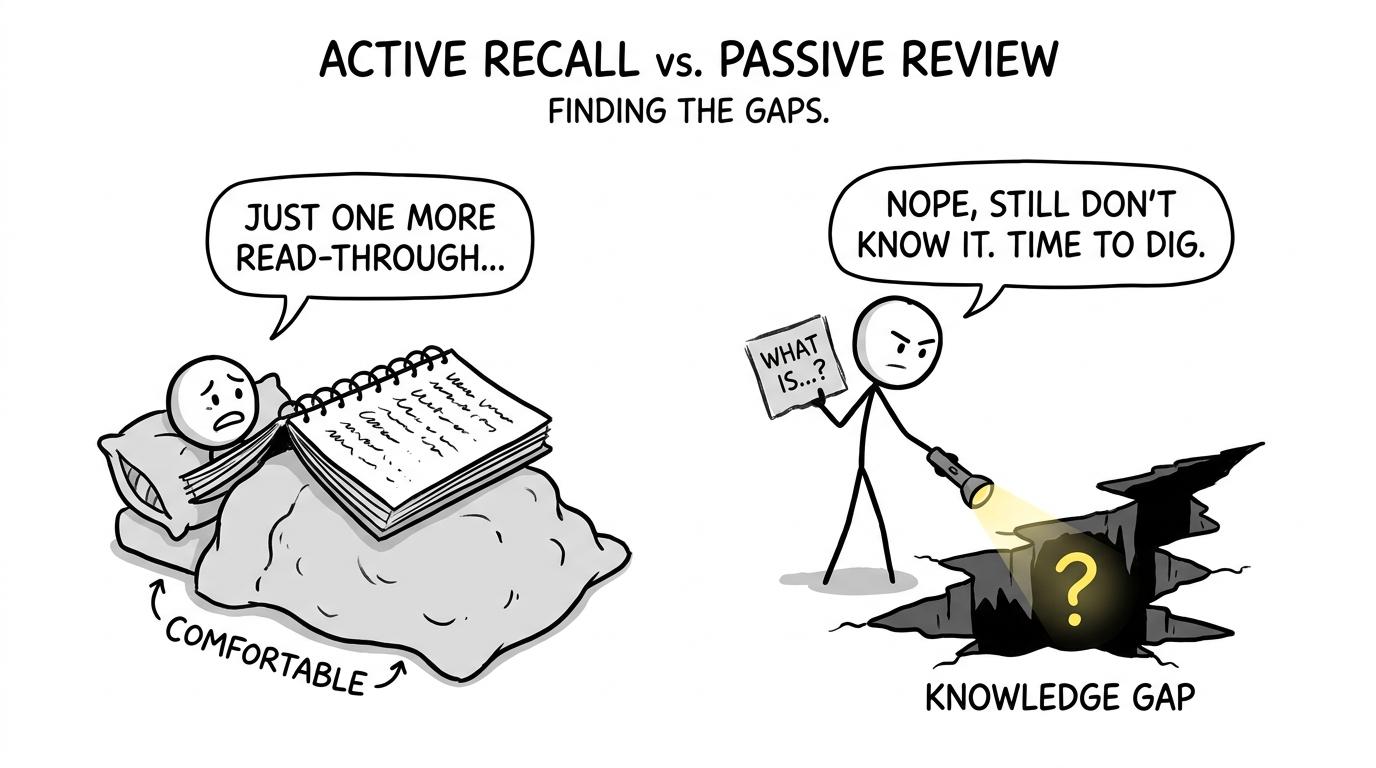 Rereading notes feels comfortable while a question exposes a hidden gap
Make multiple-choice distractors genuinely useful
A weak multiple-choice question has one sensible answer and several absurd ones. That tests eyesight more than Arabic.
Useful distractors can come from:
- vocabulary with a related meaning;
- confusion between positive and negative statements;
- similar-looking words;
- a correct detail attached to the wrong person;
- present, past or future time confusion;
- an option mentioned in the text but not answering the question.
Every distractor should be clearly wrong for a reason. If two answers could reasonably work, rewrite the item.
Tag each question and schedule it again
Label questions by theme, skill, tier and weakness. After attempting one, record whether the problem was recall, comprehension, grammar, accuracy or timing.
Then revisit it after a gap. Language-learning research reviewed by Ofsted emphasises planned revisiting and the development of increasingly automatic recall across oral and written forms. The useful cycle is:
write, attempt, check, correct, revisit.
For a similar revision structure in maths, see how to stop forgetting GCSE maths content. The subject changes, but the memory problem does not.
When homemade questions are most valuable
Your questions are especially useful when official materials reveal a precise weakness. Perhaps you repeatedly miss time markers in reading, struggle to extend speaking answers or avoid a particular grammatical structure in writing. A small set built around that weakness can provide focused practice without requiring another complete paper.
They are also valuable when you have exhausted a familiar exercise. You can reverse a translation direction, change a reading statement into a question, convert vocabulary notes into retrieval prompts, or adapt a speaking topic by changing the audience and time frame.
In maths, the equivalent is moving from a full paper to targeted repair. Students can use Edexcel GCSE Maths mini tests or board-specific revision through the AQA GCSE Maths hub and OCR GCSE Maths hub. The lesson is the same: broad assessment identifies the gap; narrow questions repair it.
When you should use official questions instead
Your own bank cannot reliably reproduce grade boundaries, paper difficulty, authentic listening delivery or the full range of examiner decisions. It may also contain unnoticed language errors.
Use official or teacher-checked materials when you need:
- an accurate picture of paper structure;
- realistic timing and stamina practice;
- authentic mark schemes;
- a dependable comparison between Foundation and Higher demand;
- evidence of your current performance across a whole paper.
A sensible balance is to diagnose with official material, repair with homemade questions, then return to official material to test whether the repair worked.
That is also the best way to use maths papers. MathsGenie's past-paper guide explains why the valuable revision happens after marking, while Edexcel GCSE Maths past papers provide papers, mark schemes and worked support for realistic maths practice.
Common mistakes when making GCSE Arabic questions
Copying notes and calling it retrieval
A gap-fill copied directly from the line above demands little memory. Close the notes and change the wording, direction or context.
Making every question difficult
A useful bank needs a range. Include direct recall, comprehension, application and extended production. Constantly writing the hardest possible task creates frustration rather than progression.
Using unverified Arabic
If you are uncertain about spelling, grammar, register or standard Arabic usage, ask your teacher to check the material. Repeated practice can strengthen an error as easily as a correct form.
Ignoring the required response language
Reading and listening papers may include questions or instructions in English and Arabic. Check official materials rather than assuming every response should use the same language.
Writing no answer or marking guidance
A question without feedback cannot reliably tell you what to improve. Even a short answer key is better than trusting what “looks right” later.
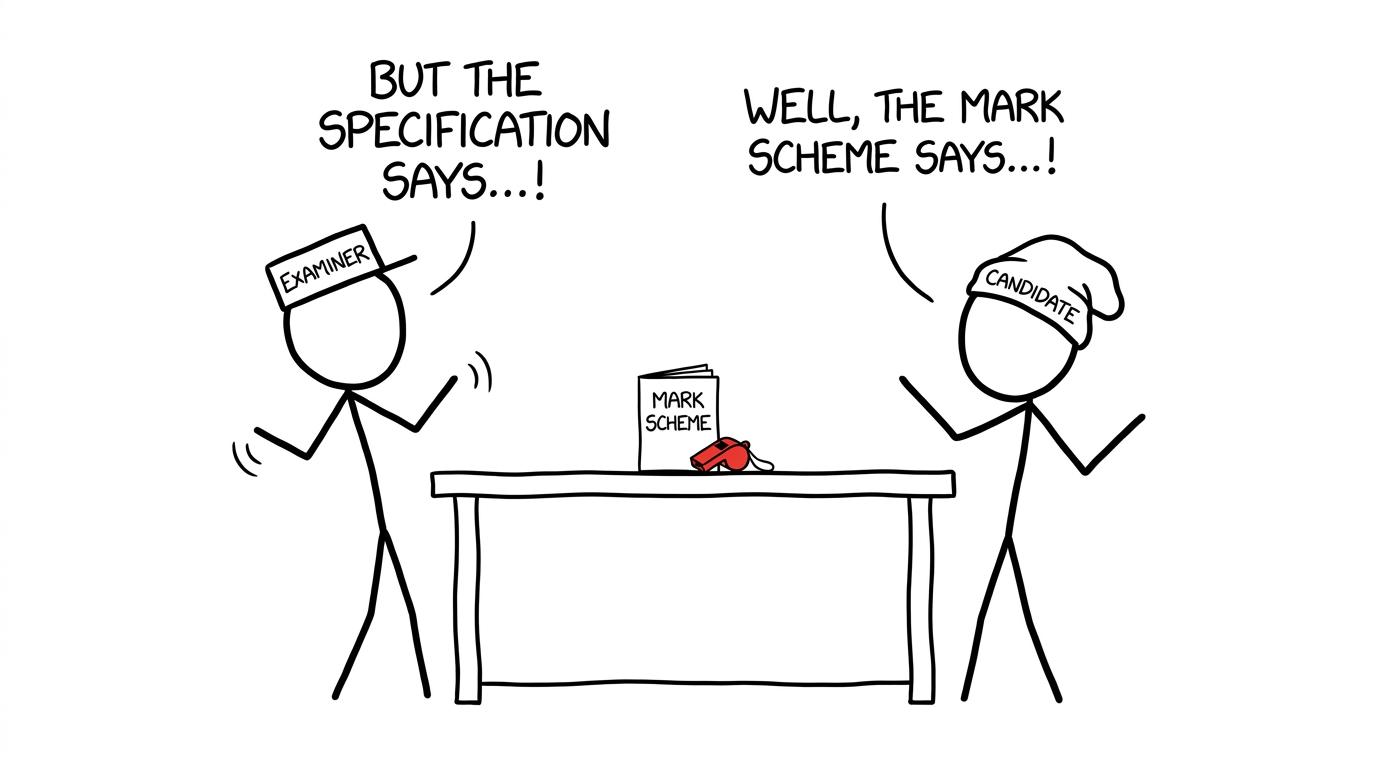 The candidate and examiner versions of one student negotiate with a tiny mark-scheme referee
Build questions, but keep an external standard
Making your own GCSE Arabic practice questions is worthwhile because it turns passive notes into decisions. You decide what matters, what a question is testing, what a successful response needs and where a learner might go wrong. That thought process can teach you almost as much as answering the finished task.
But keep official specifications, sample materials, past papers and teacher feedback as your standard. Your questions are the workshop; official assessment is the measuring tool.
Use the same disciplined habit across your GCSE revision. For maths, begin with MathsGenie's free revision lessons and practice questions, then move into mini tests, past papers and predicted papers. Mark carefully with the available mark schemes and video solutions, repair one weakness at a time, and return to a fresh question to prove that the knowledge now holds.