Long Division Exam Questions: GCSE Guide
Long division exam questions explained with three GCSE worked examples, method-mark guidance, common mistakes and exam-style practice questions.

Long division can feel unforgiving. One misplaced digit appears to spoil everything that follows. Yet long division exam questions are often more generous than they look because a correct written method may earn credit even when the final answer is wrong.
The reliable approach is simple: divide, multiply, subtract and bring down. Repeat this cycle until every digit has been used, keeping each quotient digit directly above the part of the dividend it belongs to. If the division does not finish exactly, give a remainder, decimal or rounded answer according to the question.
This guide follows a hypothetical student, Maya, through three GCSE exam-style questions of rising difficulty. It shows the full method and explains where method marks may come from. Exact mark allocations vary between exam boards and individual mark schemes, but clear working gives an examiner something to reward.
The long division checklist
Before answering a long division GCSE exam question, use this checklist:
- Write the dividend inside the division bracket and the divisor outside.
- Estimate the answer so that you know its approximate size.
- Ask how many whole times the divisor fits into the first usable part of the dividend.
- Write that quotient digit in the correct column.
- Multiply, subtract and bring down the next digit.
- Repeat until no unused digits remain.
- State any remainder clearly or continue into decimals when required.
- Check by multiplying your answer by the divisor.
You can revisit the complete method in the Multiplication and Division lesson, which combines explanations, videos and practice resources.
Question one: an exact whole-number answer
Maya begins with a straightforward question.
Work out 936÷12936 \div 12936÷12. Show your working.
She first estimates. Since 12×80=96012 \times 80 = 96012×80=960, the answer should be slightly below 808080. This quick thought matters because it would expose an answer such as 780780780 immediately.
Step-by-step solution
Start with the first two digits because 121212 does not divide into 999 as a whole number.
121212 fits into 939393 seven times because
12×7=84. 12 \times 7 = 84. 12×7=84.Write 777 in the tens column. Subtract:
93−84=9. 93-84=9. 93−84=9.Bring down the final 666 to make 969696. Then:
96÷12=8. 96 \div 12=8. 96÷12=8.Therefore,
936÷12=78. 936 \div 12=78. 936÷12=78.Maya checks by reversing the operation:
78×12=936. 78 \times 12=936. 78×12=936.Where the marks may come from
On a typical two-mark question, a valid long-division process could earn a method mark, with the correct answer earning the accuracy mark. For example, showing 12×7=8412 \times 7=8412×7=84 and then working with the remaining 969696 demonstrates the required process.
Do not treat this as a fixed allocation for every paper. Always use the published mark scheme when reviewing long division past paper questions and topic booklets.
Question two: division with a remainder
The next question does not divide exactly.
Work out 5743÷235743 \div 235743÷23. Give your answer as a whole number with a remainder.
Maya estimates first. Since 232323 is close to 252525 and 5750÷25=2305750 \div 25=2305750÷25=230, she expects an answer somewhere around the low to mid 200200200s.
Step-by-step solution
232323 fits into 575757 twice:
2×23=46. 2 \times 23=46. 2×23=46.Subtract:
57−46=11. 57-46=11. 57−46=11.Bring down the next digit, 444, to make 114114114. Now 232323 fits into 114114114 four times:
4×23=92. 4 \times 23=92. 4×23=92.Subtract:
114−92=22. 114-92=22. 114−92=22.Bring down the final 333 to make 223223223. Then 232323 fits into 223223223 nine times:
9×23=207. 9 \times 23=207. 9×23=207.The amount left is
223−207=16. 223-207=16. 223−207=16.So the answer is
5743÷23=249 remainder 16. 5743 \div 23=249\text{ remainder }16. 5743÷23=249 remainder 16.The remainder is sensible because 16<2316<2316<23. Maya checks the complete answer using
23×249+16=5727+16=5743. 23 \times 249+16=5727+16=5743. 23×249+16=5727+16=5743.Where the marks may come from
A multi-mark question may reward evidence of successive correct stages. Maya has shown the partial quotients 222, 444 and 999, along with the subtraction at each stage. If she made a late arithmetic slip after establishing a valid process, some method credit might still be available, depending on the mark scheme.
The crucial habit is to leave the working visible. An unsupported incorrect answer usually gives an examiner much less to reward.
You now have the full cycle in hand; use the Maths Genie GCSE lessons and GCSE Question Bank when you want to repeat it across fresh exam-style questions.
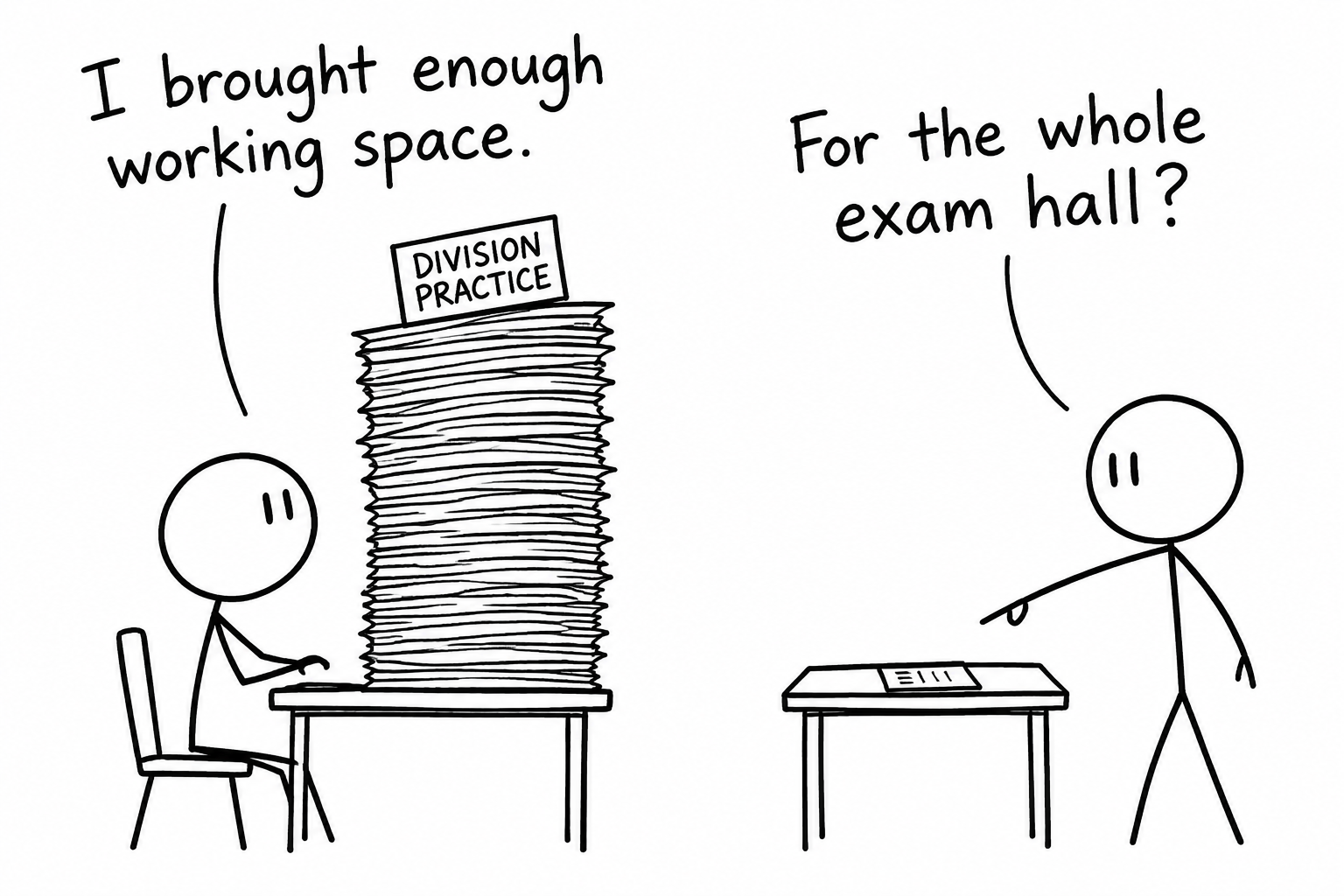 A GCSE student arrives with far more division working paper than the entire exam hall needs
Question three: long division with decimals
Maya's third question adds a decimal and a context.
A ribbon measuring 52.9252.9252.92 metres is cut into 141414 equal lengths. Work out the length of each piece.
The calculation is
52.92÷14. 52.92 \div 14. 52.92÷14.Maya estimates before starting. Since 56÷14=456 \div 14=456÷14=4, each piece should be slightly shorter than 444 metres.
Step-by-step solution
141414 fits into 525252 three times:
3×14=42. 3 \times 14=42. 3×14=42.Subtract:
52−42=10. 52-42=10. 52−42=10.When Maya reaches the decimal point in the dividend, she places the decimal point directly above it in the quotient. She then brings down the 999, making 109109109 tenths.
141414 fits into 109109109 seven times:
7×14=98. 7 \times 14=98. 7×14=98.Subtract:
109−98=11. 109-98=11. 109−98=11.Bring down the final 222 to make 112112112. Then:
112÷14=8. 112 \div 14=8. 112÷14=8.Therefore,
52.92÷14=3.78. 52.92 \div 14=3.78. 52.92÷14=3.78.Each ribbon piece is 3.783.783.78 metres long.
Maya checks:
3.78×14=52.92. 3.78 \times 14=52.92. 3.78×14=52.92.Where the marks may come from
The written division may provide the method evidence, while 3.783.783.78 earns accuracy credit. Because this is a contextual question, including the unit completes the communication of the answer. The exact decision about marks always belongs to that paper's mark scheme.
Decimal division becomes easier when it is practised alongside related number skills. The Multiplication and Division revision guide and Fractions, Decimals and Percentages revision can help you connect those methods.
Common mistakes in long division exam questions
Writing quotient digits in the wrong columns
Place each quotient digit above the final digit of the number being divided at that stage. Poor alignment can turn 787878 into 708708708 or 780780780.
Forgetting to bring down a digit
After subtracting, bring down exactly one unused digit. Marking each digit lightly as you use it can stop you from skipping one.
Choosing a multiple that is too large
The product must not exceed the current number. If you are dividing 114114114 by 232323, use 444 because 23×4=9223 \times 4=9223×4=92, not 555 because 23×5=11523 \times 5=11523×5=115.
Accepting an impossible remainder
A remainder must be smaller than the divisor. If division by 232323 produces a remainder of 313131, another group of 232323 can still be removed.
Losing the decimal point
When dividing a decimal by a whole number, carry the decimal point vertically into the answer. Then continue the same divide, multiply, subtract and bring-down cycle.
Hiding all the working
A calculator-style answer without a method can be risky when the question says to show working. Neat subtraction lines and intermediate products make the process easy to follow and may preserve method marks.
Exam-style practice
Try these without looking back at the examples:
- Work out 1728÷241728 \div 241728÷24.
- Work out 6385÷276385 \div 276385÷27, giving your answer as a whole number with a remainder.
- A total mass of 67.3267.3267.32 kilograms is shared equally between 181818 containers. Find the mass in each container.
The answers are 727272, 236236236 remainder 131313, and 3.743.743.74 kilograms. If an answer is wrong, do not merely cross it out. Find the first stage where your quotient, multiplication or subtraction changed direction. That first error is the skill to practise.
For more structured practice, use the Multiplication and Division exam booklet, then compare your working with its answers rather than checking only the final number.
Turn the method into marks
Maya's progress came from making every stage visible: estimate, divide, multiply, subtract, bring down and check. Knowing that routine is the first step; following it accurately under exam pressure takes deliberate practice.
Your turn. Build confidence with the Maths Genie Multiplication and Division lessons, then answer fresh GCSE Question Bank problems using a full written method.