We can use long multiplication to multiply big numbers together.
Example 1:
728 × 6
Step 1
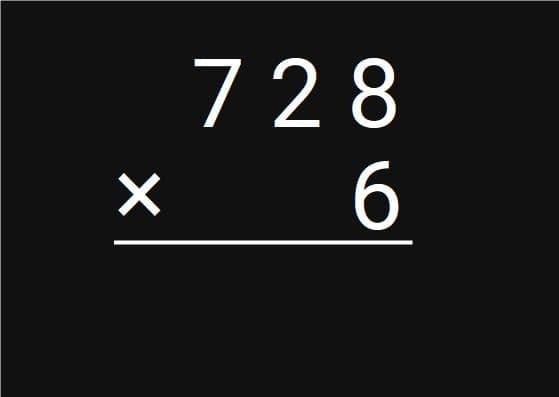
Rewrite the question in columns (one number on top of the other) lining up the ones in 728 with the ones in 6.
Step 2
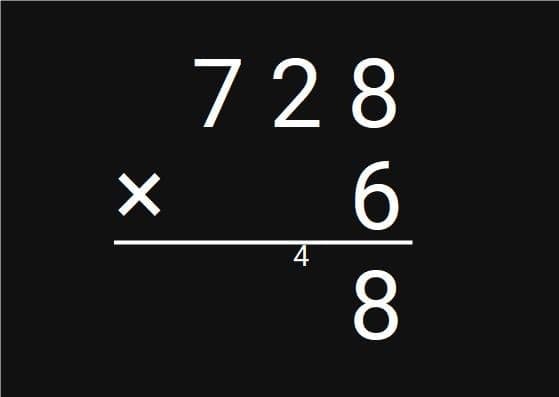
We are going to multiply each of the digits in 728 by 6, one at a time. We work from right to left (from the smallest to the largest column). We start with the 8.
6 × 8 = 48
We cannot put 48 in the ones column. We put the 8 in the ones column and we will add 4 to the next column (the tens).
Step 3
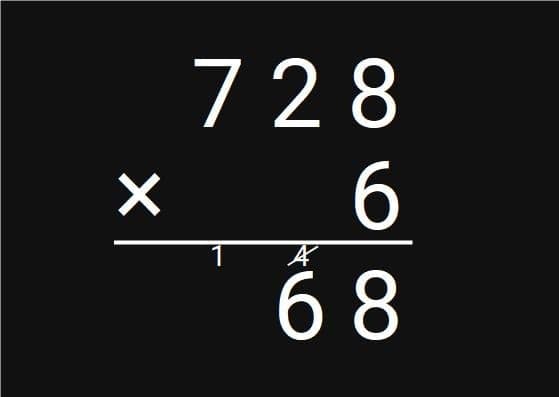
The next column is the tens. We have 6 × 2.
6 × 2 = 12
The answer goes in the next column, the tens column (because the actual calculation is 6 × 20). We also need to add on the 4 we have carried over.
12 + 4 = 16
We put 6 in the tens and carry one over to the hundreds.
Step 4
The next column is the hundreds. We have 6 × 7.
6 × 7 = 42
The answer goes in next column, the hundreds column.
We also need to add on the 1 we have carried over. 42 + 1 = 43
We put 3 in the hundreds and carry 4 over to the thousands.
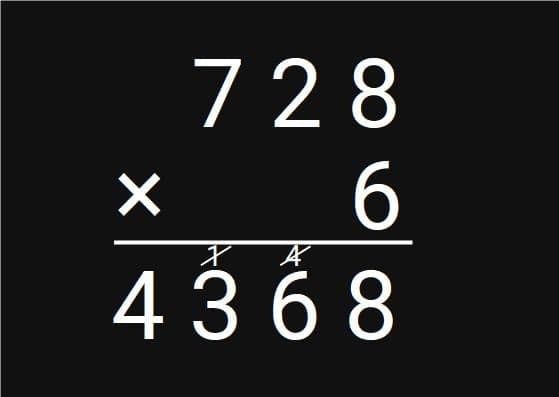
728 × 6 = 4368
Example 2:
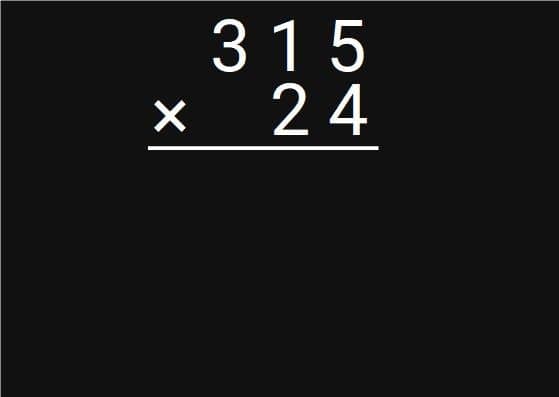
315 × 24
Step 1
Rewrite the question in columns (one number on top of the other).
Step 2
We are going to multiply each of the digits in 315 by 4, and then multiply each of the digits in 315 by 20.
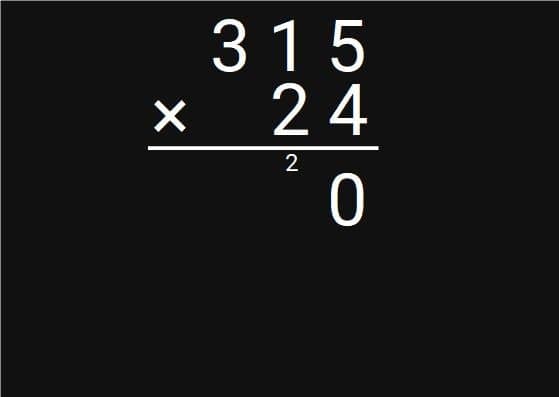
We start with 4 × 5.
4 × 5 = 20
We put zero in the ones and carry 2 over to the tens.
Step 3
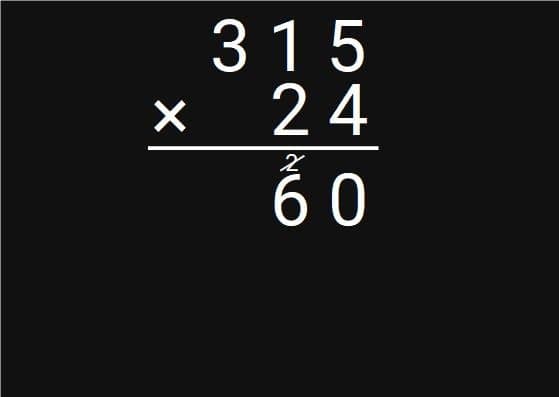
The next calculation is 4 × 1.
4 × 1 = 4
We need to add on the 2 we carried over. 4 + 2 = 6
Step 4
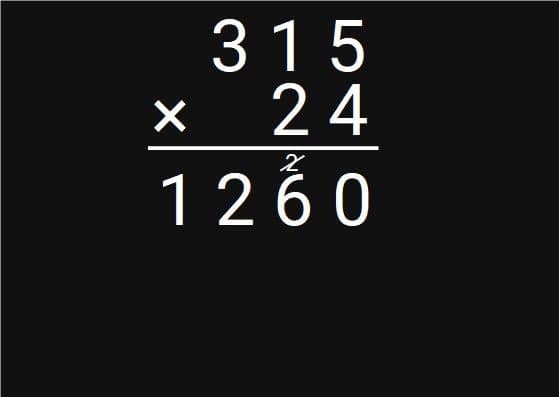
The next calculation is 4 × 3.
4 × 3 = 12
The 2 goes in the hundreds column and we carry 1 over to the thousands.
We have now multiplied 315 by 4. 315 × 4 = 1260
Step 5
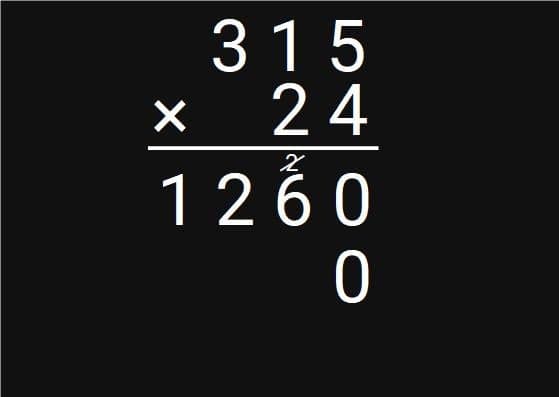
We are now going to multiply 315 by 20. We will multiply each of the digits in 315 by 2, one at a time. As we are multiplying by 20 (not 2), all of the answers will be ten times bigger. We add a zero in the ones column and our first answer will go in the tens column.
Step 6
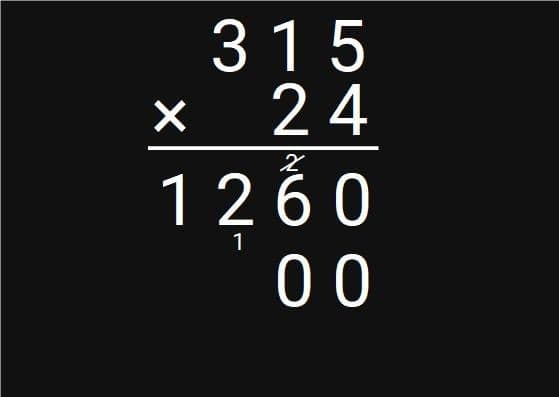
The next calculation is 2 × 5.
2 × 5 = 10
The 0 goes in the tens column and we carry 1 over to the hundreds.
Step 7
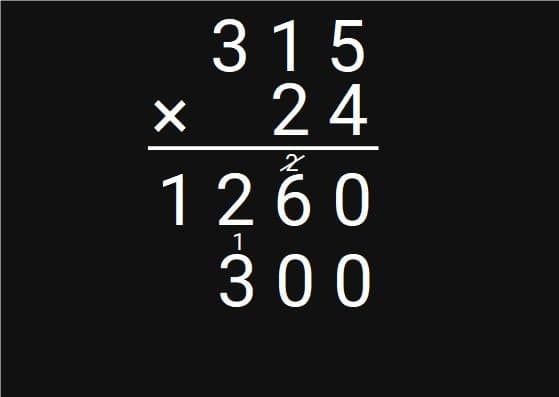
The next calculation is 2 × 1.
2 × 1 = 2
We have to add on the 1 we carried over. 2 + 1 = 3
Step 8
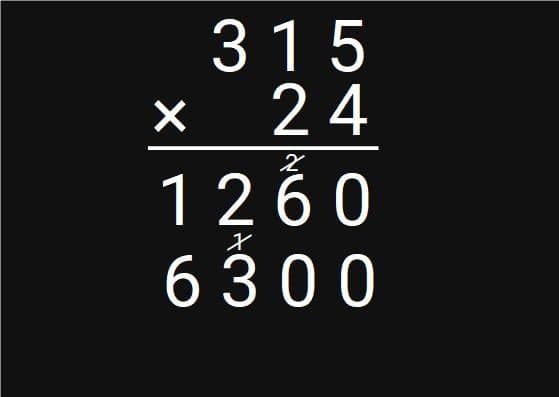
The next calculation is 2 × 3.
2 × 3 = 6
We have now multiplied 315 by 20.
315 × 20 = 6300
Step 9
We can now add together 315 × 4 and 315 × 20 to give us 315 × 24
Using column addition we add 1260 and 6300.
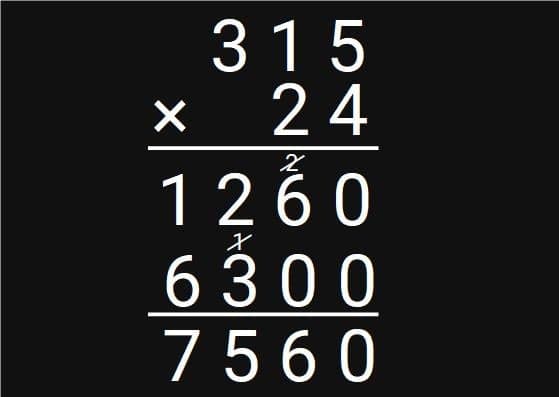
315 × 24 = 7560
Example 3:
4.96 × 0.7
Step 1
We are going to take the decimals out of the question and put them back in at the end.
Note: there are three digits after the decimal points in the question (we need to multiply the question by 10 three times to take out the decimals, this is what we will undo at the end).
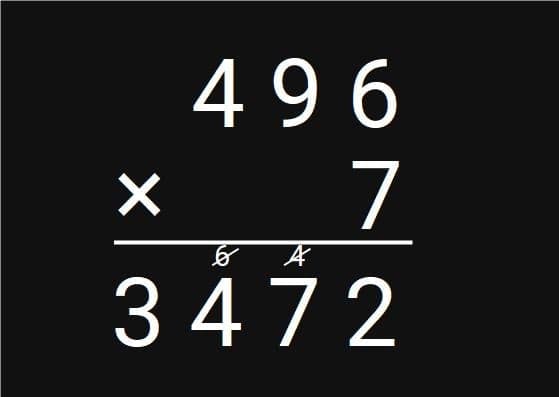
We will work out 496 × 7.
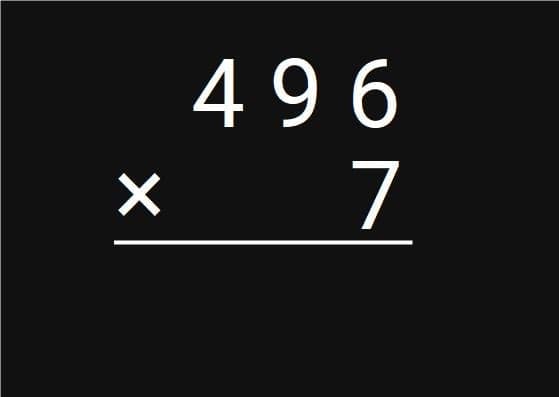
Step 2
We will multiply all of the digits in 496 by 7, from right to left.
We start with 7 × 6
7 × 6 = 42
We put the 2 in the ones column and carry 4 over to the tens.
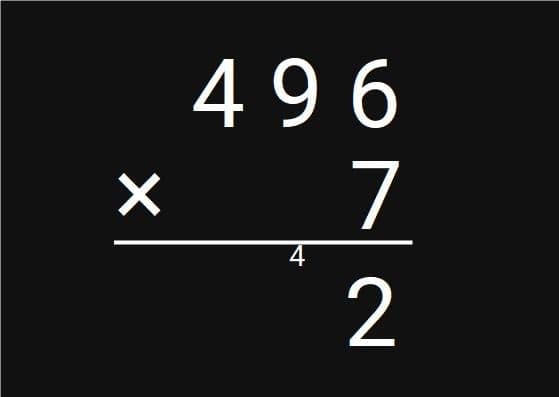
Step 3
The next calculation is 7 × 9
7 × 9 = 63
We have to add on the 4 we carried over. 63 + 4 = 67
The 7 goes in the tens column and we carry 6 over to the hundreds.
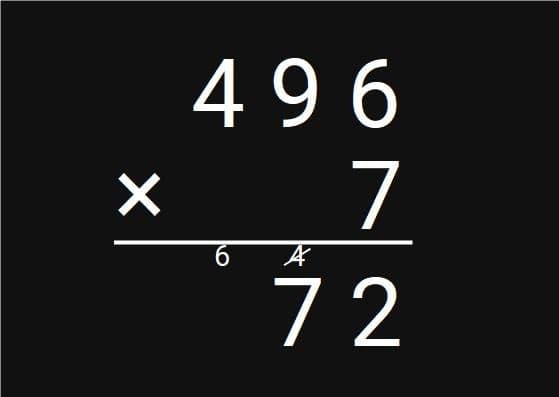
Step 4
Finally we have 7 × 4
7 × 4 = 28
We have to add on the 6 we carried over. 28 + 6 = 34
496 × 7 = 3472
Step 5
Now we just need to put the decimals back in.
As we multiplied the querstion by 10 three times we have to divide the answer by 10 three times.
There were three digits after the decimal points in the question so there will be three digits after the decimal point in the answer.
4.96 × 0.7 = 3.472
Try these:
We can use short division to divide large numbers.
Example 1:
392 ÷ 8
Step 1
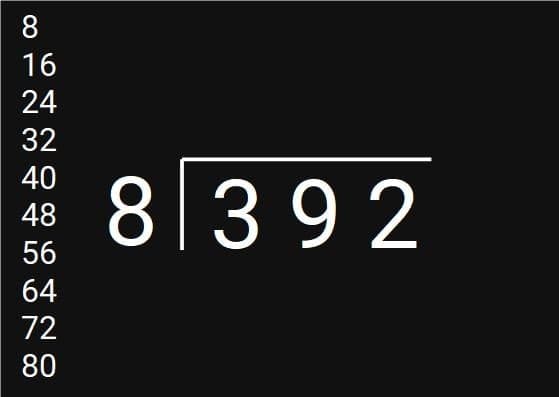
Rewrite the question with 392 inside the "bus stop" and 8 on the left of the "bus stop".
Writing out the 8 times table will help us with the division.
Step 2
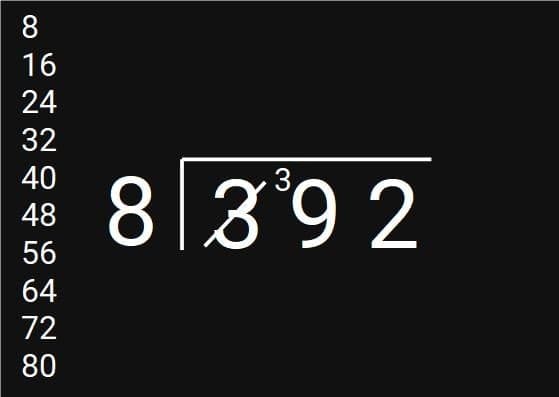
We are going to divide each of the digits in 392 by 8, one at a time. We start on the left with the biggest digit, the hundreds in this example.
How many times does 8 go into 3? None, so we can carry the 3 over into the tens where it is worth 30.
Step 3
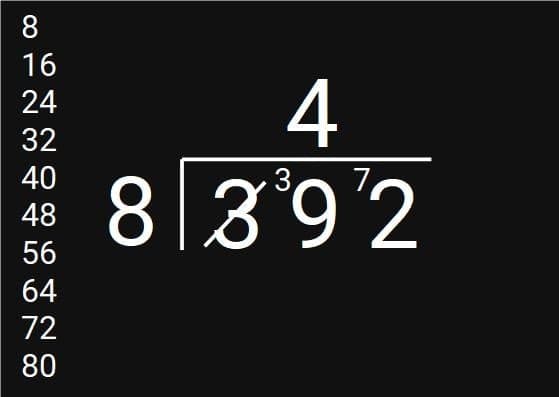
We now move on to the tens. How many times does 8 go into 39? We can see that 8 × 4 = 32
We can put 4 on our answer line (above the "bus stop"). 39 - 32 = 7
So we have 7 left to carry over to the ones.
Step 4
We now move on to the ones. How many times does 8 go into 72? We can see that 8 × 9 = 72
We can put 9 on our answer line.
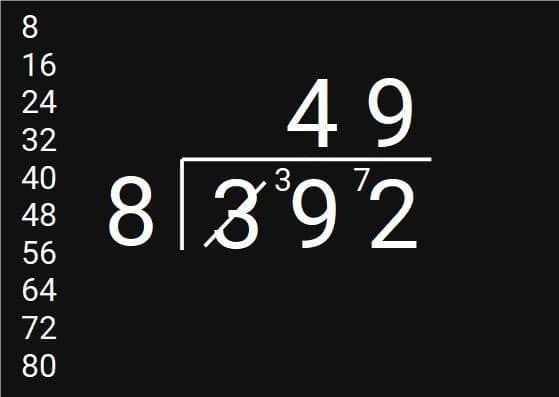
392 ÷ 8 = 49
Example 2:
756 ÷ 12
Step 1
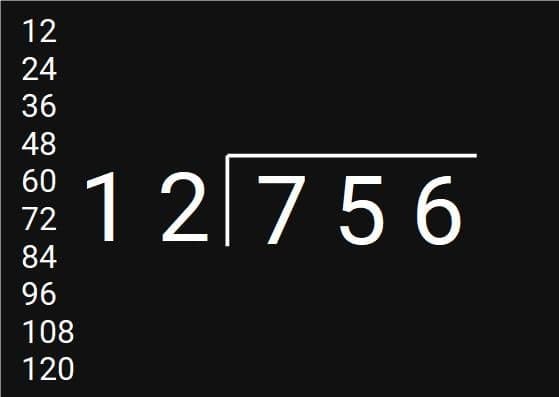
Rewrite the question with 756 inside the "bus stop" and 12 on the left of the "bus stop".
Writing out the 12 times table will help us with the division.
Step 2
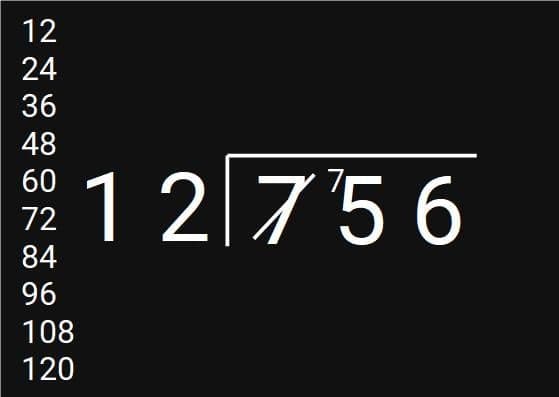
We start with the hundreds column. 12 does not go into 7, so we carry the 7 over to the tens column (where it is worth 70).
Step 3
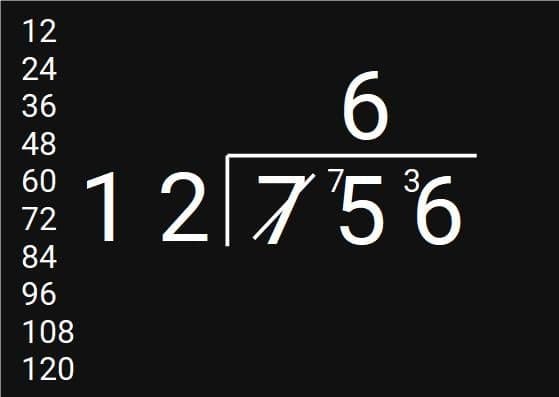
We now move onto the tens. How many times does 12 go into 75? We can see that 12 × 6 = 72.
We put 6 on the answer line and we have 3 left (75 - 72 = 3) to carry over to the ones.
Step 4
We now move onto the ones. How many times does 12 go into 36? We can see that 12 × 3 = 36.
We put 3 on the answer line.
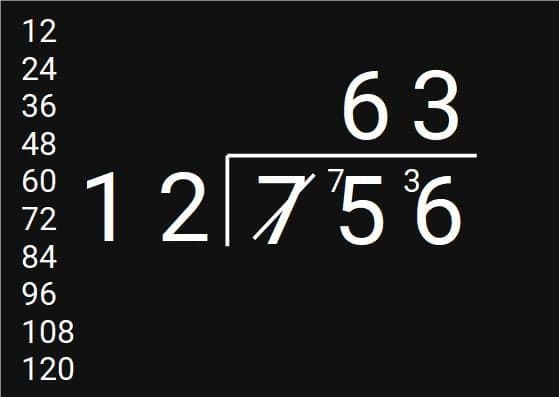
756 ÷ 12 = 63
Example 3:
258 ÷ 0.4
Step 1
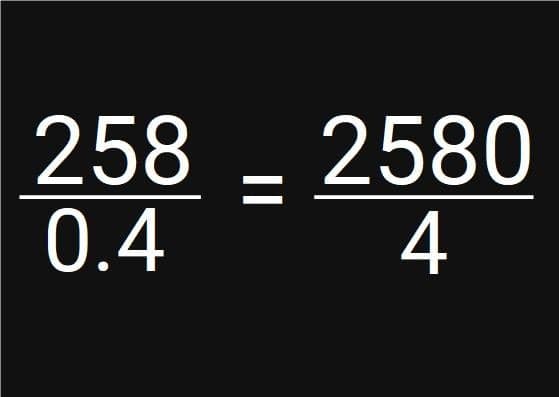
We can get rid of the decimal by multiplying both numbers by 10. This is the same as using equivalent fractions.
258 ÷ 0.4 will give the same answer as 2580 ÷ 4
Step 2
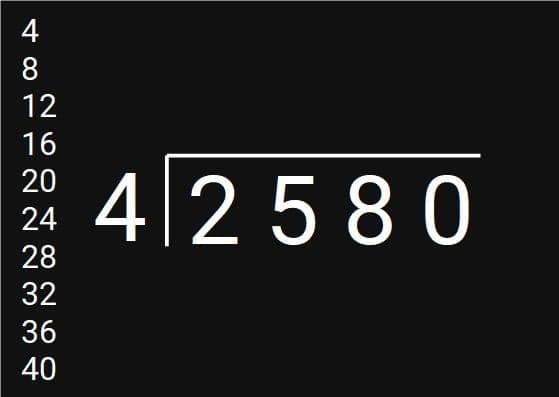
We can rewrite our 2580 ÷ 4 with a "bus stop".
Writing out the 4 times table will help with the calculations.
Step 3
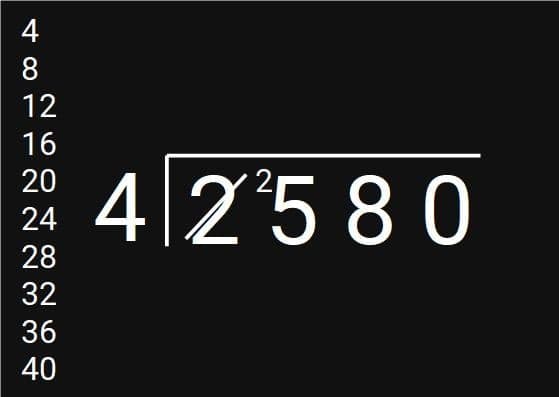
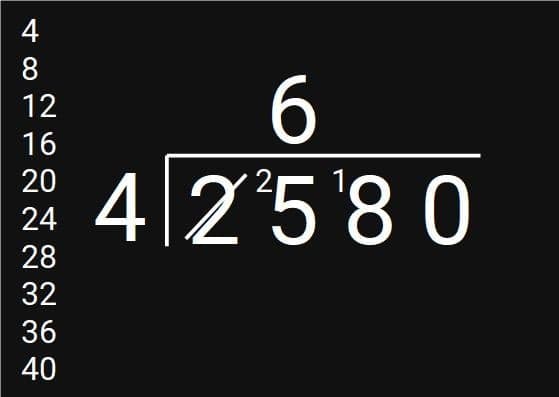
We start with the thousands. 4 does not go into 2. We carry the 2 over into the hundreds.
Step 4
Next is the hundreds. How many times does 4 go into 25? We can see that 4 × 6 = 24. 6 goes on the answer line and we have one (25 - 24 = 1) left to carry over to the tens.
Step 5
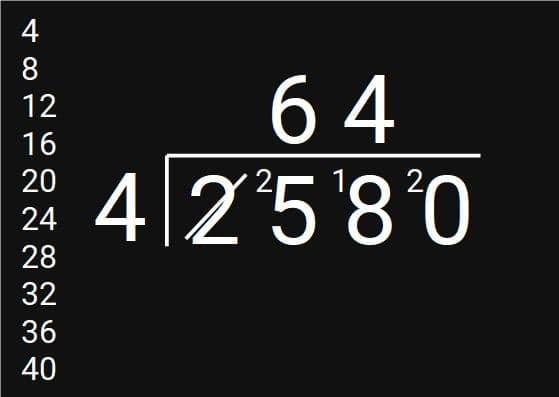
Next is the tens. How many times does 4 go into 18? We can see that 4 × 4 = 16. 4 goes onto the answer line and we have two (18 - 16 = 2) left to carry over to the ones.
Step 6
Next is the ones. How many times does 4 go into 20? 4 × 5 = 20. 5 goes onto the answer line.
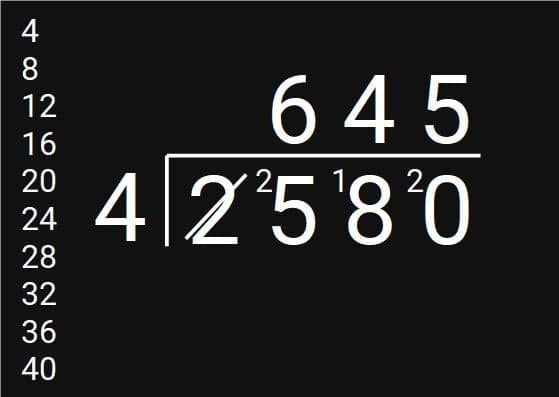
258 ÷ 0.4 = 645
Try these:
