Linear Sequences GCSE Maths: A Clear Guide
Linear sequences GCSE maths explained with a simple method, step-by-step worked examples, common mistakes and exam-style practice questions for revision.

A student can look at 5,8,11,145, 8, 11, 145,8,11,14 and immediately see that the numbers go up by 333. Then the exam asks for the nth term, and that simple pattern suddenly feels unfamiliar.
For linear sequences GCSE maths questions, the essential idea is this: find the common difference, place it in front of nnn, and then adjust the expression so that it produces the first term. Once those two jobs are separated, the topic becomes far more manageable.
Imagine a student who keeps writing 3n3n3n for the sequence above. The difference is correct, yet the answer is not. The turning point comes when they stop treating the common difference as the whole rule. It is only the beginning.
The linear sequences checklist
Use this process whenever you need to find an nth term:
- Find the common difference between consecutive terms.
- Put that difference in front of nnn.
- Substitute n=1n=1n=1 into your expression.
- Compare the result with the actual first term.
- Add or subtract the required adjustment.
- Check the rule using another term.
You can explore the complete topic through the Maths Genie Sequences lesson, which brings together explanations and exam-style practice.
What is a linear sequence?
A linear sequence changes by the same amount each time. This fixed amount is called the common difference.
For example:
7,11,15,19,…7, 11, 15, 19, \ldots7,11,15,19,…Each term increases by 444, so the common difference is 444.
A decreasing sequence can also be linear:
20,15,10,5,…20, 15, 10, 5, \ldots20,15,10,5,…Here, the common difference is −5-5−5. A negative common difference is still constant, so the sequence is linear.
The nth term of any linear sequence has the form:
an+ban+ban+bThe coefficient aaa is the common difference. The value bbb adjusts the sequence so that the expression gives the correct terms.
| Part of the rule | What it tells you |
|---|---|
| aaa in an+ban+ban+b | The common difference |
| bbb in an+ban+ban+b | The adjustment from the multiples of aaa |
| nnn | The position of the term |
How to find the nth term
Return to the sequence:
5,8,11,14,…5, 8, 11, 14, \ldots5,8,11,14,…The common difference is 333, so begin with:
3n3n3nThe terms generated by 3n3n3n are:
3,6,9,12,…3, 6, 9, 12, \ldots3,6,9,12,…Compare these with the original sequence. Every original term is 222 greater, so add 222:
3n+23n+23n+2That is the nth term. Check it using n=1n=1n=1:
3(1)+2=53(1)+2=53(1)+2=5It also works for n=4n=4n=4:
3(4)+2=143(4)+2=143(4)+2=14This is what finally clicks for our hypothetical student: the common difference gives the nnn term, while the first term reveals the adjustment.
Open the Sequences lesson and Question Bank when you are ready to apply this method without setting up your own practice.
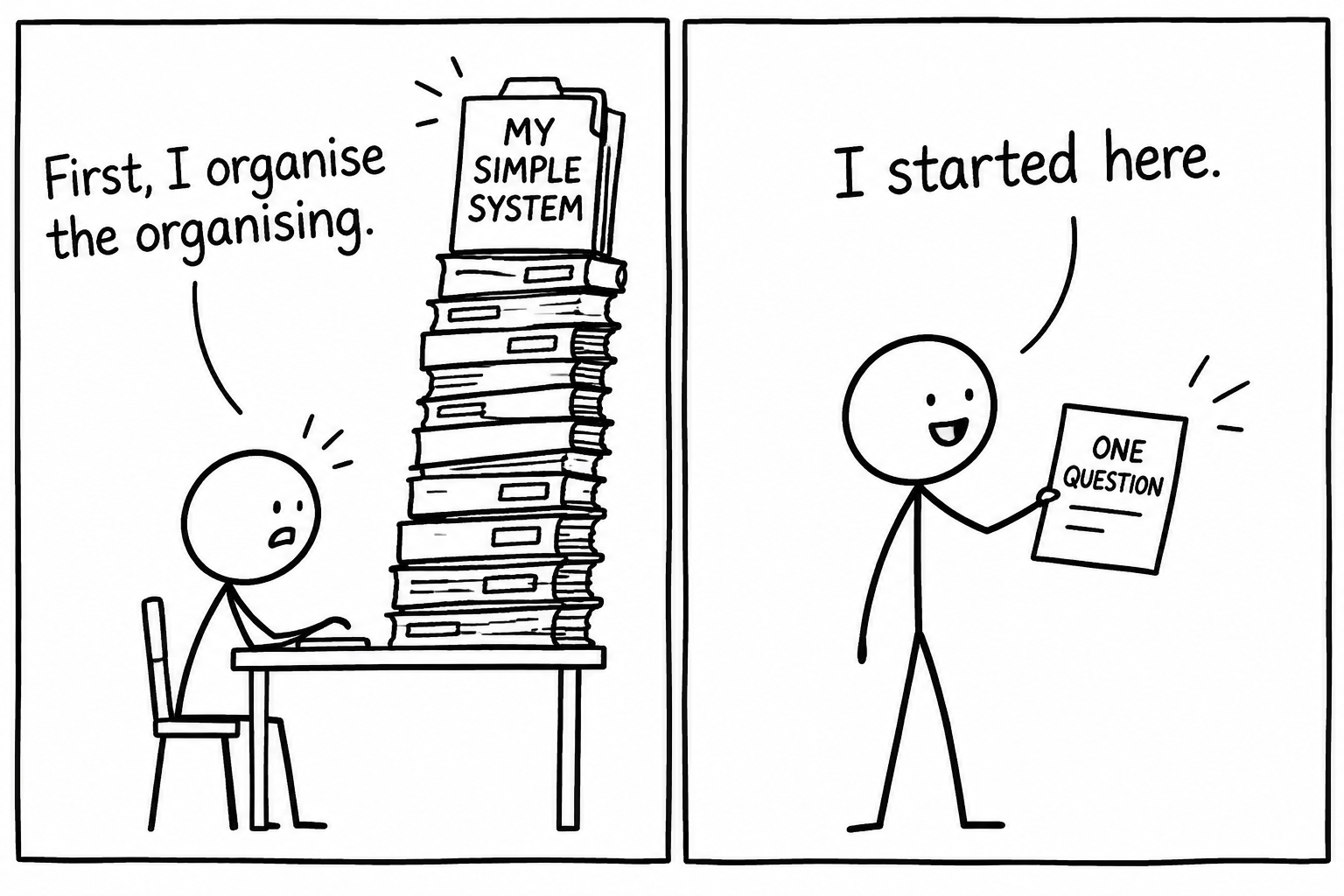 A student over-organises revision while another begins with one question
Linear sequences worked examples
Finding an nth term for an increasing sequence
Find the nth term of:
6,10,14,18,…6, 10, 14, 18, \ldots6,10,14,18,…The common difference is 444, so start with:
4n4n4nWhen n=1n=1n=1, this gives 444, but the actual first term is 666. Add 222:
4n+2\boxed{4n+2}4n+2Check the third term:
4(3)+2=144(3)+2=144(3)+2=14The check agrees with the sequence. More examples are available in the Sequences revision guide.
Finding an nth term for a decreasing sequence
Find the nth term of:
17,13,9,5,…17, 13, 9, 5, \ldots17,13,9,5,…The common difference is −4-4−4, so begin with:
−4n-4n−4nAt n=1n=1n=1, this gives −4-4−4. To reach the actual first term, 171717, add 212121:
−4n+21\boxed{-4n+21}−4n+21Check the second term:
−4(2)+21=13-4(2)+21=13−4(2)+21=13A frequent error is to use 4n4n4n because the terms change by 444. Direction matters. Since the sequence decreases, the coefficient must be negative.
Finding a particular term
The nth term of a sequence is:
3n+53n+53n+5Find the twentieth term. Substitute n=20n=20n=20:
3(20)+5=653(20)+5=653(20)+5=65The twentieth term is therefore:
65\boxed{65}65Notice that nnn represents a position, not the previous term. You are not continuing the sequence one step at a time. You are jumping directly to the required position.
Deciding whether a number is in a sequence
A sequence has nth term:
6n−16n-16n−1Is 838383 a term in the sequence? Set the nth term equal to 838383 and solve:
6n−1=836n-1=836n−1=83 6n=846n=846n=84 n=14n=14n=14Because 141414 is a positive whole number, 838383 is the fourteenth term.
If solving produced a decimal, fraction, zero or negative value for nnn, the number would not appear in the sequence. Term positions must be positive whole numbers.
Exam-style linear sequences questions
Try these without looking at the answers first. Write down each common difference and show your substitution, because method marks can matter even if a later calculation goes wrong.
Question one
Find the next two terms and the nth term of:
4,9,14,19,…4, 9, 14, 19, \ldots4,9,14,19,…Question two
Find the nth term of:
30,24,18,12,…30, 24, 18, 12, \ldots30,24,18,12,…Then calculate the fifteenth term.
Question three
A sequence has nth term 7n+27n+27n+2. Determine whether 100100100 is a term in the sequence.
Answers
For question one, the common difference is 555. The next terms are 242424 and 292929, and the nth term is:
5n−1\boxed{5n-1}5n−1For question two, the common difference is −6-6−6, so the nth term is:
−6n+36\boxed{-6n+36}−6n+36The fifteenth term is:
−6(15)+36=−54-6(15)+36=-54−6(15)+36=−54For question three:
7n+2=1007n+2=1007n+2=100 7n=987n=987n=98 n=14n=14n=14Therefore, 100100100 is the fourteenth term. For a longer set, use the Sequences exam booklet. Students following AQA can use the matching AQA Sequences revision page.
Common mistakes with linear sequences
Using the first term as the coefficient
In 5,8,11,145, 8, 11, 145,8,11,14, the coefficient is not 555. It is 333 because the common difference is 333.
Stopping after finding the common difference
Writing 3n3n3n is only the first step. Compare its first term with the actual first term to find the adjustment.
Losing a negative sign
For a decreasing sequence, the common difference is negative. The sequence 12,9,6,312, 9, 6, 312,9,6,3 begins with −3n-3n−3n, not 3n3n3n.
Substituting the term instead of its position
To find the tenth term, substitute n=10n=10n=10. The letter nnn represents the position in the sequence.
Assuming every sequence is linear
A sequence is linear only when its first differences are constant. If the differences themselves change, another rule is needed. At higher grades, this may lead into the nth term of a quadratic sequence.
Make the method stick
Knowing the method and using it reliably under exam pressure are different things. Our student improves when each answer is checked against two terms rather than accepted after one line, but that habit only becomes automatic through focused questions and worked feedback.
Start the Maths Genie Sequences Lessons and Question Bank and practise finding, checking and using nth-term rules.