The Nth Term of a Quadratic Sequence
x

Revision notes for Edexcel GCSE Maths The Nth Term of a Quadratic Sequence. Open the guide for explanations and worked examples. Written against the Edexcel GCSE Maths (1MA1) specification, so the content matches what's examinable rather than general Maths background.

The Nth Term of a Quadratic Sequence

What you'll learn

  • How to recognise a quadratic sequence using differences.
  • How to find missing terms by continuing the pattern.
  • How to work out the nth term in the form an2+bn+can^2 + bn + can2+bn+c.
  • How to use the nth term formula to find a term number.

1. Sequence basics

A sequence is a list of numbers following a rule. Each number is called a term.

The term number tells you the position of a term: first, second, third, and so on. We usually call the term number nnn.

Definition

Nth term

The nth term is a formula that gives the value of a term when you substitute in its position number nnn.

For example, if the nth term is 3n2−23n^2 - 23n2−2, the fourth term is found by using n=4n = 4n=4.

Substitution into an nth term formula means replacing the position number n with the term number you want.

Example

Using an nth term formula

The nth term of a sequence is 2n2+3n−12n^2 + 3n - 12n2+3n−1. Find the 7th term.

  1. The 7th term means n=7n = 7n=7.

  2. Substitute n=7n = 7n=7 into the formula:

    2(7)2+3(7)−12(7)^2 + 3(7) - 12(7)2+3(7)−1
  3. Work it out carefully:

    2×49+21−1=1182 \times 49 + 21 - 1 = 1182×49+21−1=118
  4. The 7th term is 118.

Common Mistake

Forgetting to square first

In 2n22n^22n2, square nnn before multiplying by 2. For example, 2(7)2=982(7)^2 = 982(7)2=98, not 196.

2. Recognising a quadratic sequence

A linear sequence has constant first differences.
A quadratic sequence has constant second differences.

Definition

First and second differences

The first differences are the gaps between consecutive terms. The second differences are the gaps between the first differences.

For example:

  • Terms: 6, 10, 16, 24
  • First differences: 4, 6, 8
  • Second differences: 2, 2

Because the second differences are constant, this is a quadratic sequence.

A difference table shows first differences between terms and second differences between those gaps.

Key Idea

Spotting quadratic sequences

If the second differences are the same each time, the nth term contains an n2n^2n2 term.

Example

Finding the next two terms

A quadratic sequence begins 3, 8, 15, 24. Find the next two terms.

Continue the first differences by adding the constant second difference each time, then add the new gaps to the sequence.

  1. Find the first differences:

    8−3=5,15−8=7,24−15=98 - 3 = 5,\quad 15 - 8 = 7,\quad 24 - 15 = 98−3=5,15−8=7,24−15=9
  2. The first differences are 5, 7, 9, so the second difference is 2 each time.

  3. Continue the first differences by adding 2:

    9+2=11,11+2=139 + 2 = 11,\quad 11 + 2 = 139+2=11,11+2=13
  4. Add these to the last term:

    24+11=35,35+13=4824 + 11 = 35,\quad 35 + 13 = 4824+11=35,35+13=48
  5. The next two terms are 35 and 48.

3. The link between second differences and an2an^2an2

A quadratic nth term usually looks like this:

an2+bn+can^2 + bn + can2+bn+c

Here, aaa, bbb, and ccc are numbers.

For GCSE quadratic sequences, the most important fact is:

Key Idea

Second difference rule

For a quadratic sequence with nth term an2+bn+can^2 + bn + can2+bn+c, the constant second difference is 2a2a2a. So aaa is half the second difference.

The coefficient of n² is found by halving the constant second difference.

So:

  • If the second difference is 6, then a=3a = 3a=3.
  • If the second difference is -4, then a=−2a = -2a=−2.
Example

Finding the n2 coefficient

A quadratic sequence has second differences of 10. What is the coefficient of n2n^2n2?

  1. The second difference equals 2a2a2a.

  2. So:

    2a=102a = 102a=10
  3. Divide by 2:

    a=5a = 5a=5
  4. The nth term starts with 5n25n^25n2.

4. Finding the nth term of a quadratic sequence

To find the full nth term, use this method:

  1. Find the second difference.
  2. Halve it to get the coefficient of n2n^2n2.
  3. Write the values of that an2an^2an2 sequence.
  4. Subtract those from the original sequence.
  5. Find the nth term of what is left.
  6. Combine the two parts.
Example

Finding a quadratic nth term

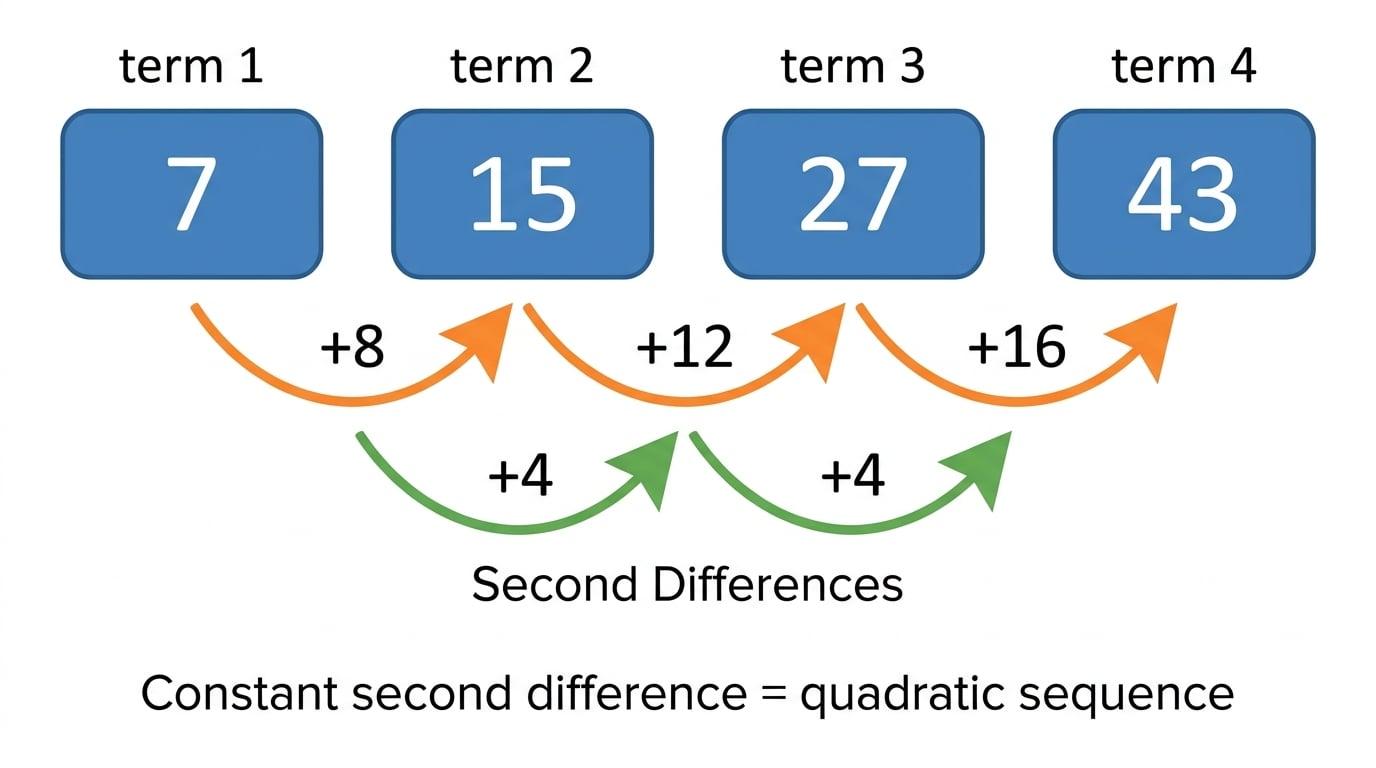
Find the nth term of the sequence 7, 15, 27, 43.

The main nth-term method compares the original sequence with the matching 2n² sequence, then finds the leftover linear sequence.

  1. Find the first differences:

    15−7=8,27−15=12,43−27=1615 - 7 = 8,\quad 27 - 15 = 12,\quad 43 - 27 = 1615−7=8,27−15=12,43−27=16
  2. Find the second differences:

    12−8=4,16−12=412 - 8 = 4,\quad 16 - 12 = 412−8=4,16−12=4
  3. The second difference is 4, so:

    a=42=2a = \frac{4}{2} = 2a=24​=2
  4. The nth term starts with 2n22n^22n2. Write the first four values of 2n22n^22n2:

    2,8,18,322,\quad 8,\quad 18,\quad 322,8,18,32
  5. Subtract these from the original terms:

    7−2=5,15−8=7,27−18=9,43−32=117 - 2 = 5,\quad 15 - 8 = 7,\quad 27 - 18 = 9,\quad 43 - 32 = 117−2=5,15−8=7,27−18=9,43−32=11
  6. The leftover sequence is 5, 7, 9, 11. This is linear, going up by 2, so its nth term is 2n+32n + 32n+3.

  7. Combine the two parts:

    2n2+2n+32n^2 + 2n + 32n2+2n+3
Tip

Quick check

Once you have your formula, test it with n=1n = 1n=1 and n=2n = 2n=2. If it does not give the first two terms, something has gone wrong.

5. When the second difference is negative

Quadratic sequences do not always increase. If the second difference is negative, the coefficient of n2n^2n2 is negative too.

Example

A decreasing quadratic sequence

Find the nth term of 18, 15, 10, 3.

Negative second differences lead to a negative n² coefficient.

  1. Find the first differences:

    15−18=−3,10−15=−5,3−10=−715 - 18 = -3,\quad 10 - 15 = -5,\quad 3 - 10 = -715−18=−3,10−15=−5,3−10=−7
  2. Find the second differences:

    −5−(−3)=−2,−7−(−5)=−2-5 - (-3) = -2,\quad -7 - (-5) = -2−5−(−3)=−2,−7−(−5)=−2
  3. The second difference is -2, so:

    a=−22=−1a = \frac{-2}{2} = -1a=2−2​=−1
  4. The nth term starts with −n2-n^2−n2. The first four values are:

    −1,−4,−9,−16-1,\quad -4,\quad -9,\quad -16−1,−4,−9,−16
  5. Subtract these from the original sequence:

    18−(−1)=19,15−(−4)=19,10−(−9)=19,3−(−16)=1918 - (-1) = 19,\quad 15 - (-4) = 19,\quad 10 - (-9) = 19,\quad 3 - (-16) = 1918−(−1)=19,15−(−4)=19,10−(−9)=19,3−(−16)=19
  6. The leftover sequence is constant, so the nth term is:

    −n2+19-n^2 + 19−n2+19
Common Mistake

Dropping the negative sign

If the second difference is negative, your n2n^2n2 term must be negative. A sequence can still have some increasing terms later or earlier, so trust the second differences.

6. Showing that a formula is correct

Sometimes you are given a sequence and asked to show that a particular formula is its nth term.

For full marks, do more than just test one term. Show the differences and build the formula.

Example

Showing a given nth term

A quadratic sequence begins 8, 13, 20, 29. Show that its nth term is n2+2n+5n^2 + 2n + 5n2+2n+5.

To show a formula is correct, use the second differences and the leftover sequence rather than just checking one term.

  1. Find the first differences:

    13−8=5,20−13=7,29−20=913 - 8 = 5,\quad 20 - 13 = 7,\quad 29 - 20 = 913−8=5,20−13=7,29−20=9
  2. The second differences are:

    7−5=2,9−7=27 - 5 = 2,\quad 9 - 7 = 27−5=2,9−7=2
  3. Since the second difference is 2, the coefficient of n2n^2n2 is 1.

  4. Compare the sequence with n2n^2n2:

    1,4,9,161,\quad 4,\quad 9,\quad 161,4,9,16
  5. Subtract:

    8−1=7,13−4=9,20−9=11,29−16=138 - 1 = 7,\quad 13 - 4 = 9,\quad 20 - 9 = 11,\quad 29 - 16 = 138−1=7,13−4=9,20−9=11,29−16=13
  6. The leftover sequence is 7, 9, 11, 13, which has nth term 2n+52n + 52n+5.

  7. Therefore the full nth term is:

    n2+2n+5n^2 + 2n + 5n2+2n+5

7. Finding which term has a given value

If you know the nth term and a term value, set the formula equal to that value and solve for nnn.

Because the formula is quadratic, you may need to factorise.

Example

Finding the term number

A sequence has nth term n2+2n+5n^2 + 2n + 5n2+2n+5. Which term has value 85?

Solving the quadratic gives possible term numbers, but only positive whole numbers can be used.

  1. Set the formula equal to 85:

    n2+2n+5=85n^2 + 2n + 5 = 85n2+2n+5=85
  2. Rearrange to make one side equal to zero:

    n2+2n−80=0n^2 + 2n - 80 = 0n2+2n−80=0
  3. Factorise:

    (n+10)(n−8)=0(n + 10)(n - 8) = 0(n+10)(n−8)=0
  4. Solve:

    n=−10orn=8n = -10 \quad \text{or} \quad n = 8n=−10orn=8
  5. Term numbers cannot be negative, so the answer is the 8th term.

Common Mistake

Reject impossible term numbers

A term number must be a positive whole number. If solving gives a negative value or a decimal, it is not a valid term number.

Exam technique

In the exam

  1. Always write the first differences and second differences clearly before trying to form the nth term.

  2. Use the rule: second difference equals 2a2a2a, so halve it to get the n2n^2n2 coefficient.

  3. Check your final formula by substituting n=1n = 1n=1 and making sure it gives the first term.

Self review

Check yourself

  • Can you explain why a constant second difference means the sequence is quadratic?

  • Given 4, 11, 22, 37, can you find the coefficient of n2n^2n2?

  • If an nth term equation gives n=6n = 6n=6 and n=−9n = -9n=−9, which value should you use and why?

Recap questions

Test yourself with 5 quick questions on this guide. Answer them all correctly to complete it.

You've reached the end

Test yourself on this topic, or move on to the next guide.

Practice questionsTake a quick quiz on this topicFlashcardsSelf-test with active recall
Quadratic InequalitiesUp next

How was this guide?

The Nth Term of a Quadratic Sequence Revision Guide

  1. GCSE
  2. /Maths
  3. /The Nth Term of a Quadratic Sequence