Learning Styles GCSE Astronomy: Do They Matter?
Learning styles GCSE astronomy: what does the evidence say? Build a practical revision plan with retrieval, spacing, exam questions and focused maths practice.
A star map can look perfectly clear at your desk and completely unfamiliar beneath the night sky. The same thing happens with equations: they make sense in a video, then vanish when the question paper opens. It is tempting to blame a mismatch between revision and your supposed learning style.
But the evidence behind learning styles GCSE astronomy revision is not convincing. Matching every activity to a label such as “visual learner” or “auditory learner” has not been shown reliably to improve attainment. Preferences are real, but they are not fixed instructions for how your brain must learn.
A better approach is to choose the method that fits the content, retrieve knowledge without notes, practise mathematical skills and revisit material over time.
The short answer and revision checklist
If you only remember one idea, make it this: do not revise according to a label; revise according to the task and the evidence of what you can actually do.
Use this checklist:
- Treat visual, spoken and practical activities as tools, not identities.
- Match the representation to the astronomy content.
- Retrieve facts and methods before looking at your notes.
- Answer calculations and data questions rather than merely watching them.
- Mark your work and record the precise reason for each error.
- Revisit difficult material on later days.
- Use timed questions to test whether learning transfers to an exam.
The MathsGenie GCSE maths revision hub is useful for the mathematical part of this process, with revision lessons, practice questions, papers and solutions organised by topic and exam board.
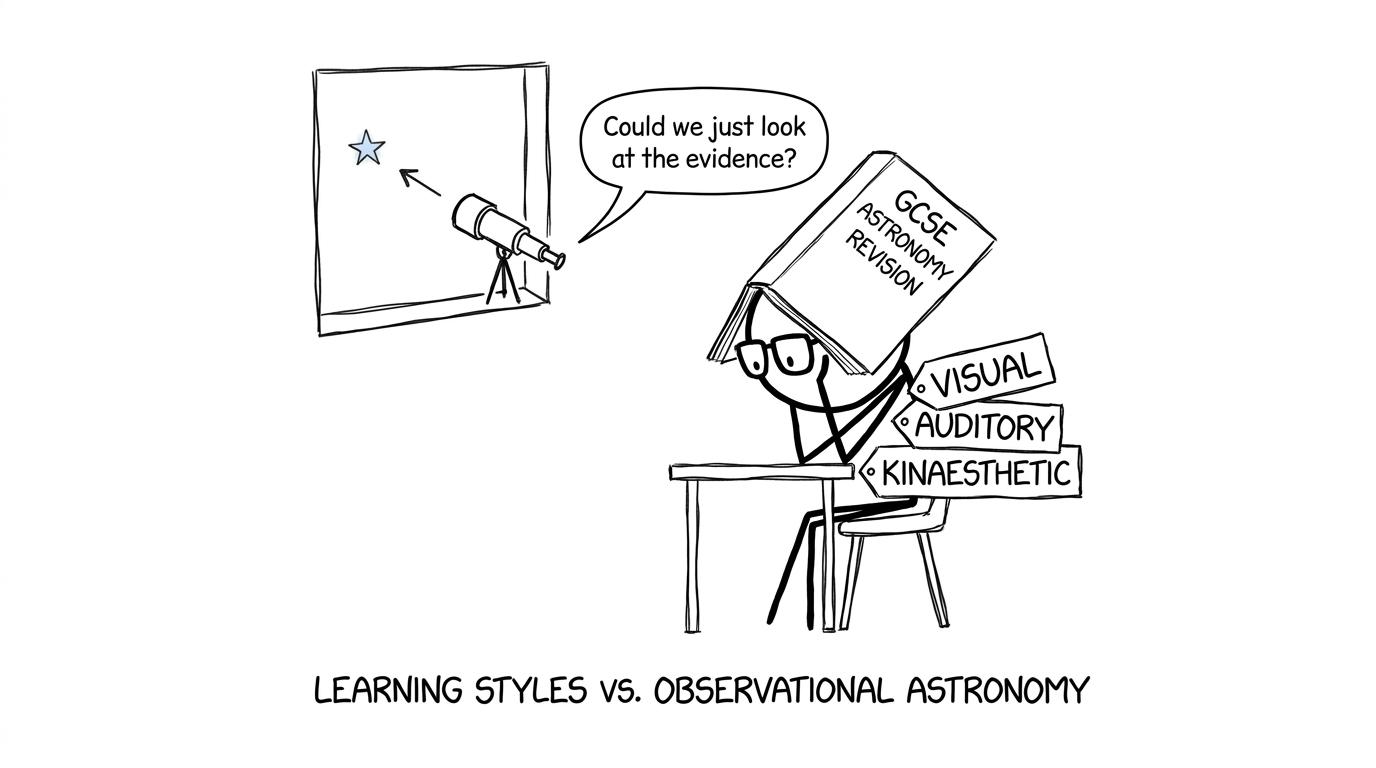 A telescope questions a student's collection of learning-style labels
What does the evidence say about learning styles?
The popular learning-styles claim is often called the meshing hypothesis. It says that a student identified as a visual learner should learn better through visual instruction, while an auditory learner should learn better through spoken instruction.
Testing that claim properly requires more than asking students which method they enjoy. Researchers must identify preferences, assign learners to matched and unmatched forms of instruction, and then give everyone the same assessment. The important question is whether matching produces better learning than not matching.
Major research reviews have not found reliable evidence for that pattern. The Education Endowment Foundation also describes the evidence for learning-styles approaches as extremely limited and warns that restricting pupils to activities based on reported preferences may harm progress. Preferences can change with the situation, while labels can quietly become limits: “I cannot understand graphs because I am not visual,” or “I cannot learn from equations because I prefer listening.”
That does not mean diagrams, discussion or physical activity are useless. It means their value comes from what they help you understand and practise, not from matching a personality category.
Preference is not proof of learning
A method can feel pleasant without producing durable knowledge. Rereading a colourful page feels fluent because the information is in front of you. Watching a clear explanation feels reassuring because the teacher is doing the difficult thinking. Neither feeling proves that you can retrieve and apply the idea independently.
Learning becomes visible when you close the notes and attempt something: label a diagram, explain a process, interpret a graph, select an equation or complete an unfamiliar question.
That small moment of uncertainty is not evidence that revision has failed. It is often the moment revision begins.
Why GCSE Astronomy needs more than one representation
Astronomy naturally uses several forms of information. A star chart is spatial. An observation is practical. A written explanation may involve cause and effect. A calculation requires symbols, units and numerical reasoning.
The sensible question is therefore not “What kind of learner am I?” but “What form best represents this idea, and how will I prove that I can use it?”
Use diagrams for genuinely spatial ideas
Diagrams are valuable for phases, eclipses, celestial coordinates, telescope arrangements and apparent motion. For these topics, the visual structure is part of the knowledge. Every student may benefit from seeing it.
But looking is only the first step. Remove the labels, reconstruct the diagram from memory and explain what changes. If you cannot do that, the diagram may have created recognition rather than recall.
Use speech to expose gaps in explanations
Explaining an astronomical process aloud can reveal missing links. You may discover that you know the opening and final statements but cannot connect them logically.
Recordings can also support review, but listening should lead to retrieval. Pause before each key point and say it first. Otherwise, an audio summary can become rereading with headphones.
Use observation because astronomy is observational
Observational activity is not valuable because somebody has been classified as a kinaesthetic learner. It is valuable because observation is part of astronomy itself.
Ofqual requires observational knowledge, skills and understanding to be assessed across GCSE Astronomy. Planning an observation, considering safety, selecting equipment, recording data and evaluating limitations are subject-specific skills. Practical experience gives those decisions meaning.
The method follows the discipline, not the label.
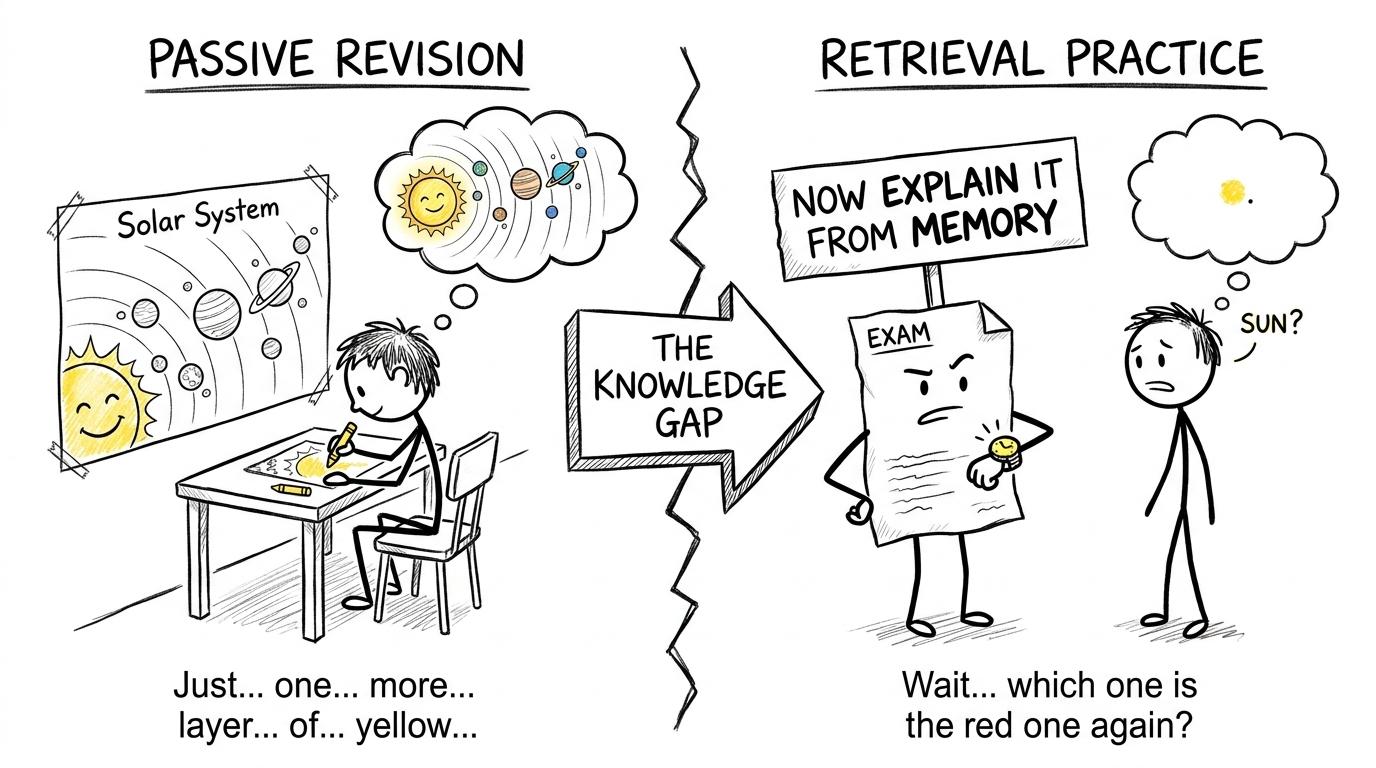 An exam paper asks a student to explain a colourful Solar System poster from memory
The maths inside GCSE Astronomy
Learning-style discussions can distract from a more useful fact: GCSE Astronomy has a substantial mathematical component. Ofqual requires at least 20%20\%20% of the total marks to reward mathematical skills at no lower than Key Stage 333 demand, assessed in an astronomical context.
The Pearson Edexcel specification includes skills such as:
- standard form and orders of magnitude;
- ratios, percentages and inverse-square relationships;
- significant figures and specialist units;
- base-101010 logarithms;
- substitution and changing the subject of an equation;
- plotting and interpreting graphs;
- gradients and intercepts;
- degrees, minutes and seconds of arc.
These skills cannot be secured by choosing only the format you prefer. You may understand a video about stellar distances and still make an error entering standard form into a calculator. You may recognise a graph and still reverse the gradient calculation.
For numerical scale, use the MathsGenie standard form revision resources. For equation work, practise changing the subject of a formula. When interpreting astronomical data, strengthen your method with the gradient of a line topic page.
The Pearson formula and data sheet reduces the need to recall astronomical equations, but it does not remove the need to select, rearrange and use them correctly. A formula on the page is only useful if you understand its variables, units and relationships. MathsGenie’s guide to whether GCSE formulae should be memorised helps separate recall from application.
A revision method stronger than learning-style matching
Research gives better support to retrieval practice and spacing than to matching teaching with supposed learning styles. However, no technique should become a slogan. It must be used carefully and connected to the content.
Retrieve before reviewing
Begin a session with a blank page or a short question set. Without notes, write what you know, sketch the relevant structure or list the steps needed for a calculation. Then check.
Retrieval reveals what is available from memory. Reviewing afterwards becomes targeted because you know which links are missing.
Space your returns
One long session can create short-term familiarity. Instead, return to the same material across several days. A simple pattern is:
- first encounter: understand and complete guided practice;
- next session: retrieve without notes;
- later session: answer mixed questions;
- final return: complete timed exam-style practice.
Spacing is not simply waiting. Each return should require effort. For a manageable structure, adapt the MathsGenie GCSE revision timetable around your Astronomy specification and exam date.
Mark, diagnose and retest
A total mark tells you how the attempt went. An error category tells you what to do next.
Classify lost marks as recall, interpretation, equation choice, rearranging, units, standard form, graph reading, significant figures or evaluation. Then repair the smallest weak skill. The MathsGenie GCSE mini tests are helpful for short mathematical checks without the load of a complete paper.
After targeted practice, use a different question to retest the skill. This matters because copying a correction is not the same as being able to produce the method independently.
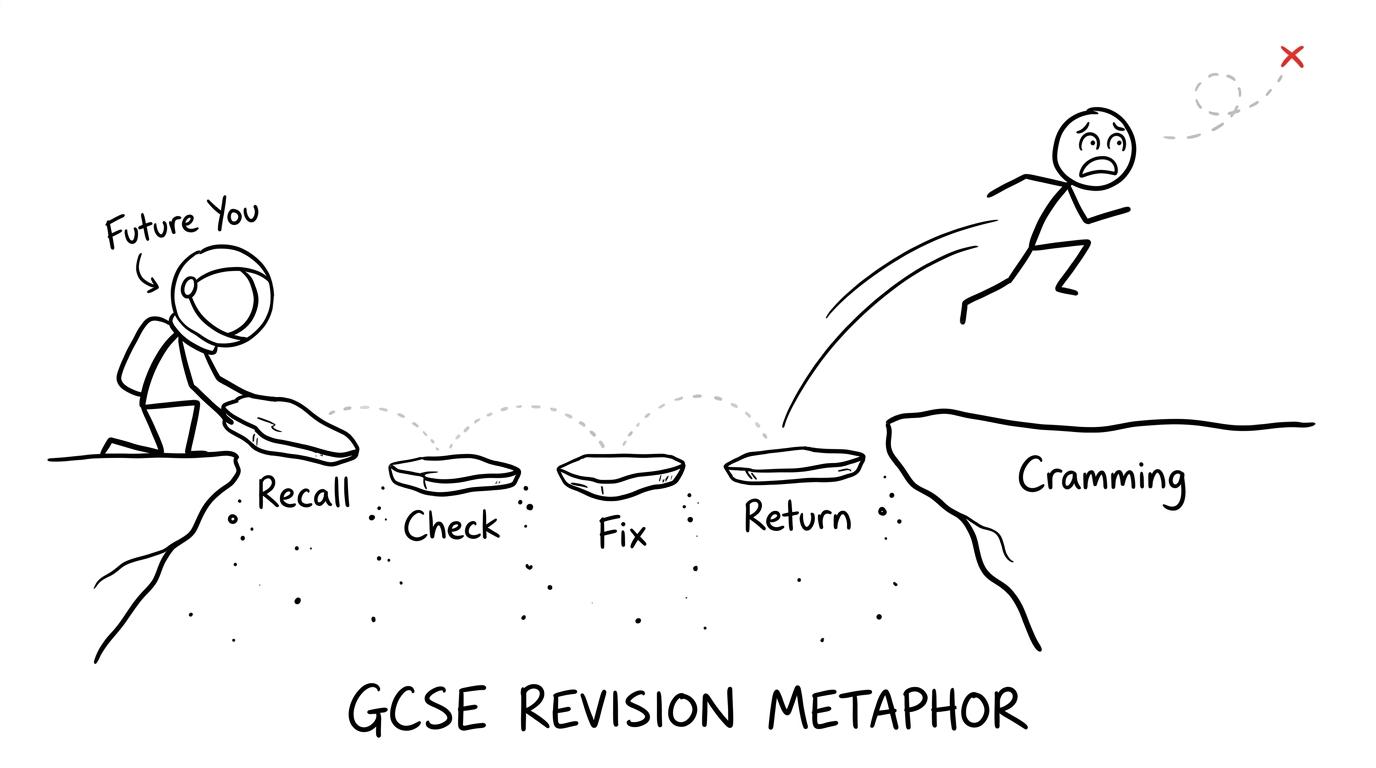 An astronaut uses small revision stepping stones while cramming floats away
How to build a balanced revision session
A productive session can contain several modes without pretending that one of them defines you:
- Recall: recover facts, definitions or diagram labels without support.
- Representation: inspect a suitable chart, model, graph or animation.
- Explanation: describe the idea aloud or in precise written sentences.
- Application: answer calculations, data questions and observational scenarios.
- Feedback: compare your response with reliable answers or a mark scheme.
- Planning: schedule the weak point for another day.
The order matters. Do not spend the whole session consuming information and leave questions until you are tired. Move into application early.
Once your individual skills are secure, use timed mixed practice. Although MathsGenie does not replace your Astronomy board materials, Edexcel GCSE maths past papers can build fluency in algebra, graphs, units and numerical reasoning that transfers into Astronomy calculations. Always use the official Astronomy specification and current materials from your school to check subject coverage.
This approach also prepares you for A Level study. As content becomes more complex, the ability to choose an appropriate representation, monitor errors and retrieve methods matters far more than maintaining a fixed learner identity.
Common mistakes when choosing revision methods
Turning a preference into a limitation
Enjoying videos does not mean you cannot learn from text. Finding diagrams useful does not remove the need to write explanations or complete calculations. Keep preferences as options, not boundaries.
Confusing variety with effectiveness
Switching between a podcast, poster and animation may feel varied, yet all three can remain passive. Each resource should lead to an observable action such as recall, a question or a corrected response.
Making beautiful notes instead of testing knowledge
Neat notes can organise information, but appearance is not the goal. If a page takes an hour to decorate and is never used for retrieval, its revision value is limited.
Avoiding the mathematical parts
Students sometimes spend most of their time on descriptive astronomy because calculations feel less comfortable. Yet mathematical skills account for a meaningful share of the assessment. Use performance, not comfort, to set priorities.
Marking without changing anything
Reading a mark scheme is not the end of the cycle. State why the mark was lost, practise that exact skill and retest it later. Feedback matters only when it changes the next attempt.
Revise the subject, not a label
Learning styles offer an attractive promise: discover your type and revision will become easier. The evidence does not support that promise. GCSE Astronomy asks you to move between diagrams, observations, explanations, data and mathematics, so restricting yourself to one preferred mode would prepare you for only part of the course.
Choose methods because they fit the content. Retrieve before reviewing. Space your practice. Mark precisely. Then return to the weak skill until your performance changes.
Start with the free MathsGenie GCSE maths revision hub to strengthen the algebra, standard form and graph skills behind Astronomy calculations. Use revision lessons and practice questions for targeted repair, mini tests for quick checks, and past papers, predicted papers, mark schemes and video solutions to build calm exam performance. The goal is not to discover what kind of learner you are. It is to become a learner who can adapt.