Is GCSE Statistics EBacc? A Clear Guide
Is GCSE Statistics EBacc? Learn why it cannot fill the maths pillar, how it may count in Attainment 8, and what this means for school options in England.
A subject can be valuable without fitting neatly into every government measure. That distinction matters when option forms arrive and similar-sounding qualifications begin to blur together.
So, is GCSE Statistics EBacc? The short answer is no. GCSE Statistics does not count as the maths component of the English Baccalaureate. To fill that component, students normally need an eligible GCSE Mathematics qualification. However, GCSE Statistics remains a separate, recognised GCSE and may count in an open slot within Attainment 8, subject to the applicable qualification and performance-table rules.
That answer is simple. What it means for your choices deserves a little more care.
The answer at a glance
- GCSE Statistics does not replace GCSE Mathematics in the EBacc.
- It does not create an extra EBacc subject or fill another EBacc pillar.
- You can take GCSE Statistics alongside the full collection of EBacc subjects.
- An approved GCSE Statistics qualification may count in an open Attainment 8 slot.
- The qualification can still be useful preparation for data-heavy subjects and later study.
- Your school decides which optional subjects, specifications and exam boards it offers.
If you are already taking the subject, begin with the free GCSE Statistics revision hub, where you can choose your exam board and find relevant papers, questions and worksheets.
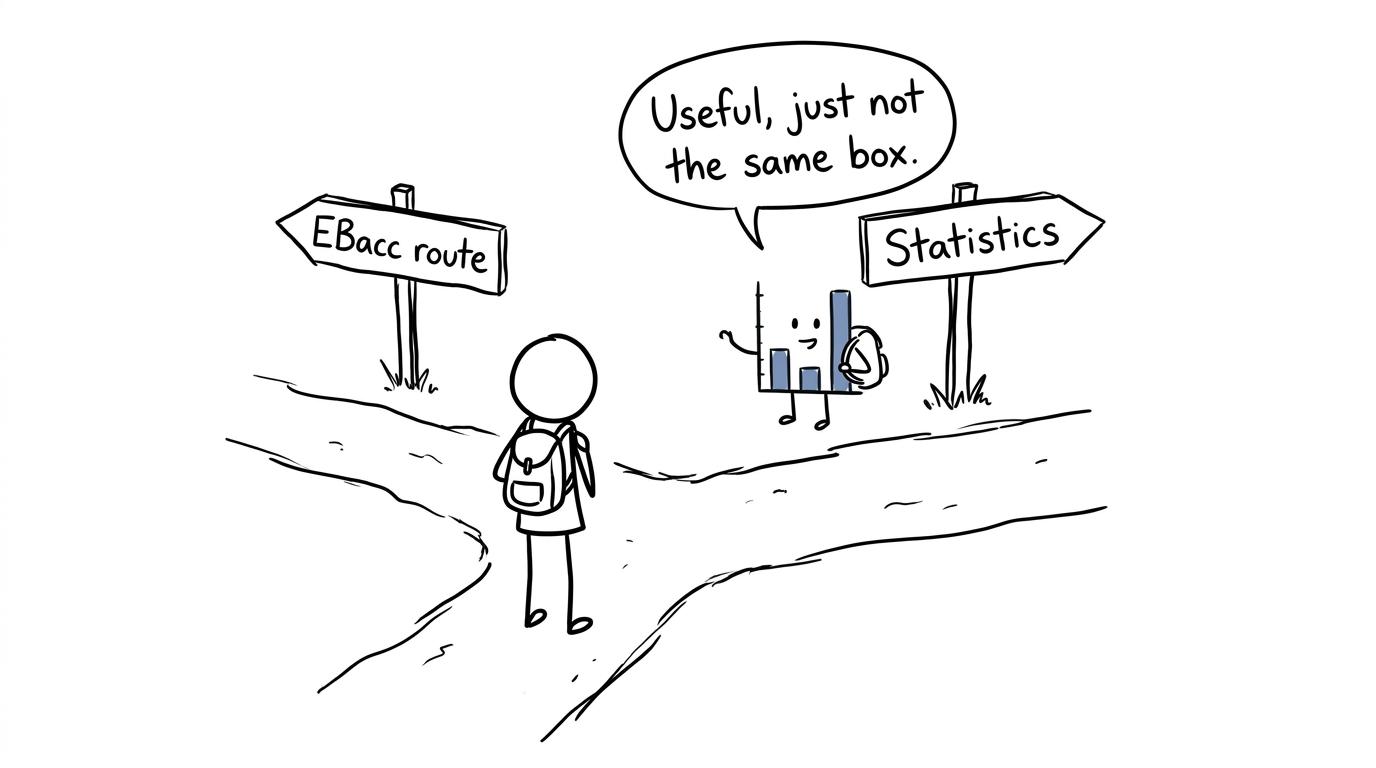 A student choosing between the EBacc route and Statistics at a school crossroads
What is the EBacc?
The English Baccalaureate, usually shortened to EBacc, is a school performance measure used in England. It is not a separate qualification, examination or physical certificate that students receive.
The measure covers a collection of academic subject areas:
- English language and English literature
- mathematics
- science
- a language
- history or geography
There are detailed eligibility rules within these pillars. For example, the science requirement can be met through an eligible combined science route or an appropriate selection of separate sciences. Computer science may also contribute within the science pillar under the relevant rules.
Schools are measured partly through EBacc entry and attainment. People therefore sometimes talk about a student “doing the EBacc”, but the student is really taking a set of individual GCSEs that satisfies the measure.
This is why the name of a subject is not enough. GCSE Statistics contains mathematics, but that does not automatically make it an eligible qualification for the EBacc maths pillar. Eligibility depends on the Department for Education’s approved list, not simply on how closely two courses are related.
Why GCSE Statistics does not count as EBacc maths
The EBacc maths pillar is designed around an eligible Mathematics qualification. Current Department for Education accountability guidance explicitly distinguishes EBacc maths qualifications from mathematical qualifications that do not count towards the EBacc, using GCSE Statistics as an example of the latter.
In practical terms, this means:
- GCSE Mathematics can fill the EBacc maths requirement.
- GCSE Statistics cannot be used instead of GCSE Mathematics.
- Taking both qualifications does not give you two EBacc maths entries.
This does not imply that one subject is “real maths” and the other is not. It means they have different purposes within a particular accountability system.
GCSE Mathematics gives broad coverage across number, algebra, ratio, geometry, probability and statistics. GCSE Statistics focuses much more closely on collecting, representing, analysing and interpreting data. You can explore the wider course through the GCSE Maths revision centre and compare it with the dedicated Statistics resources.
Can GCSE Statistics count towards Attainment 8?
This is where many explanations become confusing because the EBacc and Attainment 8 are related school measures, but they are not identical.
Attainment 8 uses results from a structured selection of qualifications. Its main groups include:
- a double-weighted mathematics element;
- an English element;
- qualifications from EBacc subject areas; and
- open slots for other approved qualifications.
Only a maths qualification that is eligible for the EBacc can occupy the double-weighted maths element. GCSE Statistics cannot take that position.
However, current Department for Education guidance says that approved mathematical qualifications which do not count towards the EBacc, including GCSE Statistics, can potentially be used in an open Attainment 8 slot. Whether a result is ultimately included depends on the qualification’s approval for the relevant year and how the student’s eligible results fill the measure.
The useful summary is:
GCSE Statistics may contribute to Attainment 8, but it does not contribute to the EBacc maths pillar.
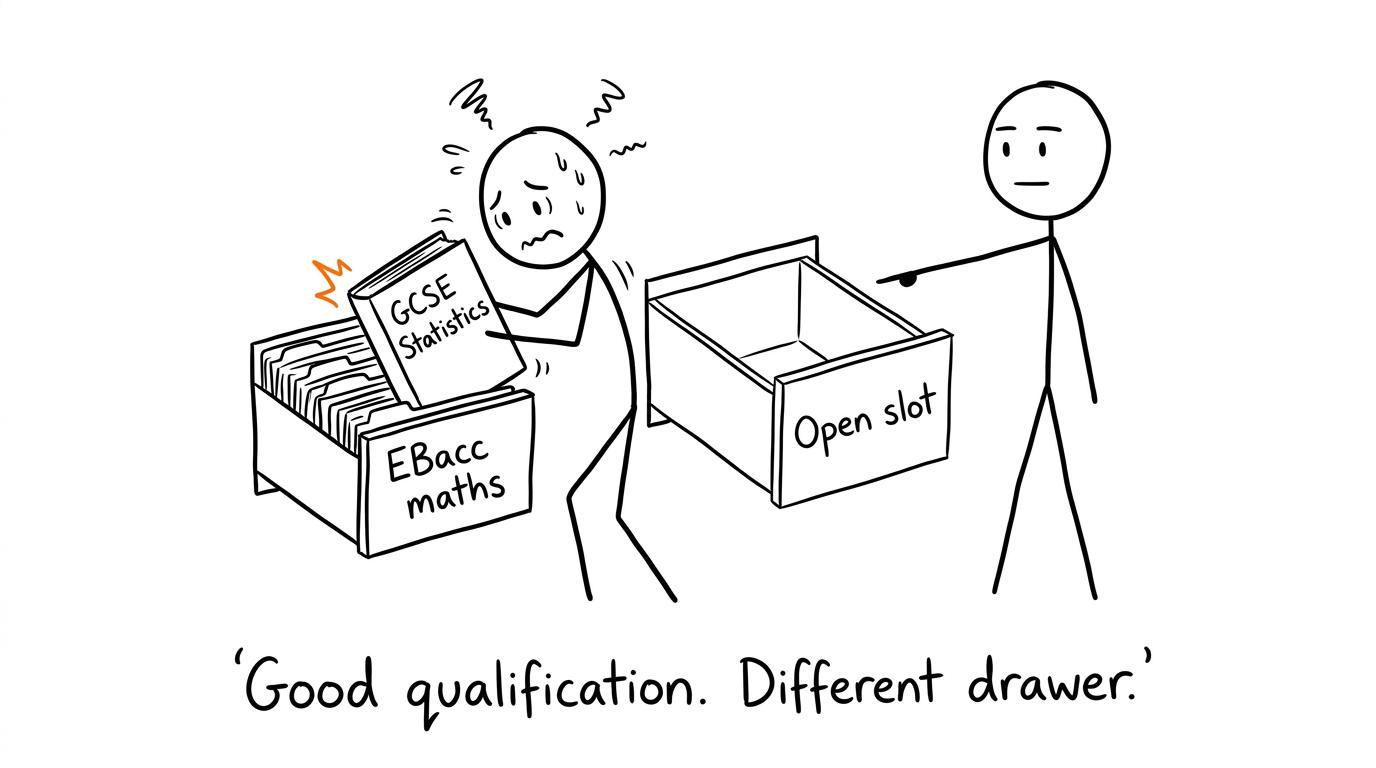 A Statistics book being directed towards the correct Attainment 8 drawer
What does this mean for your school options?
Suppose your school offers GCSE Statistics as an option. Taking it does not stop you from meeting the EBacc requirements, provided your complete subject combination still includes all the necessary EBacc areas.
The important question is not simply, “Does Statistics count?” It is, “What would I take Statistics instead of?”
If it occupies an optional slot that would otherwise be used for art, music or another non-EBacc subject, you may still have a complete EBacc combination elsewhere on your timetable. If choosing it means you no longer take a language, history or geography, your overall combination may not satisfy the full EBacc entry criteria.
Before submitting an option form, ask your school:
- Which exam board and specification will I follow?
- Is GCSE Statistics taught as an additional GCSE or inside an option block?
- Which subject would I give up by selecting it?
- Would my complete timetable still meet the EBacc entry requirements?
- Is the specific qualification approved for the relevant performance-table year?
Schools organise their timetables differently, so another student’s option combination may not answer these questions for you. Your subject teacher, options lead or examinations officer can confirm the arrangement at your school.
Is GCSE Statistics still worth taking?
A government measure answers one narrow question. Your education has to answer several wider ones.
GCSE Statistics can be a sensible option if you enjoy analysing evidence, interpreting graphs and questioning whether a conclusion is justified. The course develops ideas around sampling, probability, distributions, correlation and the communication of statistical findings. Exact content and assessment arrangements depend on the specification followed by your school.
These habits can support later work in subjects such as A Level Mathematics, sciences, geography, psychology, economics and other courses involving quantitative evidence. It should not be treated as a replacement for checking the entry requirements of a future course, but it can provide useful experience.
It may also strengthen the statistics you meet within GCSE Mathematics. The courses are separate, yet some underlying habits transfer: reading scales carefully, choosing suitable representations, interpreting averages in context and distinguishing correlation from causation.
If your school follows Pearson Edexcel, the Edexcel GCSE Statistics revision page brings together lessons, worksheets, question-bank practice and past papers for foundation and higher tier. Students following another board should select the correct route from the main Statistics hub rather than assuming that every specification assesses identical content.
How to revise when you take both subjects
Taking GCSE Mathematics and GCSE Statistics can feel like one large course because some vocabulary overlaps. It is better to treat them as two connected specifications.
Keep separate topic checklists
Create one checklist for GCSE Mathematics and another for GCSE Statistics. This prevents a familiar-looking statistics topic from hiding material that is specific to the separate GCSE.
MathsGenie’s guide to the best order for learning GCSE Maths topics can help you sequence the broader Mathematics course without losing sight of Statistics as its own subject.
Practise with the correct exam board
Edexcel, AQA, OCR and Eduqas specifications are not interchangeable. GCSE Statistics is not necessarily available from every board your school uses for its other subjects, and assessment structures can differ.
Check the board and tier printed on your materials. Then use papers, mark schemes and revision lessons matched to that specification.
Mark for interpretation, not only calculation
Statistics questions often test whether you can explain what a result means in context. A correct numerical result may not earn every available mark if the question also asks for comparison, criticism or interpretation.
Use a mark scheme to notice command words and the level of detail expected. A calm revision loop works well: attempt, mark, identify the exact weakness, practise it and retest it later. The GCSE Maths revision timetable guide shows how to organise that cycle around school and other subjects.
 A student detective finding clues in a past paper and mark scheme
Common mistakes about GCSE Statistics and the EBacc
Assuming every maths-related GCSE counts as EBacc maths
The subject name does not determine eligibility. GCSE Statistics is mathematical, but it does not fill the EBacc maths pillar.
Thinking the EBacc is an additional certificate
The EBacc is a performance measure based on an eligible combination of qualifications. You sit the individual GCSE examinations and receive grades 999 111 for those qualifications.
Confusing EBacc with Attainment 8
GCSE Statistics may be eligible for an open Attainment 8 slot without being an EBacc subject. “Counts in school performance measures” is therefore too vague unless the speaker identifies the measure.
Believing Statistics can replace compulsory Mathematics
It cannot. Students should expect GCSE Statistics to be taken alongside GCSE Mathematics, not instead of it.
Choosing from the subject title alone
An option may be academically interesting but still affect your wider timetable. Check what selecting Statistics prevents you from taking and whether that matters for your plans.
Revising Statistics as though it were only one GCSE Maths unit
The separate qualification has its own specification and papers. Browse the full range of GCSE subjects and revision resources, then keep your two courses organised separately.
Make the decision, then make the subject count
GCSE Statistics is not part of the EBacc and cannot replace GCSE Mathematics within its maths pillar. It may, when approved under the relevant rules, contribute through an open Attainment 8 slot. Most importantly, you can still complete the full EBacc subject combination while taking Statistics as an additional option.
Once your school has confirmed the timetable and specification, the label matters less than the work in front of you. Start with MathsGenie’s free GCSE Statistics revision resources. Use revision lessons to understand each idea, practice questions and mini tests to expose weak areas, then past papers and predicted papers to build exam readiness. Mark every attempt carefully with mark schemes and video solutions, and use the revision planner to keep the two GCSEs moving forward together.
A qualification does not need to sit inside every performance measure to be worthwhile. It needs to fit your options, your interests and the direction you want to take next.