

Is GCSE Biology Hard? What Students Really Say
Is GCSE Biology hard? See what students find difficult, why maths and practical questions matter, and how to revise with a focused, realistic exam plan.
The unsettling thing about GCSE Biology is that understanding a lesson can feel easy, yet answering the exam question can feel strangely difficult. You recognise the topic. You remember the diagram. Then the mark scheme asks for three precise ideas and you only write two.
So, is GCSE Biology hard? The straight answer is that it is challenging but manageable. Informal student discussions do not produce one verdict: some students describe Biology as the easiest science because its ideas feel intuitive, while others find it the hardest because of the volume of content, exact terminology and unfamiliar application questions. These comments are experiences, not representative survey data, but their recurring themes are useful.
For maths students, there is another important point. Biology is not calculation-free. Percentages, rates, ratios, graphs, averages, standard form and units can all affect your marks. Strengthening those skills through MathsGenie's free GCSE and A Level revision can make part of Biology feel much more predictable.
GCSE Biology difficulty at a glance
Here is the honest checklist:
- The individual ideas are usually learnable. The greater challenge is remembering many connected processes.
- Scientific vocabulary must be precise. Everyday wording may not earn the mark.
- Questions test application as well as recall. Knowing a fact is not always enough.
- Practical work matters. You may need to identify variables, interpret results or evaluate a method.
- Maths is a meaningful part of the course. For separate GCSE Biology, at least 10%10\%10% of marks across the qualification must assess mathematical skills.
- Difficulty varies by topic and student. Genetics may feel abstract to one person, while another struggles more with homeostasis or ecology.
- The exam board changes the organisation, not the basic challenge. AQA, Edexcel, OCR and Eduqas use different specifications and paper structures, so revise from the correct one.
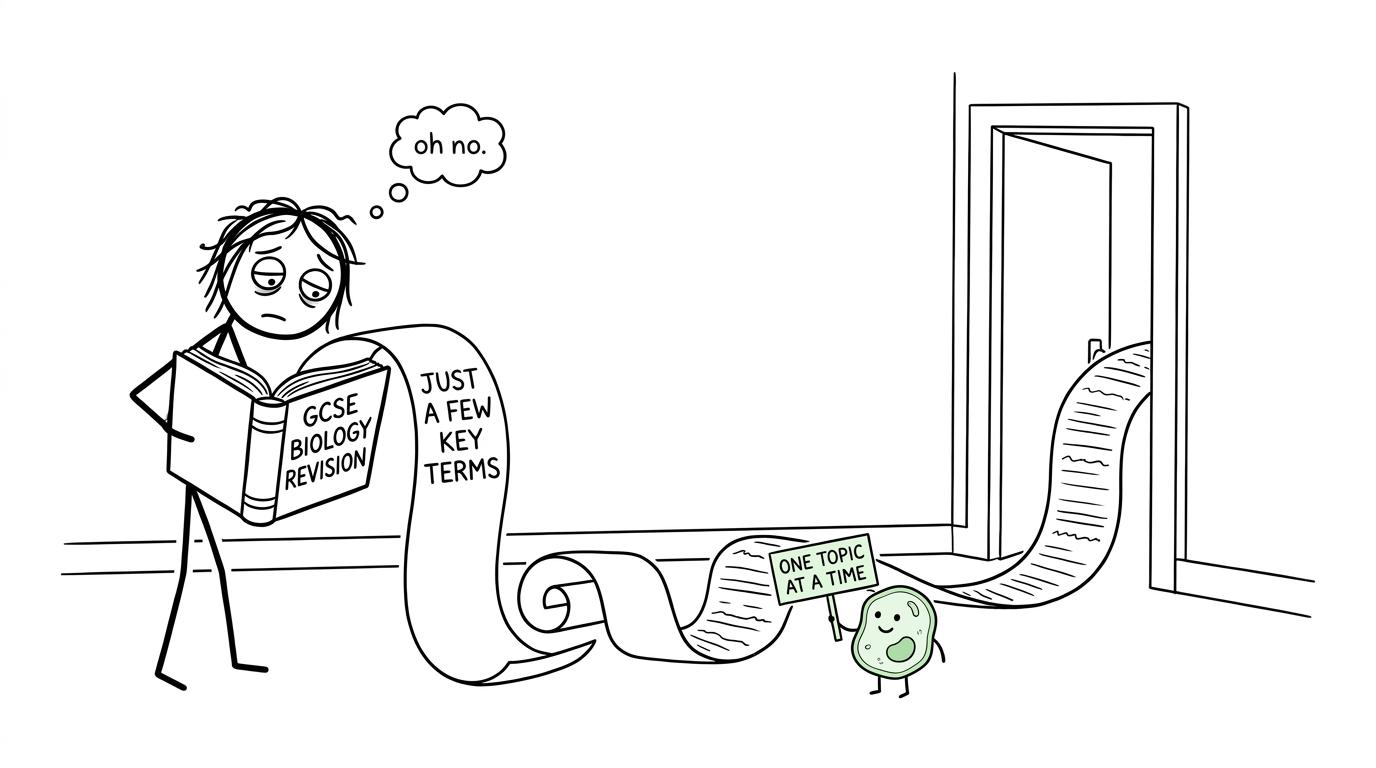 A GCSE Biology book produces a comically long scroll of key terms while a friendly cell recommends one topic at a time
What students who have taken GCSE Biology tend to say
Student comments should be read carefully. Online discussions are self-selecting, and one person's easiest subject can be another person's hardest. Even so, several patterns appear repeatedly.
“There is too much to remember”
The most common concern is often volume rather than impossible concepts. Students may understand enzymes, inheritance and homeostasis separately, but the course asks them to retain all of these while distinguishing similar terms and recalling multi-stage processes.
This is why Biology can become harder late in the course. The first few topics may feel comfortable. The difficulty emerges when your memory must hold material from across the specification at once.
“I knew the topic but lost marks”
Biology mark schemes reward relevant, precise statements. A student can have a broadly correct idea but omit a necessary biological term, fail to link cause and effect, or give a description when the command word asks for an explanation.
This is not evidence that the subject is arbitrary. It means exam performance depends on turning understanding into an answer that addresses the exact question.
“The paper focused on what I did not revise”
Students often leave an exam feeling that their strongest topics barely appeared. That feeling is one reason selective revision is risky. Predicted topics can help organise final practice, but they cannot replace full specification coverage.
The same principle applies in maths. GCSE predicted papers are valuable for fresh exam-style practice, not as permission to ignore parts of the course.
“Biology was the easiest science for me”
This view appears too. Some students prefer Biology because many topics connect to organisms, health and ecosystems rather than relying as heavily on equations as Physics or quantitative work as Chemistry.
That does not make Biology automatically easy. It means its type of difficulty may suit students who remember processes, interpret evidence and write precise explanations.
Why GCSE Biology can feel harder than expected
The subject combines several kinds of thinking
A single paper can move from recalling a cell structure to analysing a graph, evaluating a practical method and writing an extended response. You must switch between factual knowledge, application and analysis.
Official assessment objectives reflect this balance. GCSE Biology does not assess recall alone: students must also apply knowledge and analyse information. Revision based entirely on reading or highlighting therefore prepares only part of the skill set.
Familiar-looking questions may test unfamiliar situations
You might learn a process in one organism, then meet a question placing the same principle in a new context. The surface details change, but the underlying biology remains.
Students who only memorise complete model paragraphs can struggle here. Students who understand the sequence, what changes, why it changes and what effect follows, are better able to adapt.
Practical questions require reasoning
Across separate science qualifications, practical knowledge and skills account for at least 15%15\%15% of marks, and students must complete at least eight specified practical activities. Exact requirements vary between specifications; for example, AQA lists ten required practical activities for its separate Biology course.
An exam can ask about variables, control measures, accuracy, repeatability, graph choice or improvements. Memorising a method word for word is less useful than understanding why each step exists.
Which Biology topics do students find hardest?
There is no official ranking, but student discussions and teacher guidance commonly highlight these areas:
- Homeostasis and response, because several organs, hormones and feedback processes interact.
- Genetics and inheritance, because alleles, genotype, phenotype and probability must be connected accurately.
- Protein synthesis, where abstract stages and terminology can blur together.
- The nervous system, especially pathways, synapses and responses.
- Bioenergetics, where photosynthesis, respiration, limiting factors and practical data meet.
- Required practicals, particularly evaluation and experimental design.
The important distinction is between “hard to understand” and “hard to retain”. A topic may make sense in class but still need repeated retrieval before it remains available under exam pressure.
How much maths is in GCSE Biology?
For separate GCSE Biology, regulations require at least 10%10\%10% of the qualification's marks to assess mathematical skills. The maths should remain within the requirements of the appropriate GCSE Maths tier, but it is placed inside scientific contexts.
Common skills include:
- ratios, fractions and percentages;
- arithmetic means;
- probability in inheritance;
- standard form and orders of magnitude;
- interpreting tables, charts and graphs;
- gradients and rates;
- areas and volumes;
- unit conversions and significant figures.
Useful relationships include:
mean=sum of valuesnumber of values\text{mean}=\frac{\text{sum of values}}{\text{number of values}}mean=number of valuessum of values percentage change=new value−original valueoriginal value×100\text{percentage change}=\frac{\text{new value}-\text{original value}}{\text{original value}}\times 100percentage change=original valuenew value−original value×100 magnification=image sizeactual size\text{magnification}=\frac{\text{image size}}{\text{actual size}}magnification=actual sizeimage sizeIf calculations are costing you Biology marks, revise the underlying skill away from the scientific wording first. MathsGenie's percentage revision guide, standard form resources and GCSE Maths topic worksheets provide focused practice with solutions.
The Biology context may change. The calculation underneath often does not.
A revision method that makes Biology less difficult
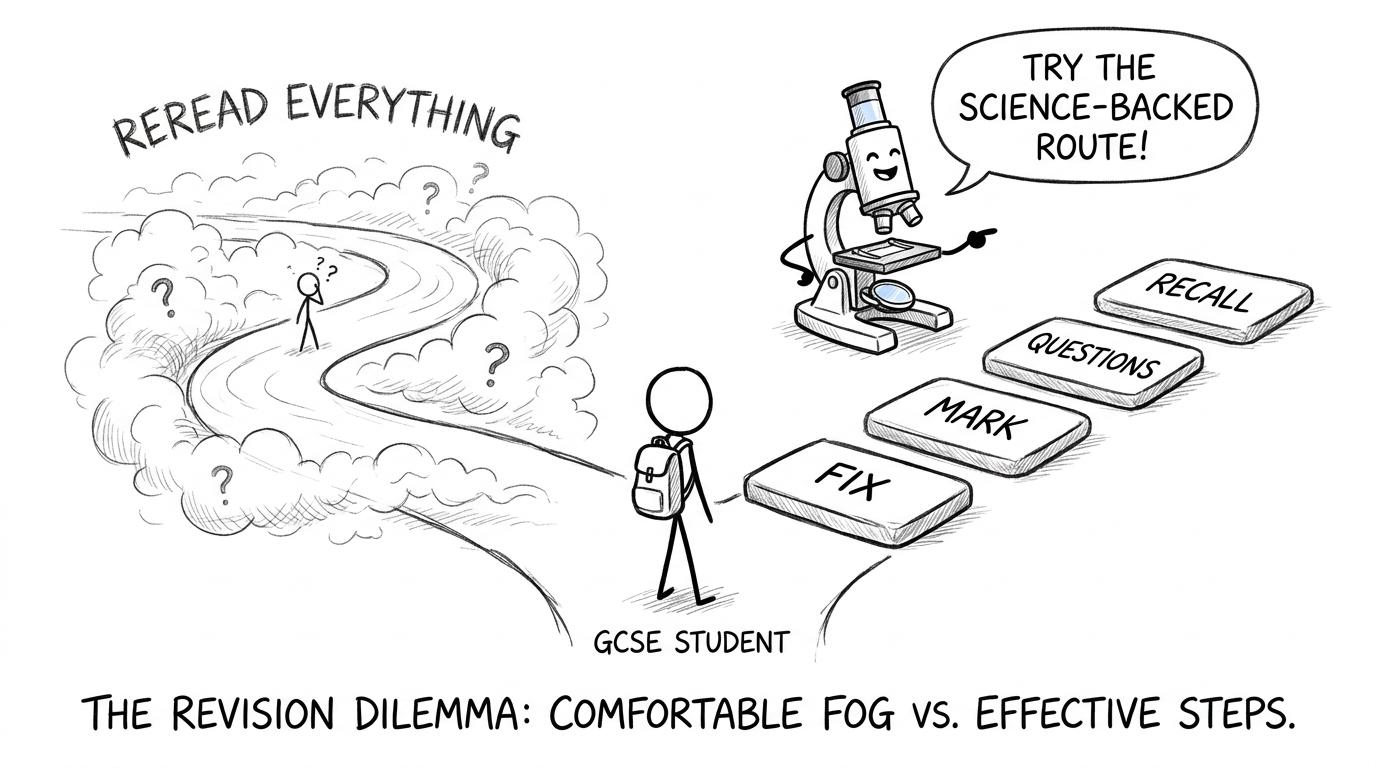 A student chooses clear revision stepping stones instead of the foggy path marked reread everything
Start with the specification
Find your exact course and tier. Separate Biology and Combined Science are not identical qualifications, and the organisation used by AQA may differ from Edexcel, OCR or Eduqas.
Turn each specification statement into a question. If the statement says you should explain a process, test whether you can explain it without notes rather than merely recognise it on a page.
Use a recall-question-mark-fix loop
A reliable session has four stages:
- recall one small topic without notes;
- answer exam-style questions;
- mark the answers carefully;
- correct the precise weakness and revisit it later.
This loop is more revealing than rereading because it exposes what your memory cannot yet produce. The MathsGenie guide to efficient OCR Biology revision applies the same principle to processes, practicals, data and mathematical skills.
Separate content gaps from answer gaps
When you lose a mark, label the cause:
- knowledge: the fact or process was missing;
- terminology: the idea was vague or scientifically imprecise;
- application: you could not transfer knowledge to the context;
- practical reasoning: variables, evaluation or method caused the problem;
- maths: calculation, units, graph reading or rounding caused the problem;
- exam technique: you misread the command word or did not use the data.
A precise diagnosis leads to a smaller, more effective next task.
Protect your maths revision time
If you are preparing for both Biology and GCSE Maths, do not let content-heavy science revision consume every evening. Use a planner that alternates recall-based Biology sessions with question-based maths sessions.
MathsGenie's guide to GCSE topics that commonly recur can help you identify core skills, while the one-week GCSE revision plan offers a structure for short, purposeful blocks.
Common mistakes that make GCSE Biology seem harder
Revising only by reading
Recognition feels like knowledge, but an exam requires retrieval. Close the book and produce the explanation, diagram labels or practical stages yourself.
Memorising wording without understanding the process
A remembered paragraph can fail when the context changes. Learn the causal chain so you can rebuild the answer.
Avoiding calculations and graphs
Maths questions can be some of the most structured marks on a Biology paper. Show working, retain units and check whether the answer is sensible.
Learning practical methods but not evaluating them
Know the independent, dependent and control variables. Understand why repeats are taken, how a mean may be used and what change would genuinely improve the investigation.
Guessing what will appear
No prediction removes the need for broad coverage. Use practice papers to diagnose gaps and build timing. The advice in when to start GCSE past papers transfers well to science: begin with smaller sections, then progress to timed papers.
Is GCSE Biology hard in the end?
GCSE Biology is hard enough to require consistent revision, but it is not hard in a mysterious way. Students most often struggle with content volume, precision, application, practical reasoning and data handling. Each of those can be trained.
The useful question is no longer simply, “Am I good at Biology?” It is, “Which kind of question is costing me marks?” Once the problem becomes specific, it becomes workable.
Use your Biology specification and official past questions for subject content. Then use MathsGenie to strengthen the transferable skills beneath the paper: percentages, ratios, graphs, averages, standard form and clear working. Begin with a free revision lesson, complete targeted practice questions, check the mark scheme or video solution, and test yourself with mini tests, past papers and predicted papers. Difficulty shrinks when your next step is clear.










