

Inverse Proportion GCSE Maths Explained
Inverse proportion GCSE maths explained with a clear method, worked examples, common mistakes and exam-style questions to strengthen your revision.
A student can understand every word in an inverse proportion question and still not know where to begin. One quantity increases, the other decreases, and the temptation is to divide whichever numbers happen to be nearby.
That is often where the marks disappear.
The central idea in inverse proportion GCSE maths is simple: when one quantity is multiplied by a scale factor, the other is divided by that same scale factor. Algebraically, if yyy is inversely proportional to xxx, then
y∝1xy \propto \frac{1}{x}y∝x1and therefore
y=kxy=\frac{k}{x}y=xkwhere kkk is the constant of proportionality. Most questions follow the same routine: write the equation, find kkk, substitute the new information and solve.
The inverse proportion checklist
Use this method whenever the question says that one quantity is inversely proportional to another:
- Write the proportional relationship.
- Replace the proportion symbol with an equals sign and kkk.
- Substitute the known values.
- Calculate the constant kkk.
- Rewrite the complete equation.
- Substitute the new value and solve.
- Check that your answer moves in the expected direction.
You can learn the method interactively in the Maths Genie direct and inverse proportion lesson, then apply it to exam-style problems.
What inverse proportion actually means
Imagine a student who keeps treating inverse proportion like direct proportion. We will call her Maya, as a hypothetical example. Whenever xxx doubles, she doubles yyy too. Her algebra is tidy, but the relationship is wrong.
Then one small observation changes the problem: in inverse proportion, the product stays constant.
Starting with
y=kx,y=\frac{k}{x},y=xk,multiply both sides by xxx:
xy=k.xy=k.xy=k.This gives two equivalent ways to recognise the relationship:
y=kxy=\frac{k}{x}y=xkor
xy=k.xy=k.xy=k.If xxx doubles, yyy must halve so that xyxyxy remains unchanged. If xxx is multiplied by 555, yyy is divided by 555.
That is the moment inverse proportion often clicks. It is not merely that one value goes up while another goes down. Their product must remain constant.
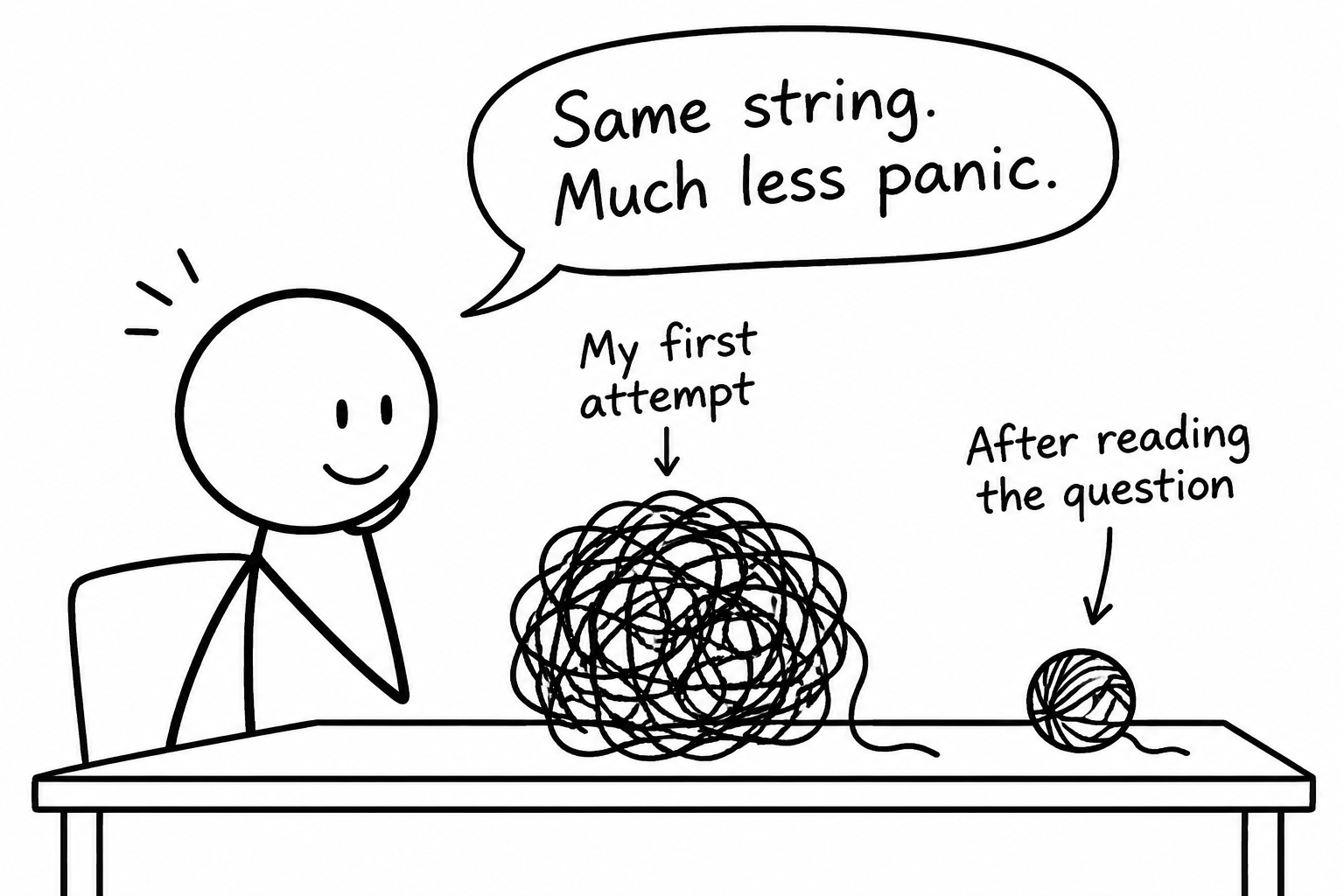 A student discovers that a calmer second attempt makes revision less tangled
Inverse proportion worked examples
Finding a missing value
Suppose yyy is inversely proportional to xxx. When x=4x=4x=4, y=9y=9y=9. Find yyy when x=6x=6x=6.
Begin with the inverse proportion equation:
y=kx.y=\frac{k}{x}.y=xk.Substitute x=4x=4x=4 and y=9y=9y=9:
9=k4.9=\frac{k}{4}.9=4k.Multiply by 444:
k=36.k=36.k=36.The complete equation is therefore
y=36x.y=\frac{36}{x}.y=x36.Now substitute x=6x=6x=6:
y=366=6.y=\frac{36}{6}=6.y=636=6.The answer is y=6y=6y=6. The direction check also works: xxx increased, so yyy decreased.
Maya used to skip the line containing k=36k=36k=36. Writing it down makes the structure visible and can also protect method marks if a later arithmetic error occurs.
Finding the original variable
Suppose ppp is inversely proportional to qqq. When p=8p=8p=8, q=3q=3q=3. Find qqq when p=12p=12p=12.
Write the relationship:
p=kq.p=\frac{k}{q}.p=qk.Substitute the known values:
8=k3.8=\frac{k}{3}.8=3k.Therefore,
k=24.k=24.k=24.The equation is
p=24q.p=\frac{24}{q}.p=q24.Substitute p=12p=12p=12:
12=24q.12=\frac{24}{q}.12=q24.Multiply by qqq and divide by 121212:
q=2.q=2.q=2.Here the unknown was in the denominator. The method did not change; only the final rearrangement did.
You now have the full routine, so use the Maths Genie inverse proportion Lessons and Question Bank to practise each step without having to organise a worksheet yourself.
Inverse proportion involving a power
Some higher-tier questions state that yyy is inversely proportional to the square of xxx. The word square changes the equation:
y∝1x2y \propto \frac{1}{x^2}y∝x21so
y=kx2.y=\frac{k}{x^2}.y=x2k.Suppose y=5y=5y=5 when x=2x=2x=2. Find yyy when x=10x=10x=10.
Substitute the first pair of values:
5=k22.5=\frac{k}{2^2}.5=22k.As 22=42^2=422=4,
5=k4,5=\frac{k}{4},5=4k,so
k=20.k=20.k=20.The complete relationship is
y=20x2.y=\frac{20}{x^2}.y=x220.When x=10x=10x=10:
y=20102=20100=0.2.y=\frac{20}{10^2}=\frac{20}{100}=0.2.y=10220=10020=0.2.Notice the scale-factor check. The value of xxx was multiplied by 555, so x2x^2x2 was multiplied by 252525. The value of yyy was consequently divided by 252525:
5÷25=0.2.5\div25=0.2.5÷25=0.2.For further explanations and mixed practice, use the direct and inverse proportion revision page or the inverse proportion revision guide.
How to recognise inverse proportion questions
The wording is usually explicit. Look for phrases such as:
- “yyy is inversely proportional to xxx”
- “aaa varies inversely as bbb”
- “ppp is inversely proportional to the square of qqq”
A context can also suggest the relationship. For example, if a fixed journey is completed at a greater average speed, the time decreases. However, a decreasing relationship is not automatically inverse proportion. You should only use the inverse model when the question gives or establishes that relationship.
The safest habit is to translate the sentence before touching the numbers:
inversely proportional to x⟶kx.\text{inversely proportional to }x \quad \longrightarrow \quad \frac{k}{x}.inversely proportional to x⟶xk.For more sustained exam practice, the direct and inverse proportion exam booklet lets you write through complete questions rather than isolated calculations.
Common mistakes with inverse proportion
Using the direct proportion equation
Writing y=kxy=kxy=kx describes direct proportion. For inverse proportion, write
y=kx.y=\frac{k}{x}.y=xk.Pause after reading the word “inversely” and write the fraction before substituting anything.
Assuming any decrease is inverse proportion
Two quantities moving in opposite directions is not enough. In the basic model, the product xyxyxy must remain constant.
Forgetting a power
If yyy is inversely proportional to x2x^2x2, the denominator must be x2x^2x2:
y=kx2.y=\frac{k}{x^2}.y=x2k.Using y=kxy=\frac{k}{x}y=xk creates a different relationship.
Substituting before writing the equation
Loose calculations make it difficult to see whether you are multiplying or dividing. Write the general equation first, find kkk, and then use the complete equation.
Skipping the reasonableness check
For positive values, increasing xxx should decrease yyy. If both increase, revisit your equation or arithmetic.
Exam-style practice
Try these inverse proportion questions before checking any worked solution:
- yyy is inversely proportional to xxx. When x=7x=7x=7, y=12y=12y=12. Find yyy when x=21x=21x=21.
- aaa is inversely proportional to bbb. When a=15a=15a=15, b=4b=4b=4. Find bbb when a=10a=10a=10.
- mmm is inversely proportional to n2n^2n2. When n=3n=3n=3, m=8m=8m=8. Find mmm when n=6n=6n=6.
The answers are 444, 666 and 222 respectively. If an answer is wrong, do not simply copy the solution. Identify whether the error occurred when forming the equation, finding kkk, substituting or rearranging. That turns one mistake into useful revision.
The Maths Genie inverse proportion Question Bank provides further exam-style questions with worked solutions and mark schemes.
Make the method stick
Maya's hypothetical breakthrough was not a new trick. She stopped guessing from the numbers and began every question with the relationship. That small routine separated understanding from panic.
Your goal is the same: recognise the wording, build the correct equation and keep the product constant. Knowing those steps is useful, but following them repeatedly is what makes the method dependable under exam pressure.
Start the inverse proportion Lessons, then practise the method in the Maths Genie Question Bank.















