

Index Laws GCSE Maths: Rules and Worked Examples
Index laws GCSE maths explained with clear rules, step-by-step worked examples, common mistakes and exam-style questions to build your confidence.
A student can understand indices perfectly on Monday, then look at x5÷x2x^5 \div x^2x5÷x2 on Tuesday and wonder whether to add, subtract or multiply the powers. The rules seem to blur together precisely when they are needed.
Imagine a student in that position. We will call them Sam. Sam keeps trying to memorise index laws GCSE maths questions as disconnected instructions. The breakthrough comes when Sam notices that every law grows from one simple idea: an index tells you how many times a base is multiplied by itself.
This guide explains that idea, turns it into a reliable method and applies it through step-by-step worked examples.
Your index laws checklist
Before working through a question:
- identify the base and the index;
- check whether the bases are the same;
- identify the operation between the powers;
- apply the relevant law only after those checks;
- simplify coefficients separately from indexed terms;
- leave the final answer with positive indices unless instructed otherwise.
The Maths Genie Indices revision page brings the lesson, questions and worked solutions together when you are ready to practise the complete method.
What is an index?
In the expression a4a^4a4, the letter aaa is the base and 444 is the index, also called the power. It means
a4=a×a×a×a.a^4=a\times a\times a\times a.a4=a×a×a×a.This expanded form explains the laws. They are not arbitrary instructions written to make algebra harder. They are shortcuts for counting repeated factors.
Sam’s first improvement is small but important: instead of asking, “Which rule do I remember?”, Sam asks, “What is being multiplied, divided or raised to another power?”
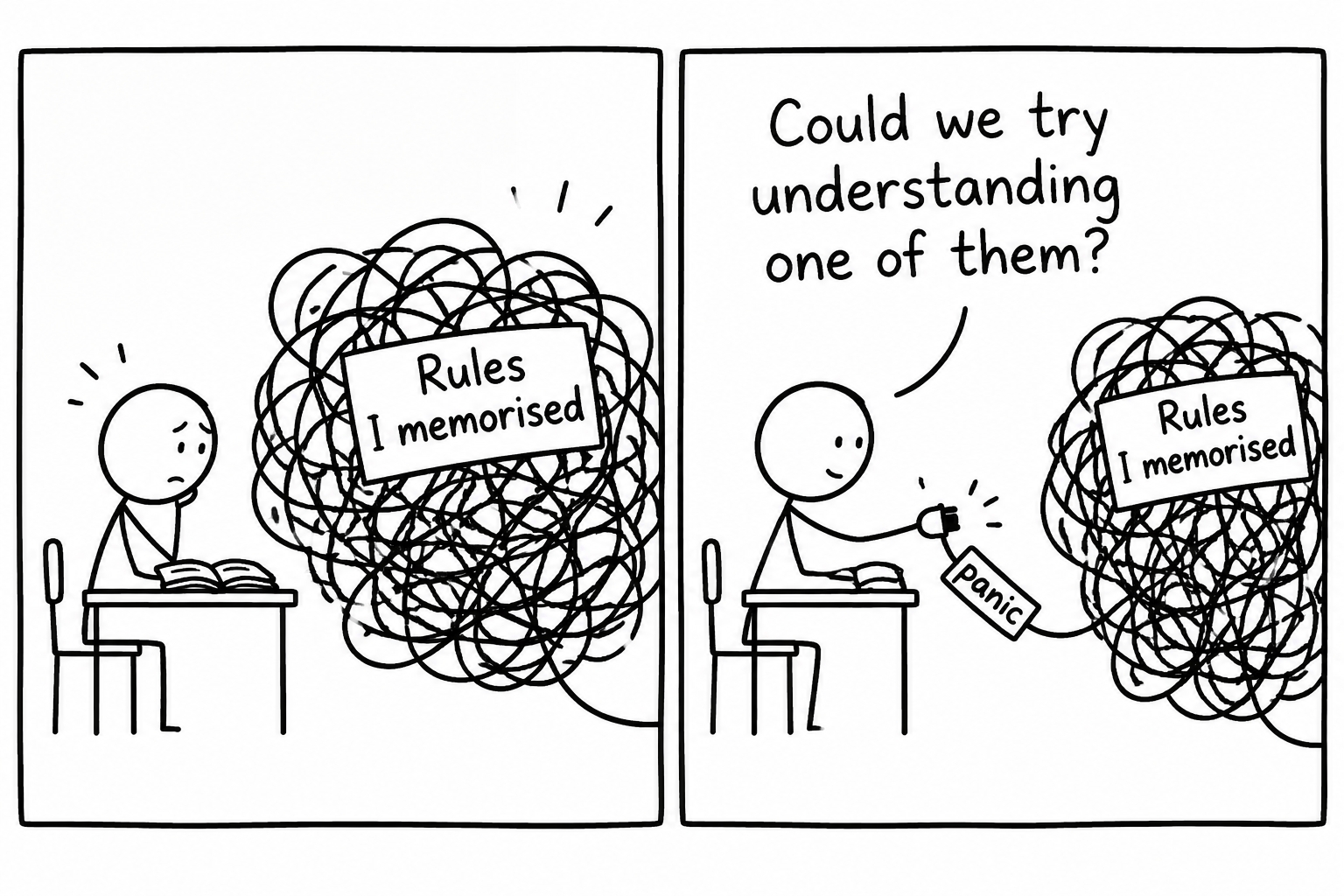 A student disconnects panic from a tangled ball of memorised rules
The main index laws explained
Multiplying powers with the same base
When powers with the same base are multiplied, add the indices:
am×an=am+n.a^m\times a^n=a^{m+n}.am×an=am+n.This works because all the repeated factors join together. For example,
a3×a2=(a×a×a)(a×a)=a5.a^3\times a^2=(a\times a\times a)(a\times a)=a^5.a3×a2=(a×a×a)(a×a)=a5.The bases must be the same. You cannot use this law to combine a3×b2a^3\times b^2a3×b2.
Dividing powers with the same base
When powers with the same base are divided, subtract the index in the denominator from the index in the numerator:
am÷an=am−n.a^m\div a^n=a^{m-n}.am÷an=am−n.Equivalently,
aman=am−n,\frac{a^m}{a^n}=a^{m-n},anam=am−n,provided a≠0a\neq 0a=0.
The subtraction reflects cancellation. In a5÷a2a^5\div a^2a5÷a2, two factors of aaa cancel, leaving three.
Raising a power to another power
When one power is raised to another power, multiply the indices:
(am)n=amn.(a^m)^n=a^{mn}.(am)n=amn.For instance, (a2)3(a^2)^3(a2)3 contains three groups of a2a^2a2, so there are six factors of aaa altogether.
A power applied to a product
An index outside brackets applies to every factor inside:
(ab)n=anbn.(ab)^n=a^nb^n.(ab)n=anbn.The same principle applies to coefficients and variables:
(3x)2=32x2=9x2.(3x)^2=3^2x^2=9x^2.(3x)2=32x2=9x2.Zero, negative and fractional indices
For any non-zero base,
a0=1.a^0=1.a0=1.A negative index means take the reciprocal:
a−n=1an.a^{-n}=\frac{1}{a^n}.a−n=an1.A fractional index represents a root:
a1n=ana^{\frac{1}{n}}=\sqrt[n]{a}an1=naand therefore
amn=amn.a^{\frac{m}{n}}=\sqrt[n]{a^m}.anm=nam.Fractional indices are generally associated with higher-tier GCSE content, while exact coverage depends on the exam board and specification. Explore them separately through fractional and negative indices revision or the concise guide to how fractional and negative indices work.
You now have the method; use the matching Maths Genie Indices Lessons and Question Bank to see each law and practise choosing it for yourself.
Index laws worked examples
Multiplying indexed terms
Simplify
4x3×2x5.4x^3\times 2x^5.4x3×2x5.First multiply the coefficients:
4×2=8.4\times 2=8.4×2=8.The base xxx is the same, and the terms are being multiplied, so add the indices:
x3×x5=x3+5=x8.x^3\times x^5=x^{3+5}=x^8.x3×x5=x3+5=x8.Therefore,
4x3×2x5=8x8.4x^3\times 2x^5=8x^8.4x3×2x5=8x8.Sam used to multiply every visible number and write 8x158x^{15}8x15. Separating the coefficients from the indices prevents that mistake.
Dividing indexed terms
Simplify
18y73y2.\frac{18y^7}{3y^2}.3y218y7.Divide the coefficients:
18÷3=6.18\div 3=6.18÷3=6.Then subtract the indices because the matching powers are being divided:
y7÷y2=y7−2=y5.y^7\div y^2=y^{7-2}=y^5.y7÷y2=y7−2=y5.The answer is
6y5.6y^5.6y5.A power outside brackets
Simplify
(2a3)4.(2a^3)^4.(2a3)4.Apply the outside power to both parts:
(2a3)4=24(a3)4.(2a^3)^4=2^4(a^3)^4.(2a3)4=24(a3)4.Calculate the coefficient and multiply the indices:
24=162^4=1624=16and
(a3)4=a3×4=a12.(a^3)^4=a^{3\times 4}=a^{12}.(a3)4=a3×4=a12.Therefore,
(2a3)4=16a12.(2a^3)^4=16a^{12}.(2a3)4=16a12.Combining more than one law
Simplify
(p3)4×p2p5.\frac{(p^3)^4\times p^2}{p^5}.p5(p3)4×p2.Start with the brackets:
(p3)4=p12.(p^3)^4=p^{12}.(p3)4=p12.Multiply powers with the same base:
p12×p2=p14.p^{12}\times p^2=p^{14}.p12×p2=p14.Finally, divide by subtracting the denominator’s index:
p14÷p5=p9.p^{14}\div p^5=p^9.p14÷p5=p9.The answer is p9p^9p9. Working one operation at a time makes a complicated expression much less fragile.
How to answer index laws questions in an exam
Index questions often test whether you can select a law, not merely recite one. Use this short routine:
- Circle or note the operation.
- Check for matching bases.
- Deal with brackets first.
- Simplify numerical coefficients separately.
- Apply one index law per line.
- Check whether any negative index should be rewritten.
Writing an intermediate line can also help the examiner follow your method. If your final answer contains an arithmetic slip, a correct method may still earn marks where the mark scheme allows it.
Try these exam-style prompts without looking back:
- simplify q4×q7q^4\times q^7q4×q7;
- simplify 20m95m3\frac{20m^9}{5m^3}5m320m9;
- simplify (3t2)3(3t^2)^3(3t2)3;
- simplify r6×r−2r^6\times r^{-2}r6×r−2;
- write k−4k^{-4}k−4 using a positive index.
The answers are q11q^{11}q11, 4m64m^64m6, 27t627t^627t6, r4r^4r4 and 1k4\frac{1}{k^4}k41. If one is wrong, identify the precise law that failed before attempting another question. Students following AQA can use the AQA GCSE Indices resources, while OCR students can work from the OCR GCSE Indices topic page.
Common index law mistakes
Applying a law when the bases differ
The expression x3×y4x^3\times y^4x3×y4 cannot become x7x^7x7, because xxx and yyy are different bases. Leave it as x3y4x^3y^4x3y4.
Multiplying indices during multiplication
For a3×a5a^3\times a^5a3×a5, add the indices. Multiplication of indices belongs to a power raised to another power, such as (a3)5(a^3)^5(a3)5.
Forgetting the coefficient
In (4x)2(4x)^2(4x)2, the outside power applies to both factors:
(4x)2=42x2=16x2.(4x)^2=4^2x^2=16x^2.(4x)2=42x2=16x2.It is not 4x24x^24x2.
Thinking a zero index gives zero
For a≠0a\neq 0a=0, a0=1a^0=1a0=1, not 000. One way to see this is
a3a3=a3−3=a0,\frac{a^3}{a^3}=a^{3-3}=a^0,a3a3=a3−3=a0,while any non-zero quantity divided by itself equals 111.
Treating a negative index as a negative value
The expression a−2a^{-2}a−2 does not mean −a2-a^2−a2. It means
a−2=1a2.a^{-2}=\frac{1}{a^2}.a−2=a21.The Maths Genie Indices revision guide is useful when you want the rules collected in one place before answering more questions.
Make the rules stick
Sam’s turning point is not memorising a longer list. It is slowing down long enough to name the operation, check the base and apply one law at a time. Knowing that routine is the first half; following it consistently under exam pressure is the second.
Your turn. Build that consistency by opening the Maths Genie Indices Lessons and Question Bank, revising one law and answering the matching index laws questions.















