

How to Use Worked Examples for GCSE Maths
How to use worked examples for GCSE Maths: learn a research-informed method, avoid passive rereading and follow a practical one-week revision plan.
A student can spend an hour rereading a maths solution and finish with a comforting sense of familiarity. Then the book closes, a similar question appears, and the first step has vanished.
Learning how to use worked examples for GCSE Maths means replacing that passive familiarity with active thinking. Study each step, explain why it works, hide parts of the solution, then solve a similar question independently. The example is not the destination. It is a bridge towards solving the problem without help.
Imagine a student called Sam making that change. Sam used to read notes and highlight methods. Now each revision session follows a short cycle: inspect, explain, complete, practise and check. Nothing dramatic changes in one evening, but revision starts revealing what Sam can actually do.
The worked-example checklist
Use this process for one topic at a time:
- Choose a question that matches the skill you need to learn.
- Read the problem before looking at its solution.
- Explain the purpose of every step in your own words.
- Cover the solution and reconstruct it.
- Complete an example with some steps removed.
- Attempt a similar question without support.
- Check your work against the answer or mark scheme.
- Record the precise mistake to revisit later.
That sequence matters. Simply copying a model answer is still passive revision.
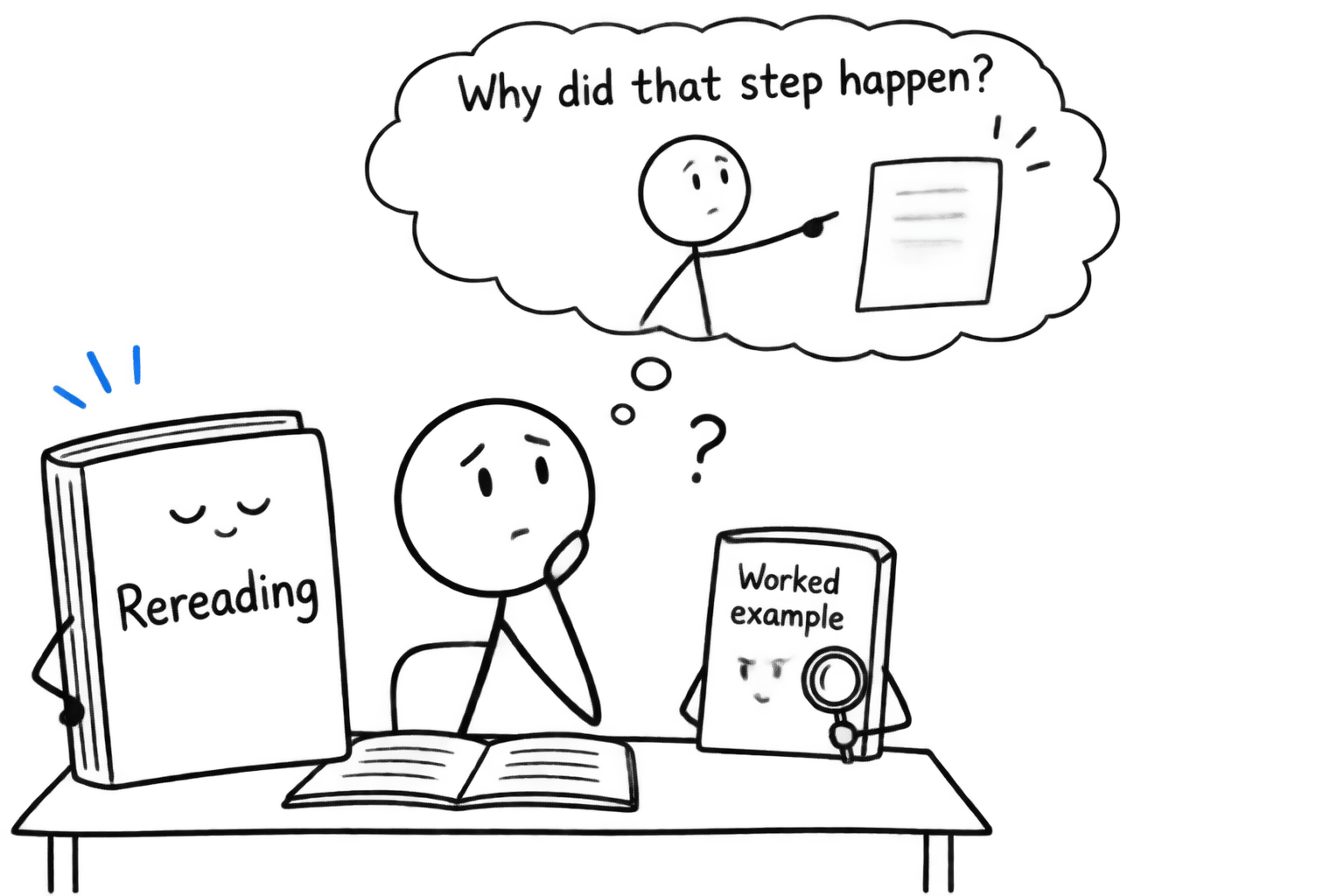 A GCSE student chooses between sleepy rereading and investigating a worked example
What research says about worked examples revision
A worked example reduces the number of decisions a beginner must make at once. Instead of searching blindly for a method while also handling arithmetic and algebra, the learner can concentrate on how a valid solution is organised.
Research on cognitive load supports this use of examples, particularly when a learner is new to a procedure. Guidance from the Education Endowment Foundation also highlights three useful ideas: explaining the reasoning, alternating examples with problems, and gradually fading support. It notes an important limit too. Once a learner is already proficient, repeatedly studying complete solutions may become unnecessary and independent problem-solving can be more useful.
This gives worked examples revision a clear purpose:
Use full guidance while a method is unfamiliar, then remove that guidance as competence grows.
Self-explanation is the active ingredient. When Sam sees a step such as
3x+5=20 3x + 5 = 20 3x+5=20followed by
3x=15, 3x = 15, 3x=15,it is not enough to think, “That looks right.” Sam should explain that subtracting 555 from both sides preserves the equality. The explanation connects the visible step to a reusable principle.
How to use worked examples for GCSE Maths
Inspect the question first
Before reading the solution, identify what the question gives you and what it asks you to find. Notice command words, units and any information hidden in a diagram.
Then predict the likely method. A prediction can be wrong and still be valuable because it forces you to compare your thinking with the model.
Annotate reasons, not actions
Weak annotations merely repeat what happened: “times by 222”. Strong annotations explain why it happened: “multiply both sides by 222 to remove the denominator while keeping the equation balanced”.
Ask these questions beside each line:
- What changed?
- Why is that operation allowed?
- Which fact, formula or rule justifies it?
- Could I recognise when to use this step in another question?
MathsGenie’s GCSE revision resources organise topics by grade and provide videos and exam-style questions, so you can study a method and then test it at an appropriate level.
Reconstruct the solution from memory
Close the page or pause the video. On blank paper, reproduce the solution and say why each step follows from the last.
If you get stuck, reveal only the next line. Then cover it again and continue. This is more useful than restarting with the complete answer visible because it identifies the exact point where your understanding breaks down.
Fade the support
Move through three levels:
- Study a complete worked solution.
- Complete a partly finished solution.
- Solve a similar problem independently.
Suppose the original model factorises
x2+7x+12. x^2 + 7x + 12. x2+7x+12.A faded example might provide
x2+9x+20=(x+□)(x+□), x^2 + 9x + 20 = (x + \square)(x + \square), x2+9x+20=(x+□)(x+□),before an independent question removes all prompts. The support decreases, but the underlying skill stays the same.
Check with precision
Do not record “algebra mistake”. That description is too broad to guide future revision. Write something specific, such as “changed the sign incorrectly when expanding the second bracket” or “used circumference instead of area”.
Use GCSE past papers when you are ready to apply methods in mixed contexts. Mark schemes show what examiners accept, while video solutions can help you locate the first step where your approach went wrong.
If arranging these example, faded and independent sessions begins to feel like another task, you can build the pattern into the MathsGenie Revision Planner instead of mapping every session by hand.
A sample week using this GCSE maths study technique
Sam chooses three weak areas rather than trying to cover the whole specification. Each session lasts about 303030 minutes, although the right duration depends on the question and the student.
| Day | Revision activity |
|---|---|
| Monday | Study two complete examples from one weak topic. Annotate every step and reconstruct the second solution from memory. |
| Tuesday | Complete two faded examples on the same topic, then answer two similar questions independently. |
| Wednesday | Study complete examples from a second weak topic and explain each decision aloud. |
| Thursday | Return to Monday’s topic without notes. Answer mixed questions and record precise errors. |
| Friday | Use a worked example for a third topic, then move immediately to a matched practice question. |
| Saturday | Attempt a short set of mixed exam questions. Use solutions only after making a serious attempt. |
| Sunday | Review the error list, retry failed questions and choose the following week’s topics. |
This is not a rigid timetable. Foundation-tier students may need more time with core number and algebra procedures. Higher-tier students may need to compare methods or practise unfamiliar problem-solving contexts. In both cases, the direction should be the same: from support towards independence.
For broader decisions about topics and timing, use the GCSE Maths revision guide as your main revision-planning hub. MathsGenie also provides Edexcel GCSE past papers, AQA GCSE past papers and OCR GCSE past papers for exam-board-specific practice.
Common mistakes with worked examples
Copying without thinking
Neat copied solutions can create the appearance of progress. If you cannot explain a line or reproduce it with the model hidden, you have not yet learnt the method.
Looking too soon
Productive effort is useful. Give an independent question a genuine attempt before checking the solution. Otherwise, the answer becomes a cue you recognise rather than knowledge you can retrieve.
Jumping to a different type of problem
The first independent question should be similar enough to test the same method. Transfer to less familiar contexts can come later. A large jump makes it difficult to tell whether the method was misunderstood or the new context caused the problem.
Studying examples after the skill is secure
Worked examples are not always the best choice. If Sam can already solve routine questions accurately, more complete models may waste time. At that stage, mixed practice, timed questions and full papers provide a more demanding test.
Memorising steps without conditions
A procedure only helps when you know when it applies. For example, dividing by a quantity containing a variable requires care because that quantity may equal 000. Learn the reasoning and conditions, not merely the shape of the model answer.
The honest limits of worked examples
Examples cannot replace independent practice. They may show a clean route through a problem, whereas an exam requires you to choose that route without being told.
They are also only as useful as their quality. A solution with unexplained jumps can leave a beginner imitating symbols without understanding. Choose examples that show enough intermediate working and use video solutions when hearing the reasoning would help.
Finally, GCSE papers mix topics. A student may solve ten clearly labelled ratio questions yet fail to recognise ratio inside a geometry problem. Once a method is secure, practise it among other topics and under exam conditions.
Turn the method into a schedule
Sam’s improvement begins when the worked example stops being something to reread and becomes something to question, hide and eventually leave behind. Knowing the cycle is one task; following it across several topics and fixed exam dates is another.
You have seen how the one-week plan works. Your turn: build your worked-example schedule in the MathsGenie Revision Planner.















