

How to Use Worked Examples for A-Level Maths
Learn how to use worked examples for A-Level Maths, replace passive rereading with active practice, and build an effective weekly revision plan.

A student can spend an hour rereading notes on differentiation and finish with a reassuring thought: “Yes, that all makes sense.” Then the textbook closes, a fresh question appears, and the first line refuses to come.
This is the gap between recognising a solution and producing one. Learning how to use worked examples for A-Level Maths means using complete solutions as temporary guidance, not as scripts to reread. Study the reasoning, explain each step, hide the solution, reproduce it, and then answer a related question independently.
That small shift turns worked examples revision from watching maths into doing maths.
The worked-example checklist
Use this sequence whenever you revise from a model solution:
- Choose one example that matches your current specification and level.
- Attempt the question briefly before revealing the solution.
- Study one step at a time and explain why it is valid.
- Cover the example and reproduce the method from memory.
- Compare your work carefully with the solution or mark scheme.
- Complete a related question without help.
- Return to the topic several days later.
The important word is related. Copying the same example from memory may test recall of that page rather than understanding of the method.
Why rereading can feel better than it works
Imagine our student revising integration. On Monday, they reread a neat page containing three solved questions. Every line looks familiar. Familiarity is comfortable, but an examination does not ask whether a solution looks familiar. It asks the student to decide what to do next.
Research reviews of learning techniques have generally judged repeated rereading as less dependable than approaches involving retrieval, practice testing and distributed practice. Research on worked examples also suggests that complete guidance can be valuable when learners are acquiring an unfamiliar procedure, because they can concentrate on the relationships between steps rather than trying random approaches.
But there is a limit. A worked solution only helps if the learner thinks about it. Simply following the ink down the page can produce an illusion of understanding.
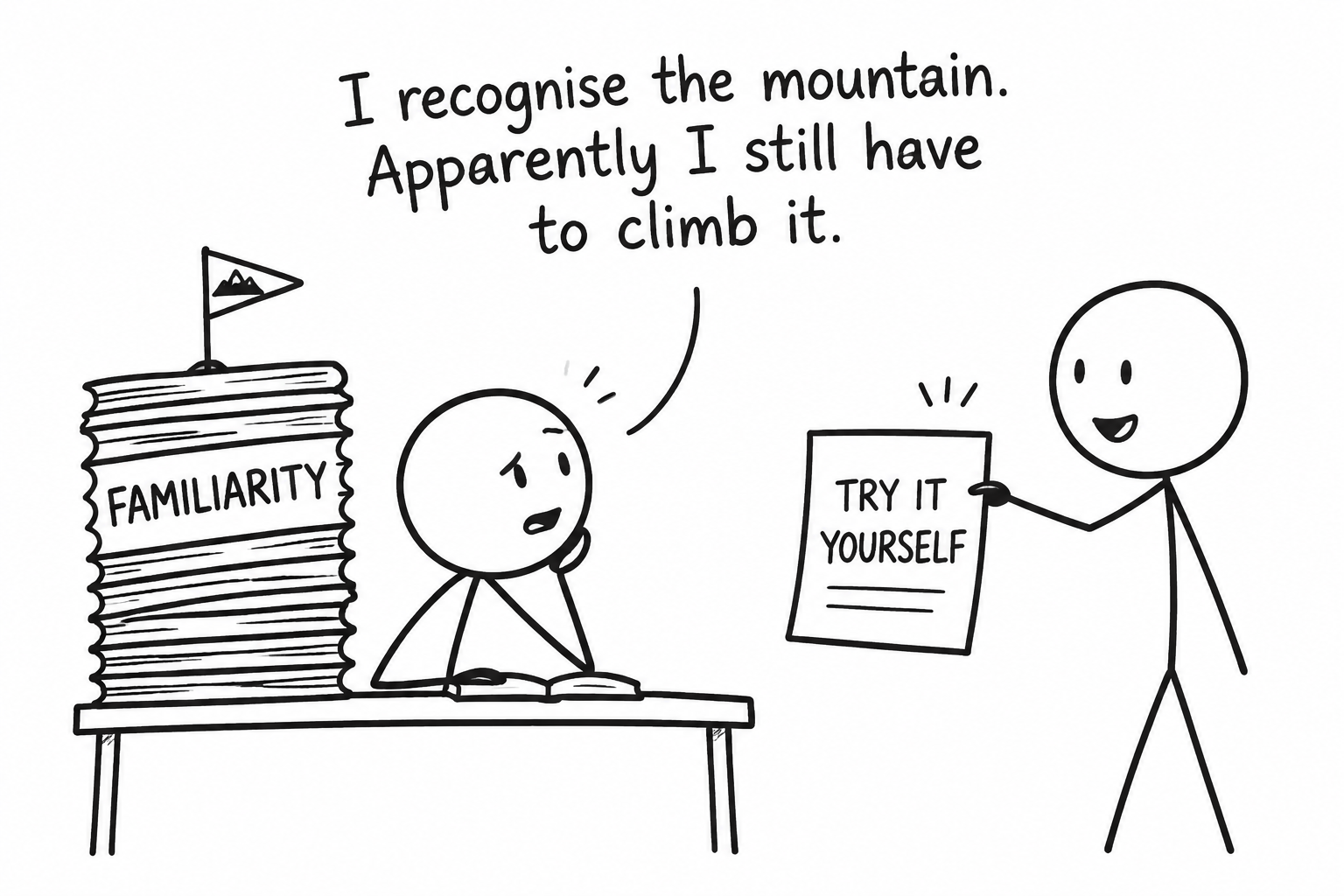 A student discovers that recognising a revision mountain is not the same as climbing it
How to use worked examples for A-Level Maths actively
By Tuesday, the student changes the routine. Instead of reading five solutions, they work deeply with two.
Attempt the opening move
Spend one or two minutes deciding how you would begin. You are not trying to complete an unfamiliar problem without support. You are activating relevant knowledge and identifying the precise point at which guidance is needed.
For a calculus question, you might ask:
- Is this differentiation or integration?
- Which rule or standard result seems relevant?
- Does the expression need rearranging first?
- Is the question asking for a function, a gradient, an area or a proof?
Record your proposed first step before looking. This prevents the solution from making the choice seem more obvious than it really was.
Explain every consequential step
Read one line, then ask why it follows. Strong prompts include:
- What fact, definition or rule justifies this?
- Why was this method chosen instead of another?
- What changed between these two lines?
- Which condition makes the step valid?
- Where could a mark be lost?
Suppose a solution transforms
dydx=3x2−4\frac{\mathrm{d}y}{\mathrm{d}x}=3x^2-4dxdy=3x2−4into
y=x3−4x+C.y=x^3-4x+C.y=x3−4x+C.Do not merely copy it. Explain that each term has been integrated and that the arbitrary constant CCC is required because differentiating any constant gives 000.
This self-explanation is the useful work. Colour-coding the page may make it attractive, but it does not replace reasoning.
Cover, reconstruct and check
Hide the worked example and reproduce the solution on blank paper. If you become stuck, reveal only the next necessary line. Then cover it again.
When checking, classify the issue:
- Knowledge gap: you did not know a rule or result.
- Selection error: you knew several methods but chose the wrong one.
- Execution error: the method was suitable, but the algebra or arithmetic failed.
- Communication error: the reasoning was not shown clearly enough.
This classification tells you what to revise. “Got it wrong” does not.
Fade the support
Guidance should gradually disappear. A useful progression is:
- Study a complete worked example.
- Complete a similar example with one or two steps removed.
- Solve a related question using only a short hint.
- Solve an unfamiliar exam-style question independently.
This process is often called fading. It matters because an experienced student may learn little from another fully explained routine question. As knowledge grows, more independent problem solving should replace full solutions.
MathsGenie’s A-Level Maths revision resources can support this progression with topic materials and questions, while A-Level Maths past papers help you test whether the method transfers to exam conditions.
Use mark schemes without copying mark schemes
A mark scheme is evidence about what earns credit, not necessarily a lesson written for first-time learning. Its lines may be compressed because examiners already understand the intervening reasoning.
After answering a question, compare your work with the mark scheme and annotate:
- the method that earned the main marks;
- any accuracy marks dependent on earlier work;
- essential notation or conclusions;
- an alternative valid route, if one is shown.
Then close the mark scheme and improve your answer independently. MathsGenie’s A-Level Maths video solutions are particularly useful when a compact written answer leaves you unsure why a step works.
A sample week of worked examples revision
The student now builds a week around one weaker topic rather than vaguely writing “calculus” in every spare box.
| Day | Worked-example activity | Independent check |
|---|---|---|
| Monday | Study two complete examples and explain each key step aloud. | Reconstruct one solution from memory. |
| Tuesday | Repeat the method with partially hidden steps. | Complete two closely matched questions. |
| Wednesday | Review the errors from Tuesday. | Answer one question without notes. |
| Thursday | Study one example with a different presentation or context. | Write how it differs from Monday’s examples. |
| Friday | Use only brief prompts where needed. | Complete a short mixed set under light time pressure. |
| Saturday | Leave the worked solutions closed. | Answer exam questions and check them afterwards. |
| Sunday | Review the error log and identify what still needs support. | Schedule the next retrieval attempt. |
The sessions need not be long. Their purpose changes across the week: understanding first, reconstruction next, then transfer and delayed retrieval.
If setting up that sequence across several A-Level topics feels cumbersome, build the week in the MathsGenie Revision Planner rather than repeatedly redrawing it on paper.
For the broader structure around this method, use the Maths revision guide as your planning starting point, then combine topic work with A-Level practice papers once independent questions become the priority.
Common mistakes with an A-Level Maths study technique
Copying before thinking
Copying can create a complete page without creating a retrievable method. Pause before each important line and predict what should happen next.
Using examples that are too difficult
A solution filled with unfamiliar notation may overwhelm rather than guide. Step back to the missing prerequisite, learn that component, and return later.
Keeping every hint available
If notes remain open throughout, you never discover what you can produce alone. Cover the support and reveal as little as possible.
Practising only one question type
Two questions can use the same underlying idea while looking quite different. Mix forms, contexts and command words so that you must select the method rather than merely repeat it.
Treating a correct answer as permanent learning
Success immediately after viewing an example may reflect short-term memory. Check again after a delay and in a mixed set.
Be honest about what worked examples cannot do
Worked examples are strongest when a method is new, complicated or repeatedly misunderstood. They are less useful when you can already complete that type of question accurately. At that stage, independent and mixed practice offers a better test.
They also cannot replace learning definitions, developing algebraic fluency or practising under examination conditions. Nor can one elegant solution prepare you for every variation across Edexcel, AQA, OCR or Eduqas specifications. Use examples that fit your course, then verify your understanding through relevant past-paper questions and mark schemes.
A balanced cycle is simple:
example→explanation→reconstruction→independent practice→later review.\text{example}\rightarrow\text{explanation}\rightarrow\text{reconstruction}\rightarrow\text{independent practice}\rightarrow\text{later review}.example→explanation→reconstruction→independent practice→later review.Turn the method into a schedule
The student’s improvement begins before any grade changes: “revise integration” becomes a sequence of specific actions, and rereading gives way to decisions, explanations and independent attempts. Knowing that sequence is useful, but following it across every topic and fixed exam date is the harder part.
You have seen how the sample week works. Now build your worked-example schedule in the MathsGenie Revision Planner.















