

How to Use Self-Explanation for A-Level Maths
How to use self-explanation for A-Level Maths: replace passive rereading with precise questions, worked reasoning and a practical weekly plan.
Rereading a page of notes can feel reassuring. The symbols look familiar, each line seems sensible, and nothing appears especially threatening. Then the notes close and the question becomes strangely difficult.
That gap between recognising a method and producing it is why learning how to use self-explanation for A-Level Maths can be valuable. Instead of merely reading a solution, you explain why each step works, how it connects to previous knowledge and when the method would fail. In practical terms, you replace “I followed that” with “I could justify that without the page”.
Imagine a student called Alex. The scenario is hypothetical, but the problem is familiar. Alex spends hours rereading examples, yet struggles to begin unfamiliar questions. The change is not to abandon notes. It is to use them as material for questioning rather than as something to absorb passively.
The self-explanation checklist
For each example or practice question:
- attempt the question before viewing the solution;
- identify the mathematical goal;
- explain why each major step is valid;
- connect the step to a definition, identity or theorem;
- predict the next step before revealing it;
- check assumptions and restrictions;
- close the solution and reconstruct the argument;
- answer a related question without help.
Self-explanation is not simply talking while you work. It is an effort to make the hidden reasoning explicit.
What self-explanation revision means
Self-explanation involves generating explanations for yourself while learning. Research reviews have generally found that prompting learners to self-explain can improve learning across different subjects and tasks. However, the effect is not automatic. Its value depends on the quality of the explanation, the learner’s existing knowledge and the support provided.
That final qualification matters in A-Level Maths. A confident but incorrect explanation can reinforce a misconception. Self-explanation should therefore sit inside a feedback loop:
attempt→explain→check→correct→retry.\text{attempt} \rightarrow \text{explain} \rightarrow \text{check} \rightarrow \text{correct} \rightarrow \text{retry}.attempt→explain→check→correct→retry.Alex’s old routine stopped after “read”. The new routine ends with checking a mark scheme, correcting the reasoning and trying again without support.
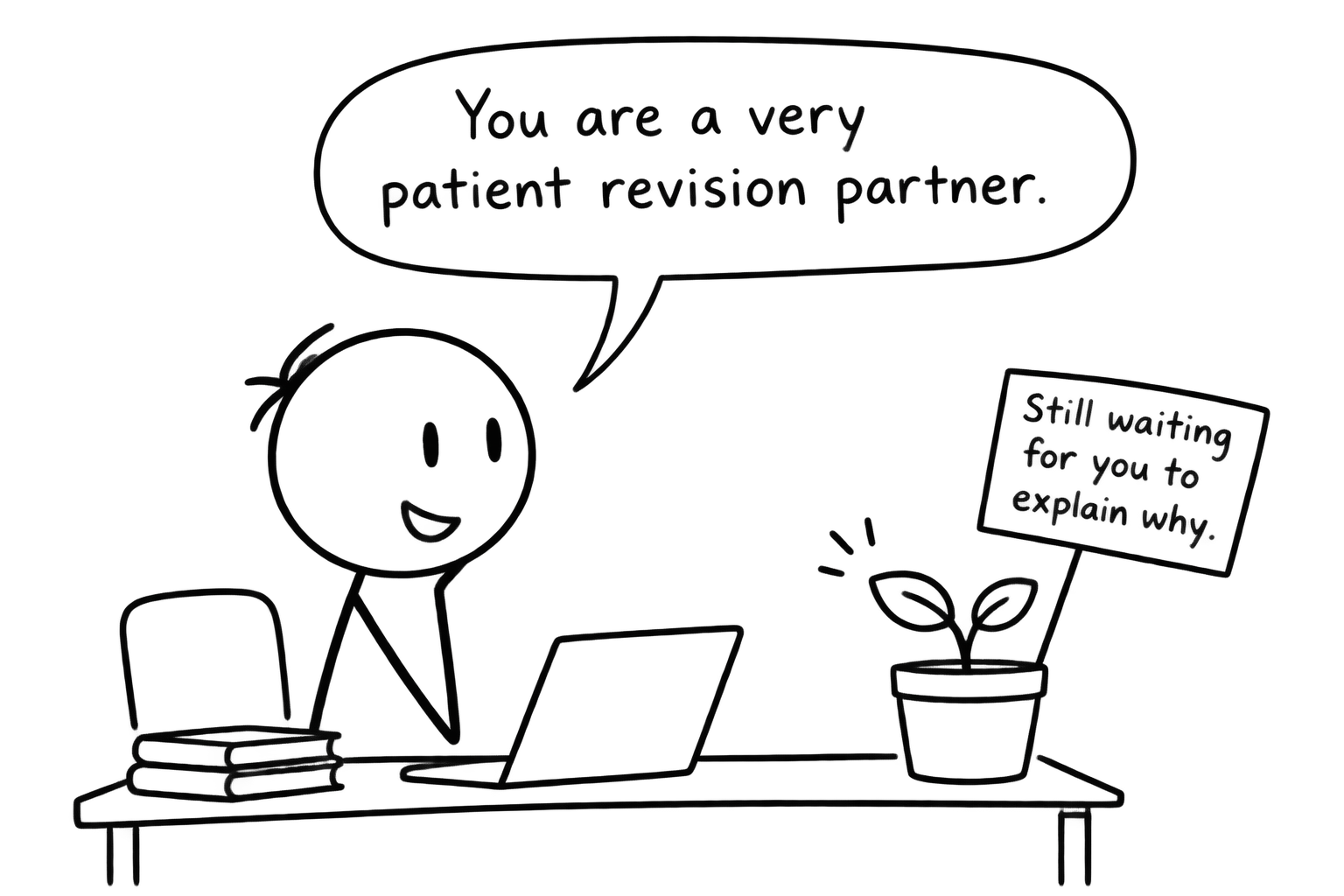 A stick-figure student discovers that a plant is a demanding revision partner
How to use self-explanation for A-Level Maths
Begin with the purpose of the question
Before manipulating any algebra, ask:
- What am I trying to find or prove?
- What information has been supplied?
- Which topic does this resemble?
- What would a valid final answer look like?
For example, if a question asks for stationary points, you should be able to explain that these occur where the derivative is zero:
dydx=0.\frac{dy}{dx}=0.dxdy=0.That explanation is more useful than remembering “differentiate and solve”, because it connects the procedure to its meaning.
Explain decisions, not every tiny movement
Narrating every symbol can overload your attention. Focus on decisions where another route was possible.
Suppose an expression contains 1−cos2θ1-\cos^2\theta1−cos2θ. A useful explanation is:
I will replace 1−cos2θ1-\cos^2\theta1−cos2θ with sin2θ\sin^2\thetasin2θ because the identity sin2θ+cos2θ=1\sin^2\theta+\cos^2\theta=1sin2θ+cos2θ=1 rewrites the expression in terms of one trigonometric function.
“I moved this over there” is not enough. Good explanations name the rule and its purpose.
Use four prompts repeatedly
A compact A-Level Maths study technique is to ask:
- Why is this step valid?
- Why is this method suitable?
- What assumption am I making?
- How can I check the result?
These prompts work across pure maths, statistics and mechanics. When modelling motion, for instance, assumptions may determine whether constant-acceleration formulae can be used. In logarithms, domain restrictions matter. When squaring an equation, checking solutions matters because extraneous solutions may have been introduced.
Predict before revealing
When using a revision lesson or worked solution, cover the next line and predict it. Even an incorrect prediction is informative if you compare it carefully with the actual step.
Use MathsGenie’s A-Level Maths revision resources to choose material for your specification, then turn each solution into a sequence of predictions. Students following Edexcel can go directly to the Edexcel A-Level Maths revision page.
Reconstruct the solution from memory
Once you understand a worked solution, close it. On blank paper, reproduce the argument and annotate the difficult decisions. If you cannot explain why a line follows, reopen the source only long enough to repair that gap.
This combines self-explanation with retrieval. One exposes the reasoning; the other tests whether you can produce it independently.
Finish with independent questions
Explanation can create an illusion of mastery if you never solve anything alone. End each session with practice questions, followed by careful checking against the mark scheme. Later, use A-Level Maths past papers and revision materials to test whether the reasoning transfers to mixed and unfamiliar questions.
A sample week of self-explanation
Alex replaces five rereading sessions with this plan. The topics are examples, so substitute the areas from your own specification that need attention.
| Day | Session | Self-explanation task |
|---|---|---|
| Monday | Differentiation | Attempt one example, justify each major step, then complete related questions independently. |
| Tuesday | Trigonometry | Explain which identities are useful and why; record any restrictions on solutions. |
| Wednesday | Statistics | Explain why a model or test is appropriate, including its assumptions and conclusion in context. |
| Thursday | Mechanics | Draw the situation, define a positive direction and explain each equation selected. |
| Friday | Mixed questions | Work without notes, then use the mark scheme to classify errors in knowledge, reasoning or accuracy. |
| Saturday | Past-paper section | Complete it under timed conditions; afterwards, explain every lost mark and redo the question. |
| Sunday | Short review | Reconstruct two difficult solutions from memory and select next week’s weak topics. |
Keep explanations brief enough that most of the session still involves doing maths. A possible 454545-minute structure is 555 minutes selecting and recalling, 252525 minutes solving and explaining, 101010 minutes checking and correcting, then 555 minutes recording what to revisit.
If arranging those sessions starts to become a revision task of its own, build the self-explanation blocks into the MathsGenie Revision Planner rather than repeatedly redrawing the week by hand.
How to tell whether the technique is working
Do not judge self-explanation by how intelligent your notes sound. Judge it by what you can do afterwards.
Look for three forms of progress:
- Independence: you need fewer hints to begin.
- Accuracy: your explanations use correct definitions and conditions.
- Transfer: you can recognise the same underlying idea in an unfamiliar question.
A simple test is to revisit a question several days later. Solve it on blank paper and explain the key decisions without seeing your previous work. If you remember sentences but cannot answer a changed question, the learning may be too tied to one example.
MathsGenie’s free A-Level resources by subject and free GCSE and A-Level revision library provide questions, videos, worksheets, past papers and mark schemes that can support this cycle. Use explanations while learning, then remove the support when testing yourself.
Common mistakes to avoid
Explaining only after reading the full answer
This often becomes paraphrasing. Attempt the question and predict steps first, even if your attempt is incomplete.
Describing actions without reasons
“I expanded the bracket” states what happened. Explain why expansion advances the solution and which law makes it valid.
Trusting an unchecked explanation
Fluency is not accuracy. Compare your work with the official mark scheme or a reliable solution, particularly when notation, assumptions or proof are involved.
Spending longer speaking than solving
Self-explanation is a learning tool, not a performance. Short written annotations or quiet questions are enough. The goal is better mathematical decisions.
Using it for everything
Straightforward facts may be revised more efficiently through retrieval practice. Timed papers require sustained independent problem-solving. Self-explanation is particularly useful when learning a method, diagnosing an error or connecting ideas, but it should not replace the rest of a balanced revision plan.
The honest limits of self-explanation
The technique cannot supply knowledge you do not yet have. If Alex misunderstands conditional probability, generating more explanations may simply produce more confident errors. A revision lesson, teacher explanation or worked solution must first repair the underlying knowledge.
It can also be mentally demanding. Novices may need prompts such as “Which theorem applies?” while more experienced students can explain larger strategic decisions. During timed practice, stopping after every line would be unrealistic. Save fuller explanations for review and error correction.
Most importantly, evidence that a technique helps on average is not a promise about every student, topic or session. Treat it as a method to test. If later performance does not improve, shorten the explanations, improve the feedback or use a different technique for that material.
Build self-explanation into your schedule
Alex’s meaningful change is not that every solution suddenly becomes easy. It is that rereading no longer disguises uncertainty: each session now ends with independent work and a clear topic to revisit. You have seen how the weekly plan works; the remaining challenge is following it consistently as fixed exam dates approach. Build your self-explanation schedule in the MathsGenie Revision Planner.















