

How to Use Mixed-Topic Practice for A-Level Maths
How to use mixed-topic practice for A-Level Maths: build better problem selection, expose weak areas and follow a realistic weekly revision plan.

A student can spend an hour rereading integration notes and feel reassuringly fluent. The examples look familiar. Each line makes sense. Then a mixed exercise asks whether to integrate, differentiate or form an equation first, and that confidence suddenly disappears.
Learning how to use mixed-topic practice for A-Level Maths closes this gap. Instead of completing a long block of nearly identical questions, you mix questions requiring different ideas. That forces you to identify the method as well as carry it out, which is much closer to what happens in an exam.
The short answer is to learn each method clearly first, then practise a carefully chosen mixture, mark it immediately and schedule your mistakes to return later.
Your mixed-topic practice checklist
A useful session has five parts:
- choose 333-555 topics, including at least one older topic;
- answer questions without being told which method each requires;
- work in manageable sets rather than attempting an entire paper every time;
- mark the set and classify each error;
- revisit missed questions after a delay.
Mixed practice is not simply random practice. The questions should be varied enough to make you think, but suitable for the content you have already been taught.
What mixed-topic practice changes
Imagine a student called Maya. This is a hypothetical example, but the pattern will be familiar. Maya revises differentiation by reading her notes and completing ten questions on the same technique. By question three, the heading has already told her what to do. She is practising execution, but not selection.
She replaces part of that routine with questions covering differentiation, integration, logarithms and trigonometry. Now every question begins with a decision:
- What information have I been given?
- What is the question asking me to find or prove?
- Which mathematical idea connects the two?
- Is there another plausible method, and why is this one better?
That decision is important. In a blocked exercise, seeing ten chain-rule questions effectively supplies the strategy. In mixed-topic practice revision, you must recognise when the chain rule is appropriate before applying it.
The most useful habit is to cover any topic heading and write a short plan before calculating. For example, your plan might say, “rewrite using indices, then differentiate”, or “form a normal distribution statement and standardise”. The plan reveals whether you can select the route, even if an algebraic slip appears later.
What the research says
Educational research usually calls this arrangement interleaving. A preregistered classroom trial published by Rohrer and colleagues in 202020202020 compared interleaved and blocked mathematics assignments across 545454 Year 777 classes. One month after the practice period, the interleaved group performed better on an unannounced test.
That is useful evidence, but it needs honest boundaries. The participants were younger than A-Level students, and their course content was not A-Level Maths. The study supports the learning principle; it does not prove that every possible mixture, timetable or A-Level resource will produce the same effect.
Interleaving can also be difficult to separate from spacing because mixed sets often bring older material back after a delay. Both features may help. Meanwhile, a session that mixes unfamiliar material indiscriminately can overload attention rather than strengthen learning.
The sensible conclusion is measured: mixed practice is promising for retaining mathematical methods and learning to distinguish between them, but it should complement clear teaching, focused initial practice and feedback. It is not a substitute for understanding.
How to build a useful mixed set
Start with methods you have already learned. If implicit differentiation is still completely new, use a lesson and focused questions first. Once you can complete straightforward examples, place it alongside related and contrasting topics.
A balanced 454545-minute set could contain:
- two recent questions;
- two questions from material covered several weeks ago;
- one question from a known weak area;
- one synoptic question connecting more than one topic.
Choose some topics that are easy to confuse. Differentiation and integration make a useful pairing because similar-looking expressions can require different actions. Binomial expansion and numerical methods are less similar, but mixing them prevents the page heading from giving away the technique.
Keep the set short enough to mark properly. Six carefully reviewed questions can teach you more than twenty questions followed by a glance at the answers.
After marking, label each mistake:
| Error type | What to do next |
|---|---|
| Knowledge gap | Return to the relevant explanation, then try a direct question |
| Method-selection error | Compare the clues in this question with a contrasting question |
| Execution error | Repeat the step slowly and record the algebraic or numerical slip |
| Communication error | Rewrite the solution with sufficient reasoning and notation |
| Time-pressure error | Retry later with a sensible time limit |
Use the mark scheme to check what a complete solution needed, not merely whether your final answer matched. If a video solution is available, pause before each step and predict what should happen next.
Once your topic list and return dates begin to sprawl, build the same mixed-topic pattern in the MathsGenie Revision Planner rather than redrawing the week by hand.
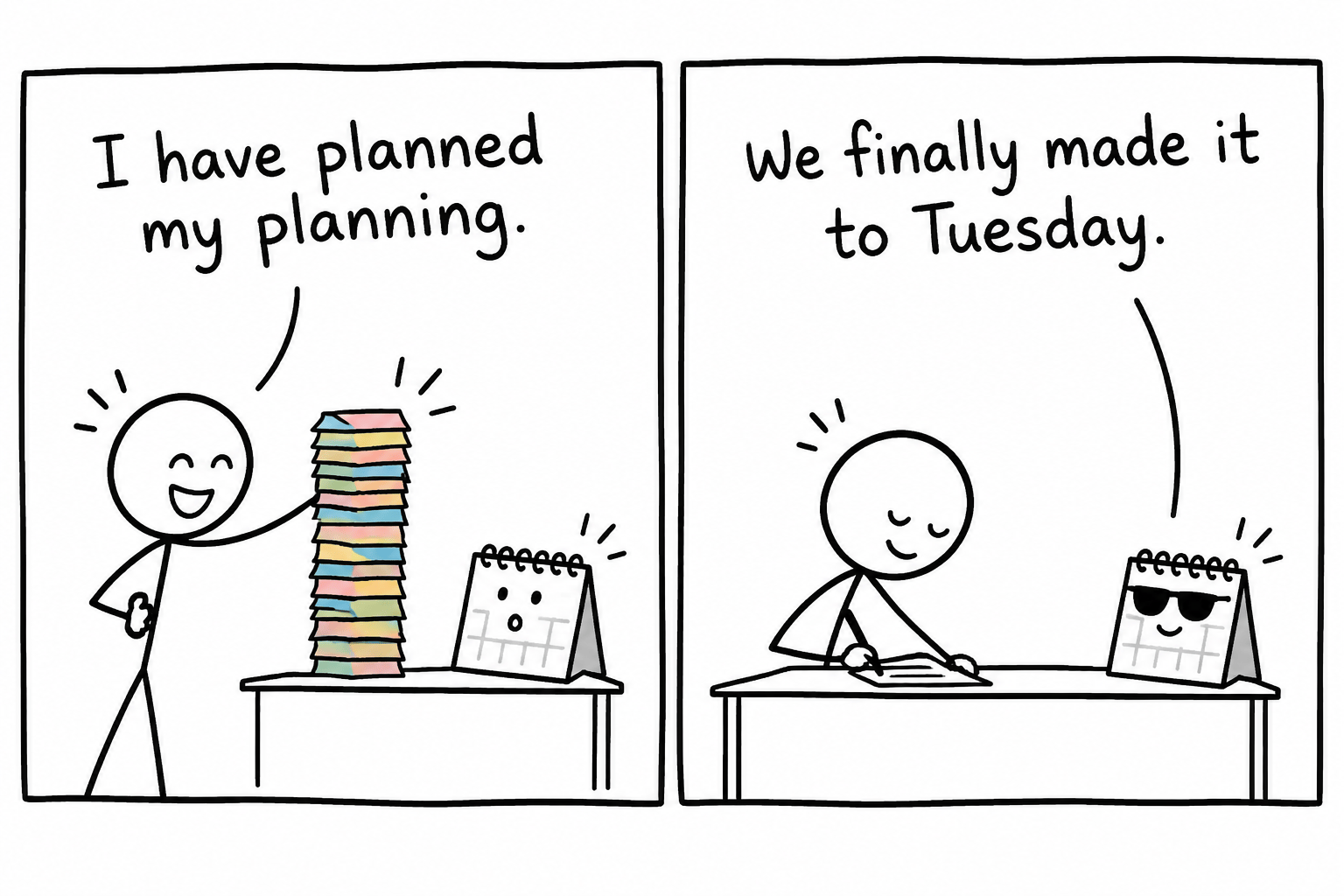 XKCD-style comic showing a student moving from planning revision to actually completing Tuesday's work
A sample week of mixed-topic practice
This sample assumes that Maya has already been taught the selected topics. It combines focused learning with mixed retrieval rather than turning every session into a miniature exam.
| Day | Session |
|---|---|
| Monday | Review one weak technique, complete three focused questions, then add two older questions |
| Tuesday | Complete a 404040-minute pure maths set mixing algebra, calculus, trigonometry and sequences |
| Wednesday | Complete a short mechanics and statistics set, then correct every error |
| Thursday | Return to Monday's missed questions without notes and add one contrasting question for each |
| Friday | Complete a timed mixed set drawn from the week's topics and one topic not seen recently |
| Saturday | Attempt part of an appropriate past paper, mark it and update the error log |
| Sunday | Rest, or spend 151515 minutes planning which errors should return next week |
The pattern matters more than the exact days. A newly learned method receives some blocked practice. It then enters a mixed set, returns after a delay and eventually appears under timed conditions.
This is an effective A-Level Maths study technique because the difficulty increases gradually. Maya no longer mistakes familiarity for mastery, but she also avoids throwing every topic into every session.
Move from mixed sets to past papers
Mixed worksheets and past papers solve related but different problems. A short mixed set gives you control over topic balance. A full paper tests endurance, timing, interpretation and the ability to move between pure mathematics, statistics or mechanics in an authentic format.
Early in revision, spend more time on targeted sets. As examinations approach, include more timed sections and complete papers appropriate to your specification. MathsGenie provides A-Level Maths revision resources, Edexcel A-Level Maths past papers and A-Level Maths predicted papers for this transition.
Use MathsGenie’s revision guide as your wider planning framework, then use the Revision Planner to organise when topics return. Relevant revision lessons, practice questions, mini tests, mark schemes and video solutions can help you respond to the weaknesses a mixed set reveals.
Common mistakes with mixed practice
Mixing topics before learning them
Interleaving is practice, not first instruction. Build a basic understanding and complete a few focused questions before adding a method to mixed work.
Making the mixture completely random
A random list can neglect important specification content or repeatedly select favourite topics. Track what you include and use your exam board specification as a coverage check.
Marking only final answers
A correct final answer can hide weak reasoning, while one arithmetic slip can obscure a sound method. Compare your working with the mark scheme and diagnose the exact point of failure.
Never repeating mistakes
An error log is useful only if it changes future practice. Put the question, or a close variation, into another session after a delay.
Abandoning focused practice altogether
If Maya misses four questions because completing the square is insecure, another broad mixture is not the immediate answer. She needs a short focused repair session before returning that skill to the mix.
Build your mixed-topic schedule
Maya's real improvement is not that planning becomes elaborate. It is that rereading gives way to choosing methods, checking errors and revisiting them on specific days. You now have the same weekly structure, but knowing the plan and consistently following it are different tasks, especially as fixed exam dates approach.
Build your mixed-topic schedule in the MathsGenie Revision Planner.















