

How to Use Interleaving for A-Level Maths
How to use interleaving for A-Level Maths: mix topics, choose methods independently and follow a practical weekly revision plan that avoids overload.
A student sits down to revise integration. They reread their notes, copy two examples and complete ten nearly identical questions. By the end, the method feels easy. Two days later, a mixed exercise asks whether to use integration by parts, substitution or neither, and that confidence disappears.
This is the problem interleaving is designed to address. How to use interleaving for A-Level Maths is fairly simple: mix related problem types within a revision session, space them across several days and make yourself choose each method before applying it. You are practising recognition as well as calculation.
Interleaving revision should not mean selecting questions at random or abandoning focused learning. First understand a method. Then mix it with methods that could plausibly be confused with it.
Your interleaving checklist
A useful interleaved session follows this pattern:
- choose 333 or 444 related topics;
- include 222 or 333 questions from each topic;
- avoid placing identical methods consecutively;
- hide topic headings where possible;
- name the likely method before beginning each question;
- mark the work and record why each error occurred;
- revisit difficult questions after a delay.
That is the method in miniature. The rest is careful selection.
Why rereading can create fragile confidence
Imagine the student swaps another evening of rereading for six mixed questions: differentiation using the chain rule, product rule and quotient rule, followed by a tangent problem. Suddenly, the page no longer announces which technique is needed.
That small uncertainty matters. In an examination, questions do not generally arrive with instructions saying, “Use the product rule now.” You must notice the structure, retrieve an appropriate method and carry it through accurately.
Blocked practice, where one method is repeated several times, can make the current procedure feel fluent because the choice has already been made. Interleaving makes practice feel less smooth because each new question requires a fresh decision. Difficulty during practice is not automatically evidence of failure. Sometimes it is evidence that the practice is testing the right skill.
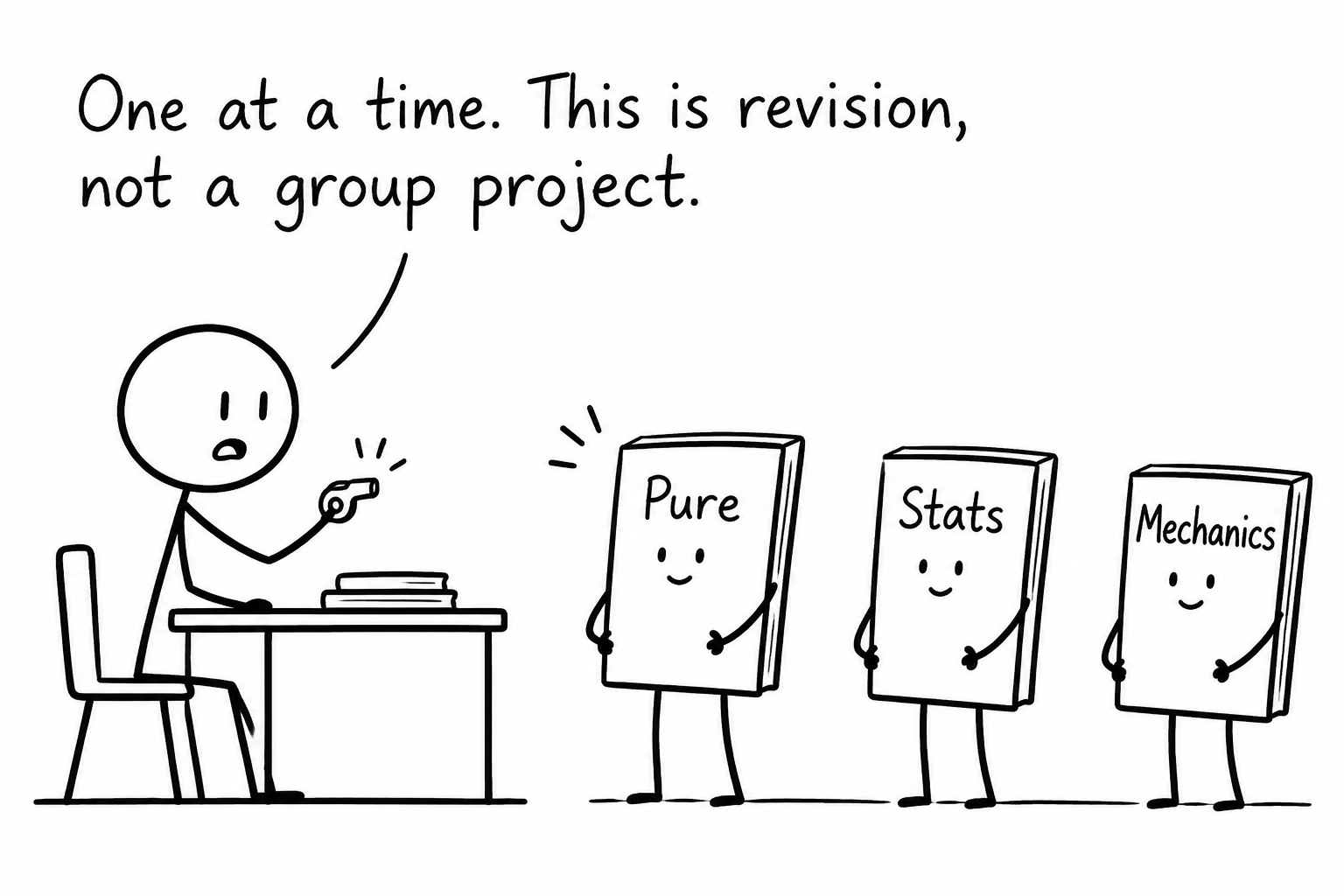 A student referees Pure, Statistics and Mechanics books as they take turns
What the research actually says
A preregistered classroom trial published in the Journal of Educational Psychology compared mostly interleaved mathematics assignments with mostly blocked assignments. It involved 545454 classes of younger secondary pupils over four months. One month after a shared review task, the interleaved group performed better on an unannounced test.
The finding supports an important idea: mixing mathematical problem types can strengthen delayed performance because learners must distinguish between strategies. It also fits earlier research suggesting that interleaving and spacing can improve retention and method selection.
But there are limits. That particular trial involved seventh-grade classes, not British A-Level Maths students. It does not prove that every mixture, timetable or learner will obtain the same result. Interleaving also combines two features: different question types are mixed, and practice of each type is spread over time. Separating their effects is not always straightforward.
The sensible conclusion is measured. Interleaving is a promising A-Level maths study technique, especially once you have gained an initial understanding, but it is not a replacement for explanations, focused practice, feedback or full papers.
How to use interleaving for A-Level Maths
Learn before you mix
If implicit differentiation is completely new, begin with a MathsGenie A-Level Maths revision lesson, notes or a teacher explanation. Complete a few focused questions until you understand the essential process.
Interleaving too early can overload the session. You cannot practise choosing between methods that you do not yet recognise. A practical progression is:
learn⟶focused practice⟶interleaved practice⟶exam practice\text{learn} \longrightarrow \text{focused practice} \longrightarrow \text{interleaved practice} \longrightarrow \text{exam practice}learn⟶focused practice⟶interleaved practice⟶exam practiceMove backwards when marking reveals a genuine gap. That is diagnosis, not defeat.
Mix topics that require meaningful choices
The best mixtures contain related methods. For example:
- product, quotient and chain rules;
- integration by substitution, integration by parts and standard integrals;
- binomial distributions, hypothesis tests and normal distributions;
- constant acceleration, resolving forces and moments;
- logarithms, exponentials and modelling;
- trigonometric identities, equations and calculus.
Mixing unrelated material can still provide spaced retrieval, but it may do less to develop discrimination. Alternating a vectors question with a simple differentiation question is varied; choosing between three plausible calculus methods is a more valuable test of judgement.
Remove labels and predict the method
Before calculating, write a brief method cue such as “chain rule” or “resolve perpendicular to the plane”. Then solve the problem.
This separates two possible weaknesses. If your method choice was wrong, the difficulty was recognition. If the choice was right but the algebra failed, the weakness was execution. Your next session should respond differently to each problem.
Mark by error type
Use mark schemes and video solutions to classify errors rather than merely count them. Useful categories include:
- knowledge gap;
- wrong method selected;
- correct method, inaccurate algebra;
- notation or communication;
- calculator mistake;
- time pressure.
MathsGenie’s A-Level past papers help you see how topics are combined under exam conditions, while A-Level predicted papers can provide further mixed practice nearer the examination period. Check your current exam board specification when deciding exactly which content to include.
A sample interleaving week
This example assumes five sessions of about 454545-606060 minutes. Adapt the length to your timetable and concentration.
| Day | Interleaved focus | Session structure |
|---|---|---|
| Monday | Chain, product and quotient rules | Brief retrieval, 999 mixed questions, mark and log errors |
| Tuesday | Binomial, normal and hypothesis testing | Identify the model before solving 666-888 questions |
| Wednesday | Integration and Monday’s weakest derivative skill | 666 integration questions plus 333 delayed derivative questions |
| Thursday | Forces, moments and constant acceleration | Mixed mechanics set, then correct method-selection errors |
| Friday | Pure, statistics and mechanics | Timed mixed section, marking and next-week topic choices |
| Weekend | Recovery or short review | Retry only the questions previously answered incorrectly |
Keep the order unpredictable but the selection deliberate. On Wednesday, for instance, you might alternate an integration-by-parts question with substitution and standard integration rather than completing each group separately.
Once this structure is clear, you can use the MathsGenie Revision Planner to build an interleaving schedule instead of arranging every session by hand.
When to use blocked practice instead
Interleaving is not a rule for every minute of revision. Blocked practice remains useful when:
- you are meeting a method for the first time;
- one algebraic procedure is causing repeated errors;
- you need several attempts to understand feedback;
- a teacher has identified a precise foundational gap.
Suppose you repeatedly differentiate ef(x)e^{f(x)}ef(x) without multiplying by f′(x)f'(x)f′(x). A short block devoted to the chain rule may be more useful than another broad mixture. Once the correction is stable, return that skill to an interleaved set.
Full papers serve a different purpose again. Use them to practise timing, stamina and unfamiliar sequencing. MathsGenie’s Edexcel A-Level Maths past papers include papers and marking resources, but students following AQA, OCR or Eduqas should use the correct materials for their specification.
Common interleaving mistakes
Mixing too many topics
A session containing ten unrelated chapters can become chaotic. Begin with 333 related skills. Increase the range only when you can review mistakes properly.
Interleaving notes rather than questions
Switching between three sets of notes is varied reading, not interleaved problem-solving. The learning value comes from retrieving and selecting methods.
Checking solutions too quickly
Productive struggle has limits, but opening the solution after 202020 seconds removes the decision-making you need to practise. Try a diagram, list known information or identify the form of the expression first.
Treating poor practice scores as proof it failed
Mixed work often feels harder than blocked work. Compare delayed performance instead: can you solve the question tomorrow, without a heading or example beside it?
Never revisiting errors
Marking is not the end of the cycle. Put unsuccessful questions into a later mini test, then remove them only after you can solve them independently.
Build the habit, not just the timetable
The student in our example has not discovered a shortcut. They have replaced the comfort of recognising a familiar page with the harder skill of recognising mathematical structure. Their sessions may feel less fluent, but every question now asks the question an examination asks: what should I do here?
Knowing the weekly pattern is easier than maintaining it while lessons, homework and fixed examination dates compete for attention. You have seen how an interleaved week works; now let the planner organise that intention into a schedule you can follow. Build your interleaving schedule in the MathsGenie Revision Planner.















