

How to Use Exam Wrappers for GCSE Maths
How to use exam wrappers for GCSE Maths: diagnose lost marks, choose focused practice and turn every mock or past paper into a better revision plan.
A student finishes a GCSE Maths mock, sees the mark and thinks, “I need to revise more.” So they reread their notes. It feels responsible, but it does not reveal why marks disappeared or what should change next.
Learning how to use exam wrappers for GCSE Maths offers a more useful response. An exam wrapper is a short reflection completed after a mock, past paper or mini test. You classify lost marks, examine how you prepared and turn that evidence into specific revision actions.
The principle is simple: do not merely record the result. Diagnose it.
The exam wrapper checklist
After marking a paper, complete these five steps:
- Record the paper, date, mark and grade boundary where appropriate.
- Classify every lost mark by its cause.
- Identify the two or three topics costing the most marks.
- Choose a precise practice task for each weakness.
- Retest those skills several days later.
This takes longer than glancing at a score, but much less time than repeatedly revising topics you already understand.
What is an exam wrapper?
An exam wrapper is a structured set of questions placed around an assessment. Before the paper, you might note how you prepared and predict which topics will be difficult. Afterwards, you compare that prediction with the marked evidence.
Exam wrappers were developed in higher education, particularly in maths and science teaching, to encourage metacognition. That means thinking accurately about your own thinking: what you know, where your judgement was wrong and which strategy should change.
Research on exam wrappers generally suggests they can support reflection, self-assessment and self-regulated learning. However, the evidence is not a promise of higher grades. Much of the published research concerns university students, studies vary in design, and reflection alone does not repair a weak skill. The useful part is the cycle that follows:
attempt→feedback→diagnosis→practice→retest\text{attempt} \rightarrow \text{feedback} \rightarrow \text{diagnosis} \rightarrow \text{practice} \rightarrow \text{retest}attempt→feedback→diagnosis→practice→retestFor a GCSE student, an exam wrapper is best understood as a decision-making tool. It helps you decide what to practise next.
How to use exam wrappers for GCSE Maths
Imagine that the student stops rereading an entire algebra chapter and marks a completed paper carefully instead. For every lost mark, they assign one category.
| Category | What it means | Sensible response |
|---|---|---|
| Knowledge gap | You did not know the fact, formula or method | Relearn the topic, then answer focused questions |
| Method error | You knew the topic but chose or applied the wrong process | Compare your working with a model solution and redo it |
| Accuracy error | Arithmetic, algebra or notation caused the loss | Practise careful written steps and checking routines |
| Question-reading error | You missed a condition, unit or command word | Underline key information and state the required answer |
| Time or strategy error | You became stuck, rushed or left accessible marks | Practise timed sections and use a return-later rule |
The categories matter because different errors need different remedies. Watching another video may help with a knowledge gap, but it will not necessarily solve poor time management. Completing twenty untimed questions may build fluency, but it will not fix a habit of ignoring units.
Mark each question using the official mark scheme where possible. MathsGenie’s GCSE Maths past papers provide papers and mark schemes for realistic practice, while the GCSE revision topics organise lessons and questions by grade.
Then answer these wrapper prompts:
- Which lost marks came from missing knowledge?
- Which came from mistakes despite knowing the method?
- Were errors concentrated in one topic?
- Did I show enough working to earn method marks?
- Where did time become a problem?
- What will I do differently before the next paper?
- On what date will I retest these skills?
The final question is essential. Without a retest date, the wrapper can become another sheet of paper that records a problem without changing it.
You now have the method; if arranging every diagnosis and retest feels cumbersome, build the sequence in the MathsGenie Revision Planner rather than leaving it as a paper list.
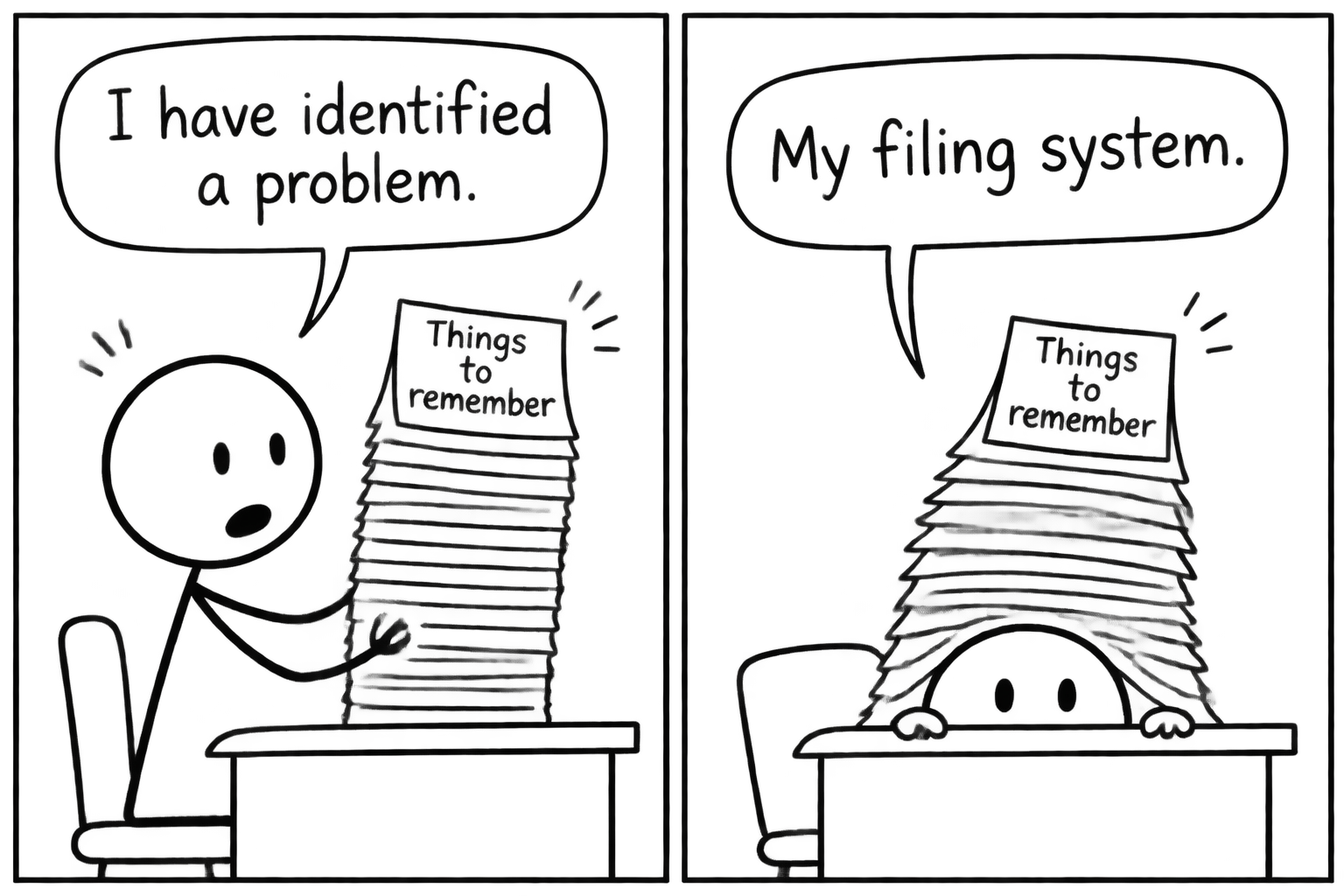 A student discovers that identifying a revision problem can create a new filing problem
Turn the wrapper into maths revision
Suppose the wrapper shows that the student lost most marks on simultaneous equations, probability trees and circle theorems. “Revise algebra, probability and geometry” is still too vague.
A stronger plan names the task and evidence of success:
- Review the method using the relevant revision lesson.
- Complete a small set of practice questions without notes.
- Mark the work and correct every error.
- Attempt fresh questions two or three days later.
- Include the topic in a mixed mini test or paper the following week.
This is where exam wrappers revision becomes more powerful than rereading. It links feedback to retrieval and application. The student must produce a solution, not simply recognise one on a page.
Use GCSE Maths revision by grade to locate an appropriate lesson and practice set. When individual skills are improving, return to GCSE Maths mini tests for mixed retrieval, then use another past paper to check whether the improvement survives under exam conditions.
A sample week using an exam wrapper
Here is a realistic weekly cycle after completing a paper on Saturday.
| Day | Revision task |
|---|---|
| Saturday | Sit one paper or timed section, then mark it accurately |
| Sunday | Complete the wrapper and choose the three highest-value weaknesses |
| Monday | Relearn weakness one and answer focused practice questions |
| Tuesday | Relearn weakness two and correct all attempts |
| Wednesday | Retest weakness one without notes, then review weakness three |
| Thursday | Complete a short mixed test containing all three topics |
| Friday | Rest or complete a brief correction session |
| Saturday | Attempt a fresh timed section and compare the error categories |
The comparison matters more than simply asking whether the mark rose. A paper can be harder, grade boundaries can differ, and a single score can fluctuate. Look for deeper changes: fewer method errors, more complete working, better pacing and successful answers on previously weak topics.
If you need another full assessment later in your revision, MathsGenie also provides GCSE predicted papers. Treat these as additional practice rather than forecasts of the exact questions that will appear.
Common exam-wrapper mistakes
Recording topics without recording causes
Writing “fractions” tells you where a mistake happened, not why. Distinguish between forgetting how to divide fractions, making an arithmetic slip and misunderstanding a worded problem.
Turning reflection into punishment
The wrapper is not a list of failures. Correct answers also provide evidence. Record the methods that worked so you know which revision habits to retain.
Copying a solution and calling it practice
A model answer can explain a method, but recognition is not independent recall. Close the solution, attempt a fresh question and mark that attempt.
Trying to repair everything at once
A paper may reveal ten weak areas. Prioritise the two or three with the greatest combination of lost marks and repeated errors. Add the rest to later weeks.
Never checking whether the plan worked
The next assessment completes the wrapper. Compare categories across papers. If knowledge errors fall but accuracy errors remain, your next plan should emphasise written steps and checking, not more content review.
Be honest about the limits
Exam wrappers cannot replace subject knowledge, good explanations, sufficient sleep or repeated question practice. Self-diagnosis can also be inaccurate. A student may label an answer “careless” when the repeated mistake actually reveals fragile understanding.
Use mark schemes and video solutions to test your diagnosis. If you still cannot explain why a method works, seek help from a teacher. The wrapper should guide revision, not pretend that every difficulty can be solved through reflection alone.
Its greatest strength is modest but valuable: it closes the gap between receiving feedback and acting on it.
Turn each paper into next week’s plan
The student in our example did not need another colour-coded set of notes. They needed a reliable way to turn lost marks into Monday’s practice, Wednesday’s retest and Saturday’s next check. Knowing that cycle is useful; following it consistently before fixed exam dates is the harder part.
Your turn. Plug your weak topics and available revision time into the planner, then let it shape the exam-wrapper actions you have identified into a schedule you can follow. Build your schedule in the MathsGenie Revision Planner.















