

How to Use Blurting for A-Level Maths
How to use blurting for A-Level Maths to recall methods, expose gaps and plan a focused week, while avoiding the limits of memory-only revision.
A student can spend an hour rereading differentiation notes and finish with a comforting thought: “Yes, I recognise all of that.” Then the notes close, a question appears, and the method vanishes.
That gap between recognising and retrieving is why learning how to use blurting for A-Level Maths can be useful. Blurting means closing your materials, writing down what you can remember, checking it carefully, and revisiting the gaps. For maths, however, recalling facts is not enough. Effective blurting must include methods, conditions and short problems before leading into proper exam-question practice.
The blurting checklist
A productive session has six stages:
- Choose one narrow topic.
- Close every book, tab and formula sheet.
- Recall key facts, methods and decisions from memory.
- Attempt one short problem without help.
- Check against reliable notes or a mark scheme.
- Correct errors, then revisit the topic after a delay.
That final step matters. Blurting is not a performance designed to prove that you know something. It is a diagnosis designed to reveal what should happen next.
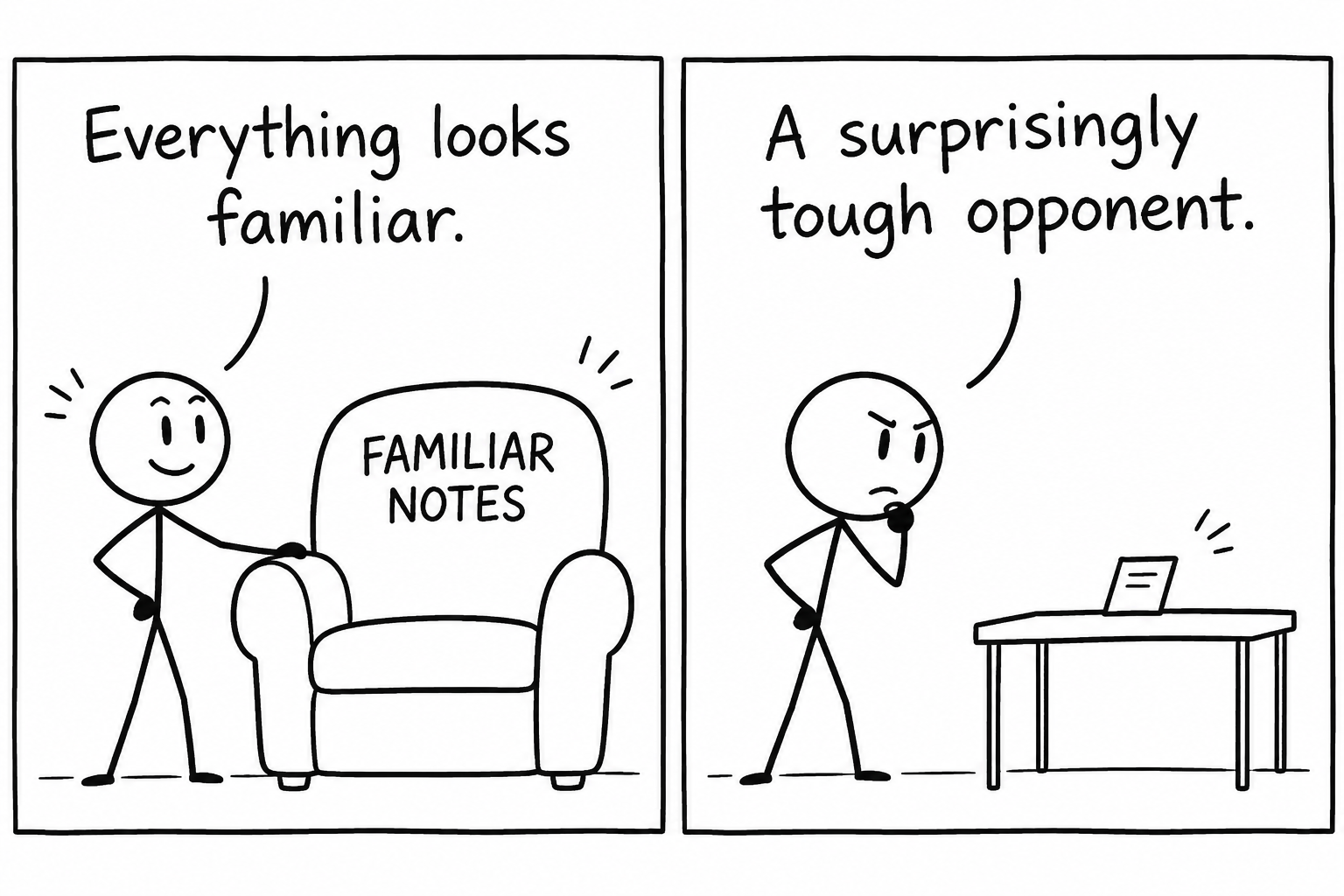 A student discovers that a blank revision sheet is tougher than familiar notes
Why rereading can create false confidence
Imagine a student called Maya. She has organised notes, highlighted examples and read each chapter more than once. Her revision feels fluent because every line seems familiar.
But familiarity is not the same as recall. An examination does not place the relevant page beside the question. Maya must identify the topic, retrieve an appropriate method and carry it through accurately.
Blurting removes the prompts. The blank page feels harder precisely because it makes memory do some work. Research on retrieval practice generally supports the value of actively recalling learned material rather than relying only on repeated reading. Spacing that retrieval across separate sessions can also make practice more demanding and support longer-term retention.
The evidence requires some care, though. A-Level Maths involves complex procedures and unfamiliar problems, not just facts. Research into mathematical problem solving does not show that retrieval practice automatically improves every kind of transfer. Blurting is therefore best treated as one part of an A-Level Maths revision system, not a replacement for worked examples, mixed exercises or timed papers.
How to adapt blurting to A-Level Maths
Traditional blurting often asks a student to fill a page with remembered information. That can work for definitions, but maths needs a more structured page.
Divide your sheet into four areas.
Recall the essential knowledge
Write definitions, formulae and conditions that are relevant to the chosen topic. For differentiation, that might include:
ddx(xn)=nxn−1\frac{d}{dx}(x^n)=nx^{n-1}dxd(xn)=nxn−1You should also recall when a result applies. Knowing a formula without its conditions can be as dangerous as not knowing it at all.
For example, recalling the chain rule should involve more than writing a symbolic pattern. You should be able to explain that a composite function is being differentiated and identify the inner function.
Reconstruct the method
Write a short sequence of decisions rather than copying a polished worked solution. For a stationary-point problem, Maya might recall:
- Differentiate the function.
- Solve dydx=0\frac{dy}{dx}=0dxdy=0.
- Find the corresponding coordinates.
- Classify the stationary point using an appropriate method.
- State the conclusion clearly.
This tests whether the structure of the method is available from memory. It also exposes missing links. If Maya remembers that stationary points involve differentiation but forgets to substitute back for the coordinates, she has found a precise revision target.
Answer a diagnostic question
Include one short question that requires the recalled knowledge. If the topic is integration, merely writing
∫xn dx=xn+1n+1+C\int x^n\,dx=\frac{x^{n+1}}{n+1}+C∫xndx=n+1xn+1+Cis weaker than using the rule and remembering the restriction n≠−1n\ne -1n=−1.
Your diagnostic question should be brief enough to reveal the method without consuming the whole session. After checking it, move to independent A-Level Maths practice questions so that you apply the idea in different forms.
Record the gap
Use three labels:
- Secure: recalled and applied correctly.
- Uncertain: broadly correct, but slow or incomplete.
- Missing: could not retrieve the knowledge or choose a method.
Be strict. A correct answer reached after several unsupported guesses is uncertain, not secure.
Once you have this four-part method, use the MathsGenie Revision Planner to place blurting sessions and follow-up questions into a schedule rather than arranging every revisit by hand.
A sample week of blurting revision
Maya stops treating “calculus” as one task. It is too broad to diagnose. Instead, she plans narrow sessions and separates the first recall from later retrieval.
| Day | Blurting focus | Follow-up |
|---|---|---|
| Monday | Differentiate powers, exponentials and logarithms | Complete topic questions and log errors |
| Tuesday | Recall integration rules and the role of CCC | Correct gaps, then attempt short integrals |
| Wednesday | Return to Monday’s differentiation without notes | Mix routine and unfamiliar questions |
| Thursday | Recall the chain, product and quotient rules | Compare method choice across questions |
| Friday | Revisit Tuesday’s integration gaps | Complete a short mixed calculus set |
| Saturday | Blurt methods from the whole week | Attempt timed questions from an A-Level past paper |
| Sunday | Review the error log and plan the next week | Rest or complete a brief weak-topic revisit |
Each initial blurt can be kept to roughly 101010-151515 minutes. Checking and follow-up practice may take longer because that is where misconceptions are repaired.
The spaced return is important. Repeating Monday’s sheet immediately may test what remains in short-term memory. Returning on Wednesday gives Maya a more honest view of what she can retrieve after time has passed.
Checking a blurt properly
Checking is not a quick glance followed by a tick. Use a different colour and annotate three kinds of issue:
- Knowledge error: a missing formula, definition or condition.
- Method error: the wrong approach or an incomplete sequence.
- Execution error: faulty algebra, arithmetic or notation.
Then write a correction beside the error and test it with a fresh question. Copying the correct method can make it look familiar again, but solving another problem tests whether the correction is usable.
When working through full papers, use official-style A-Level Maths past papers and their mark schemes to understand where marks are awarded. Video solutions can then help when a written mark scheme shows the required result but does not make the reasoning clear.
Common blurting mistakes
Choosing a topic that is too broad
“Pure maths” produces a scattered page. “Using the product rule” gives you something testable. Narrow prompts make gaps easier to act on.
Making the page look attractive
Blurting is retrieval, not note decoration. If presentation consumes more attention than recall, the method has drifted away from its purpose.
Looking too soon
Struggle is not automatically evidence of failure. Give yourself time to retrieve, but do not turn the session into prolonged guessing. Mark a gap, check it and repair it.
Recalling formulae without using them
A formula blurt may support memory, but A-Level Maths assesses application. Every session should lead to at least one unseen question.
Never returning to the topic
One successful session does not establish durable knowledge. Revisit uncertain material after a delay and mix it with older topics.
Replacing exam practice with blurting
This is the largest limitation. Blurting can reveal whether Maya remembers the quotient rule. It cannot, by itself, prepare her to recognise a disguised quotient in a long modelling question, manage time or communicate a complete proof. Those skills require varied questions and timed papers.
Where blurting fits in your revision
Blurting works best near the beginning of a revision cycle. It identifies what you can retrieve before you spend time answering questions. The result should change your next action:
- Missing knowledge leads to a revision lesson or worked example.
- An uncertain method leads to focused practice.
- Repeated execution errors lead to slower checking and an error log.
- Secure knowledge leads to mixed or timed exam questions.
That makes blurting an efficient A-Level Maths study technique, but not a complete revision strategy. Maya improves the quality of her revision when she stops asking, “Have I read this?” and starts asking, “Can I retrieve it, apply it and recognise when it is needed?”
Build your blurting schedule
Maya’s real difficulty was not understanding the method. It was remembering which topic to revisit and when, alongside lessons, homework and past papers. Exams have fixed dates, so every unplanned week reduces the time available for useful spaced practice.
You have seen how the sample week works. Now build your blurting schedule in the MathsGenie Revision Planner.















