

How to Use Active Recall for A-Level Maths
How to use active recall for A-Level Maths: replace passive rereading with retrieval, exam questions, feedback and a practical weekly revision plan.
A student opens a textbook at differentiation and feels an immediate flicker of relief. The examples look familiar. The annotations make sense. Yet, faced with a blank exam question the next morning, the first line refuses to appear.
This is the gap that how to use active recall for A-Level Maths needs to solve. Instead of repeatedly looking at a method, you practise retrieving it without support, apply it to questions, check the result and revisit it later. For maths, however, recalling facts is only the beginning. You must also recognise when and how to use them.
Imagine that student swapping an hour of rereading for a shorter but more demanding routine. They close the book, write what they remember, attempt questions and use the evidence to plan the next session. Revision feels less comfortable, but it becomes more informative.
Active recall for A-Level Maths at a glance
A useful session follows five steps:
- choose one precise skill, not an entire chapter;
- retrieve key facts and method steps from memory;
- solve questions without notes;
- mark every answer and diagnose each error;
- schedule another attempt after a delay.
The central rule is simple: try to remember before you look. This turns revision from exposure into a test of what you can actually produce.
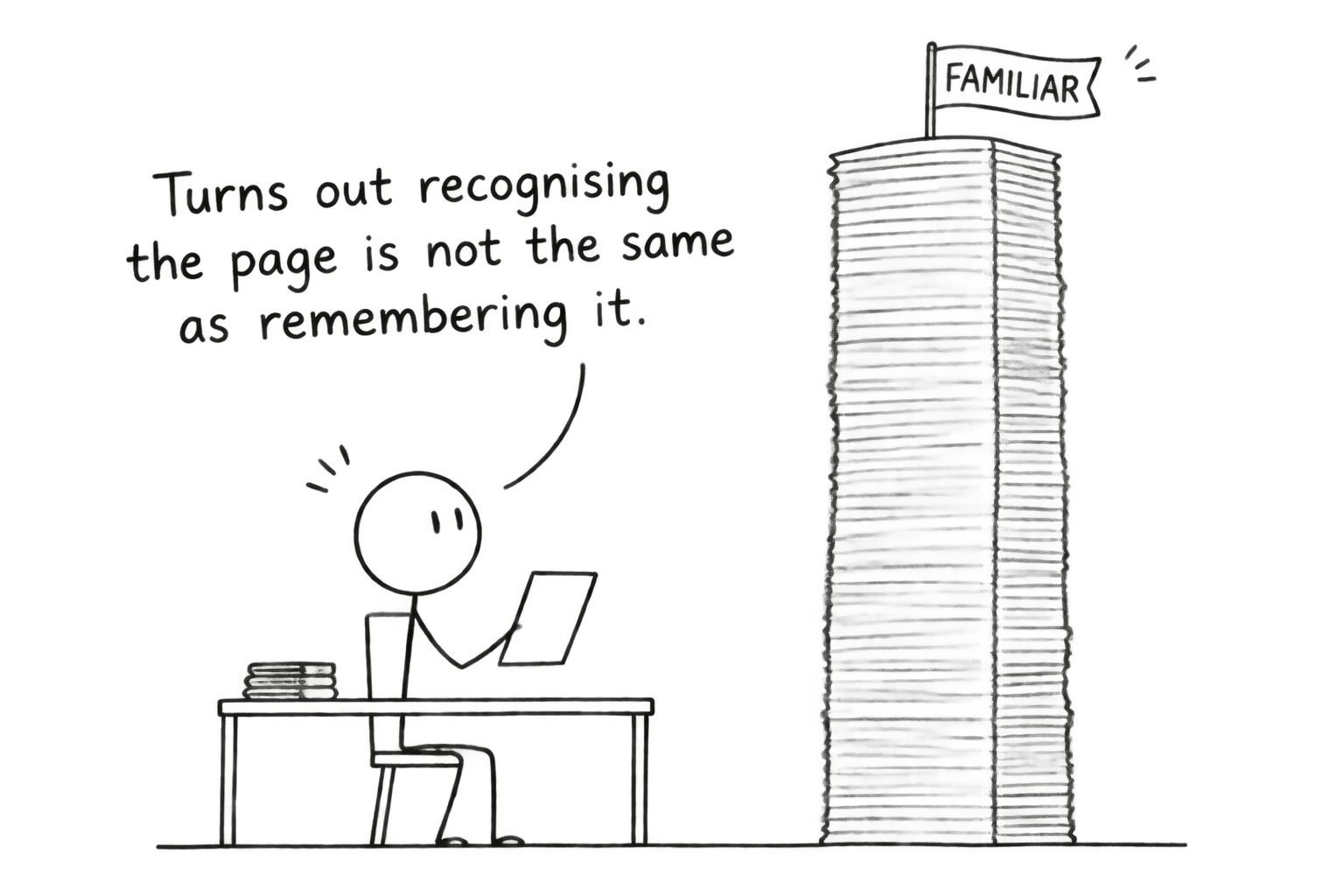 A student discovers that familiar notes are not the same as remembered knowledge
What active recall revision research suggests
Active recall is often called retrieval practice in learning research. Its basic principle is that bringing information to mind can strengthen later access to it. Classroom research generally supports retrieval practice across different subjects and formats, especially when attempts are followed by feedback.
This helps explain why rereading can be deceptive. A page becomes easier to recognise, so it feels learned. But an examination does not ask whether a worked solution looks familiar. It asks you to generate a route from a new prompt, usually under time pressure.
Difficulty is not automatically evidence that revision is failing. If retrieving the quotient rule feels harder than reading it, that effort may reveal what has and has not been retained. For example, you should be able to produce
ddx(uv)=vdudx−udvdxv2\frac{\mathrm{d}}{\mathrm{d}x}\left(\frac{u}{v}\right)=\frac{v\frac{\mathrm{d}u}{\mathrm{d}x}-u\frac{\mathrm{d}v}{\mathrm{d}x}}{v^2}dxd(vu)=v2vdxdu−udxdvwithout simply recognising it on a formula sheet.
There are limits. Remembering a formula does not guarantee that you can select it, manipulate it accurately or interpret an unfamiliar problem. Evidence for retention is stronger and more straightforward than evidence that retrieval automatically transfers to every novel task. Active recall is therefore best treated as one part of maths revision, alongside varied problem-solving, feedback and exam practice.
How to use active recall for A-Level Maths
Start with a narrow retrieval prompt
Do not write “revise calculus” on your plan. Choose something observable, such as:
- recall the product, quotient and chain rules;
- sketch the shapes of standard trigonometric graphs;
- state the conditions needed for a binomial approximation;
- explain how to test whether two events are independent;
- derive the equation of a tangent from a gradient and point.
Close your notes and write everything you can remember for two or three minutes. This is sometimes called blurting. Then compare your attempt with a trusted lesson or textbook and correct it in another colour.
For instance, a good prompt is not merely “What is integration?” It is “How would I integrate xnx^nxn, and what restriction applies?” Your recalled answer should include
∫xn dx=xn+1n+1+c,n≠−1.\int x^n\,\mathrm{d}x=\frac{x^{n+1}}{n+1}+c, \qquad n\ne -1.∫xndx=n+1xn+1+c,n=−1.The restriction matters. Active recall should retrieve conditions and notation, not just the memorable centre of a rule.
Move quickly from recall to calculation
Flashcards can help with definitions, identities, distributions and method triggers. They are less useful when they become a substitute for doing mathematics.
After recalling a method, answer questions without notes. Begin with one routine question to check execution, then use questions with different wording or mixed topics. A strong active recall revision sequence might be:
- State the relevant rule from memory.
- Explain when it applies.
- Complete one direct question.
- Complete one question where the method is not named.
- Mark both attempts and record the cause of each error.
This develops factual recall, procedural fluency and method selection. Those are related skills, but they are not identical.
Use feedback immediately
Retrieval without correction can rehearse an error. Mark your response while your reasoning is still fresh, using the complete solution or mark scheme rather than checking only the final answer.
Classify errors under short labels:
- recall: the formula or fact was missing;
- selection: you knew the method but did not recognise when to use it;
- execution: algebra, arithmetic or notation broke down;
- interpretation: you misunderstood the context or what the answer represented;
- exam technique: insufficient working or an incomplete conclusion cost marks.
The label determines the next action. A recall error needs another closed-book prompt. A selection error needs mixed questions. An execution error needs focused practice on the weak step.
MathsGenie's A-Level Maths revision resources can provide the question practice and solutions needed to complete this loop, rather than leaving recall as an isolated memory exercise.
Space and mix your retrieval
Do not wait until a topic feels forgotten forever, but do allow some forgetting to occur. Revisit it after a delay, then extend the interval when retrieval is successful.
A practical pattern could be:
- first attempt on Monday;
- short retrieval on Wednesday;
- mixed questions on Saturday;
- another check the following week.
Intervals should respond to evidence. If Wednesday's attempt is weak, revisit sooner. If you can recall and apply the method accurately, leave a longer gap and mix it with another topic.
Interleaving also matters. An exercise headed “integration by parts” has already told you what to do. Mixed questions make you identify the method yourself. Gradually include A-Level Maths past papers, where techniques appear without helpful chapter labels.
Once you have listed the topics and revisit dates, use the MathsGenie Revision Planner to organise this active recall cycle instead of rebuilding it on paper each week.
A sample week of active recall revision
This example assumes five manageable sessions. Adjust their length around lessons, other subjects and your current workload.
| Day | Active recall task | Evidence to keep |
|---|---|---|
| Monday | Retrieve differentiation rules, then complete two focused questions without notes | Missing rules and errors |
| Tuesday | Recall statistical definitions, then explain which distribution fits several short scenarios | Misidentified conditions |
| Wednesday | Return to Monday's weak points, then attempt one mixed calculus question | Changes since Monday |
| Thursday | Retrieve trigonometric identities and exact values, then solve two equations | Sign and interval errors |
| Saturday | Complete a timed mixed set or part of a past paper, mark it and choose next week's priorities | Marks lost by topic and cause |
The hypothetical student in our opening no longer counts pages read. They count successful retrievals, corrected misconceptions and questions completed without support. On Sunday, they do not need to invent an entirely new plan. They carry forward the errors that still need attention.
You can support the paper stage with MathsGenie's A-Level Maths past papers, then compare your working carefully with the available mark schemes. The MathsGenie revision blog also collects related planning guidance, while the revision-planning guide explains how a day-by-day plan can give each return session somewhere to live.
Common active recall mistakes
Turning every note into a flashcard
Not all knowledge belongs on a card. Use short prompts for facts and triggers, but retrieve full methods by solving questions. If a card's answer requires several lines of reasoning, a blank-page explanation or practice question may be better.
Looking too soon
A brief struggle is useful because it exposes the boundary of your knowledge. Commit to an answer before checking. If you are completely stuck, use the smallest possible hint, then restart the question later without that support.
Recalling formulas without meaning
Knowing sin2θ+cos2θ=1\sin^2\theta+\cos^2\theta=1sin2θ+cos2θ=1 is valuable. Knowing when it simplifies an expression is more valuable. Pair every fact prompt with an application prompt such as, “What form in the question would make this identity useful?”
Practising only successful topics
Active recall can become comfortable if you repeatedly test material you already know. Use your error record to decide what returns. Weak topics should appear more often, while secure ones should still receive occasional checks.
Treating recall as a complete revision system
Retrieval cannot replace teaching when you do not yet understand a concept. Learn the idea through a clear explanation and worked examples first. It also cannot replace longer, timed papers, because stamina, method selection and communication must be practised in examination conditions.
Build your active recall schedule
The student in our example improved the process by replacing a loose pile of handwritten intentions with scheduled return dates. The real challenge is not understanding active recall; it is remembering which topic to retrieve next while every subject competes for time.
You have seen how the weekly cycle works. Exams have fixed dates, so turn your weak topics, question sessions and spaced reviews into a plan you can follow. Build your active recall schedule in the MathsGenie Revision Planner.















