

How to Stop Procrastinating on Revision
How to stop procrastinating on revision with a realistic five-step plan for starting, removing distractions and building a routine you can follow.
A student sits down at the kitchen table at 6:006{:}006:00 pm. The textbook is ready. The exam date is fixed. Yet, twenty minutes later, the pencil case has been reorganised and no revision has happened.
A parent watching this may see laziness. The student usually feels something more complicated: the task is too large, the starting point is unclear, or getting an answer wrong feels easier to avoid than confront.
If you want to know how to stop procrastinating on revision, the practical answer is to make starting smaller, make each task specific and remove the need to decide what to do in the moment. Do not wait to feel motivated. Choose one short task, set a start time, remove distractions and begin for ten minutes.
That first ten minutes matters because procrastination is often a problem with starting, not a lack of ambition.
The anti-procrastination checklist
Use this sequence whenever revision keeps slipping:
- Name one precise task, not an entire subject.
- Reduce it to a task you can start in ten minutes.
- Decide when and where you will begin.
- Put your phone beyond reach.
- Work actively by answering questions or recalling ideas.
- Record the next task before you stop.
- Return at the next planned time, even if today was imperfect.
This is deliberately simple. A complicated system can become another thing to postpone.
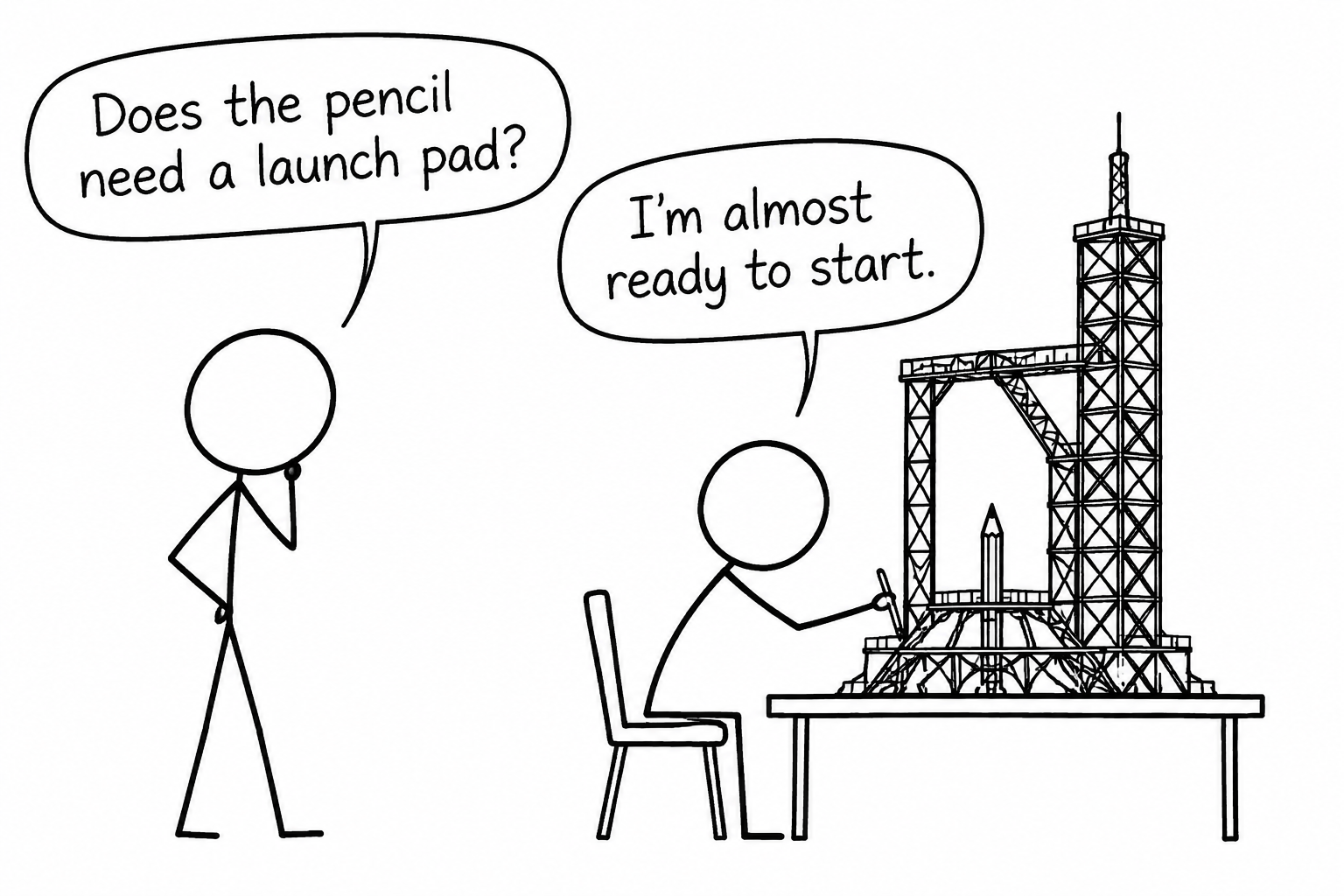 A student builds an elaborate launch pad for a pencil instead of beginning revision
Why revision gets postponed
Procrastination can look like poor time management, but time is not always the real issue. A student might have a free evening and still avoid beginning because “revise maths” is vague and emotionally heavy.
Compare these two tasks:
- Revise algebra.
- Complete five factorising questions, mark them and retry any mistakes.
The second task has a visible beginning and end. It also removes a decision. This matters because broad intentions leave questions unanswered: Which topic? Which resource? How long? What counts as finished?
Fear can play a part too. Attempting a question creates the possibility of being wrong. Avoiding it protects confidence briefly, but the uncertainty remains. A short, specific task makes that discomfort manageable.
A five-step plan for starting revision
Imagine the student at the kitchen table tries again the following evening. This time, the aim is not to create the perfect timetable. It is simply to make the next action obvious.
Turn subjects into visible actions
Write tasks that produce evidence of work. “Do science” and “look at maths” are not useful instructions.
Better tasks include:
- answer ten questions on simultaneous equations;
- recall one biology topic without notes, then check omissions;
- plan one English Literature paragraph;
- complete one past-paper section under timed conditions;
- mark yesterday’s questions and correct every error.
For maths, the free GCSE revision resources and A Level maths revision resources give each session a clearer focus. Choose a topic, attempt its practice questions and use the mark scheme or video solution to check your thinking.
Make the first session deliberately small
Tell yourself you need to work for ten minutes, not all evening. Pick up the pen, attempt the first question and continue only when the timer ends.
Ten minutes will not complete a course. That is not its purpose. Its purpose is to cross the gap between intending and doing. Once work has started, continuing often feels less demanding because the uncertainty has gone.
If you stop after ten focused minutes, you have still strengthened the habit of beginning. The next session can be longer, perhaps 252525 minutes followed by a short break. Increase the duration only when you can start consistently.
Use an if-then plan
An if-then plan links a predictable situation to an action. For example:
If it is 6:006{:}006:00 pm and I have finished eating, then I will sit at the desk, put my phone in another room and answer five algebra questions.
This is more effective than “I will revise later” because “later” has no clear trigger. Choose a time that fits school, meals, travel, sleep and other commitments. Revision planning should organise your real week, not an imaginary week in which nothing interrupts you.
Remove friction before the start time
Motivation should not have to compete with notifications, missing worksheets and ten open browser tabs.
Before the session:
- place the required book or webpage ready;
- put your phone outside arm’s reach, preferably in another room;
- close unrelated tabs;
- keep water and basic equipment nearby;
- tell family members when the session will finish if interruptions are likely.
Parents can help by supporting the agreed routine without repeatedly asking whether revision has started. A calm question such as “What is your first task?” is often more useful than “How many hours have you done?”
Finish by making tomorrow easier
At the end, write down the next physical action. It might be “retry question 777 without the solution” or “complete the second half of the paper”. Leave the relevant materials ready if possible.
This prevents the next session from beginning with another planning debate. The student at the kitchen table no longer has to decide what revision means each evening. The first step is already waiting.
If setting up these tasks across several subjects feels like another project to avoid, use the MathsGenie Revision Planner to build the schedule rather than drawing it all by hand.
Use a study technique that makes progress visible
Passive reading feels comfortable, but it can hide whether you can recall or apply anything. Active revision produces evidence.
For GCSE revision and A Level revision, useful approaches include:
- answering practice questions without copying an example;
- recalling a method or definition before opening notes;
- completing part of a paper under timed conditions;
- marking work and identifying the exact cause of each error;
- returning to weak topics after a gap rather than doing them once.
MathsGenie’s GCSE maths past papers can turn “revise maths” into a concrete paper or section. The site’s revision lessons, practice questions, mini tests, mark schemes and video solutions can then help you move from recognising a method to using it independently.
A productive session is not one in which everything feels easy. It is one that shows you what you can do and what needs another attempt.
What to do after a missed revision session
One missed session does not ruin a plan. The greater risk is treating it as proof that the whole timetable has failed.
Do not try to squeeze every missed task into tomorrow. Instead:
- protect tomorrow’s most important planned task;
- move the missed work to the next genuinely available slot;
- shorten or remove a lower-priority task if necessary;
- ask why the session was missed and adjust the trigger, duration or environment.
A realistic timetable contains space. Exams have fixed dates, but students still need sleep, meals, school and time away from revision. Consistency grows from a plan that can survive an imperfect day.
Common revision mistakes
Waiting for motivation
Motivation often appears after starting. Use a time, place and tiny first action instead of asking whether you feel ready.
Measuring only hours
Two hours beside an open textbook is not automatically better than 303030 focused minutes of retrieval and practice. Track completed tasks and corrected mistakes as well as time.
Planning every minute
An overloaded timetable creates failure before work begins. Leave room for difficult topics, schoolwork and ordinary life.
Revising comfortable topics repeatedly
Familiar work can create a reassuring sense of fluency. Give more time to weaknesses identified through questions, past papers and marking.
Making the plan instead of doing the work
Colour coding can be useful, but revision planning has a stopping point. Once you know the next task and start time, begin.
Build a revision routine you can begin
The student at the kitchen table did not need a dramatic change in personality. The improvement was quieter: one defined task, one start time and fewer decisions at the moment of action. Knowing the plan helps, but following it becomes harder when every day still has to be organised from scratch.
Your exams have fixed dates, so each week without a workable schedule reduces the time available. Build your subject schedule in the MathsGenie Revision Planner.















