How to Revise Maths in a Noisy House
How to revise maths in a noisy house: plan short sessions, handle interruptions and protect quiet time with practical GCSE and A Level maths revision tips.
If you’re wondering how to revise maths in a noisy house, start by matching your tasks to the noise: save unfamiliar methods and timed papers for quieter windows, use busier periods for short practice and corrections, and leave yourself a clear restart point whenever you’re interrupted.
You don’t need to wait for a silent home. You need a plan that allows for the home you have.
A workable plan for a noisy evening
Replace “revise maths tonight” with a small, specific sequence:
- Choose one topic and have the questions ready.
- Find a quieter window for the hardest thinking.
- Work for twenty minutes, then mark and correct your answers.
- Keep a shorter fallback task ready.
- Write down what to revisit next time.
Twenty minutes is a starting point, not a scientifically perfect session length. Adjust it to your concentration and household.
MathsGenie’s guide to revising GCSE maths efficiently follows this approach: identify a weakness, practise, check your work and revisit difficulties. The room changes how you organise that process.
Find quieter windows before filling your timetable
A realistic plan starts by noticing when the house settles down. Is the kitchen quieter before dinner? Does a sibling have an activity one afternoon? Is there a short window before everyone gets home?
Protect those windows for unfamiliar methods, difficult explanations or longer exam questions. At A Level, that might mean a demanding mechanics problem. At GCSE, it could mean a geometry question with several connected steps.
Use busier periods for familiar practice, checking corrections or recalling methods you have already learnt. These tasks still need attention, but they are often easier to resume.
The GCSE maths revision timetable guide can help turn those windows into a weekly routine. Include spare time so one disrupted evening does not push everything else back.
Build your schedule in the Revision Planner, separating demanding tasks from shorter fallback sessions.
Ask for a small, specific quiet agreement
“Please be quiet while I revise” leaves everyone guessing about what you need and for how long.
Try: “Could the television be lower until half past seven? I’m doing a timed set of questions.” Ask beforehand where possible, rather than once you are frustrated.
You might agree on headphones for shared entertainment, fewer interruptions during one slot, or temporary use of another room. Explain when you will be available again, especially if you have household responsibilities.
Some families cannot offer much quiet space. Ask school or college whether a library, classroom or supervised revision space is available, and check opening times before relying on it.
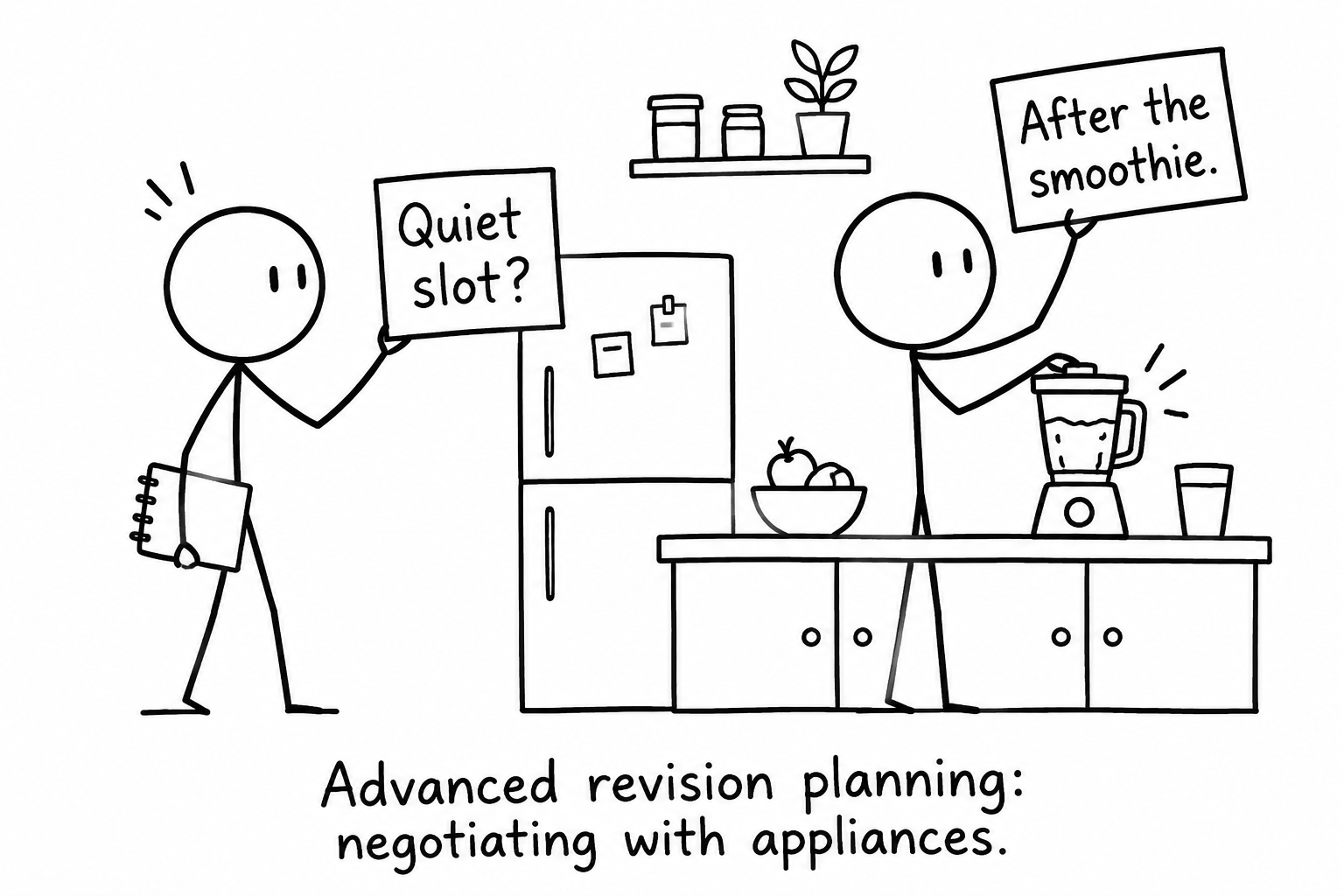 A stick-figure student negotiates a quiet revision slot with someone using a blender
Use a study technique that survives interruptions
An interruption is especially frustrating when it makes you lose your place. Make each session easy to restart.
Give the session a visible finish line
Replace “do algebra” with “attempt four questions, mark them and correct one mistake”. You can see what remains after a distraction.
Choose questions that match your qualification and specification. GCSE students should check their foundation or higher tier; A Level students should select relevant pure maths, statistics or mechanics content.
MathsGenie’s Edexcel GCSE maths mini tests offer focused practice when a full paper is impractical. For another exam board, check that the content matches your course.
Leave a restart note
Before leaving the table, write “Next: check the negative sign” or “Read the final instruction again”. Underline your current question.
When you return, read the last completed step and your note before continuing. You have somewhere to restart without reconstructing the whole session.
Attempt, check, then return later
Try questions without looking at the method first. Check your answers, identify why an error happened, then attempt a similar question in a later session.
Retrieving a method from memory reveals more about your independent understanding than repeatedly rereading it. MathsGenie’s revision lessons and practice resources support explanation and practice. With video solutions, pause before the next step and decide what you would do yourself.
Reduce distraction without adding another one
Move away from television or conversation if possible, even if that means changing seats. Keep your phone out of reach and turn off unnecessary notifications.
Earplugs or headphones may help. If you use background sound, keep it low and test whether it helps. Lyrics, podcasts and changing playlists can compete with the question.
Judge your setup by whether you complete questions accurately and understand your corrections. Feeling occupied does not tell you whether revision is working.
Common mistakes when revising in a noisy house
Waiting for perfect silence. Keep a fallback task ready so an imperfect evening still has a useful purpose.
Watching videos all evening. Follow explanations with an independent attempt. Otherwise, you may recognise a method without being able to use it.
Treating every mistake as a noise problem. Check whether you misunderstood the method, forgot earlier knowledge or lost your place. Each needs a different response.
Treating an interrupted paper as a reliable mock result. A fragmented attempt can reveal topic weaknesses, but cannot reliably measure exam timing. Reserve occasional quiet slots for full papers from MathsGenie’s GCSE past papers collection, which also includes predicted papers and mini tests. Use the relevant mark scheme afterwards.
Cutting sleep to recover lost time. Move unfinished work into a spare slot instead of routinely revising late into the night.
Turn your quieter windows into a schedule
Give demanding questions a quieter slot and keep smaller tasks ready for noisy evenings. Start with one topic, one realistic window and one fallback task. Build your household’s revision schedule with MathsGenie’s Revision Planner, then adjust it as you discover what works.