How to Plan Revision for Several Mocks in One Week
How to plan revision when you have several mocks in one week: prioritise subjects, practise effectively and build a realistic schedule with time to rest.
Imagine opening your mock timetable and finding English on Monday, maths on Tuesday, science on Wednesday and another paper on Friday. You sit down to revise, then spend twenty minutes deciding which subject deserves your attention.
If you are wondering how to plan revision when you have several mocks in one week, start with your exam dates, identify the most useful tasks for each subject, and give the nearest papers more time while keeping later ones moving. Leave space for breaks and unfinished work.
Let's follow a hypothetical student, Sam, through that process. The aim is a week where you know what to do next, even when several subjects compete for the same evening.
Get the week out of your head
Sam's first task is to gather the information that will shape the plan:
- Confirm each mock's date, start time and length.
- Check which topics or components your teacher has included.
- Block out lessons, travel, meals, commitments and bedtime.
- Identify realistic revision windows.
- Leave one short window unallocated for catching up.
Mock arrangements are set by your school or college, so use the information your teachers provide rather than assuming every paper covers the full specification.
For GCSE maths, check your foundation or higher tier and whether the paper allows a calculator. At A Level, establish whether the mock includes pure maths, statistics, mechanics or a particular combination.
For the wider approach, MathsGenie's revision timetable guide explains how to build a routine you can keep following beyond mock week.
Choose priorities using evidence
Sam initially wants to divide every evening equally between subjects. That feels fair, but subjects have different needs.
Use three questions to decide what comes first:
- How soon is the exam? Tomorrow's paper needs immediate preparation.
- What can you currently do without help? Use recent marked work or a short self-test.
- What could you improve in the available time? Choose specific gaps you can realistically address.
A topic you half-understand may deserve attention before an unfamiliar topic that would consume the whole evening. Keep broader gaps on your list for later revision or teacher support.
Replace “revise maths” with a finishable task, such as “attempt simultaneous equations questions, mark them and retry mistakes”. For A Level, that might mean practising integration questions and checking where you lose method marks.
The GCSE maths revision timetable guide develops this topic-based approach. The same planning principle works across qualifications: give each session a clear outcome.
Build a rolling mock-week schedule
Sam gives each evening a main task for the nearest exam and a shorter task for a later paper. This prevents Friday's subject from disappearing until Thursday night.
Here is an illustrative structure. Adapt it to your actual timetable and energy.
| When | Main revision task | Shorter follow-up |
|---|---|---|
| Weekend before mocks | Prepare Monday's paper and tackle a weak maths topic | Brief recall for Wednesday's science paper |
| Monday after English | Practise and mark questions for Tuesday's maths mock | Recall key science knowledge |
| Tuesday after maths | Answer questions for Wednesday's science mock | Plan an answer for Friday's paper |
| Wednesday after science | Work on Friday's weakest assessed topic | Revisit mistakes from earlier practice |
| Thursday | Complete focused practice for Friday | Check equipment and finish at your planned time |
Try a manageable block, perhaps thirty minutes, followed by a short break. Adjust the length to your attention and the task. Include marking within the block or schedule it explicitly afterwards.
If two mocks fall on the same day, prepare both earlier in the week. Give the weaker subject your better concentration window, then use shorter recall sessions to keep the other ready.
Build your version of this crowded-week schedule in the Revision Planner once you have identified your dates, priorities and available time.
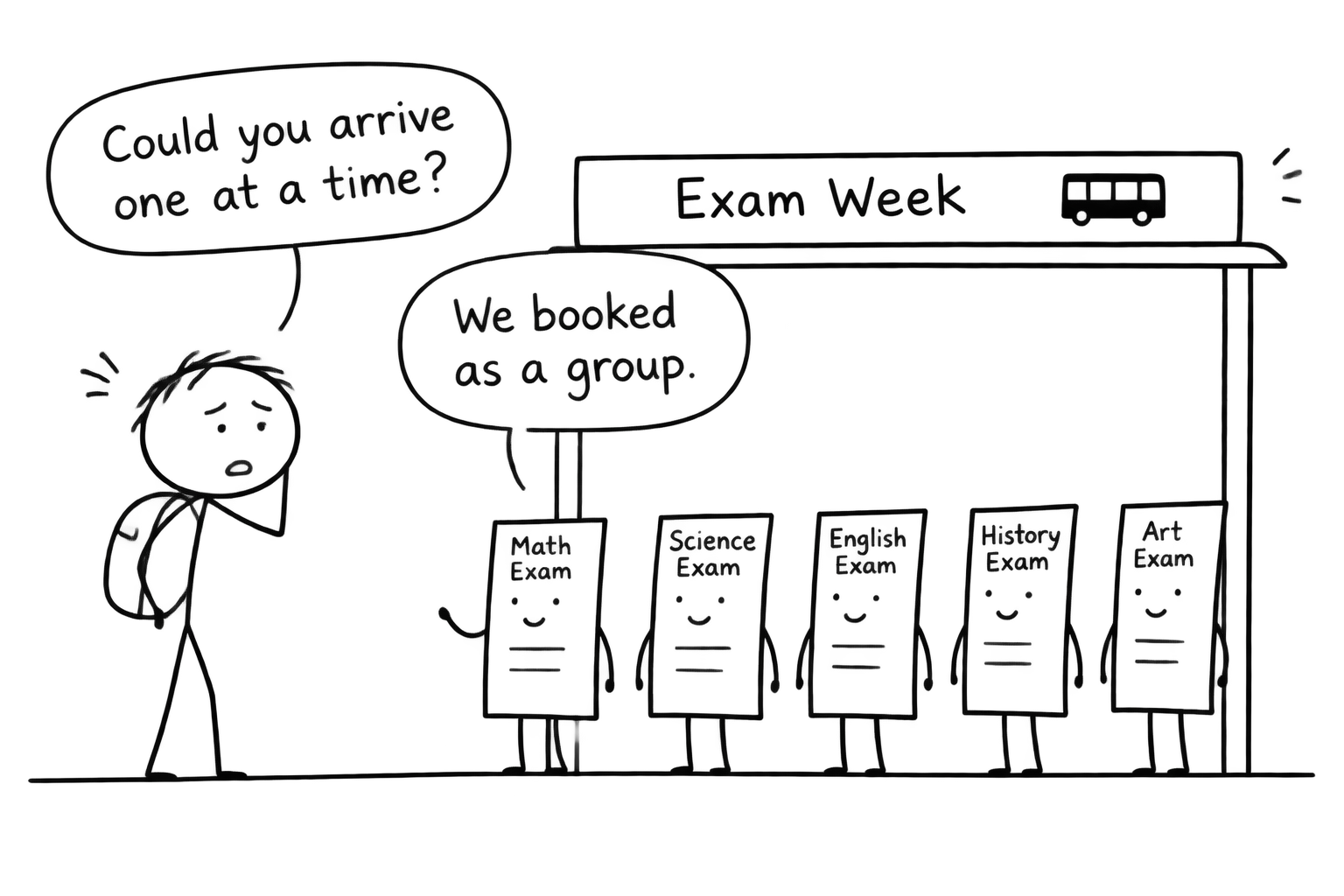 A student asks a queue of mock exam papers to arrive separately, and one replies that they booked as a group.
Make each revision block earn its place
A timetable allocates time. Your study technique determines what happens inside it.
Sam uses a simple sequence: attempt, check, correct, revisit.
Start with your notes closed. Answer questions, recall key information or outline an essay. Then check your work against reliable notes or a mark scheme. Identify the gap and practise the part that caused difficulty.
For maths, reading a solution can make a method feel familiar before you can use it independently. After reviewing a revision lesson or video solution, close it and attempt a fresh question yourself.
MathsGenie's maths revision resources provide material for this process, including practice questions and past papers. Choose questions that match your course and the content your teacher has confirmed.
Schedule a brief return to difficult material on another day where possible. Retrieval practice and spaced practice have research support, although neither removes the need to understand the content and correct mistakes.
Adjust after each paper
After Monday's exam, Sam takes a break before looking at Tuesday's tasks. Replaying every answer with friends could easily consume the next revision window.
Keep any immediate reflection brief. Note a useful lesson, such as leaving enough checking time, then turn to the next paper. Save detailed analysis for when you receive marked work.
Each evening, ask what you completed, what still matters and what needs moving. If a task overruns, reduce or replace another task rather than automatically extending bedtime.
If you still have several weeks before mocks, the one-month maths revision plan offers a longer preparation structure. During mock week itself, keep decisions focused on the next useful step.
Common revision-planning mistakes
Filling every spare minute. School days and exams take energy. Leave room for food, rest and ordinary delays.
Only preparing tomorrow's subject. Keep a small preparation slot for later papers so each evening does not become a fresh emergency.
Planning more than practising. A readable list of tasks is enough. Start the first one before improving the layout.
Using full papers without time to review them. Targeted questions may be more useful when time is tight. If you complete a paper, reserve time to mark it and address errors.
Build a week you can follow
In Sam's hypothetical week, moving the rough paper plan into the Revision Planner would make the next task clearer, while still leaving decisions about priorities and rest with Sam. You have the same method now; the remaining job is turning competing deadlines into a usable schedule. Your turn: Build your schedule for several mocks in one week in the Revision Planner.