How to Plan Revision for GCSE Further Maths
How to plan revision for GCSE Further Maths with a practical weekly structure, effective study techniques and balanced GCSE revision.
A parent looks at a revision timetable and sees neat coloured boxes. Their child often sees something else: a promise that every evening for the next two months will go exactly as planned.
It will not. Homework expands, tiredness arrives and one difficult algebra question consumes half an hour. That does not mean planning has failed. It means the plan needs to expect real life.
Here is the direct answer to how to plan revision for GCSE Further Maths: list the content in your specification, identify your weakest areas, schedule short sessions across each week, revisit topics using spaced practice, and move gradually from individual questions to timed papers. Keep ordinary GCSE Maths in the timetable too, because Further Maths builds on it rather than replacing it.
Your GCSE Further Maths revision checklist
A useful plan should include:
- the exact qualification and specification you are taking
- a topic audit based on questions, not confidence alone
- two or three focused Further Maths sessions each week
- continued GCSE Maths practice
- repeated retrieval of older topics
- mixed and timed exam questions
- time to mark work and correct mistakes
- a flexible weekly review
Start with the qualification. Schools may use different Level 2 Further Mathematics qualifications, so check the title and exam board on your school documents. For example, AQA describes its Level 2 Certificate in Further Mathematics as an untiered qualification which builds on Key Stage 4 mathematics and places particular emphasis on higher mathematical skills and algebraic reasoning. Your own specification should determine the topics you revise.
Build the plan around evidence
Imagine a student, Maya, making her first plan. She writes “algebra” on Monday, “calculus” on Wednesday and “matrices” on Saturday. It looks sensible, but each label hides an important question: what will she actually do?
A session should describe an action and an outcome. “Revise algebra” is vague. “Complete ten factor theorem questions, mark them and redo every error without notes” is measurable.
Before scheduling anything, divide the specification into three groups:
| Group | Meaning | What to schedule |
|---|---|---|
| Red | You cannot yet begin or complete typical questions independently | A revision lesson followed by straightforward practice |
| Amber | You know the method but make errors or need prompts | Mixed practice and delayed retrieval |
| Green | You can answer accurately without notes | Short retrieval and exam-paper practice |
Test yourself with a small set of questions before assigning a colour. Familiar notes can create a misleading sense of fluency. The real test is whether you can choose and use a method when the notes are closed.
Use a simple weekly structure
Further Maths needs regular contact more than occasional marathon sessions. A practical starting structure is three sessions per week, adjusted around your other subjects and the time remaining before the exams.
| Session | Main purpose | Example structure |
|---|---|---|
| Session A | Learn or repair | Review one red topic, then answer focused questions |
| Session B | Retrieve and mix | Recall an older method, then complete mixed questions |
| Session C | Apply under pressure | Complete an exam section or timed set, mark it and correct errors |
A session might last 303030-505050 minutes, but there is no universal number that suits every student. Your school workload, current understanding and proximity to the exams matter. The guide to GCSE revision hours can help you judge the overall workload, while the GCSE Maths revision timetable guide explains how to turn available time into workable sessions.
Do not simply add Further Maths on top of an already full timetable. Decide which sessions deserve priority and protect recovery time. A shorter plan you can follow is more valuable than an ambitious one abandoned after four days.
If setting up those repeating sessions feels like another revision task, you can lightly map them in the MathsGenie Revision Planner once you know which topics need attention.
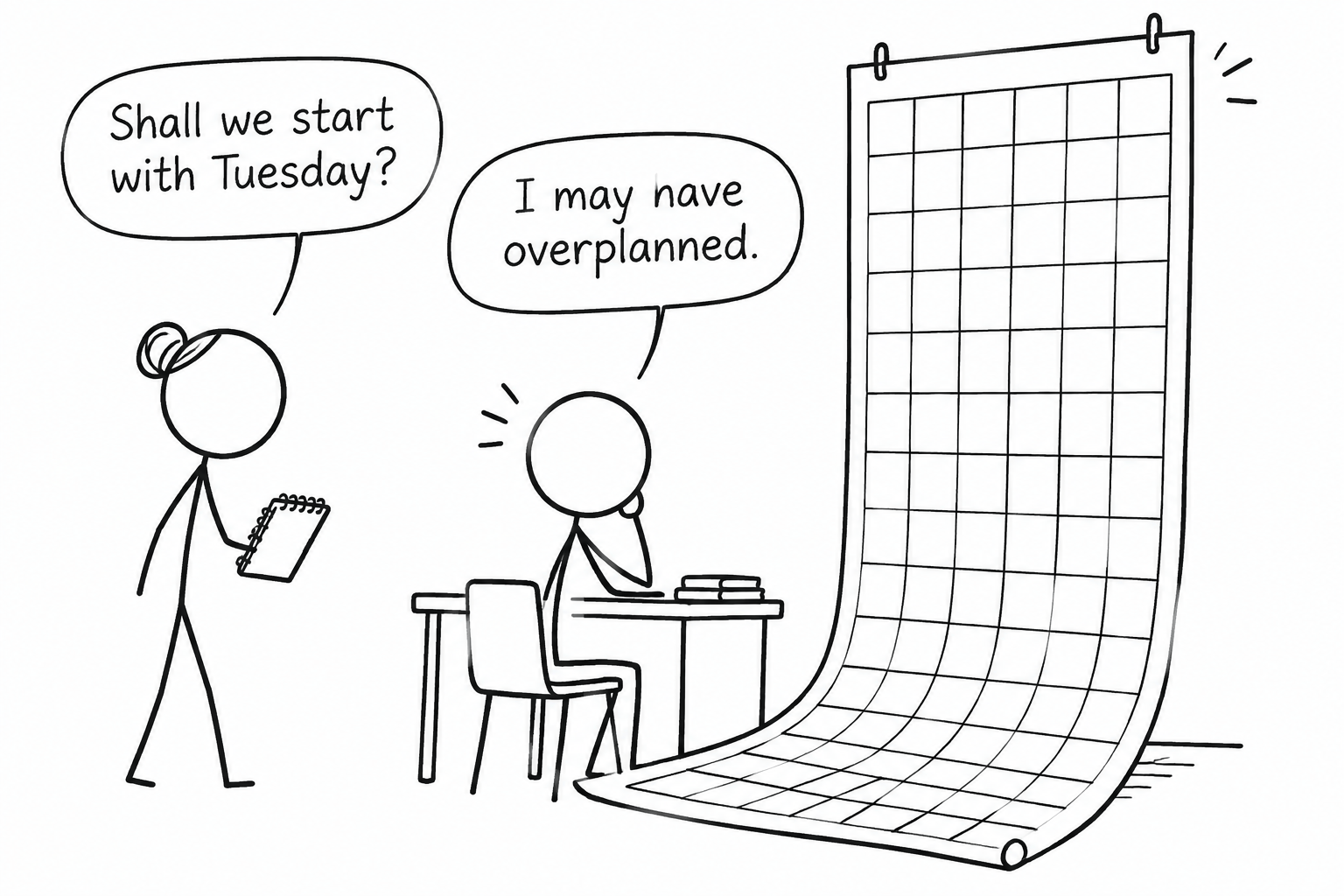 A student discovers that a modest revision plan is easier to begin than an enormous wall calendar
Choose a study technique for each stage
A good plan does not name only the topic. It also names the study technique.
Learn the method actively
Use a revision lesson or worked solution to understand why each step is valid. Pause before the next step and predict it. Then close the explanation and reproduce the method independently.
Copying a solution can feel smooth because each decision has already been made. In an exam, making those decisions is the work. Follow learning immediately with practice questions so that understanding has to become action.
Revisit topics through spaced practice
Return to a topic after a gap rather than completing it once and declaring it finished. A simple pattern is:
- first practice on the day you learn it
- a brief retrieval attempt later that week
- mixed questions the following week
- an exam question after a longer gap
The exact gaps can change. The principle is that recall should become effortful before you revisit the topic. That effort strengthens your ability to retrieve the method later.
Mix topics deliberately
Blocked practice helps while learning a new technique. Mixed practice becomes important afterwards because exam questions do not announce the required method.
Mixing algebra, coordinate geometry, sequences, matrices or calculus, where these appear on your specification, forces you to recognise structures rather than merely repeat the same procedure. Keep the mix manageable at first. Three carefully selected topics are enough.
Mark, diagnose and redo
A mark scheme is not just a score generator. For every lost mark, record the cause:
- missing knowledge
- wrong method
- algebraic or arithmetic slip
- incomplete reasoning
- misreading the question
- poor use of time
Then correct the solution and attempt the question again later without looking. MathsGenie’s free revision resources, practice questions, past papers, mark schemes, video solutions and mini tests can support this cycle. The aim is not to collect completed sheets. It is to reduce repeated errors.
Balance Further Maths with GCSE Maths
Further Maths can expose gaps in ordinary GCSE content, particularly algebraic manipulation. If expanding, factorising, rearranging formulae or working with indices is unreliable, advanced questions become harder for reasons unrelated to the new idea.
Keep at least one regular slot for core GCSE Maths and use your errors to decide its focus. This is not stepping backwards. It is strengthening the machinery that Further Maths depends on.
Parents can help without becoming the teacher. Ask three calm questions at the end of the week:
- Which topic improved?
- Which mistake appeared more than once?
- What will change next week?
These questions keep attention on evidence rather than hours spent at a desk.
Move from topics to papers
Topic practice should dominate early revision because it lets you repair specific weaknesses. As the exam approaches, increase the proportion of mixed and timed work.
A sensible progression is:
- Learn one method and answer focused questions.
- Combine it with two or three previous topics.
- Complete an untimed exam section.
- Complete a timed section.
- Attempt a full paper in the correct conditions.
- Use the mark scheme to build the next week’s topic list.
Past papers are most useful when followed by analysis. Writing down a percentage and moving on wastes much of their value. Spend enough time reviewing the paper to understand why each mark was lost, then schedule the resulting weaknesses.
Predicted papers can provide fresh practice, but they cannot tell you exactly what will appear. Treat them as mixed exam preparation, not forecasts. The specification and official past papers remain the foundation of revision planning.
Common revision-planning mistakes
Making every session the same length
Some tasks need ten minutes of retrieval; others need a longer sequence of teaching, practice and correction. Plan around the task rather than filling identical boxes.
Revising favourite topics first
Comfortable questions create momentum, but weak topics create the largest risk. Begin most weeks with one red or amber area while concentration is strongest.
Leaving papers until the final week
Timed work reveals problems with method selection, stamina and pacing. Introduce exam sections early enough to act on what they show.
Counting time instead of outcomes
An hour at a desk is not automatically an hour of effective revision. Record completed questions, corrected errors and topics successfully retrieved.
Treating the plan as fixed
Review it weekly. If a supposedly green topic collapses under mixed practice, move it back to amber. If school deadlines change, reschedule rather than trying to repay every missed minute.
Build the schedule you can follow
Maya’s useful change was not adding more hours. It was replacing broad labels with specific tasks, keeping GCSE Maths in view and using each marked paper to shape the following week. Knowing that structure is the first step; fitting it consistently around school and other subjects is the harder one.
Exams have fixed dates, so every unplanned week reduces the time available for spaced practice and corrections. Your turn: enter your exam date, available study days and minutes, then build your GCSE Further Maths schedule in the Revision Planner.