How to Get a Grade 9 in GCSE Astronomy
How to get grade 9 GCSE Astronomy: build specification knowledge, sharpen calculations, master observations and turn past-paper errors into marks.
A telescope can reveal a distant galaxy, but it cannot reveal why you lost three marks on an explanation question. That requires a different kind of observation.
If you are wondering how to get grade 9 GCSE Astronomy, the short answer is this: learn the whole specification accurately, practise applying ideas to unfamiliar situations, become fluent with the mathematical skills, and review every past-paper mistake until you can explain its cause. Grade 999 performance is not simply knowing more facts. It is using knowledge precisely when the question changes shape.
This guide follows the current Pearson Edexcel GCSE Astronomy specification, code 1AS01\text{AS}01AS0. Always check the specification and arrangements provided by your school or centre.
Your grade 9 astronomy checklist
A strong revision system should include:
- a specification tracker covering all 161616 topics
- regular retrieval practice without notes
- accurate use of astronomical vocabulary
- confident calculations using the supplied formulae and data
- practice interpreting graphs, diagrams and observations
- planned responses to extended questions
- timed work from official papers
- an error log that leads to specific re-practice
- secure knowledge of your own observational work
The important word is system. An occasional heroic revision session feels productive, but repeatable habits usually change marks more reliably.
Understand what the GCSE Astronomy exams reward
Edexcel GCSE Astronomy has two externally examined papers. Paper 111, Naked-eye Astronomy, assesses Topics 111 to 888. Paper 222, Telescopic Astronomy, assesses Topics 999 to 161616. Each paper lasts one hour and forty-five minutes, carries 100100100 marks and contributes half of the qualification.
Across the qualification, the assessment objectives are:
| Assessment objective | What it rewards | Weighting |
|---|---|---|
| AO1 | Knowledge and understanding of scientific ideas, techniques and procedures | 40%40\%40% |
| AO2 | Applying knowledge and understanding | 40%40\%40% |
| AO3 | Analysing, interpreting and evaluating observations, data and methods | 20%20\%20% |
This balance explains why rereading alone has a ceiling. Only 40%40\%40% is principally about demonstrating knowledge. The remaining marks require you to apply, analyse, evaluate or make judgements.
At least 20%20\%20% of the marks reward mathematical skills. Knowledge and understanding of observational work are also assessed in the written examinations. Students must complete the observational work required by the current specification, including unaided and aided observation, even though there is no separately marked coursework component.
The lesson is simple: do not divide revision into “facts” and “everything else”. For each topic, ask three questions:
- What must I know?
- Where could I apply it?
- What data, method or observation could I be asked to evaluate?
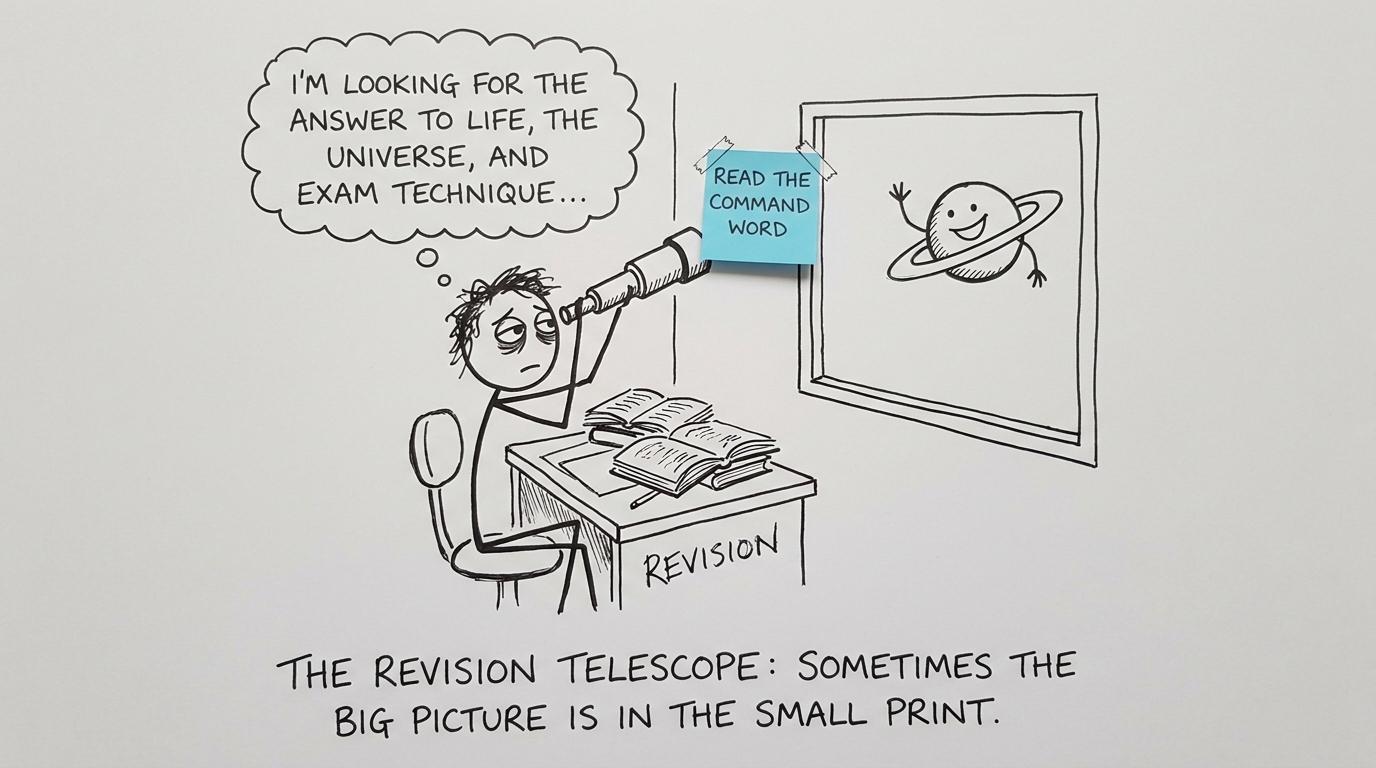 A student uses a telescope to inspect a revision reminder while a planet waves outside
Turn the specification into a working map
A textbook tells a story. A specification defines the examinable destination. Grade 999 revision needs both, but the specification should control your checklist.
Separate the course into its two paper areas, then rate every specification statement:
- Green: you can explain it accurately and answer an unfamiliar question.
- Amber: you recognise it but need prompts or make small errors.
- Red: you cannot yet retrieve or apply it reliably.
Do not rate a topic green because your notes look familiar. Close the book and produce the explanation, labelled diagram or comparison from memory. Recognition is comfortable; retrieval is what the examination demands.
Use short, mixed reviews rather than completing one topic once and abandoning it. The structure in MathsGenie’s GCSE revision timetable guide can be adapted for Astronomy: several focused topic sessions, followed by a timed section and careful review.
Replace passive revision with retrieval and application
Flashcards are useful for definitions, instruments, historical models and stages in stellar evolution. They become less useful when every card asks for one isolated word.
Build prompts that force relationships:
- compare two observing methods
- explain why a phenomenon occurs
- predict what changes when one variable changes
- identify evidence supporting a model
- evaluate a procedure and propose an improvement
- connect a diagram to what an observer would actually see
After recalling an answer, check its scientific precision. Astronomy contains pairs of ideas that are easy to blur: rotation and revolution, apparent and absolute magnitude, altitude and declination, galaxy and Solar System, resolution and magnification.
Use command words deliberately. Describe asks what happens or what is seen. Explain requires a reason. Evaluate needs a balanced judgement supported by relevant evidence or limitations. Pearson examiner reports have repeatedly highlighted the difference between explaining why something happens and merely stating what happens.
Make the mathematical marks dependable
Large distances, small wavelengths and proportional relationships make mathematical fluency central to Astronomy. The examination supplies a formulae and data sheet, so success depends less on memorising equations than on selecting, rearranging and using them correctly.
The supplied relationships include:
Equation of Time=AST−MST\text{Equation of Time}=\text{AST}-\text{MST}Equation of Time=AST−MST T2r3=constant\frac{T^2}{r^3}=\text{constant}r3T2=constant magnification=fofe\text{magnification}=\frac{f_o}{f_e}magnification=fefo M=m+5−5logdM=m+5-5\log dM=m+5−5logd λ−λ0λ0=vc\frac{\lambda-\lambda_0}{\lambda_0}=\frac{v}{c}λ0λ−λ0=cv v=H0dv=H_0dv=H0dPractise deciding which quantities are given, which quantity is required and whether the equation must be rearranged. Always show substitution and retain enough calculator precision until the final line.
Astronomical data often appear in standard form, so use MathsGenie’s standard form revision guide to remove uncertainty around powers of ten. Strengthen equation manipulation with the rearranging harder formulae lessons.
Geometry and observation can also involve angles and right-angled triangles. The SOHCAHTOA revision resources provide focused practice. For plotted observations, correlation and sensible lines of best fit, revisit scatter graphs.
Treat units as part of the answer, not decoration. Before moving on, ask whether the magnitude, sign, significant figures and unit are sensible.
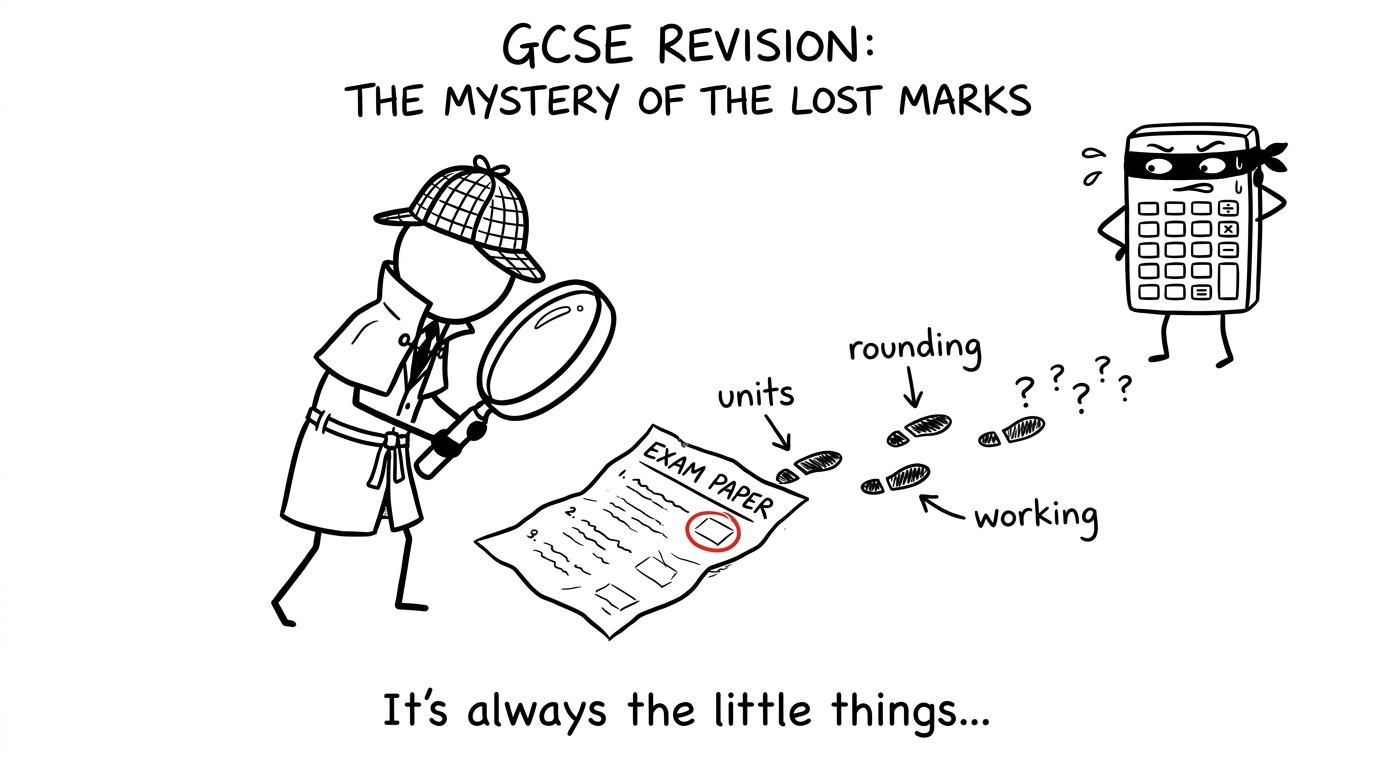 A student detective follows clues labelled units, rounding and working
Treat observational skills as examinable knowledge
Observation is where Astronomy becomes more than a collection of diagrams. It is also where vague answers lose marks.
For each observation you complete, know:
- the aim and astronomical target
- the equipment and why it was suitable
- the location, date, time and observing conditions
- the variables or measurements recorded
- relevant safety considerations
- limitations, uncertainties and practical improvements
- how the evidence supports the conclusion
Avoid generic evaluation phrases such as “use better equipment” or “repeat it”. State what should be improved, how it changes the method, and why it would improve reliability, accuracy or the quality of the observation.
Your own observing record is a powerful revision resource because it connects procedures to real constraints: cloud, light pollution, atmospheric disturbance, limited resolution and changing sky position. Review it alongside the specification rather than treating it as a task that ended when the observation was completed.
Use past papers as feedback, not a score generator
A paper score tells you where you are. The review tells you where to go next.
Complete questions without notes, mark them carefully, and classify every lost mark:
- missing knowledge
- inaccurate vocabulary
- failure to apply known knowledge
- calculation or calculator error
- weak interpretation of data
- incomplete evaluation
- misread command word
- omitted label, unit or working
- time pressure
Then write a specific correction. “Revise stars” is too broad. “Distinguish the evidence provided by absorption spectra from the information provided by apparent brightness” creates an action.
Reattempt unsuccessful questions after a delay, without looking at the mark scheme. The guide to using past papers properly explains this mark, diagnose, fix and retest cycle. MathsGenie’s GCSE past-paper library can also strengthen the mathematical fluency that Astronomy calculations rely upon.
The June 202520252025 Edexcel Astronomy grade 999 boundary was 162162162 out of 200200200, but boundaries change between series. Do not build your plan around one historical threshold. Aim for secure performance across both papers and leave a margin for unfamiliar questions.
Build a weekly routine that changes performance
A practical week might contain:
- two short specification and retrieval sessions
- one calculation and data session
- one observational-skills or extended-response session
- one timed set followed by detailed marking
- a brief retest of earlier mistakes
Near the examination, increase timed practice but keep targeted repair sessions. Full papers reveal weaknesses; focused questions repair them.
MathsGenie’s GCSE Maths revision hub offers revision lessons, practice questions, mini tests and mark schemes for the numerical skills beneath Astronomy. Its maths predicted papers can provide additional calculator and problem-solving practice, although they are not predictions for the Astronomy papers.
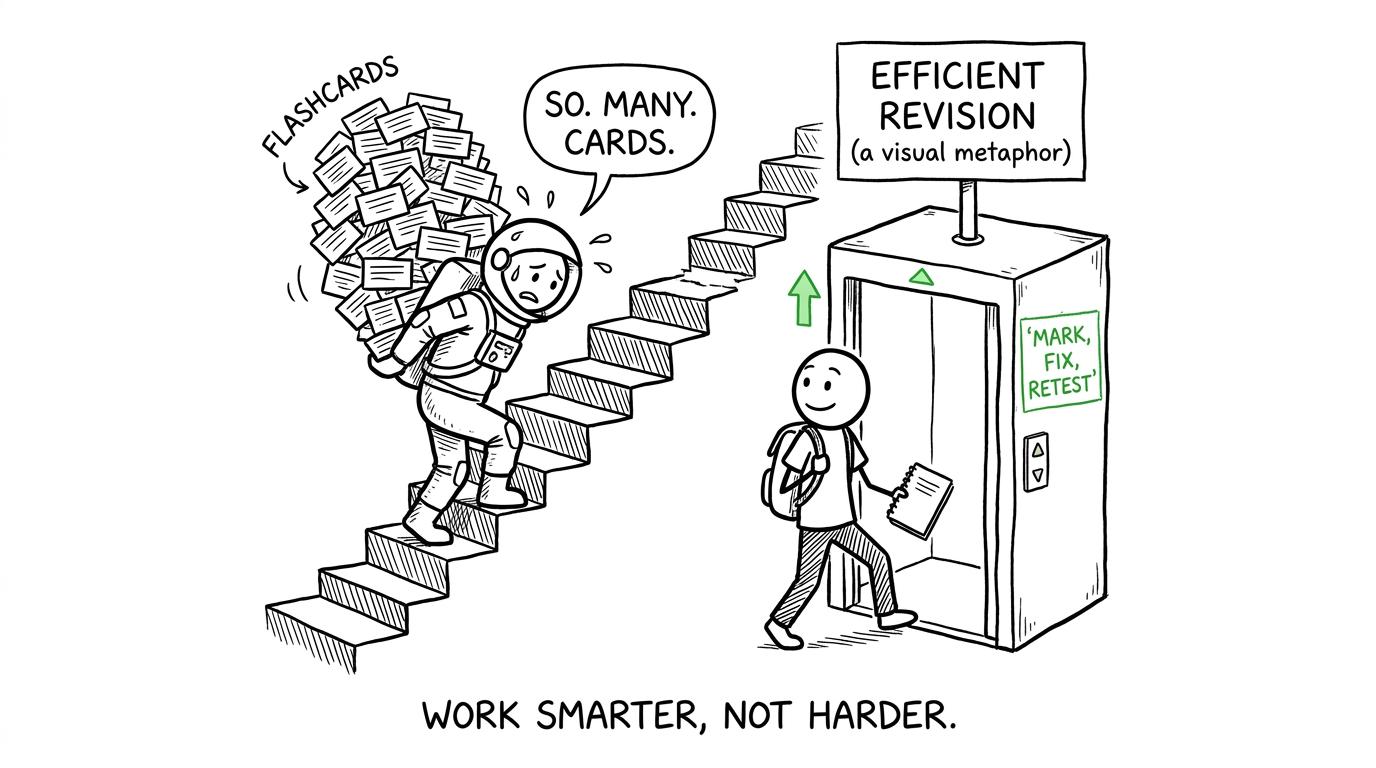 One student carries endless flashcards while another takes the mark, fix, retest lift
Common mistakes that keep strong students below grade 9
Learning facts without testing application
Knowing a definition is not the same as using it to interpret an unfamiliar observation. Follow factual recall with an application or evaluation prompt.
Writing around the command word
A long description does not become an explanation through length. Identify exactly what the command word requires before writing.
Treating diagrams casually
Labels, orientation and relative positions matter. Read every instruction carefully, label the requested object and distinguish what is observed from the physical arrangement in space.
Rounding too early
Keep unrounded calculator values during intermediate stages. Round only the final answer to a sensible precision unless the question instructs otherwise.
Ignoring the formulae and data sheet until the exam
Use the current sheet during practice. Learn where information appears and what every symbol represents.
Marking generously
Do not award yourself a mark because you “meant” the correct idea. Compare your wording with the mark scheme and record what was actually missing.
Make grade 9 the result of the process
A grade 999 cannot be guaranteed, and it is not earned through one secret resource. It grows from small corrections: a clearer explanation, a properly labelled diagram, an equation rearranged without a sign error, and a past-paper mistake that never returns.
Begin with your Edexcel Astronomy specification tracker. Then use MathsGenie as your free mathematical revision base: strengthen weak methods through revision lessons, practise with exam questions and mini tests, check mark schemes and video solutions, and build exam stamina with past papers and predicted maths papers. Observe your errors as carefully as astronomers observe the sky. They show you exactly where the next marks are waiting.