How to Get Grade 8 GCSE French: Revision Plan
How to get grade 8 GCSE French with stronger vocabulary, grammar, listening, speaking and exam habits through a practical Higher-tier revision plan.
A grade 8 can feel strangely close and far away at the same time. You may understand most classroom French, complete your homework and still find that listening extracts move too quickly or writing marks disappear through small grammatical errors.
The clearest answer to how to get grade 8 GCSE French is this: take Higher tier, revise all four language skills regularly, learn vocabulary through active recall, strengthen a small set of high-value grammar structures and use timed exam practice to identify exactly where marks are being lost. More revision is not automatically better. Better feedback is.
The same principle applies in maths. A student improves fastest when they attempt something, mark it honestly, diagnose the weakness and try again. MathsGenie's guide to finding your weakest GCSE topics explains that feedback loop in more detail.
Your grade 8 GCSE French checklist
A strong revision plan should include:
- confirmation that you are entered for Higher tier
- vocabulary retrieval on most days
- regular listening and dictation practice
- speaking aloud without reading a complete script
- accurate use of present, past and future time frames
- planned answers that address every bullet point
- translation practice in both directions
- timed work using materials for your exam board
- careful marking followed by correction and re-testing
- continued revision of your other GCSE subjects
Grade 8 is not awarded for knowing every French word. It reflects strong performance across the whole qualification, including the ability to understand unfamiliar material and communicate accurately when the task changes.
Understand what the current GCSE French exam rewards
The reformed GCSE French specifications taught from September 2024 are being awarded for the first time in summer 2026. Common exam boards offering the qualification include AQA, Pearson Edexcel and Eduqas. Always check the specification and sample assessment materials for your own board because timings and task details can differ.
Across the new qualifications, students are assessed through speaking, listening, reading and writing. Each area generally contributes a quarter of the qualification. The newer assessments also place explicit emphasis on prescribed vocabulary, grammatical accuracy, dictation and reading aloud.
Foundation tier offers grades 1 to 5. To achieve grade 8, you must be entered for Higher tier, where grades 4 to 9 are available. All assessments must be taken at the same tier.
There is no permanent percentage that guarantees grade 8. Grade boundaries are established for each examination series after the papers have been marked. Older results can offer context, but they should not become your target, particularly because the first assessments for the reformed specifications are in 2026. MathsGenie's Edexcel GCSE French grade boundaries page contains historical boundaries for the previous specification, so use them only as historical information rather than a prediction for the new course.
Replace passive revision with retrieval
Reading vocabulary lists feels productive because every word looks familiar. The problem arrives when the book closes. Recognition is not the same as recall.
Use short, repeated tests instead. Look at the English word and produce the French. Reverse the direction later. Say the answer aloud, write it and place difficult words into a separate re-test pile. Include gender, articles, spellings and common word partnerships rather than learning isolated translations.
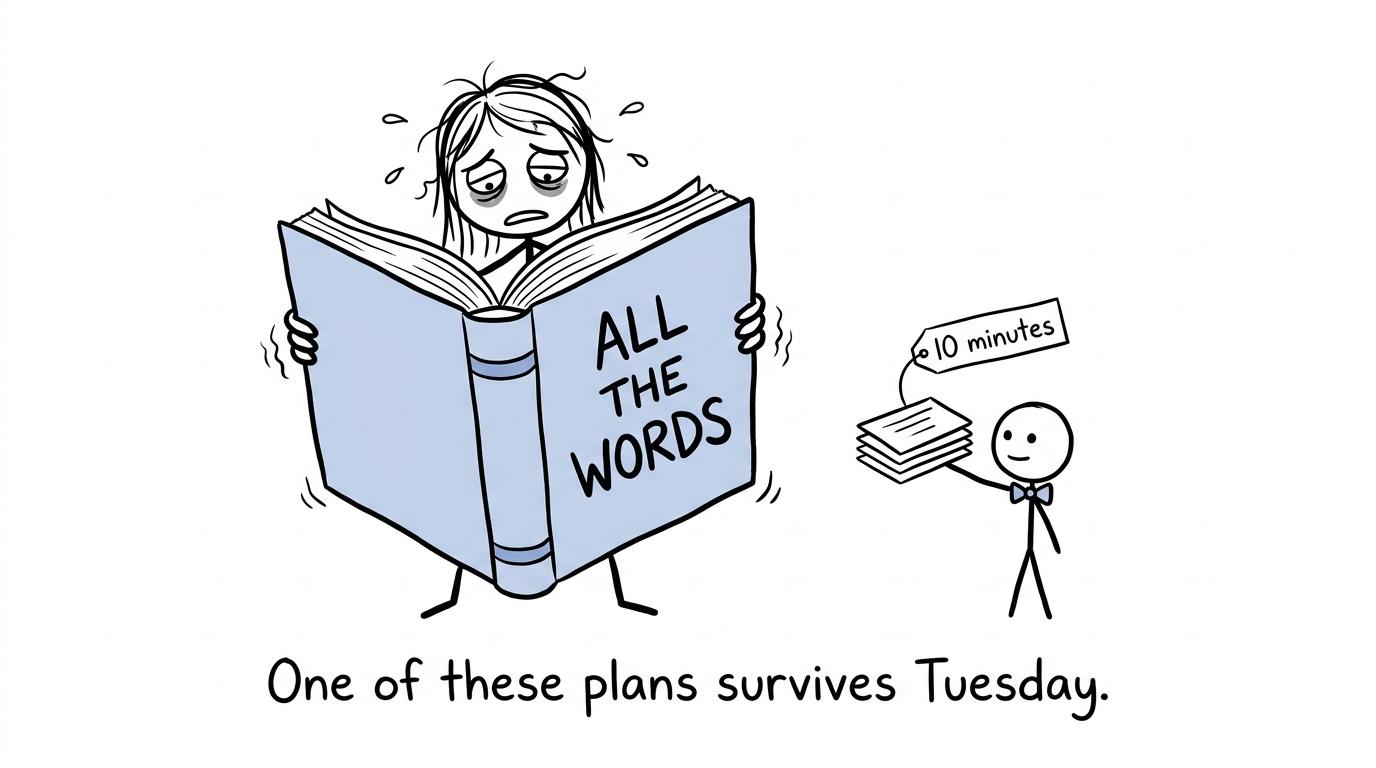 A student choosing between impossible cramming and manageable daily vocabulary revision
A useful daily session might contain three parts:
- previously learned vocabulary
- one current specification theme
- words you missed in recent exam practice
The final category matters most. Your personal error list is usually more valuable than another generic list because it records the language you cannot yet retrieve under pressure.
This mirrors effective maths revision. The GCSE Maths revision hub brings lessons, questions, papers and checking tools together so that students can move from learning to retrieval rather than repeatedly reading notes.
Build grammar that works under pressure
Grade 8 writing and speaking need range, but ambitious language only earns its place when you can control it. Ten memorised phrases with unreliable endings are less useful than a smaller set of adaptable structures you understand.
Prioritise:
- secure present-tense verb forms
- a reliable past tense
- a clear future or conditional construction
- adjective agreement
- negative forms
- opinions supported by reasons
- connectives that create logical development
- object pronouns and relative clauses where you can use them accurately
- common irregular verbs
- question formation for speaking tasks
Create a grammar error log. Record the original error, the rule and a corrected version. Then revisit that rule in a new context. Correction without re-testing is only half a revision session.
Aim to expand your grammatical range gradually. A sentence becomes valuable when you can adapt its person, tense and topic without losing control of the verb.
Train listening as a decoding skill
Listening often creates the greatest anxiety because the recording does not wait for you to feel ready. Yet listening is not a single ability. It combines vocabulary recall, recognition of French sounds, attention to detail and recovery after a missed phrase.
Practise these separately:
- predict likely vocabulary from the question before listening
- listen for negatives, time markers and changes of speaker
- write short dictation extracts exactly as heard
- compare your transcription with the correct version
- replay only after committing to an answer
- note whether an error came from vocabulary, sound recognition or concentration
For the reformed GCSE, dictation is part of the listening assessment. That makes sound-symbol knowledge important: you need to connect spoken French with accurate written forms.
Do not stop mentally when one word is unfamiliar. Higher-tier material is designed to contain challenge. Keep following the overall meaning and use the surrounding language to infer what you can.
Make speaking spontaneous, not scripted
A polished script can create confidence, but it can also create dependence. If one question changes, the whole answer may collapse.
Prepare flexible building blocks instead: opinions, reasons, time phrases, descriptions and follow-up details that can be recombined. Practise answering unexpected questions aloud with a short preparation limit. Record yourself and listen for clarity, verb accuracy and whether each answer is developed.
Reading aloud also appears in the reformed GCSE speaking assessments. Practise pronunciation patterns, silent endings and French sound-symbol correspondences. The goal is not to imitate a particular accent. It is to communicate clearly and intelligibly.
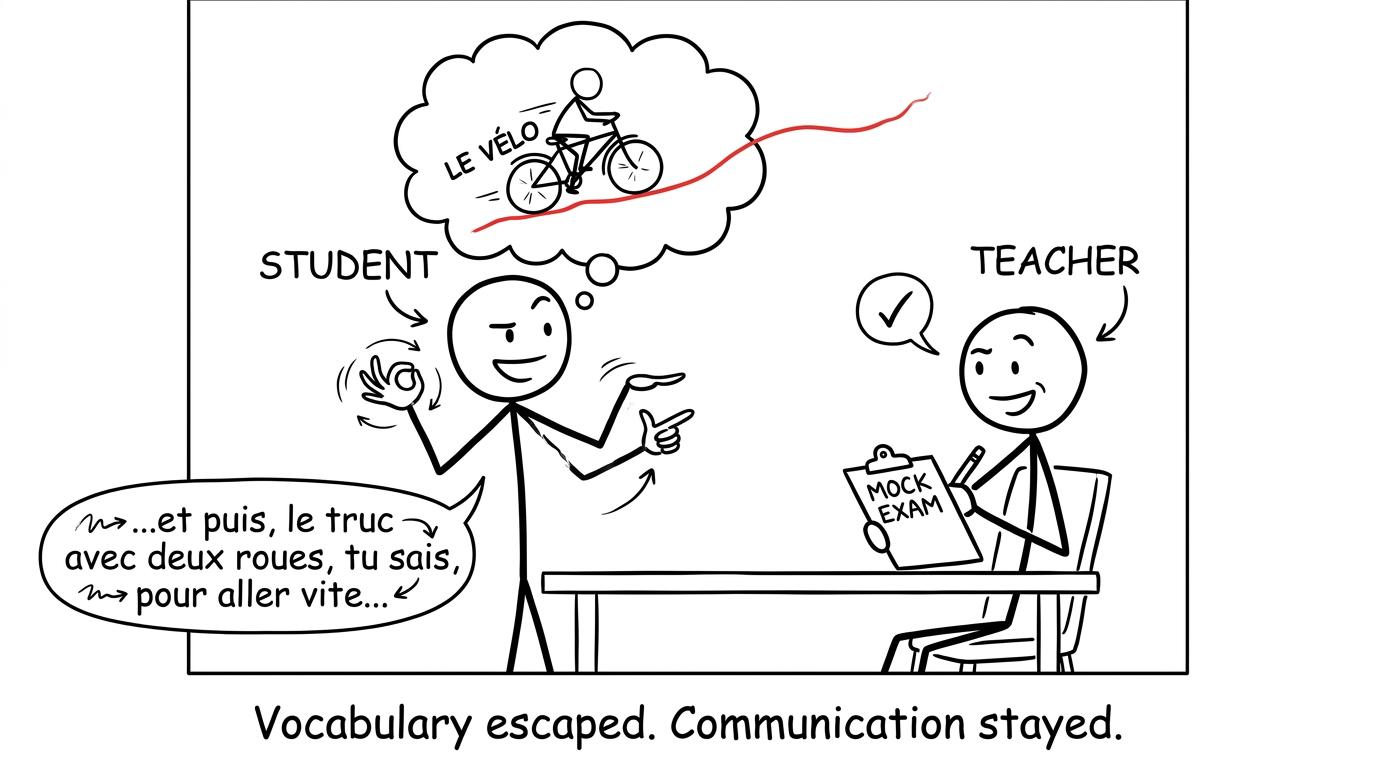 A French student continuing to communicate after a missing vocabulary word escapes
If you forget a word, describe it using language you do know. The ability to keep communicating is more useful than pausing while searching for a perfect expression.
Turn writing into a controlled checking process
Strong writing answers the task before it tries to impress the examiner. Underline every bullet point, identify the required audience or context and decide which time frames are needed.
After writing, check in layers:
- Coverage: Have you answered every part of the task?
- Communication: Are your ideas clear and developed?
- Verbs: Do subjects and endings agree?
- Time frames: Are tense choices consistent?
- Accuracy: Have you checked gender, adjective agreement, accents and negatives?
- Range: Have you used varied vocabulary and structures you can control?
Do not simply count words and stop. A response can reach the suggested length while missing a compulsory detail.
Translation deserves its own practice because it exposes gaps quickly. Translate the complete meaning rather than replacing words one by one. Mark each attempt strictly, repair the relevant grammar and retry a different passage later.
Use past papers as evidence, not judgement
A paper should tell you what to revise next. Begin with individual sections, then move towards complete timed assessments as your knowledge becomes more secure. Use the correct board, specification and tier.
After marking, label every lost mark:
- vocabulary gap
- grammar error
- misunderstood question
- incomplete detail
- listening discrimination
- spelling or transcription
- weak timing
Then practise the smallest skill that would prevent the error from returning. MathsGenie's article on when to start GCSE past papers explains why topic practice should gradually develop into timed sections and full papers.
Mark schemes are most useful when they change your next answer. The guide to using GCSE mark schemes shows how to move beyond adding up marks and identify what an examiner actually rewards.
A weekly revision rhythm that can last
A grade 8 plan must survive ordinary school weeks. It should not depend on finding several free hours every evening.
A balanced week could include:
- brief vocabulary retrieval on most days
- two focused grammar sessions
- two listening or dictation activities
- two short speaking practices
- one reading or translation section
- one timed writing task or extended paragraph
- one session devoted only to correcting and re-testing mistakes
Rotate themes so that older vocabulary remains active. Near the examination, increase timed work without abandoning retrieval and correction.
You will also be preparing for maths and other subjects. MathsGenie's one-week GCSE revision plan offers a useful model for dividing limited time between diagnosis, focused practice and realistic papers. For maths specifically, Edexcel GCSE Maths past papers include mark schemes and solutions that help you maintain progress while French revision becomes more intensive.
Common mistakes that hold students below grade 8
Memorising complete answers
Long scripts are fragile. Learn adaptable structures and practise responding to altered questions instead.
Chasing difficult language at the expense of accuracy
Sophisticated vocabulary cannot rescue unclear meaning or uncontrolled verbs. Add complexity only when the foundations remain accurate.
Revising only writing
Written revision can feel comfortable, but listening and speaking require repeated exposure. Every skill needs its own practice.
Ignoring small recurring errors
Missed accents, agreements and verb endings become costly when repeated. Keep an error log and re-test each pattern.
Treating a paper score as a verdict
One result is information, not identity. Break it into causes and repair the largest recurring weakness first.
Using historical boundaries as a promise
Boundaries vary, and older specifications are not directly comparable with the reformed GCSE. Aim for consistently strong performance across all components instead of guessing a safe percentage.
Make the next revision session specific
The route to grade 8 is rarely one dramatic change. It is a collection of smaller changes: testing vocabulary instead of rereading it, speaking before you feel perfectly ready, correcting grammar rather than merely noticing it and allowing past papers to shape the next week's work.
Choose one weak French skill today and complete a short test without notes. Mark it, write down the reason for every lost mark and schedule a re-test. That is how revision becomes measurable.
For the maths part of your GCSE timetable, make MathsGenie your free revision base. Use the GCSE Maths revision resources for revision lessons and practice questions, then build exam confidence with past papers, mark schemes, predicted papers, mini tests and video solutions. A calm system matters because every subject is competing for the same limited time, and a good system gives that time somewhere useful to go.