

How to Get a Grade 6 in GCSE Economics
How to get grade 6 GCSE Economics with better application, analysis, calculations and evaluation, supported by a focused and realistic revision plan.
A student can know what inflation means, remember why demand curves slope downwards and still lose marks. The problem is rarely a complete lack of knowledge. More often, the answer never applies that knowledge to the case, develops the chain of reasoning or reaches a justified conclusion.
That is the short answer to how to get grade 6 GCSE Economics: move beyond remembering content and practise turning it into applied, analytical answers. Alongside this, secure the quantitative skills that appear across the course and learn exactly what each command word requires.
A Grade 6 is not tied to one permanent raw mark. Grade boundaries change between exam series according to the difficulty of the papers, so your target should be a reliable standard of performance rather than a guessed percentage.
Your Grade 6 revision checklist
A strong plan should help you:
- recall accurate definitions without relying on prompts;
- apply each point to the business, household, market or economy in the question;
- build connected chains of economic reasoning;
- interpret extracts, graphs and numerical data;
- evaluate by weighing relevant arguments and reaching a judgement;
- answer the command word rather than writing everything you know;
- complete timed questions and learn from the mark scheme;
- maintain the underlying maths needed for percentages, averages and graphs.
The important shift is from passive familiarity to exam-ready performance. A page can look familiar without being retrievable under pressure.
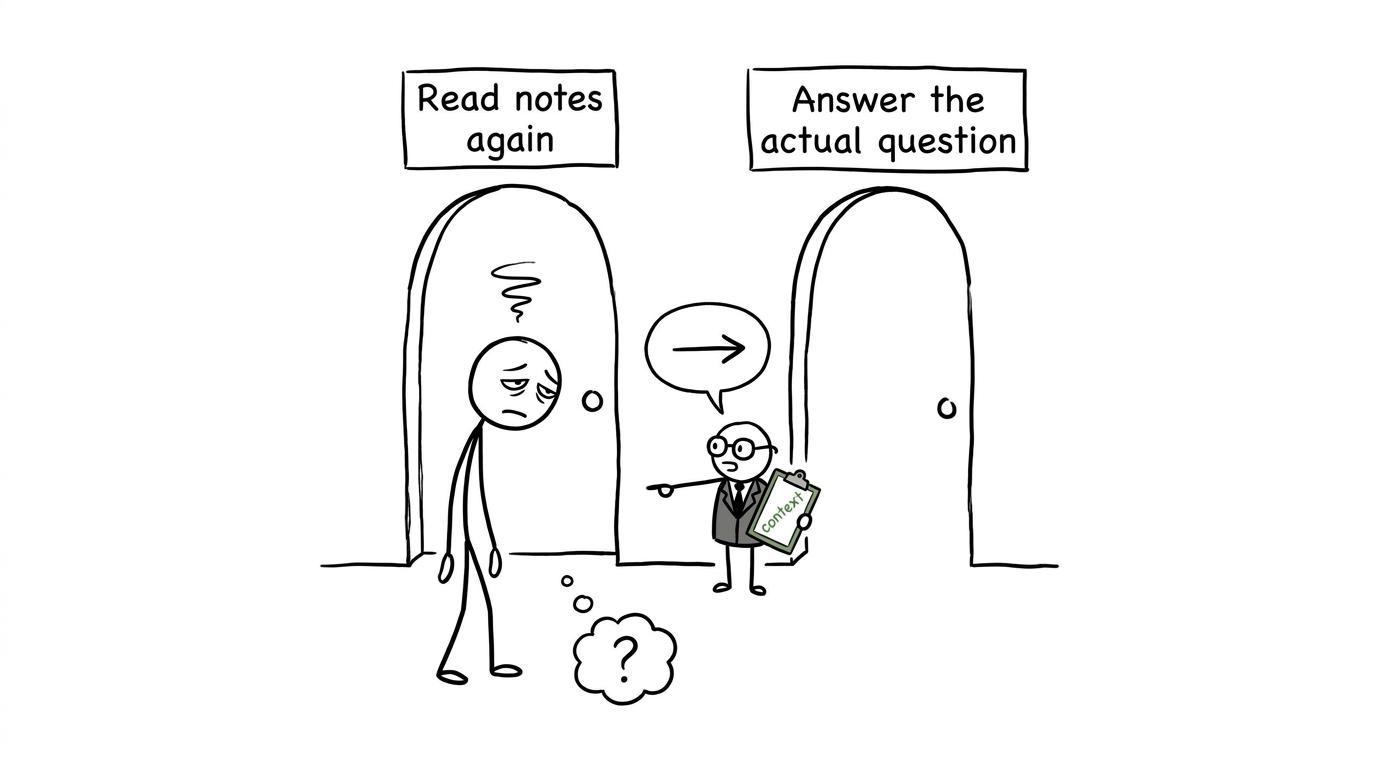 A student choosing between rereading notes and answering the actual question
Understand what GCSE Economics is assessing
For GCSE Economics qualifications regulated in England, the assessment objectives give substantial weight to more than recall. Broadly, 35%35\%35% concerns knowledge and understanding, 35%35\%35% concerns application, and 30%30\%30% concerns analysis and evaluation.
This explains why simply learning a textbook does not guarantee a Grade 6. Knowledge gives you the raw material, but application and reasoning convert it into marks.
Your exact papers and question styles depend on your specification. AQA and OCR offer GCSE Economics, while Pearson Edexcel offers International GCSE Economics. Do not assume that timings, command words or mark allocations are identical. Download your own specification and use past papers from the correct qualification.
Knowledge must be precise
Definitions are the foundations of longer answers. If terms such as opportunity cost, productivity, inflation and external cost are vague in your mind, analysis becomes difficult.
Build a compact retrieval list for each topic. It should include:
- essential definitions;
- causes and consequences;
- relevant stakeholders;
- diagrams or data that may support an argument;
- advantages, disadvantages and conditions affecting the outcome.
Test yourself from memory. Reading the list is not the same as recalling it.
Application must be visible
Application means using the information supplied, not merely mentioning a name from the extract. Select a meaningful detail and explain why it changes the economic argument.
For instance, the size of a firm, the elasticity of demand, household income or the duration of a policy may affect the likely outcome. Specific context makes an answer economically useful. Generic phrases such as “this helps the economy” usually leave too much unexplained.
Analysis needs a complete chain
Good analysis connects cause to consequence. A useful mental structure is:
change →\rightarrow→ immediate effect →\rightarrow→ stakeholder response →\rightarrow→ wider consequence.
Each arrow needs an explanation. If one link is assumed rather than stated, the examiner cannot safely reward the reasoning you intended.
Evaluation needs a decision
Evaluation is not a paragraph beginning with “however” and ending without an answer. It asks you to weigh arguments, consider limitations and decide which factor matters most in the stated context.
Useful evaluative questions include:
- Does the effect depend on the short run or long run?
- Which stakeholder gains, and who may lose?
- How large is the likely effect?
- What assumptions does the argument rely upon?
- Is another factor more influential?
A judgement should follow from the analysis already presented. Do not introduce an unsupported opinion in the final sentence.
Make quantitative skills a dependable source of marks
Official GCSE Economics requirements state that at least 10%10\%10% of the total marks must reward quantitative skills at Key Stage 3 level or above. These skills are assessed within economic contexts rather than as isolated maths exercises.
They include percentages and percentage change, averages, revenue, costs, profit, gross and net pay, graph construction, and the interpretation of economic data.
The underlying relationships should feel automatic:
percentage change=new value−original valueoriginal value×100\text{percentage change}=\frac{\text{new value}-\text{original value}}{\text{original value}}\times 100percentage change=original valuenew value−original value×100 total revenue=price×quantity sold\text{total revenue}=\text{price}\times\text{quantity sold}total revenue=price×quantity sold profit=total revenue−total cost\text{profit}=\text{total revenue}-\text{total cost}profit=total revenue−total costKnowing a formula is only the first step. You must also identify the correct figures, retain units, show sufficient working and interpret the result in context.
Use MathsGenie's free percentage change revision to strengthen a common Economics calculation. The averages revision lesson is useful when working with average costs, incomes or economic indicators, while real-life graphs revision can improve confidence when reading scales, gradients and changing trends.
After calculating, ask: what does this figure show? Economics rewards the meaning of data, not only arithmetic accuracy.
Change the way you revise
The habits that move performance upwards are usually less dramatic than students expect. They are also less comfortable.
Replace rereading with retrieval
Close the book and write what you can remember about one narrow area. Then compare your response with the specification or class notes. Correct omissions in another colour and test the same material later.
This reveals the difference between recognition and recall. Highlighting can make a topic look organised, but it does not prove that you could explain it in an exam.
Practise questions in small sets
Do not wait until you feel ready for a full paper. Begin with a short group of questions sharing one command word. You might practise several “explain” questions, then compare how consistently you provide an applied chain.
Later, mix topics and question types. This forces you to identify the required method rather than repeating a recently rehearsed pattern.
Keep an error log that changes your behaviour
After marking, classify each lost mark:
- missing knowledge;
- weak application;
- broken analysis;
- unsupported evaluation;
- numerical or graph error;
- misunderstood command word;
- poor timing.
Beside each error, write one corrective action. “Revise inflation” is too broad. “Recall three causes of cost-push inflation, then complete one applied explanation” is usable.
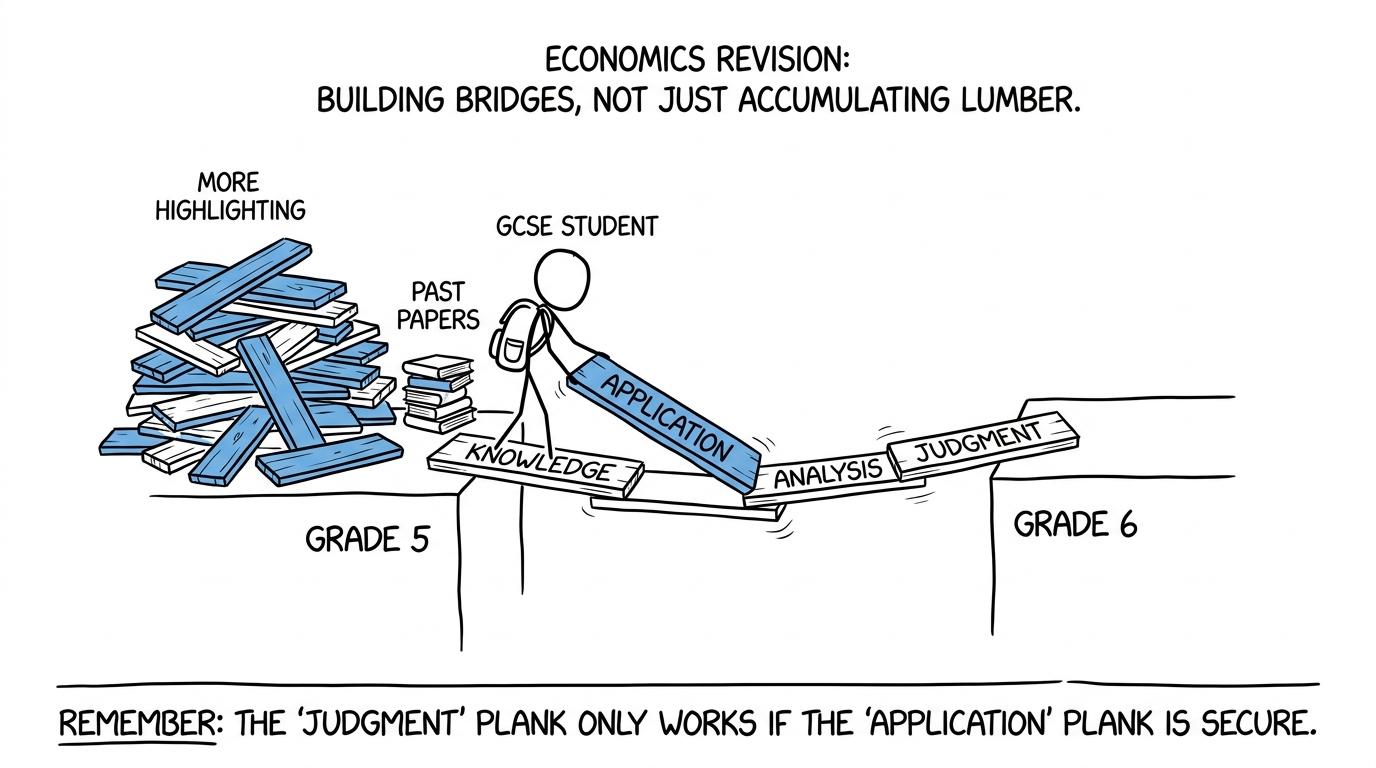 A bridge from Grade 5 to Grade 6 built from useful exam skills
Use past papers and mark schemes deliberately
A past paper is most valuable after it has been marked honestly. Complete questions without notes, follow the stated timing and use the official mark scheme or examiner guidance from your exam board.
Do not copy model wording and call the task complete. Compare the structure of your answer with what was rewarded:
- Was the economic concept accurate?
- Did you use relevant evidence from the question?
- Was each link in the reasoning explicit?
- Did the conclusion answer the precise issue?
Then rewrite only the weakest section. This is faster and more focused than repeatedly completing papers without repairing recurring errors.
MathsGenie's GCSE maths past papers are not Economics papers, but they can sharpen the numerical fluency needed for data questions. The GCSE predicted papers can provide additional timed maths practice, while the main GCSE maths revision resources organise free lessons, practice questions, mini tests and video solutions by grade and topic.
Build a weekly routine you can sustain
A useful week contains several short contacts with the subject rather than one exhausting session. A balanced routine might contain:
- one knowledge-retrieval session;
- one quantitative-skills session;
- one session focused on short applied answers;
- one extended-response practice;
- one review of errors from earlier work.
Plan by task, not merely by time. “Revise Economics for 454545 minutes” gives no definition of success. “Recall market failure definitions and complete two timed analysis questions” does.
If maths fluency is limiting your Economics performance, use the free MathsGenie revision planner to organise the supporting topics. A plan reduces the daily decision of what to do next, which is often where revision quietly stalls.
Common mistakes that hold students below Grade 6
Writing generic answers
An answer can be economically correct but insufficiently applied. Use the specific market, figures, stakeholder or policy described in the question.
Confusing analysis with repetition
Restating the original point in different words does not extend reasoning. Ask what happens next, why it happens and who is affected.
Giving balanced points without a judgement
Two opposing paragraphs do not automatically create evaluation. Weigh them using context and finish with a reasoned conclusion.
Ignoring units and scales
Check whether data is measured in pounds, percentages, thousands or millions. Read both axes before interpreting a graph and show working for calculations.
Treating every question as an essay
A short-mark question requires a proportionate response. Use the command word and mark allocation to decide how much development is needed.
Revising only favourite topics
Confidence can hide gaps. Use the specification as a checklist and spend more time on weak areas, while revisiting strong areas often enough to retain them.
Turn revision into evidence
Getting a Grade 6 in GCSE Economics is not about finding one perfect revision technique. It is about producing repeated evidence that you can recall knowledge, apply it to unfamiliar contexts, explain economic consequences, handle data and reach supported judgements.
Begin with one weak area. Retrieve the content, answer a question, mark it carefully and repair the precise weakness. Then repeat the cycle.
For the numerical side of Economics, make MathsGenie your free revision base. Use its revision lessons, practice questions, mini tests and video solutions to strengthen percentages, averages and graphs, then test that fluency through past papers and predicted maths papers. Better habits are rarely spectacular. They are simply dependable. and dependable performance is what the exam eventually rewards.










