

How to Get Grade 6 GCSE Business: A Practical Plan
How to get grade 6 GCSE Business with focused recall, contextual answers, stronger calculations, timed practice and a reliable weekly revision routine.
A grade can feel mysterious when you are working hard but your marks refuse to move. You know the definitions. You have highlighted the textbook. Yet a longer question arrives and the knowledge seems to scatter.
The clearest answer to how to get grade 6 GCSE Business is not to revise everything for longer. It is to change what your revision produces. You need secure knowledge, accurate calculations, answers applied to the case study and judgements supported by evidence. Then you need to practise those skills until they remain reliable under timed conditions.
Grade boundaries vary by exam board and examination series, so there is no universal percentage that guarantees a grade 6. Your most useful target is therefore consistent improvement across the assessment objectives rather than chasing an unofficial raw-mark figure.
Your grade 6 checklist
A strong plan should help you:
- learn the precise meaning of key business terms
- retrieve knowledge without looking at notes
- apply each point to the business in the question
- build connected chains of analysis
- evaluate options before reaching a justified conclusion
- calculate and interpret business data accurately
- practise using questions from your own exam board
- mark answers, record weaknesses and revisit them
This matters across AQA, Edexcel, OCR and Eduqas. Paper structures and topic organisation differ, but GCSE Business assessments reward knowledge, application, analysis and evaluation.
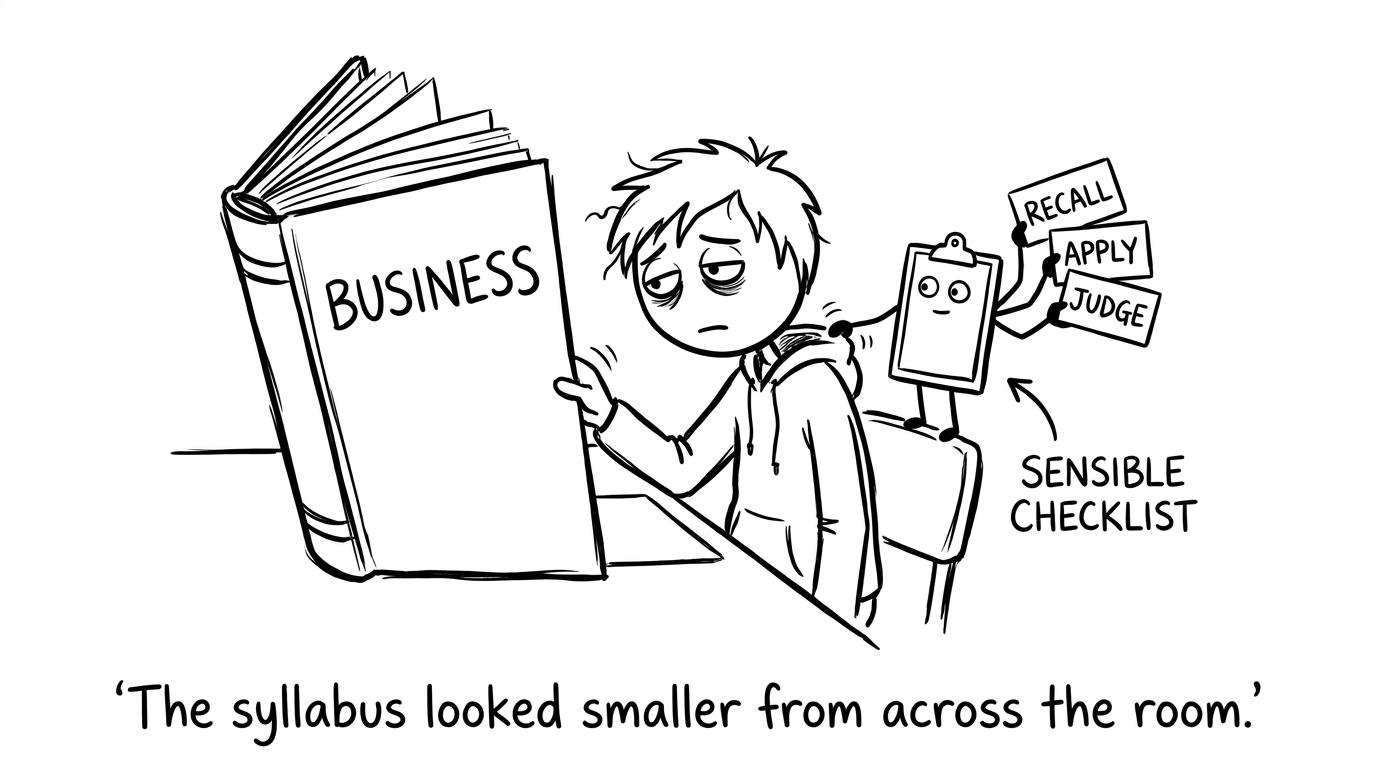 A student discovers that a short revision checklist is less frightening than a giant textbook
Understand where GCSE Business marks come from
Current GCSE Business requirements in England divide assessment between three objectives. AO1, knowledge and understanding, carries 35%35\%35%. AO2, application to business contexts, carries 35%35\%35%. AO3, analysis and evaluation, carries 30%30\%30%.
That balance explains why memorising a revision guide is rarely enough. Knowledge gives you material to use, but almost two-thirds of the assessment concerns what you do with that material.
A student who can define cash flow but cannot connect it to the business in the case study has only completed the first step. A grade 6 answer usually needs to move from a correct idea to a relevant consequence and, where required, a reasoned judgement.
Before building your timetable, check your own specification. Confirm whether you take AQA, Edexcel, OCR or Eduqas, and use that board's current topic list, command words, specimen materials and past papers. Do not assume that a friend's paper has the same structure as yours.
Turn passive revision into active recall
Rereading feels smooth because the page supplies the answers. The examination does not.
For each small topic, close your notes and retrieve the essential content from memory. You might write down definitions, objectives, advantages, disadvantages, formulas and possible effects on stakeholders. Check the result immediately, correct it and test it again later.
Keep the units narrow. Instead of revising all of marketing, separate it into market research, segmentation, the marketing mix and competitive response. Small units make weak knowledge visible.
A useful routine is:
- choose one micro-topic
- recall it without notes
- check against the specification or class materials
- complete a relevant examination question
- mark the response
- retest the weakest part on another day
This is similar to the repair cycle in MathsGenie's guide to finding your weakest GCSE topics. Evidence should decide what you revise next. Familiarity should not.
Apply every answer to the business context
Application is often the bridge between a middling answer and a stronger one. It means using the information given about the particular business rather than writing an answer that could describe any organisation.
Look for clues in the case study:
- the size and ownership of the business
- its objectives
- its products, customers and location
- whether it operates in a mass or niche market
- financial or market data
- a recent change, problem or decision
Use those details to shape the consequence you discuss. Naming the business is not automatically application. Repeating a sentence from the extract is not enough either. The context must affect your reasoning.
Ask: Why does this point matter to this business now?
A small business with limited finance may experience a decision differently from a multinational. A firm focused on rapid growth may judge risk differently from one prioritising survival. Context changes the answer because it changes the likely impact.
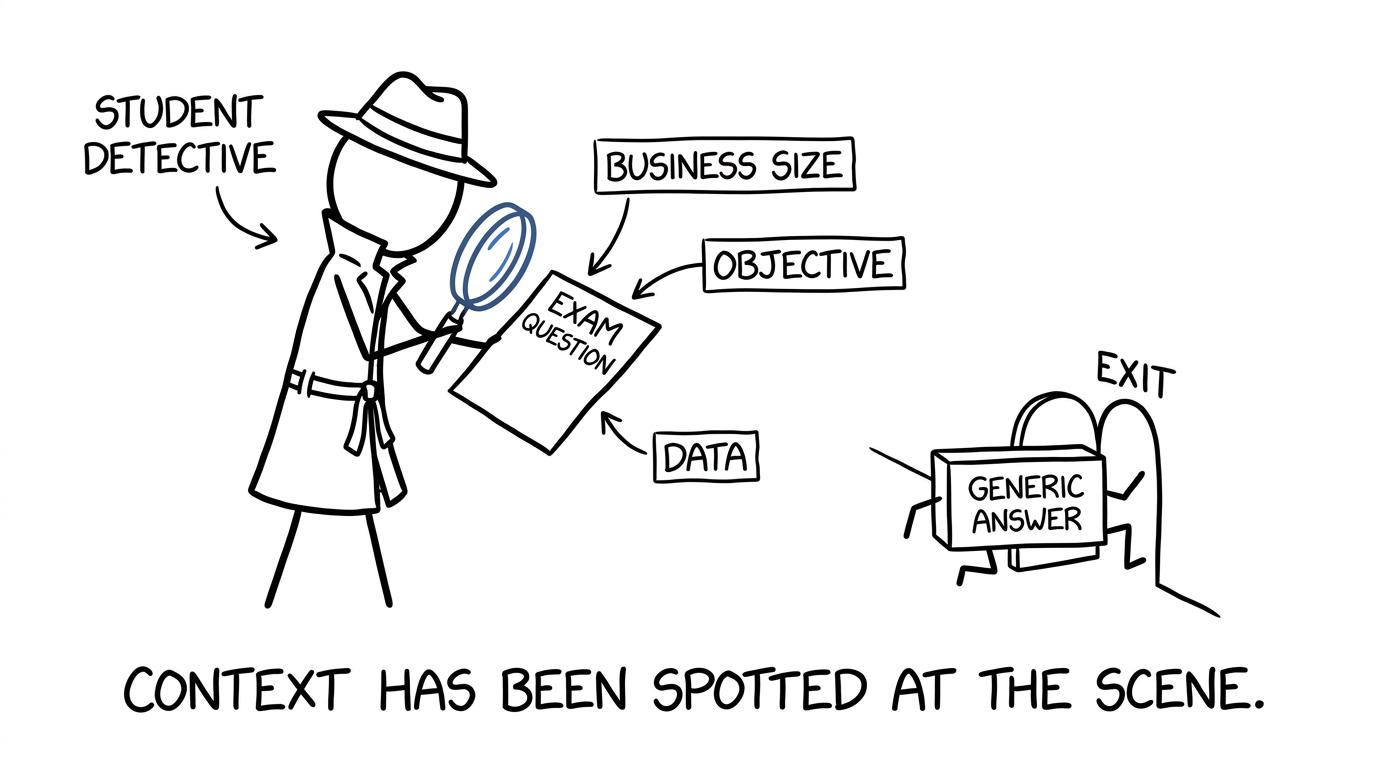 A student detective finds context clues while a generic answer attempts to escape
Build analysis one link at a time
Analysis explains how or why one business event leads to another. The safest way to improve it is to build a short causal chain rather than producing a long paragraph filled with disconnected terminology.
A useful structure is:
decision or change →\rightarrow→ immediate effect →\rightarrow→ further business consequence
The final consequence should connect to something meaningful, such as revenue, costs, profit, cash flow, productivity, competitiveness, customer satisfaction or an objective from the case study.
Do not force endless links into every answer. One well-explained chain is more convincing than several vague claims. After writing each link, ask whether it genuinely follows from the previous one. Words such as “therefore” cannot repair a missing logical step.
Command words matter too. A question asking you to identify requires a different response from one asking you to explain, analyse, justify or evaluate. Build a small command-word checklist from your board's mark schemes and use it whenever you practise.
Make evaluation conditional and decisive
Evaluation is not simply adding “however” near the end. It means weighing relevant factors and making a supported judgement.
For decision questions, consider:
- short-term and long-term effects
- costs, benefits and opportunity costs
- the reliability of the available evidence
- which stakeholders are affected
- the business's size, objectives and financial position
- what the final outcome depends on
A strong conclusion answers the exact question. It selects an option or identifies the most important factor, then explains why that judgement fits the context. Conditional reasoning can strengthen it: the better decision may depend on demand, finance, competitor behaviour or the owner's appetite for risk.
Avoid memorising one universal paragraph structure and treating it as the answer. Structures can organise thought, but the marks come from relevant business reasoning.
Secure the quantitative skills that protect easy marks
At least 10%10\%10% of the marks in regulated GCSE Business qualifications assess quantitative skills in a business context. These include calculations and the interpretation of numerical information. That is too significant to leave until the final week.
You should be comfortable with:
- percentages and percentage change
- averages
- revenue, costs and profit
- gross and net profit margins
- average rate of return
- cash-flow forecasts
- graphs, charts and market data
Keep the core relationships secure:
revenue=selling price×quantity sold\text{revenue}=\text{selling price}\times\text{quantity sold}revenue=selling price×quantity sold profit=revenue−total costs\text{profit}=\text{revenue}-\text{total costs}profit=revenue−total costs percentage change=changeoriginal value×100\text{percentage change}=\frac{\text{change}}{\text{original value}}\times 100percentage change=original valuechange×100 gross profit margin=gross profitrevenue×100\text{gross profit margin}=\frac{\text{gross profit}}{\text{revenue}}\times 100gross profit margin=revenuegross profit×100Calculation is only part of the task. You may also need to explain what the result suggests about performance or use it to support a decision. Always show your method, include suitable units and check whether the answer is plausible.
If percentages are costing you marks, use MathsGenie's percentage change revision guide and percentage change practice questions. You can also strengthen averages, ratio skills and data interpretation through the GCSE Statistics revision hub.
Use a weekly routine that creates feedback
A realistic grade 6 routine is built around repeated contact with the subject, not one heroic weekend.
Two knowledge sessions
Choose one or two specification areas. Retrieve definitions and relationships from memory, check them and answer short questions. Keep these sessions focused.
One quantitative session
Practise a mixture of business calculations and data interpretation. If the underlying arithmetic is weak, repair it through the free GCSE Maths revision hub, where you can choose your exam board and access lessons, questions and revision guides.
One extended-answer session
Complete an application, analysis or evaluation question from your own board. Begin untimed if necessary, but progress towards the real examination time available. Mark it with the official mark scheme and compare its qualities with any examiner guidance provided by your board or teacher.
One correction session
Rewrite only the part that failed. Then attempt a different question testing the same skill. The goal is not to make your old answer look tidy. It is to prove that the weakness has changed.
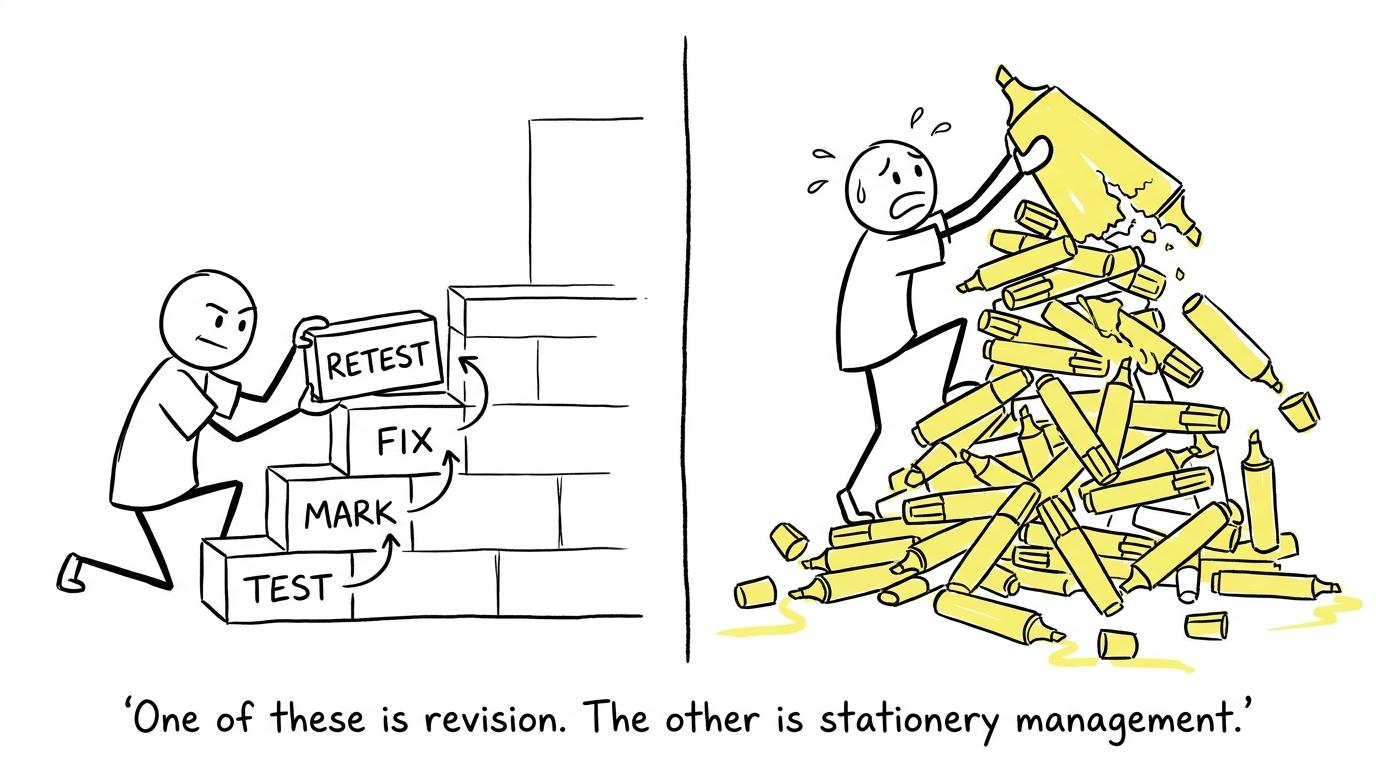 One student builds a staircase from testing and feedback while another climbs a mountain of highlighters
Use past papers without wasting them
A past paper is a diagnostic tool, not a score-producing ritual. Early in revision, complete individual sections or selected questions. Later, sit full papers under the correct conditions for your board.
After marking, classify every lost mark:
- missing knowledge
- weak application
- incomplete analysis
- unsupported evaluation
- calculation error
- misread command word
- poor timing
Your next revision session should target the largest repeated category. Keep an error log containing the question, reason for the lost mark, correction and retest date.
MathsGenie's guide to using past papers properly is written for maths, but its central loop transfers well: attempt, mark, diagnose, repair and reattempt. For Business, use official papers and mark schemes for your own specification rather than relying on generic questions alone.
Common mistakes that keep students below grade 6
Revising definitions but not decisions
Definitions matter, but GCSE Business also tests whether you can use knowledge. Follow recall with an applied question.
Writing generic context
Dropping the business name into a sentence does not prove application. Explain how a specific detail changes the likely effect.
Stopping analysis too soon
Do not end with a vague statement such as “this is good for the business”. Name the business consequence and explain why it matters.
Giving an unbalanced or indecisive conclusion
Evaluation needs comparison, but your final judgement must still answer the question. Choose, justify and state what the decision depends on.
Ignoring calculations
A wrong denominator, missing percentage sign or unlabeled monetary answer can waste marks. Practise the method and interpretation together.
Completing papers without repairing errors
A pile of marked papers can create the appearance of progress. Improvement happens when the same error is less likely to recur.
Make grade 6 the result of a repeatable process
Moving towards grade 6 is usually less about discovering a clever shortcut and more about making ordinary habits reliable. Recall the content. Apply it to the case. Explain the consequence. Judge using evidence. Calculate carefully. Then use feedback to decide what comes next.
Start with one diagnostic Business paper and identify your three biggest mark leaks. For the quantitative gaps underneath them, make MathsGenie your free revision base. Use its revision lessons and practice questions to rebuild individual skills, mini tests to check recall, and past papers, predicted papers, mark schemes and video solutions to develop stronger exam habits in maths.
Do not wait to feel completely ready. Choose one weakness, practise it today and return to it after marking. Grade 6 becomes more reachable when every revision session has a clear job.











