

How Stressful Is GCSE Business Compared to Other GCSEs?
How stressful is GCSE Business? See where students rank it, what makes it demanding, and how to balance it confidently with GCSE maths revision.
The timetable can make two subjects look equal. One hour for Business. One hour for maths. Yet the effort inside those hours may feel completely different.
So, how stressful is GCSE Business compared with other GCSEs? The short answer is that students tend to place it in the lower-middle to middle of the difficulty range. It is not consistently reported as one of the hardest GCSEs, and some informal student polls have placed it among the easier options. However, other student anxiety surveys have ranked Business closer to the middle, particularly because of its content, extended responses and time pressure.
The fairest conclusion is that GCSE Business is usually manageable, but it is not effortless. Its stress comes less from highly abstract ideas and more from remembering content, applying it to unfamiliar case studies and writing enough relevant analysis before time runs out.
GCSE Business stress at a glance
Use this quick checklist before deciding how difficult the subject will feel for you:
- Content load: moderate, covering areas such as marketing, finance, operations, people and external influences.
- Mathematical demand: usually accessible, but accurate percentages, ratios, averages and financial calculations matter.
- Writing demand: moderate to high because longer questions require application, analysis and judgement.
- Exam pressure: significant, especially when several case-study questions must be completed within one paper.
- Coursework pressure: current major GCSE Business specifications are primarily or entirely examined, depending on the qualification followed, so stress is concentrated around written papers.
- Overall position: generally not among the most stressful GCSEs, but rarely a subject that can be revised successfully through last-minute memorisation alone.
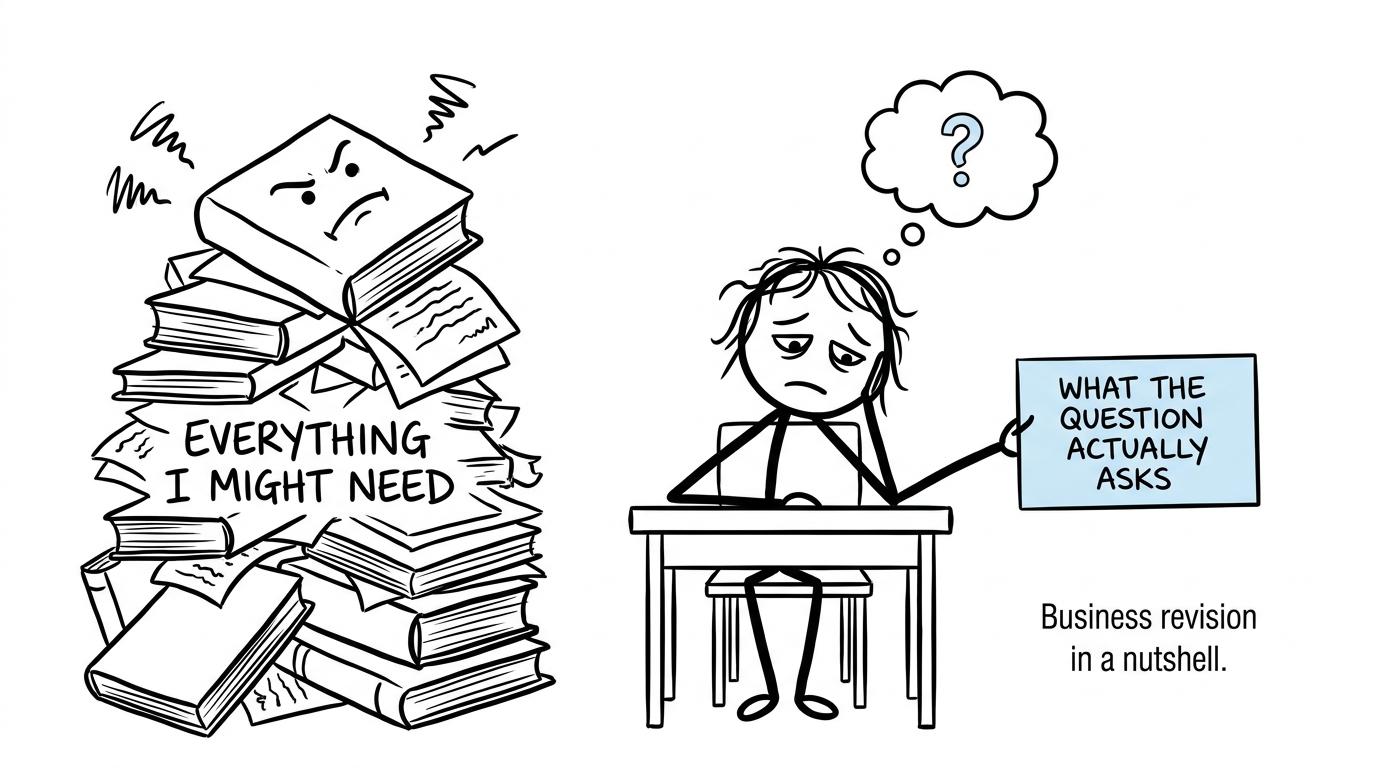 A student choosing useful revision over an enormous pile of everything
Where GCSE Business tends to rank for stress
There is no official, nationally accepted table ranking GCSE subjects by stress. Ofqual researches qualification difficulty and grading comparability, but difficulty is not identical to a student's emotional experience. Stress also depends on teaching, confidence, workload, assessment timing and the combination of subjects being taken.
The available student reports give a mixed but useful picture. An informal student poll published in 2023 placed Business among the easiest GCSE subjects. A separate commercial survey of exam anxiety placed Business sixth in its list of subjects causing anxiety, behind subjects including biology, chemistry, maths, computer science and English Language.
These sources are not directly comparable and should not be treated as precise national rankings. Their samples, questions and methods differ. Together, however, they suggest something more realistic than either label alone: Business tends to sit somewhere around the middle, often leaning towards the less stressful side, but experiences vary considerably.
It is usually seen as less technically demanding than maths or the sciences. The concepts can also feel more familiar because they involve prices, customers, employees and everyday organisations. Yet familiarity can be deceptive. Knowing what profit means is not the same as producing a well-developed, context-specific judgement under timed conditions.
How Business compares with other GCSE subjects
GCSE Business versus maths
Maths is cumulative. If fractions, algebra or ratio are insecure, later topics can become harder because one method depends on another. Business is less abstract and its topics can sometimes be repaired more independently.
However, maths questions often have clearer right or wrong outcomes. In Business, two students may know the same definition, but the student who applies it precisely to the case study and develops a logical chain of reasoning is likely to earn more marks. That uncertainty can create stress.
Business also includes quantitative skills. Specifications commonly require numerical work to contribute at least 10%10\%10% of the overall marks. Depending on the exam board, students may meet revenue, costs, profit, cash flow, percentages, averages and financial ratios.
If those areas worry you, the free MathsGenie lessons on GCSE percentages, ratio revision and averages can make the numerical side of Business feel far more predictable.
GCSE Business versus science
Biology, chemistry and physics are often reported as stressful because they combine broad specifications with technical vocabulary, practical knowledge and calculations. Students taking combined science must also prepare for several papers.
Business usually contains fewer technically complex ideas. Its challenge is depth of application rather than scientific detail. A remembered definition may collect some marks, but stronger answers must explain why a decision matters to the particular business in the question.
For many students, this makes Business less stressful than science. For someone who prefers calculations to extended writing, the opposite may be true.
GCSE Business versus English and humanities
Business shares some demands with English, history and geography. You must read sources carefully, select evidence and construct extended responses. The difference is that Business writing is generally more functional. You are analysing decisions, consequences and trade-offs rather than interpreting language or building a historical argument.
That structure can reduce stress. Once you understand what command words such as analyse, evaluate and justify require, longer answers become less mysterious. But students who expect Business to be purely about memorising definitions may find these questions unexpectedly demanding.
GCSE Business versus practical options
Comparisons with art, drama, music, design and technology or PE are difficult. Practical subjects may involve sustained projects, performances or preparation outside written exams. Business usually places more weight on terminal examination performance.
One student may prefer steady project deadlines; another may prefer revising for written papers. The less stressful subject is often the one whose assessment style matches how you work best.
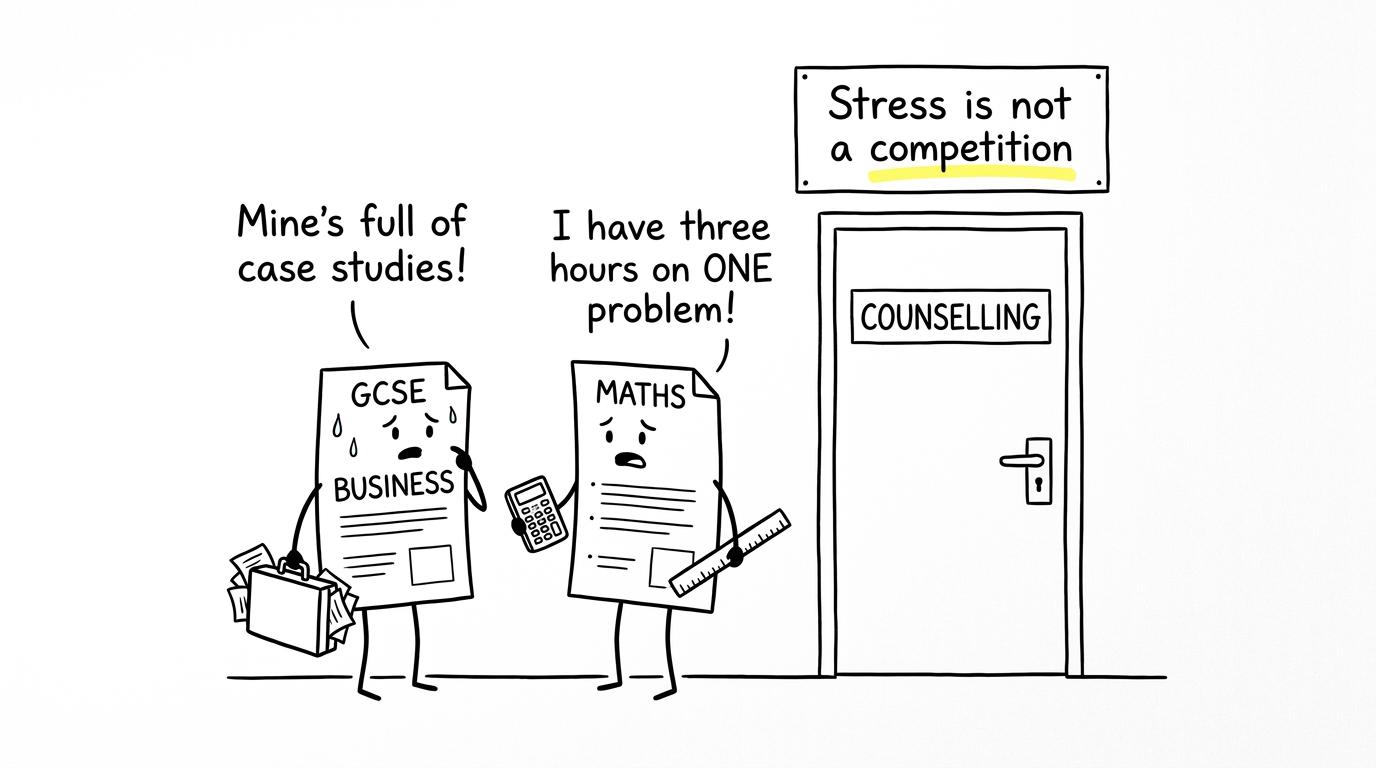 Business and maths papers remembering that stress is not a competition
What actually makes GCSE Business stressful?
The specification looks familiar until detail matters
Words such as marketing, profit and recruitment sound understandable. The specification then separates them into objectives, methods, advantages, disadvantages and effects on different stakeholders.
This creates a common trap: recognition feels like knowledge. In an exam, you need to recall the idea without prompts and use it accurately in context.
Case-study application cannot be memorised
Business papers use unfamiliar organisations and scenarios. A generic answer may be correct in principle but too detached from the information provided. Students must connect business knowledge to details such as the firm's size, market, objective, workforce or financial position.
This is why practice questions matter more than endlessly rewriting notes.
Extended questions create timing pressure
The major exam boards organise GCSE Business differently. For example, AQA currently uses two written papers of 111 hour 454545 minutes, each worth 50%50\%50%. OCR uses two 111 hour 303030 minute papers, also equally weighted. Pearson Edexcel likewise assesses the qualification through two written papers. Students should always check the latest specification supplied by their school because timings and question structures differ between boards.
Across these papers, the stressful moment is often not the first question. It is the final extended response when the clock is running down. Planning briefly, responding to the command word and moving on when the available time has passed are examinable habits in everything but name.
Business competes with compulsory subjects
Business is usually an option, while English, maths and science carry unavoidable revision demands. The pressure comes from allocation: how much time should go to Business when a maths paper is also approaching?
Do not divide revision equally by default. Divide it according to evidence. A marked assessment, mini test or timed paper tells you more than a vague feeling of being behind. The MathsGenie GCSE revision hub helps you identify weak maths topics by board and tier rather than revising everything indiscriminately.
How to make GCSE Business less stressful
Use a learn, apply, check cycle
For each small topic:
- recall the key terms without notes;
- answer a short or extended exam-style question;
- check the mark scheme or teacher feedback;
- write down one specific improvement;
- return to the topic several days later.
This works because stress often grows from uncertainty. Each completed cycle replaces “I think I know this” with evidence.
Separate knowledge problems from writing problems
If you cannot remember a definition, you have a knowledge gap. If you know the content but lose marks on evaluation, you have an exam-technique gap. Treating both as “I am bad at Business” hides the action you need to take.
Use three headings in an error log: knowledge, application and exam technique. Your revision should follow whichever heading appears most often.
Protect maths without abandoning Business
A short, repeatable routine is more useful than a heroic weekend timetable. The GCSE 202020-minute maths revision routine is designed for busy school days, while the one-month GCSE maths revision plan helps organise the final run-in.
You might alternate focused Business recall with maths topic practice, then use one longer weekly session for a timed paper. What matters is that every session has a defined output: questions answered, marks checked or mistakes corrected.
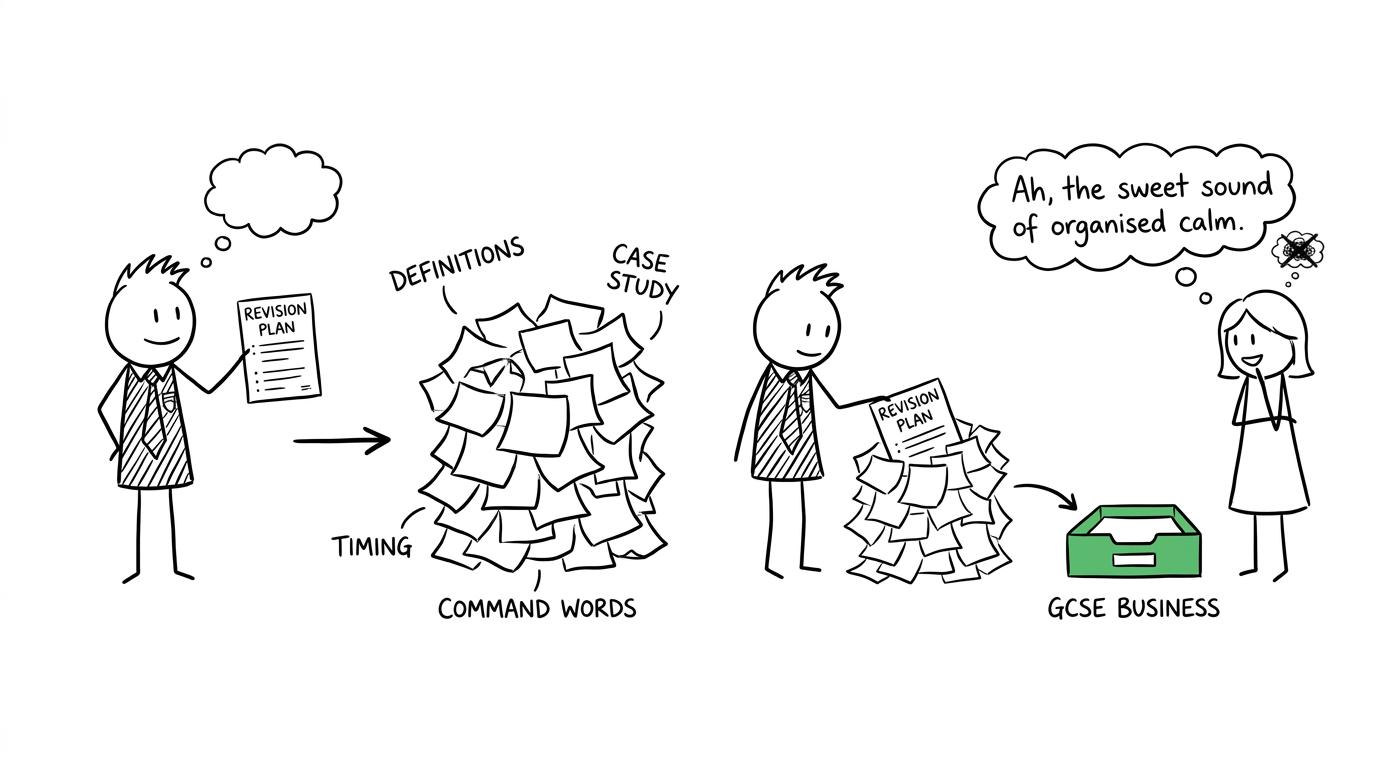 A revision plan turning a chaotic stress monster into an organised filing tray
Common mistakes when judging and revising GCSE Business
Assuming an “easy” GCSE needs little revision
A subject can have accessible concepts and still produce demanding exams. Business rewards precise application and developed reasoning, not familiarity with commercial vocabulary.
Treating student rankings as facts
Online polls describe the students who answered them. They do not prove that one subject will be easier for you. Use them as context, not as a prediction of your grade or wellbeing.
Memorising model answers word for word
The business in the exam will have its own circumstances. Memorised paragraphs often become generic because they do not respond to those circumstances. Learn structures and reasoning habits instead.
Ignoring the numerical marks
Students sometimes choose Business expecting to avoid maths. That is a mistake. Percentages, financial data and numerical interpretation can offer dependable marks when practised properly.
Completing papers without reviewing them
A paper shows what went wrong; review changes what happens next. This principle also matters in maths. Use Edexcel GCSE maths past papers with the relevant mark schemes, then repair the topics that cost you marks. Nearer the examination, GCSE predicted papers can provide fresh timed practice, although no predicted paper can guarantee the content of the real exam.
The calmest answer is an honest one
GCSE Business tends to be reported as less stressful than the most technically or content-heavy GCSEs, but it sits closer to the middle when writing, application and timing are considered. It is manageable for most students who revise consistently. It becomes stressful when familiar-looking content creates false confidence and exam practice begins too late.
The same lesson applies to maths. Calm does not come from being told a subject is easy. It comes from seeing the question, recognising the method and knowing you have practised it before.
Start at the MathsGenie GCSE maths revision area. Choose your exam board and foundation or higher tier, then combine free revision lessons with practice questions, mini tests, past papers, predicted papers, mark schemes and video solutions. Let each marked attempt decide the next step. That is how a crowded GCSE timetable becomes a plan rather than a source of panic.











