

How Long Revise GCSE English Literature Per Week?
How long revise GCSE English Literature per week? Build a realistic plan by months left, with active recall, essay practice and balanced GCSE maths revision.
Revision time has a strange habit of expanding in your imagination. English Literature feels as though it demands every evening because there are plays, novels, poems, quotations and essay plans to remember. Maths can create the same pressure, only with formulas and problem-solving techniques instead.
So, how long revise GCSE English Literature per week? A realistic starting point is 1.51.51.5 to 333 hours each week when the exam is several months away, rising to 333 to 555 hours during the final 666 to 121212 weeks. If fewer than 333 weeks remain, you might temporarily use 555 to 777 hours, provided this does not displace sleep, schoolwork or revision for maths and other subjects.
There is no official number prescribed by AQA, Edexcel, OCR or Eduqas. Your best total depends on how long you have left, your current knowledge and the feedback from your teacher. The goal is not to collect hours. It is to become better at recalling texts, analysing writers’ choices and producing focused responses under timed conditions.
Your quick weekly revision checklist
A useful English Literature week should normally include:
- retrieval of quotations, themes and character development
- analysis of language, form and structure
- one essay plan or timed paragraph
- regular unseen poetry or comparison practice where required
- checking work against assessment objectives and teacher feedback
- enough protected time for GCSE maths and your other subjects
Think of this as a minimum viable system. You can increase the time near the examination, but every session should have a specific purpose.
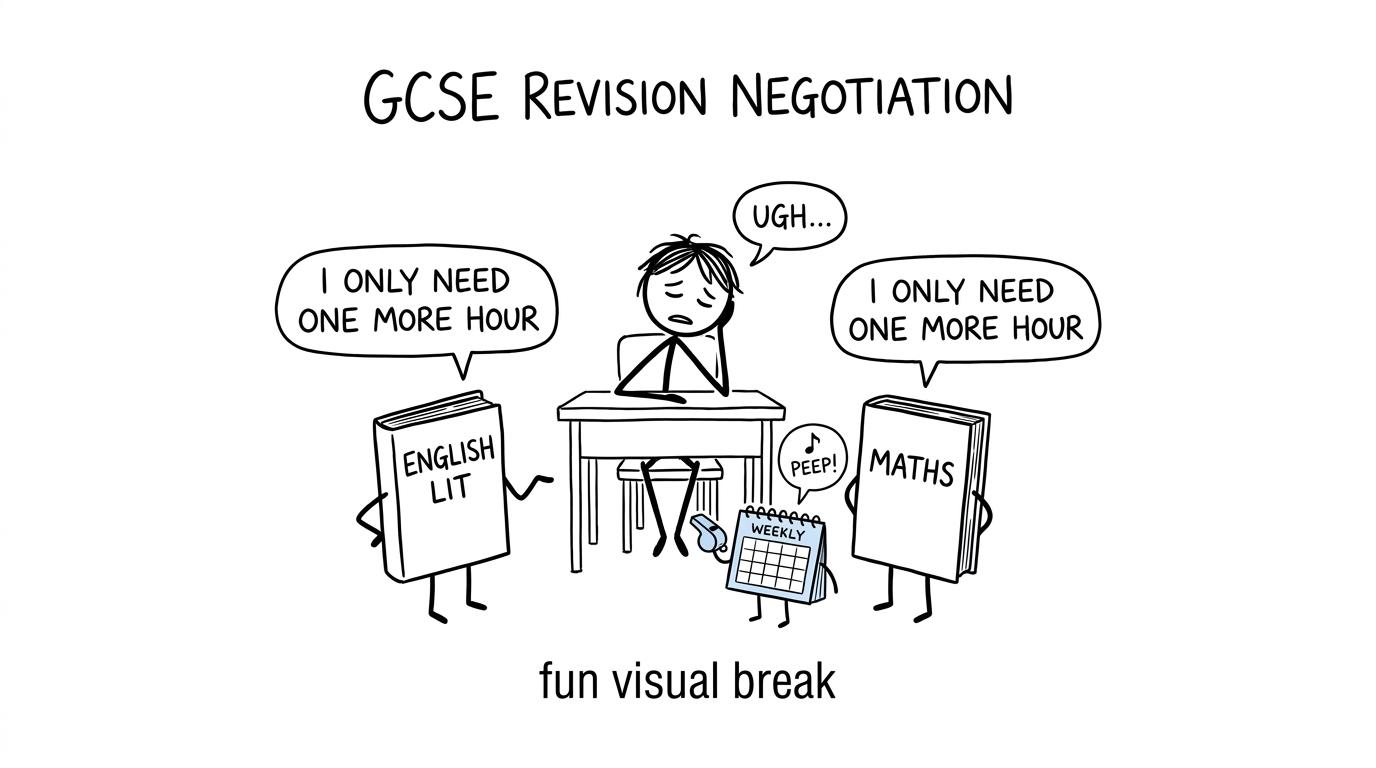 A weekly calendar referees a negotiation between English Literature and maths revision books
Recommended weekly time based on months left
These ranges are planning estimates rather than exam-board rules. Begin near the lower end if your classwork is secure. Move towards the upper end if you have missing knowledge, incomplete texts or weak timed responses.
| Time before the exam | Suggested English Literature revision | Main priority |
|---|---|---|
| More than 666 months | 1.51.51.5 to 222 hours per week | Secure texts, themes and core quotations |
| 333 to 666 months | 222 to 333 hours per week | Retrieval, analysis and short essay plans |
| 666 to 121212 weeks | 333 to 444 hours per week | Timed writing, comparisons and weak areas |
| 333 to 666 weeks | 444 to 555 hours per week | Exam questions, feedback and targeted recall |
| Fewer than 333 weeks | 555 to 777 hours per week temporarily | Prioritised exam practice and correction |
More time is not automatically better. Six distracted hours of copying notes may produce less learning than three focused sessions involving retrieval, writing and feedback.
Research on learning supports planning, monitoring and evaluating revision rather than relying on passive rereading. Retrieval practice also requires you to recall material before looking at the answer. It can feel harder precisely because it reveals what you do not yet know.
How to adjust the estimate to your situation
Start with three questions.
How secure is your knowledge?
List every assessed text, poetry cluster and unseen component in your specification. Give each area a simple rating:
- Secure: you can recall relevant evidence and explain its significance.
- Developing: you understand the text but struggle to select precise references.
- Weak: plot, themes, characters or analytical methods remain unclear.
Spend more time on weak and developing areas. Equal time can feel organised, but it is often inefficient. A secure text does not deserve the same attention as a poetry comparison you cannot yet begin.
What does your exam board require?
GCSE English Literature specifications assess reading, interpretation, textual evidence, analysis, context and accurate writing. However, paper structures and set texts differ between AQA, Edexcel, OCR and Eduqas. Check your current specification, the texts taught by your school and whether extracts or poems are provided in each examination.
English Literature is normally untiered, unlike GCSE maths, where foundation and higher tier affect the questions you face. That makes accurate specification checking especially important: do not revise a generic internet list when your school has taught a particular text or poetry cluster.
What is your current workload?
Your weekly plan must fit around maths, English Language, science and your remaining subjects. If you are also preparing for maths exams, start from the GCSE Maths Revision hub, choose your board and protect separate sessions for problem-solving practice.
A timetable that looks perfect but cannot survive a normal school week is not a plan. It is a wish. Build around commitments you actually have, then leave one open session for unfinished work or rest.
What to do during each revision hour
An hour should produce evidence of learning. That might be a quotation recalled correctly, an improved interpretation or a timed response you have checked.
A balanced 606060-minute session could contain:
- 101010 minutes recalling themes, quotations or character links without notes
- 151515 minutes checking gaps and correcting inaccurate knowledge
- 151515 minutes planning a response to an exam-style question
- 151515 minutes writing one analytical section under time pressure
- 555 minutes recording the next action
This is not a rigid formula. A full timed essay will need longer. The principle is to move from memory to application, then from application to feedback.
The same loop is valuable in maths: attempt, mark, diagnose and revisit. MathsGenie explains this process in its guide to using GCSE past papers properly. The subject changes, but the useful habit remains the same: unfinished marking means unfinished revision.
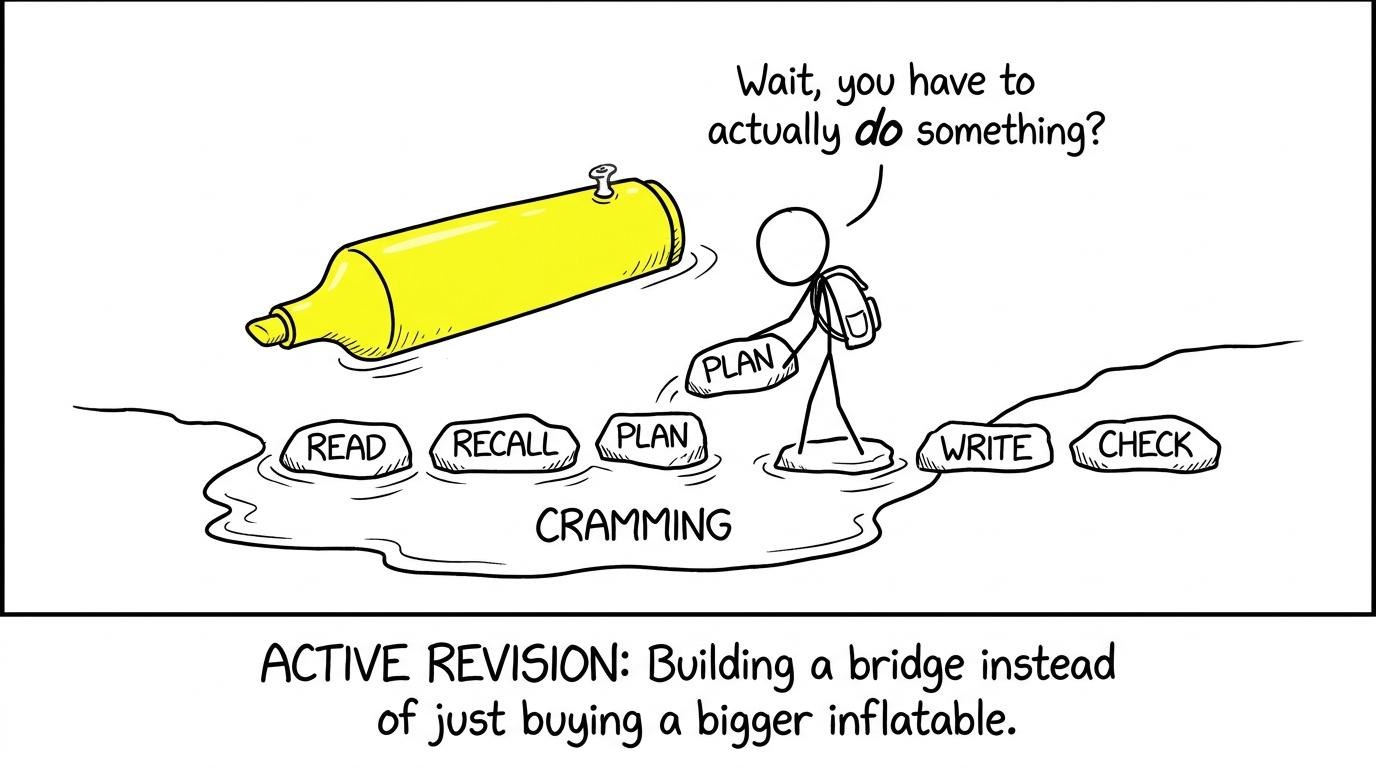 A student crosses the cramming puddle using active revision stepping stones
A realistic weekly timetable
If you have several months left, three short sessions are often easier to sustain than one long weekend block.
| Session | Length | Suggested focus |
|---|---|---|
| Early week | 303030 to 404040 minutes | Closed-book recall of one text or poetry cluster |
| Midweek | 404040 to 505050 minutes | Essay planning and close language analysis |
| Weekend | 454545 to 606060 minutes | Timed writing, marking and corrections |
This produces roughly 222 to 2.52.52.5 hours of purposeful revision. In the final weeks, add another timed-writing session or extend the weekend session.
Do not simply make every session longer. Concentration fades, and an overloaded timetable can damage revision elsewhere. For maths, short topic sessions and mini tests can sit alongside English without forcing two essay-heavy subjects into the same evening. If you need a broader structure, adapt the rhythm in MathsGenie’s one-month GCSE maths revision plan.
Focus on the skills that earn marks
Official GCSE English Literature assessment objectives place substantial emphasis on understanding and responding to texts, supporting interpretations with references, and analysing language, form and structure. Context matters, but it should inform your interpretation rather than become a detached history paragraph.
That means your revision should include more than memorising quotations. For each important quotation or reference, ask:
- What interpretation does this evidence support?
- Which word, structural choice or dramatic method deserves analysis?
- How does the moment connect to the text as a whole?
- Is context genuinely helping me explain the writer’s choices?
Essay practice then teaches you to select from what you know. You do not need to unload every memorised idea. Strong responses choose evidence that answers the question.
Balance English Literature with GCSE maths
Students preparing for maths exams need to preserve regular mathematical practice. Literature knowledge can be revisited through short recall sessions, but mathematical fluency also weakens when practice disappears for weeks.
Keep the subjects in separate blocks. For example, use English for quotation retrieval and essay planning on one evening, then complete topic questions or a mini test on another. The MathsGenie past-paper library helps you check papers and mark schemes without turning revision into a search exercise.
Choose resources matching your board. MathsGenie provides dedicated collections for AQA GCSE Maths past papers, OCR GCSE Maths revision and Edexcel GCSE Maths past papers. Near the exam, Edexcel predicted papers can provide fresh practice, but they should supplement official past papers rather than replace them.
The important calculation is not whether English receives exactly the same time as maths. It is whether each subject receives enough deliberate practice to address its current weaknesses.
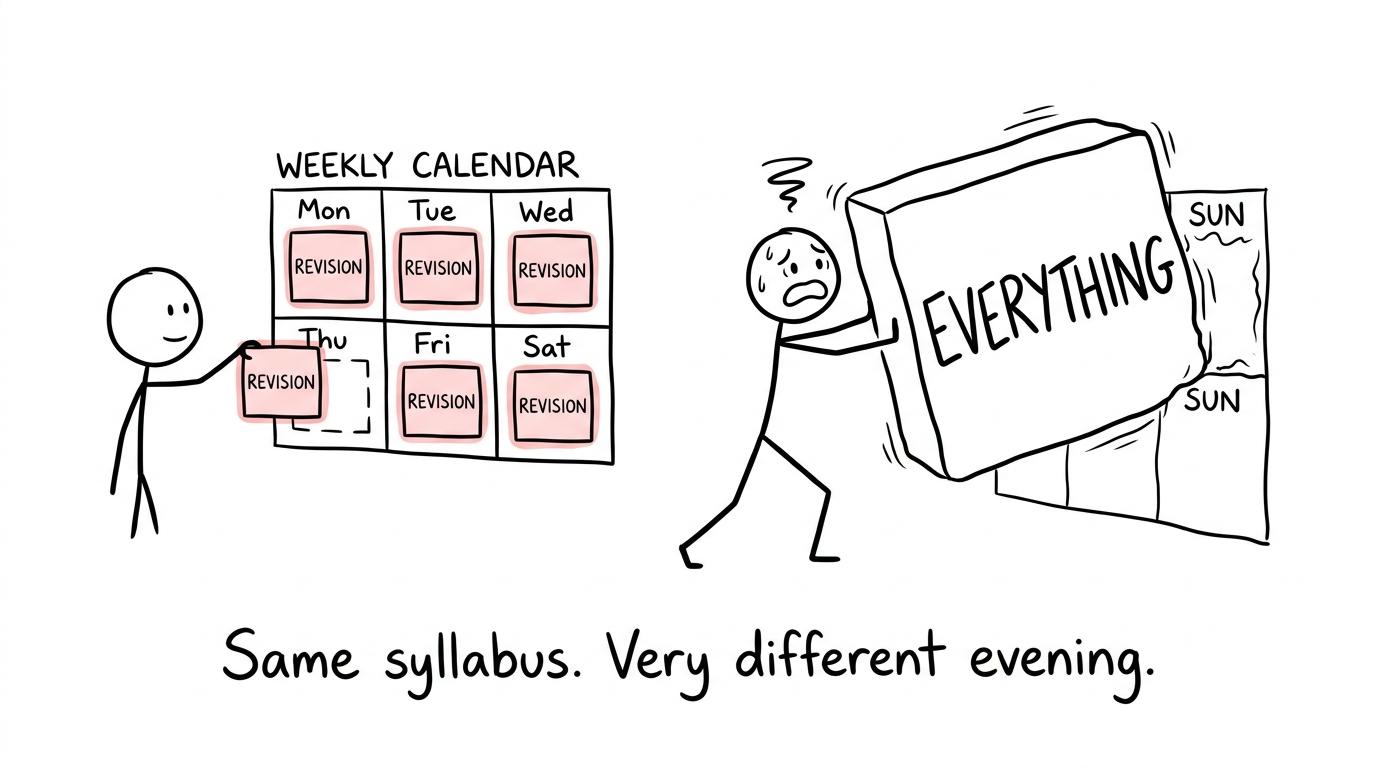 One student spreads revision across the week while another tries to squeeze everything into Sunday
Common revision mistakes
Counting hours instead of completed actions
“Revise English for two hours” is vague. “Recall quotations for one theme, plan one comparison and write one timed paragraph” is measurable. Plan outputs, then estimate the time required.
Rereading without retrieval
Rereading can refresh your understanding, but it does not prove that you can recall ideas in an examination. Close the book, write what you remember, then check and correct it.
Memorising quotations without interpretations
A quotation is evidence, not a complete argument. Connect it to the question, analyse the writer’s method and explain its effect or significance.
Writing essays without reviewing them
Repeated writing can preserve the same weaknesses. Use teacher feedback, assessment objectives and available mark schemes to identify one change for the next response.
Sacrificing every other subject
A sudden literature panic should not erase maths from the timetable. Maintain short, regular practice and use your revision planner to notice neglected subjects before they become emergencies.
Increasing hours until the plan collapses
If you repeatedly miss sessions, reduce the daily load and restore consistency. A smaller timetable completed for several weeks is more valuable than an ambitious one abandoned after three days.
Build a plan you can repeat
For most students, the right answer begins at 1.51.51.5 to 333 hours of GCSE English Literature each week several months before the exam, increasing gradually as timed practice becomes more important. Use your teacher’s feedback and your current specification to adjust that range.
Then protect your maths revision. Open the MathsGenie GCSE revision hub, choose your exam board and tier, and turn each session into a clear loop: learn through revision lessons, practise with exam questions, check mark schemes and video solutions, retest with mini tests, then build exam confidence through past papers and predicted papers.
Revision becomes calmer when every hour has a job. Choose this week’s weakest area, schedule the first short session and begin.










