

Highest Grade Foundation Maths: The Grade 5 Cap
Highest grade foundation maths is grade 5. Learn how tiers, GCSE maths grade boundaries and focused Maths Genie revision can guide your exam choice.
A parent opens a mock-results envelope and sees a grade 5. The first feeling is relief. The second is uncertainty: is that the highest grade foundation maths allows, or could the result have been higher?
The direct answer is grade 5. On foundation tier GCSE Maths in England, grade 5 is the maximum available. Foundation papers award grades 1-5, while higher tier papers cover grades 4-9, with a limited grade 3 safety net for candidates who fall just below the grade 4 boundary.
That does not make foundation tier an easier version of the same decision. It makes it a different route, designed to give students an appropriate paper while allowing them to achieve a standard pass at grade 4 or a strong pass at grade 5.
Foundation maths at a glance
Before deciding what the grade cap means for you, keep these points in view:
- The highest possible foundation tier result is grade 5.
- A student cannot receive grade 6 or above from a foundation paper, regardless of the mark achieved.
- Foundation tier covers grades 1-5.
- Higher tier mainly covers grades 4-9.
- Grade boundaries are set after the examinations and can change between exam series.
- Tier decisions should consider likely outcomes, confidence and performance across the whole specification.
- Students should confirm their tier with their school or exam centre.
The best starting point is the Maths Genie GCSE Maths revision hub, where students can select their exam board and work through relevant lessons, questions and papers.
Why is grade 5 the highest grade on foundation maths?
The cap exists because GCSE Maths is tiered. One paper cannot easily provide accessible questions for a student developing basic number skills while also testing the advanced reasoning required for grade 9. Foundation and higher papers solve that assessment problem in different ways.
Foundation tier offers a broader run of accessible and intermediate questions. Higher tier includes more demanding algebra, geometry, probability and problem-solving. There is overlap around grades 4 and 5, but the upper end of each paper is different.
This distinction applies to the 9-1 GCSE Maths qualifications used by major exam boards in England, including Edexcel, AQA, OCR and Eduqas. A perfect foundation score would still produce no more than grade 5 because grade 5 is the qualification outcome attached to the top of that tier.
For many students, this is not a disadvantage. If the immediate goal is to secure grade 4 or 5, a paper built around the foundation specification may offer a more suitable route than confronting a higher paper containing substantial material above the student’s current level.
What GCSE maths grade boundaries actually mean
A tier cap and a grade boundary are not the same thing.
The tier cap says which grades are available. The grade boundary says how many marks were needed for each available grade in a particular exam series.
For a clearly dated example, the June 2025 Edexcel GCSE Maths foundation qualification had a maximum of 240240240 marks across its papers. The published boundaries were 175175175 marks for grade 5 and 144144144 marks for grade 4. Those figures belong specifically to that exam board, tier and series. They should not be treated as permanent targets for another year.
Exam boards set GCSE maths grade boundaries after reviewing how students performed and how demanding the papers were. A harder paper can have lower boundaries; a more accessible paper can have higher ones. The standard represented by the grade is intended to remain comparable even when the raw mark changes.
This is why a student should not build an entire revision plan around one old boundary. Past boundaries offer context, not a promise. Use them alongside timed papers, topic performance and teacher judgement.
Is foundation or higher tier the better choice?
Imagine a student whose recent assessments sit around grade 4. The family may look at higher tier and see possibility: grades 6-9 become available. The teacher may look at the same paper and see risk: too many inaccessible questions could prevent the student from collecting marks consistently.
Both perspectives are understandable. The useful question is not simply, “Which tier offers the highest grade?” It is, “On which tier is this student most likely to demonstrate what they know?”
Foundation may be appropriate when
- the main target is grade 4 or 5;
- core number, ratio, algebra and geometry skills still need consolidation;
- higher-tier questions regularly become inaccessible early in the paper;
- foundation mocks show a stronger and more dependable performance.
Higher may be appropriate when
- the student has a realistic target of grade 6 or above;
- grade 5 content is generally secure;
- unfamiliar multi-step problems can be approached with confidence;
- performance across higher-tier assessments supports the move.
Tier entry is normally managed by the school or exam centre, so students and parents should discuss the evidence with the maths teacher. A single excellent homework or disappointing mock should not carry the whole decision. Look for a pattern.
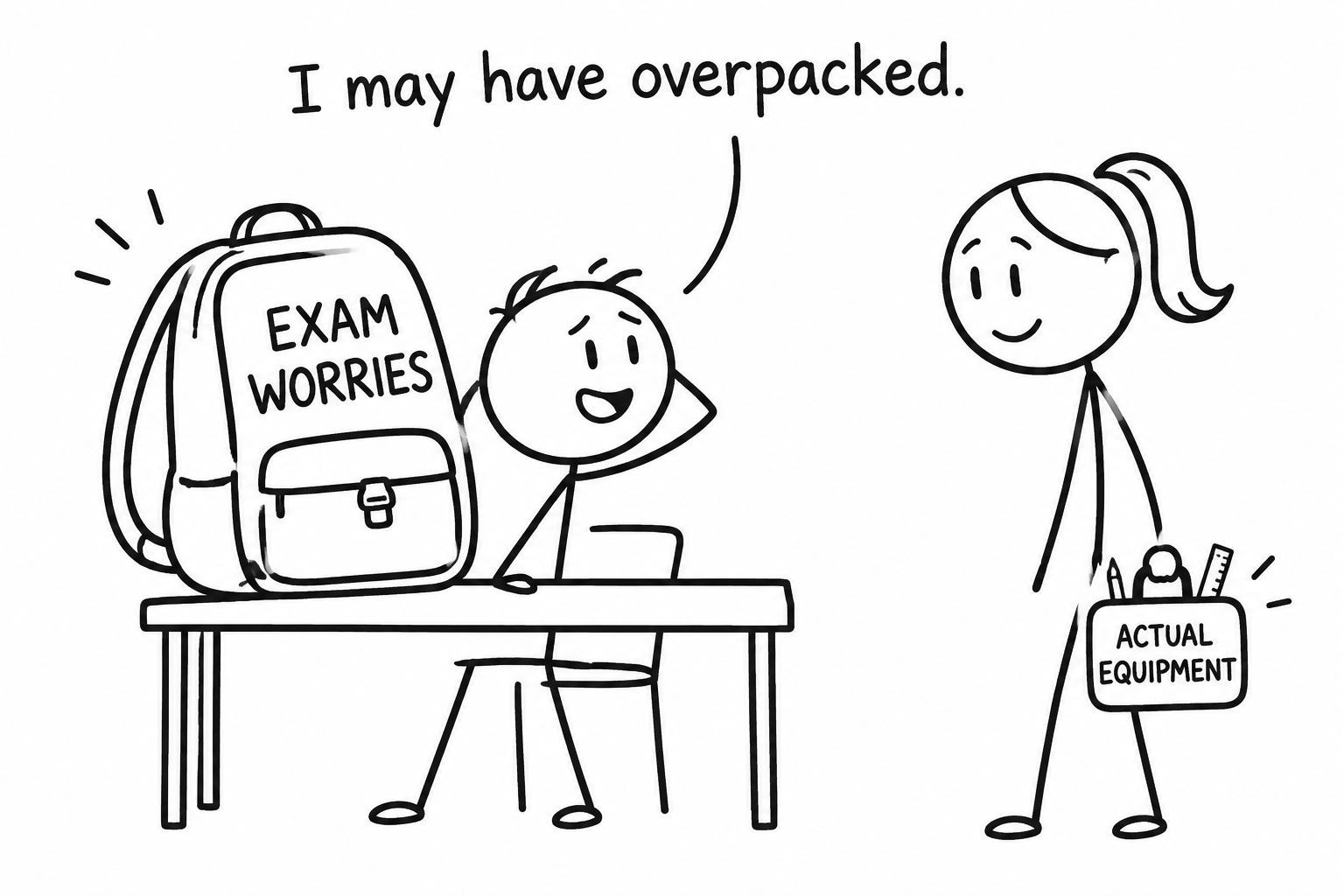 A student jokes about overpacking exam worries while a parent carries the actual equipment
How to move towards grade 5 on foundation maths
The final marks rarely come from discovering one spectacular trick. They usually come from reducing small losses across familiar topics.
Start by identifying where marks disappear. Is the student unsure how to begin, or do correct methods end with arithmetic errors? Are calculator inputs the problem? Are written explanations too vague? Each diagnosis suggests a different kind of revision.
Secure high-frequency foundations
Number fluency supports almost everything else. Fractions, decimals, percentages, ratio and proportion appear directly, but they also sit inside probability, area, finance and data questions.
Use the fractions, decimals and percentages revision lesson to rebuild understanding, then move to an exam-style fractions, decimals and percentages booklet. Students following another exam board should select the matching version through the GCSE hub.
Revise actively, not passively
Watching a solution can make a method feel familiar without making it retrievable. A better sequence is:
- review one short lesson;
- answer practice questions without notes;
- mark the work carefully;
- record the precise error;
- retry the question later from a blank page.
The Maths Genie revision guides combine topic notes with examples and videos, but the important step is what happens next: attempting questions independently.
Use papers as diagnosis
Past papers are valuable, but completing paper after paper without analysing mistakes can preserve the same weaknesses. Use mark schemes and video solutions to separate four issues: missing knowledge, incorrect method, careless execution and poor exam timing.
Then return to topic lessons before trying another paper. Maths Genie provides free past papers, predicted papers, practice questions, mark schemes, video solutions and mini tests, so revision can move between diagnosis and repair rather than becoming a stack of unexplained scores.
A consistent routine usually beats a dramatic final-week effort. The GCSE maths revision timetable guide can help families build a manageable weekly structure. If time is short, the one-month GCSE Maths revision plan offers a more focused route.
Common mistakes about foundation GCSE maths grades
Assuming a high mark can become grade 6
It cannot. Grade 5 remains the maximum result on foundation tier, even when a student scores well above the grade 5 boundary.
Treating last year’s boundary as this year’s target
Boundaries vary by exam board and exam series. Use dated boundaries to interpret past performance, not to predict an exact future requirement.
Moving to higher tier for status alone
Higher tier opens access to grades 6-9, but access is not the same as attainment. The paper must suit the student’s current knowledge and likely performance.
Revising only the hardest questions
Students near grade 5 often gain more by becoming highly reliable on accessible and intermediate questions. Secure methods, complete working and careful checking protect marks that are already within reach.
Looking only at the total mock grade
A total score hides useful detail. Topic-level analysis may reveal that algebra is secure while ratio, transformations or probability are holding the result back.
Make the grade cap useful
Knowing that grade 5 is the highest foundation result turns a vague worry into a practical decision. If grade 5 matches the student’s goal, foundation tier can be a sensible route. If the goal is grade 6 or above, discuss higher-tier readiness with the school while there is time to address gaps.
Either way, improvement begins at topic level. Visit Maths Genie and choose Maths Genie Lessons on the topics that move marks most. Combine those lessons with practice questions, mini tests, past papers and honest review. The grade may appear on one results sheet, but it is built through many small, correct decisions beforehand.















