Is Higher Tier GCSE Portuguese Needed for Sixth Form?
Higher tier GCSE Portuguese sixth form rules explained: when Foundation grade 5 is enough, when Higher matters, and what entry requirements to check.
A tier decision can feel much larger than the letters printed on an exam paper. Students often worry that choosing Foundation will quietly close a sixth-form door, even when their strongest subjects lie elsewhere.
The short answer to the higher tier GCSE Portuguese sixth form question is reassuring: Higher tier Portuguese is not normally a universal requirement for entering sixth form. A Foundation grade 555 may satisfy a sixth form that asks for grade 555 in Portuguese or counts it towards a general GCSE total. However, Foundation is capped at grade 555. If a course requires grade 666 or above in Portuguese, Higher tier becomes necessary.
The detail that matters is not simply the tier. It is the published entry requirement for your chosen sixth form and subjects.
The decision in one checklist
Before changing tier or worrying about your application, check:
- Does the sixth form require a particular number of GCSEs at grades 444, 555 or above?
- Can Portuguese count as one of those GCSEs?
- Does your chosen sixth-form subject have its own entry grade?
- Are you hoping to continue Portuguese or another language?
- Is your expected Portuguese grade above 555?
- What grades are required in GCSE Maths and English?
- Has the sixth form confirmed its requirements for your year of entry?
The most important distinction is between general sixth-form entry and subject-specific entry. They are related, but they are not the same rule.
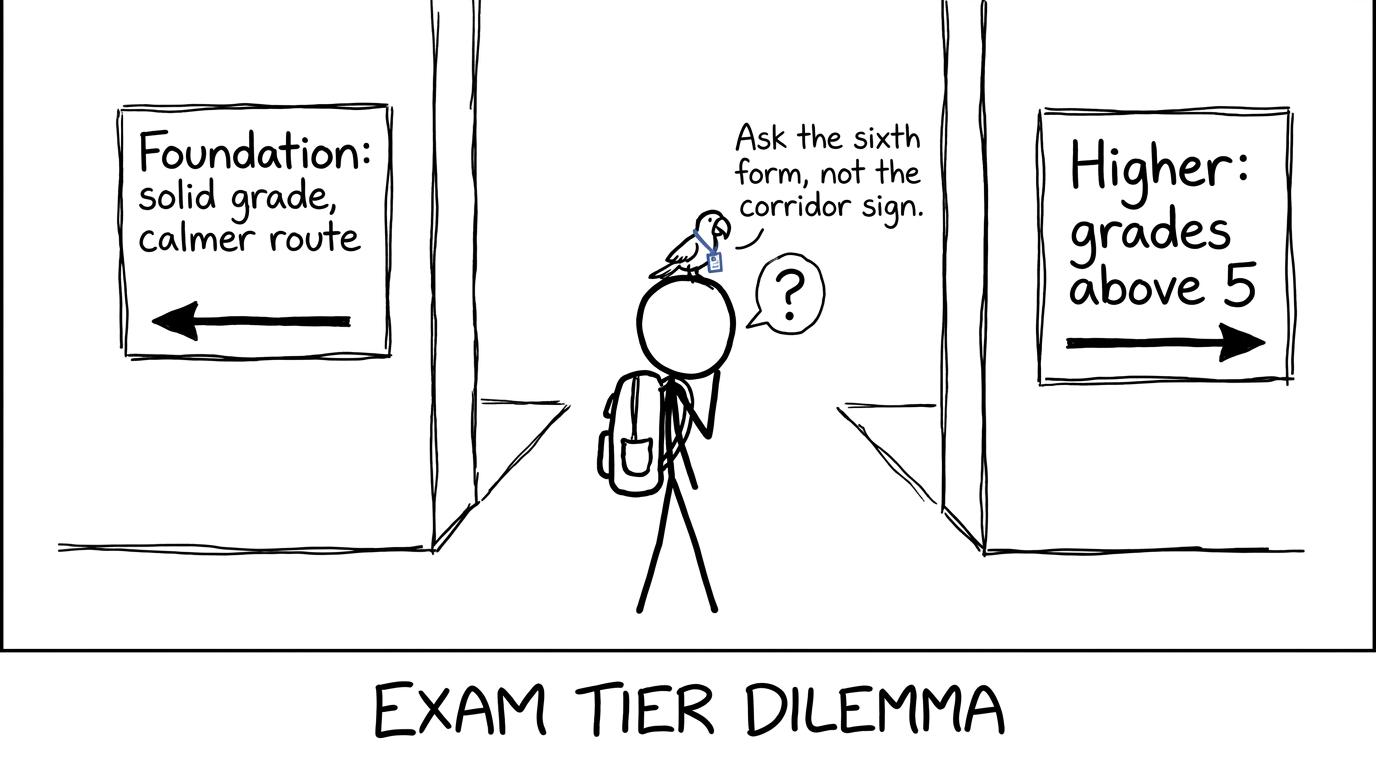 A student choosing between Foundation and Higher routes while a parrot recommends checking the actual sixth-form rules
Is Higher tier GCSE Portuguese actually required?
Usually, no. Sixth forms set their own admissions criteria, so there is no single national rule saying every applicant must have taken Higher tier Portuguese.
Many sixth forms describe entry in terms of achieved grades. A typical policy might ask for a set number of GCSEs at grade 444 or 555 and then impose additional requirements for individual A Level courses. The precise combination varies significantly between institutions and can change between admission years.
If Portuguese is simply one qualification within your overall GCSE profile, a Foundation grade 444 or 555 may count in exactly the same way as the equivalent numerical grade achieved through Higher tier.
Your GCSE certificate records the subject and grade rather than advertising the tier on which you sat the assessment. More importantly, regulatory arrangements require grades 444 and 555 to represent comparable attainment across Foundation and Higher tiers. A grade 555 is therefore a grade 555; it is not treated as a weaker version because it came from Foundation.
The practical issue is the grade ceiling. Foundation Portuguese offers grades 111 to 555. Higher offers grades 444 to 999, with a narrow grade 333 safety net for candidates just below the grade 444 boundary. Higher is the only route to grades 666, 777, 888 and 999.
When a strong Foundation grade is enough
A strong Foundation result means grade 555, because that is the highest available grade on the tier. It may be enough in several situations.
Portuguese is part of your general GCSE total
Suppose a sixth form asks applicants to achieve a certain number of GCSEs at grade 555 or above. If its admissions policy accepts Portuguese as one of those full GCSE qualifications, a Foundation grade 555 can contribute to that total.
There is no automatic reason for the institution to demand Higher tier when its written rule only demands the grade. Still, check whether the policy excludes any qualification types or imposes a minimum grade profile across particular subjects.
You are not taking Portuguese in sixth form
If you plan to study subjects such as maths, physics, economics or history, the institution is more likely to focus on the relevant GCSE grades for those courses. Your Portuguese result may strengthen your overall profile, but the tier itself is unlikely to decide whether you can begin A Level Maths.
For students considering maths after GCSE, the relevant question is normally the required GCSE Maths grade. Some sixth forms ask for grade 666, while more demanding courses or Further Maths pathways may ask for grade 777 or higher. Always use the requirement published by the institution rather than assuming that one rule applies everywhere.
You can begin preparing for that transition through the GCSE Maths revision hub, which includes resources for Edexcel, AQA, OCR and Eduqas.
The stated Portuguese requirement is grade 555
If the sixth form explicitly asks for grade 555 in Portuguese, a Foundation grade 555 should normally meet the numerical requirement unless the policy also specifies Higher tier. Ask admissions staff to confirm this in writing if the wording is unclear.
This is one reason to separate facts from rumours. “They prefer Higher” and “the prospectus requires grade 666” are very different statements.
When Higher tier Portuguese matters
Higher tier becomes important whenever the grade you need is unavailable on Foundation.
A course requires grade 666 or above
Sixth forms commonly set higher entry thresholds for subjects that continue directly from GCSE, including modern languages, maths and the sciences. Published requirements vary, but grades 666 and 777 are often used for particular A Level courses.
If a Portuguese-related course requires at least grade 666 in GCSE Portuguese, Foundation cannot satisfy that condition because its maximum is grade 555. In that case, Higher tier is not merely preferable. It is mathematically necessary to make the required grade available.
That does not mean every student should automatically take Higher. The sensible tier is the one offering the best realistic route to the grade needed, based on evidence from assessments and teacher judgement.
You want the strongest possible academic profile
Grades above 555 may help you meet an institution's overall admissions profile, even when Portuguese is not one of your sixth-form subjects. Selective sixth forms may calculate totals or require several GCSEs within a higher grade range.
Read the calculation carefully. If an institution adds your best grades, then increasing Portuguese from grade 555 to grade 777 could strengthen your total. But if Portuguese already meets a simple grade 555 threshold, taking Higher may provide no admissions advantage unless you achieve above that threshold.
For context, you can review historical Edexcel GCSE Portuguese grade boundaries. Boundaries change between exam series, so use them to understand past outcomes rather than predict the exact marks required in your own exams.
What if you want to study maths at sixth form?
For a student applying to A Level Maths, Portuguese is normally part of the wider GCSE picture rather than the decisive subject. The crucial requirements are usually:
- the sixth form's general admissions threshold;
- its minimum grade in GCSE Maths;
- sometimes a minimum grade in English;
- any separate requirement for Further Maths.
Portuguese may help you reach the required number of GCSE passes, but Higher tier Portuguese cannot compensate for missing the stated GCSE Maths grade. Admissions decisions follow the course criteria, not a general impression that one Higher paper balances another subject.
Think of revision time as a budget. Every hour spent pushing Portuguese towards a higher grade is an hour unavailable for maths, English or science. That does not make Portuguese less valuable. It means the best decision depends on which marks unlock your intended route.
MathsGenie helps make that allocation evidence-based. Start with a timed paper, mark it and identify the exact topics costing you marks. The guide to using GCSE past papers properly explains this diagnose-and-repair process.
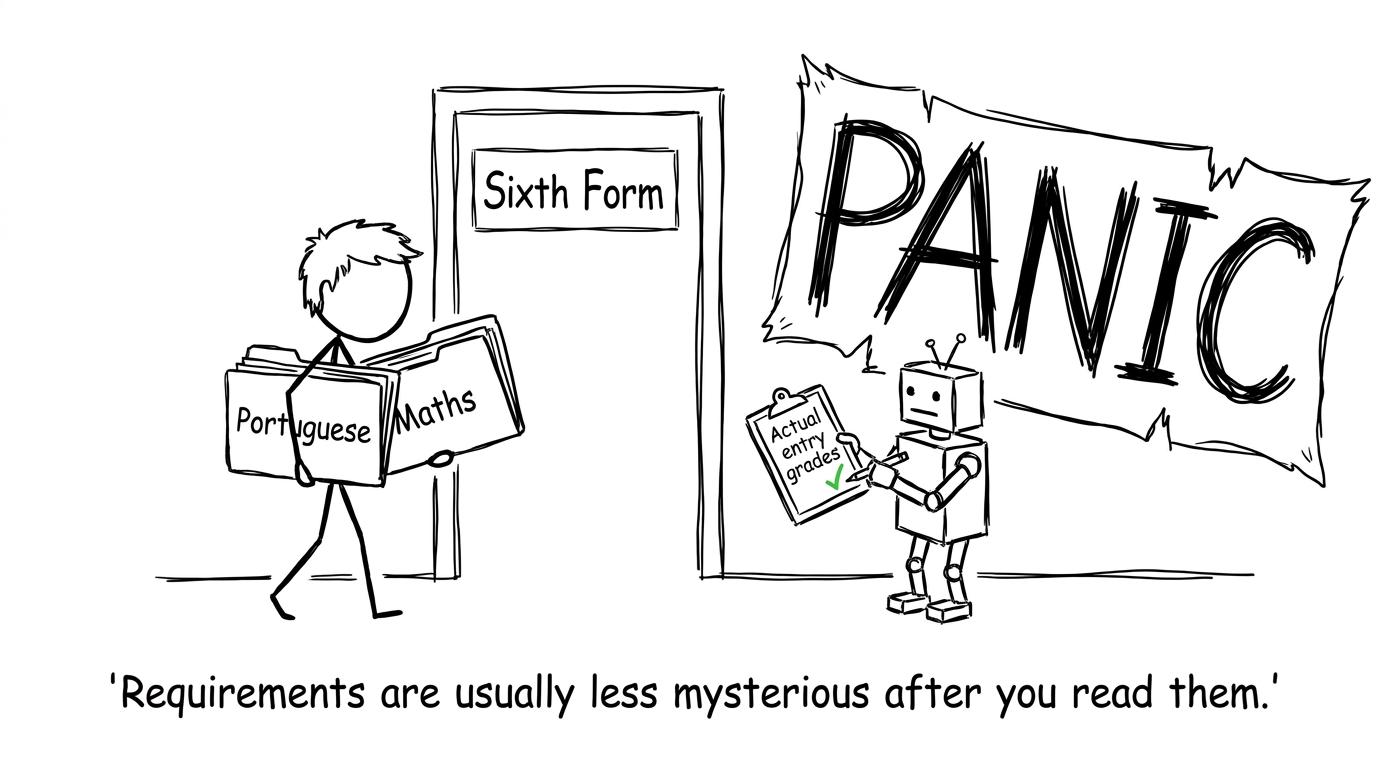 A sixth-form admissions robot checks actual entry grades while ignoring a dramatic panic banner
How to make the tier decision calmly
A tier should be chosen from evidence, not from the belief that Higher always “looks better”.
First, obtain the sixth form's current admissions policy and subject pages. Check the year carefully. Requirements for a previous cohort may not apply to yours.
Next, write down three separate figures:
- the general sixth-form entry threshold;
- the grade required for each intended subject;
- your realistic predicted grades based on recent assessments.
Then ask your Portuguese teacher how securely your current work matches Higher-tier demand. Higher Portuguese assesses Foundation knowledge alongside additional Higher grammar and structures. It also opens the full grade range, but students who perform substantially below the lower Higher boundaries can receive an unclassified result.
Finally, contact the sixth form if the policy is ambiguous. Useful questions include:
- “Does a Foundation grade 555 in Portuguese meet this requirement?”
- “Do you require applicants to have sat Higher tier, or only to achieve the stated grade?”
- “Can Portuguese count towards the general GCSE total?”
- “What happens if an applicant narrowly misses a subject requirement?”
A clear answer from admissions is more useful than weeks of speculation.
Protecting your GCSE Maths grade at the same time
Tier discussions can consume revision time without producing a single extra mark. Once you have confirmed the Portuguese requirement, return your attention to the subjects that determine your offer.
For maths, use a simple cycle:
- choose the correct exam board and tier;
- complete a short diagnostic paper or mini test;
- mark every response using the mark scheme;
- name each weak topic precisely;
- use a revision lesson and targeted practice questions;
- retest the topic before attempting another full paper.
The guide to starting GCSE past papers can help you decide when to move from topic practice to timed papers. Edexcel students can also use GCSE Maths predicted papers after building secure topic knowledge.
Predicted papers should supplement official past papers rather than replace them. Their value lies in fresh exam-style practice, while mark schemes and video solutions show where your method lost marks.
If your revision window is short, the one-week GCSE maths revision plan provides a focused structure. Students intending to continue maths can later explore Edexcel A Level Maths past papers to understand the next stage without trying to learn it prematurely.
Common mistakes to avoid
Assuming every sixth form uses the same rules
Entry requirements are local to the institution. One sixth form may accept a grade 555 where another requires grade 666. Check each place separately.
Confusing tier with grade
Foundation and Higher are assessment routes. The achieved GCSE grade is what most admissions policies state. Grades 444 and 555 are intended to be comparable across the tiers.
Forgetting the Foundation ceiling
No amount of excellent Foundation performance can produce grade 666. If you need grade 666 or above, you must discuss Higher entry with your school early enough for it to act.
Looking only at general entry requirements
Meeting the overall sixth-form threshold does not guarantee entry to every A Level. Maths, Further Maths, sciences and languages may have separate subject requirements.
Choosing Higher for appearance alone
Higher provides access to grades above 555, but it also has more demanding content and a restricted lower-grade safety net. Choose it because the target grade is realistic and useful, not because the word “Higher” sounds more impressive.
Make the requirement serve the plan
The real question is not whether Higher tier GCSE Portuguese is universally necessary. It is whether your intended sixth form requires a grade that Foundation cannot provide.
If the requirement is grade 555, a Foundation grade 555 may be enough. If it is grade 666 or higher, you need Higher tier. If Portuguese simply contributes to a general GCSE total, its numerical grade is usually more important than the tier label. Confirm all three points with the sixth form and your school before making a final decision.
Then put the uncertainty down and return to revision that changes results. Use MathsGenie's free GCSE Maths resources to combine revision lessons, practice questions, mini tests, past papers, predicted papers, mark schemes and video solutions. A requirement becomes less frightening once it is specific, and a target becomes useful once today's revision is built around it.