

Higher Tier GCSE Bengali Sixth Form Requirements
Higher tier GCSE Bengali sixth form entry rules vary. See when Foundation grade 5 is enough, when Higher matters, and what to check with schools.
There is a particular kind of GCSE worry that begins with one small choice and quickly grows into a question about your entire future. You are entered for Foundation Bengali. Someone says sixth forms prefer Higher. Suddenly, one tier decision feels as though it could close every door.
The short answer to the higher tier GCSE Bengali sixth form question is reassuring: sixth forms do not generally require Higher tier Bengali simply because you want to enter Year 12. They usually consider your final GCSE grades, their general admissions threshold and the entry requirements for your chosen subjects. A strong Foundation grade can therefore be enough. However, Foundation Bengali is capped at grade 555, so it cannot meet a course requirement of grade 666 or above.
Your quickest checklist is:
- Read the published admissions policy for each sixth form.
- Check both the general entry threshold and your chosen subjects' requirements.
- Ask whether GCSE Bengali counts among the qualifications used in the calculation.
- Remember that Foundation can award grades 111 to 555.
- Consider Higher if you need grade 666 or above or are ready for its greater demand.
- Keep English and maths requirements in view because these are commonly stated separately.
Is Higher Tier GCSE Bengali necessary for sixth form?
Usually, no. There is no single national rule saying that every applicant must have taken Higher tier GCSE Bengali.
Sixth forms and colleges set their own admissions criteria. One may ask for five GCSEs at grade 555 or above, including English and maths. Another may use a higher overall threshold, while individual A Level courses can impose additional conditions. A Level Mathematics, sciences and modern foreign languages often have subject-specific grade requirements, but the exact grade differs between institutions.
This means the useful question is not simply, "Did I take Higher Bengali?" It is:
Does my achieved Bengali grade satisfy the published rules of the sixth form and courses to which I am applying?
If a sixth form counts Bengali towards a requirement for five GCSEs at grade 555, a Foundation grade 555 may do exactly the job required. If it asks for six GCSEs at grade 666, Foundation Bengali cannot provide one of those grade 666s.
Tier is the route through the assessment. Grade is normally the result used in admissions.
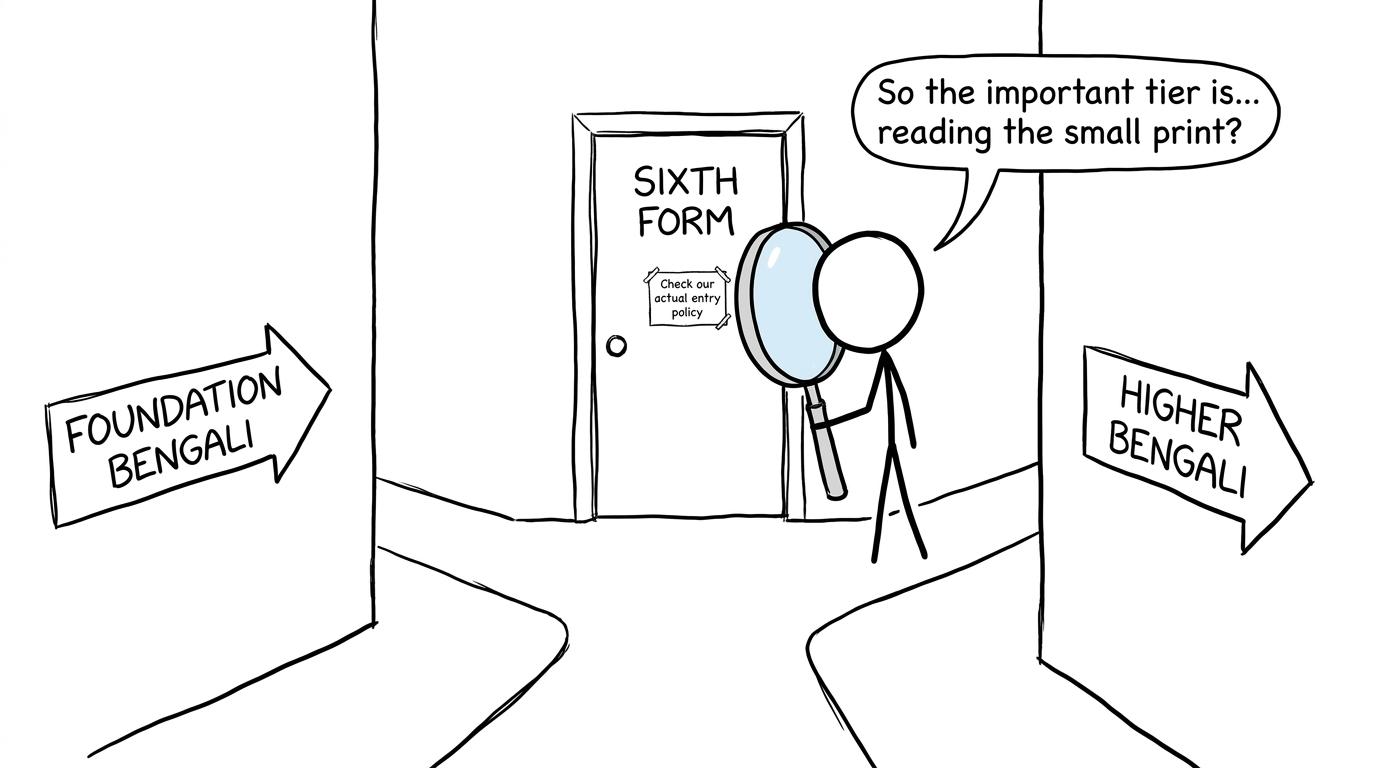 A student discovers that checking the admissions policy matters more than guessing about tiers
What Foundation and Higher Bengali actually allow
Under the current AQA GCSE Bengali specification, students take listening, speaking, reading and writing at the same tier. The available grade ranges are:
- Foundation tier: grades 111 to 555
- Higher tier: grades 444 to 999, with a narrow allowed grade 333 for students who just miss grade 444
A student cannot take Foundation listening and Higher writing. The tier applies across all four assessments in the same exam series.
The important distinction is opportunity. Foundation provides access to grade 555, but not grades 666 to 999. Higher creates access to the top grades, while also carrying the risk of an unclassified result if performance falls below the limited grade 333 safety net.
Grades 444 and 555 are intended to be comparable across the two tiers. A grade 555 achieved through Foundation is not labelled as a weaker kind of grade 555 merely because of the tier. GCSE certificates do not normally state the tier of entry. Admissions staff see the awarded grade.
Do not confuse AQA GCSE Bengali with a differently structured qualification such as International GCSE Bengali. Check the precise qualification title and exam board before comparing grade rules.
When a strong Foundation grade is enough
A Foundation grade 444 or 555 may be enough when Bengali is being used as one of your general GCSE passes rather than as preparation for a particular A Level.
Imagine that a sixth form's published threshold asks for a group of GCSE passes and you already meet its separate English, maths and course-specific conditions. If Bengali is accepted within that group, a Foundation pass can contribute in the same way as the same numerical grade from Higher tier.
Foundation may be the sensible entry when:
- your realistic target is grade 444 or 555;
- your teacher's assessment shows that Higher questions create a substantial risk of falling below the safety net;
- your intended sixth-form courses do not require a Bengali grade above 555;
- you can meet the institution's overall admissions threshold with your likely results;
- securing a dependable grade leaves enough revision time for English, maths and your intended A Level subjects.
This is not about choosing the easiest paper. It is about choosing the assessment that gives the best evidence of what you know.
The same principle is familiar in maths. Foundation and Higher have different grade ranges, so tier decisions should be based on evidence rather than prestige. The GCSE maths topics by exam board and tier guide can help you understand that distinction for Edexcel, AQA, OCR and Eduqas maths.
When Higher Tier Bengali may matter
Higher becomes necessary if you need a grade unavailable on Foundation.
You need grade 666 or above
If the sixth form requires grade 666 or 777 in the language you intend to continue, Foundation cannot satisfy that condition. This is a mathematical limit, not a judgement about your ability:
maximum Foundation grade=5\text{maximum Foundation grade}=5maximum Foundation grade=5Check the subject page carefully. General admission and subject admission are separate tests, and passing one does not guarantee the other.
You hope to take A Level Bengali
AQA's A Level Bengali specification does not impose a formal previous-learning requirement. It says that course entry decisions are at the discretion of schools and colleges, while recommending skills and knowledge associated with GCSE Bengali or an equivalent qualification.
In practice, a provider offering A Level Bengali may set its own threshold or assess whether you have sufficient listening, reading and writing skills. Some may expect a strong GCSE grade even though the exam board itself does not prescribe one. Higher is therefore not automatically required by AQA, but it may be needed to reach a provider's chosen grade threshold.
Availability also matters. Not every sixth form teaches A Level Bengali, so confirm that the course will run and ask how it is delivered before making a tier decision around it.
Bengali affects an overall grade calculation
Some selective sixth forms calculate an average or total using specified GCSE subjects. A grade above 555 could strengthen an application, but only if Bengali is included in that calculation. Certain policies restrict which qualifications count or treat qualifications taken outside the normal school timetable differently.
Never assume. Ask the admissions team for a written answer.
What to ask your sixth form before choosing a tier
A short email can remove weeks of uncertainty. Include the full qualification name and ask:
- Does AQA GCSE Bengali count towards your general GCSE entry requirement?
- Would a Foundation grade 555 be treated as a grade 555 for admissions purposes?
- Is Bengali included in any average-grade or total-grade calculation?
- Are privately entered or community-language GCSEs accepted?
- What grade is required if I want to continue with Bengali?
- Are there separate English and maths conditions for my chosen courses?
Keep the reply. Admissions arrangements can vary by institution and entry year, so current written information is more reliable than advice remembered from an older sibling or shared in a group chat.
Protecting your maths grade while revising Bengali
Tier anxiety can consume revision time without earning a single mark. Once you have checked the policy and spoken to your teacher, turn the decision back into a plan.
Sixth forms commonly publish specific requirements for GCSE Mathematics, particularly for A Level Mathematics, Further Mathematics, physics, chemistry, computer science or economics. Your Bengali decision should therefore sit inside a balanced GCSE strategy rather than replacing it.
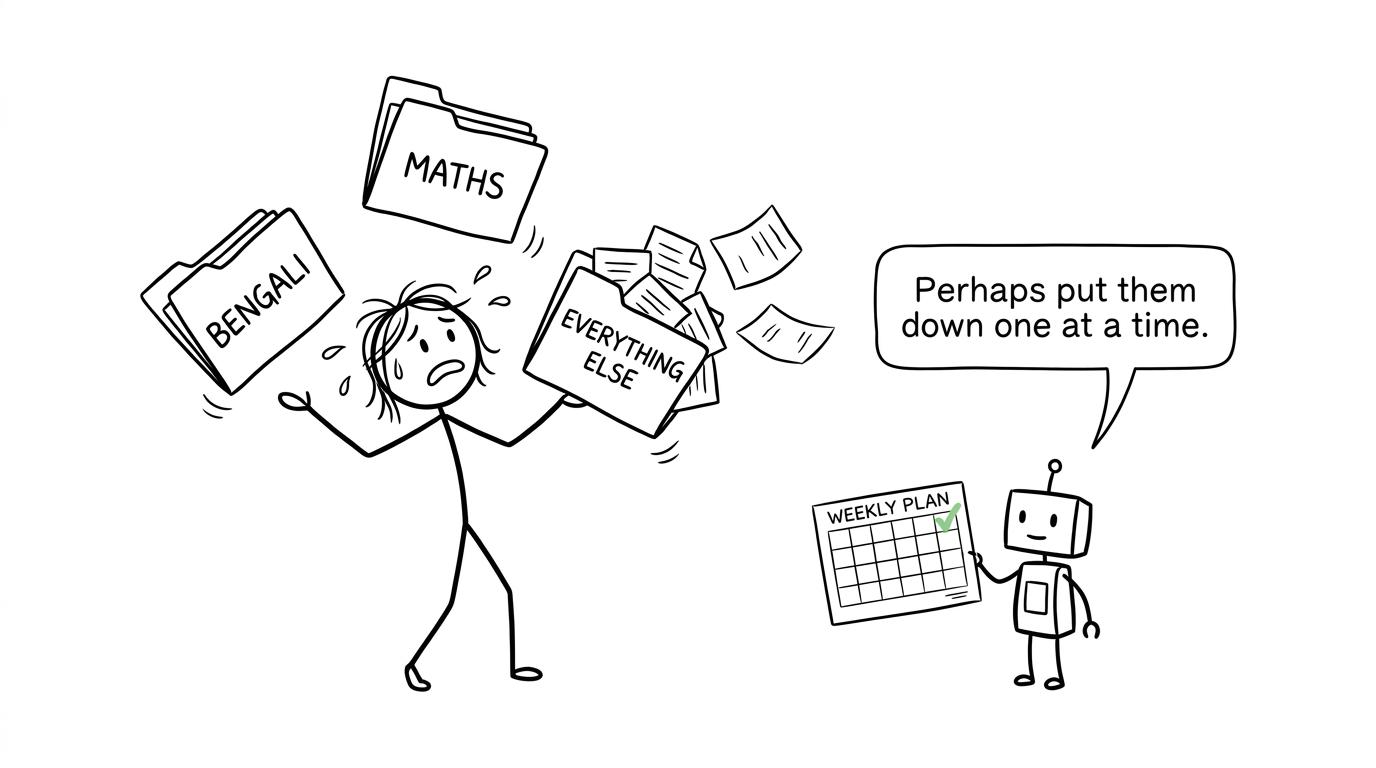 A student learns to balance Bengali, maths and other GCSE revision one folder at a time
Use the MathsGenie GCSE Maths revision hub to select your board and tier. Then follow a simple cycle:
- identify a weak topic;
- use a revision lesson to rebuild the method;
- complete focused practice questions;
- mark them and record the precise error;
- retest the skill later;
- move into mixed and timed papers.
If you are unsure where the gaps are, GCSE maths mini tests provide a shorter diagnostic than a full paper. A realistic GCSE maths revision timetable can then balance maths with Bengali and your other subjects.
For board-specific preparation, use the Edexcel GCSE Maths revision area or practise with AQA GCSE Maths past papers. Students following OCR or Eduqas can select their board from the main revision hub.
Common mistakes to avoid
Assuming Higher is always more impressive
Higher is useful when its grade range matches your goal and current performance. It is not automatically the best entry for every student. An attainable Foundation grade 555 may be more useful than an unrealistic Higher entry that ends in an unclassified result.
Looking only at general sixth-form entry
You may satisfy the overall threshold but miss a condition for one chosen A Level. Read both parts of the policy.
Believing Foundation appears negatively on the certificate
The awarded grade is what normally appears, not the tier. A Foundation grade 555 is still grade 555.
Assuming every GCSE is counted
Some sixth forms specify which subjects or qualification types contribute to an admissions calculation. Check whether Bengali is accepted, especially if it was taken privately or outside your normal timetable.
Letting one decision crowd out maths revision
Sixth-form applications often place direct importance on English and maths. Do not spend every evening worrying about Bengali tiering while avoidable maths gaps remain untouched.
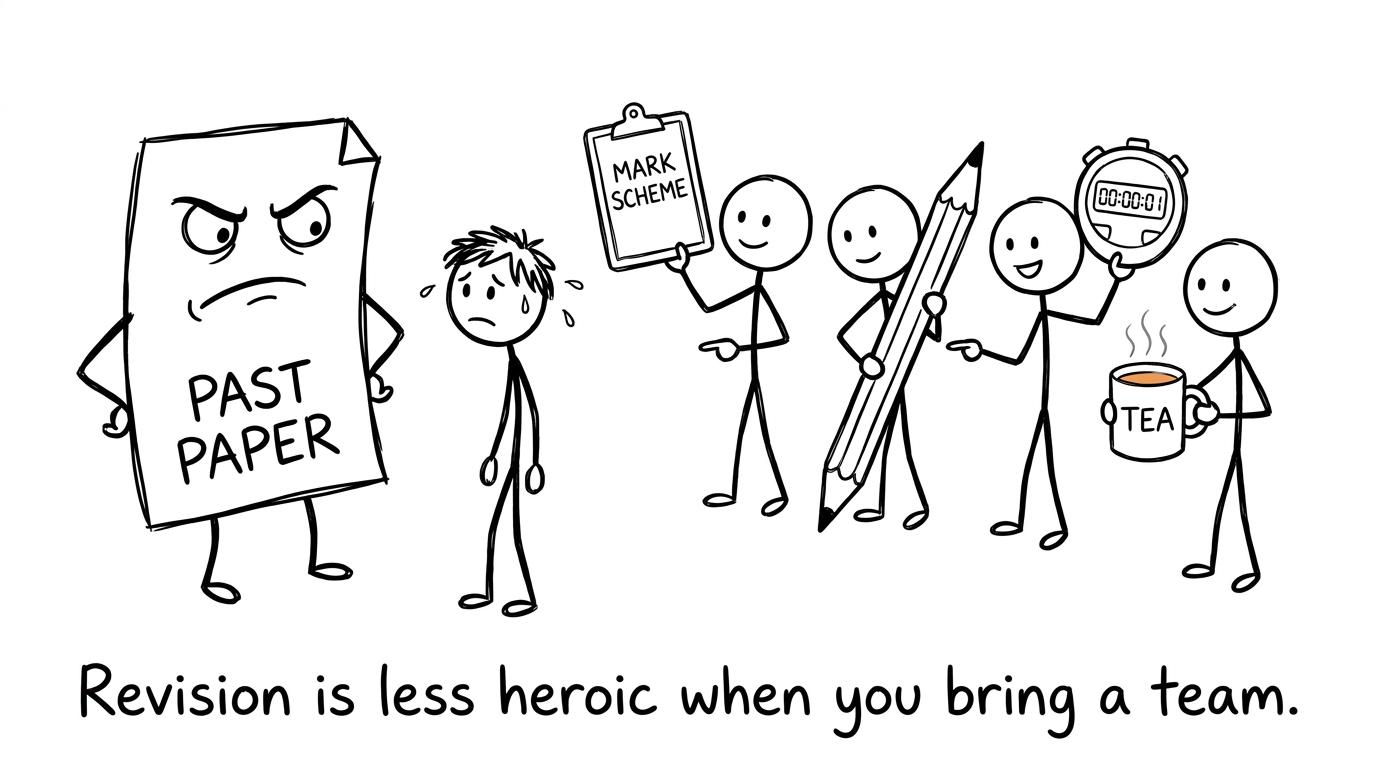 A past paper faces a well-equipped revision pit crew
Make the decision from evidence, not fear
Higher tier GCSE Bengali is not a universal sixth-form requirement. A strong Foundation grade can be enough when the institution accepts Bengali and its threshold is grade 555 or below. Higher matters when you need access to grades 666 to 999, particularly for a language course or a demanding overall admissions calculation.
Check the current policy, confirm how Bengali is counted and discuss your likely performance with your teacher. Then return your attention to the work that changes grades.
MathsGenie makes that next step free and practical. Build your week with the revision planner, learn through focused revision lessons, and strengthen each topic with practice questions and mini tests. When your methods are secure, use the past-paper library with mark schemes and video solutions, adding predicted papers nearer the exams. The goal is not to choose the tier that sounds most ambitious. It is to make informed choices and earn the strongest set of results you can carry into sixth form.










