

HCF and LCM Using Venn Diagrams Exam Questions
HCF and LCM using Venn diagrams exam questions explained through three GCSE examples. Learn prime factor placement, clear working and common mistakes to avoid.

A student can know what HCF and LCM mean and still hesitate when two overlapping circles appear. In HCF and LCM using Venn diagrams exam questions, the method is to split each number into prime factors, place shared factors in the overlap, then multiply the appropriate entries. The overlap gives the HCF; every entry across the diagram gives the LCM.
Imagine a student working through three questions, each requiring a little more thought. Their progress comes from making the working visible, so a mistake in the final multiplication does not hide everything they understood.
The questions below are original exam-style examples, not reproduced past paper questions. Mark allocations vary, so the guidance explains where working can support method marks without promising a particular score.
The method to keep beside you
HCF means highest common factor: the largest positive integer that divides exactly into both numbers. LCM means lowest common multiple: the smallest positive integer that is a multiple of both.
For a prime-factor Venn diagram:
- Write each number as a product of prime factors.
- Draw overlapping circles, one labelled with each number.
- Put matching prime factors in the overlap, pairing them one at a time.
- Put the remaining factors in their own circle.
- Multiply the overlap entries for the HCF.
- Multiply every entry once for the LCM.
Repeated primes matter. Each occurrence needs its own place. To check your diagram, multiply everything inside each individual circle, including its overlap. You should recover the number on that circle.
MathsGenie's Prime Factors, HCF and LCM lesson page brings these connected skills together.
Question one: build the diagram from two numbers
Find the HCF and LCM of 181818 and 242424 using a Venn diagram.
Our hypothetical student starts with factor trees, continuing until every endpoint is prime:
18=2×3×318 = 2 \times 3 \times 318=2×3×3 24=2×2×2×324 = 2 \times 2 \times 2 \times 324=2×2×2×3Place shared factors first
Both lists contain a 222 and a 333. The student pairs these and puts one of each in the overlap. Crossing out the used factors helps prevent duplication.
The diagram should contain:
| Region | Prime factors |
|---|---|
| 181818 only | 333 |
| Overlap | 2, 32,\ 32, 3 |
| 242424 only | 2, 22,\ 22, 2 |
Multiplying the overlap gives:
HCF=2×3=6\mathrm{HCF} = 2 \times 3 = 6HCF=2×3=6Multiplying every entry across all three regions gives:
LCM=3×2×3×2×2=72\mathrm{LCM} = 3 \times 2 \times 3 \times 2 \times 2 = 72LCM=3×2×3×2×2=72Make the method visible
The factor trees or complete prime decompositions show how the student started. The diagram shows which factors are shared, and the multiplication shows how each answer was obtained. Depending on the question's mark scheme, this working may earn credit even if a later arithmetic slip occurs.
Once you can place the factors yourself, use MathsGenie's Lessons and Question Bank to practise the same method with different numbers.
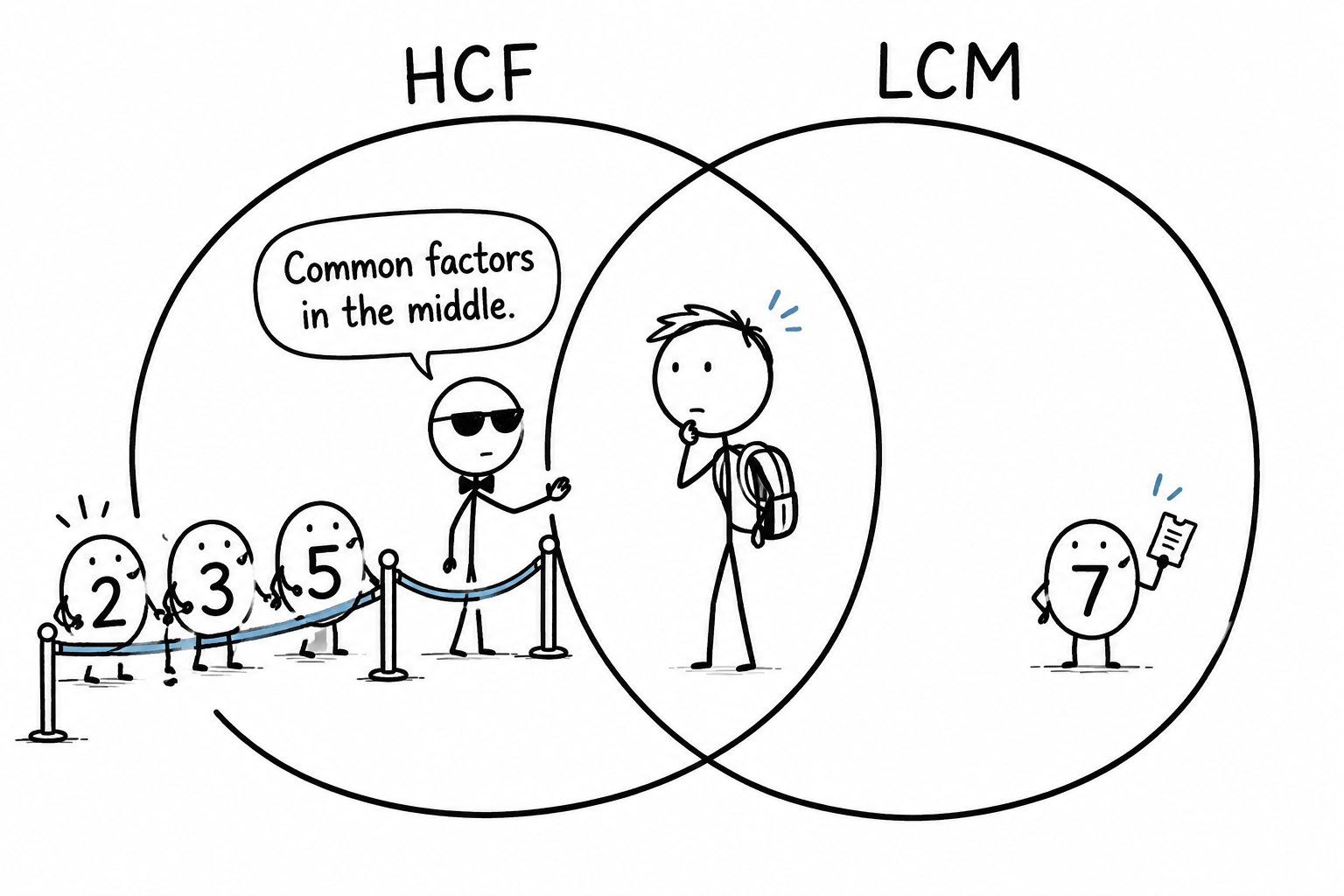 A light-hearted stick-figure comic about prime factors queuing for overlapping circles
Question two: handle repeated prime factors
Find the HCF and LCM of 727272 and 120120120 using prime factors and a Venn diagram.
The student now recognises the process. The challenge is keeping track of repeated factors:
72=23×3272 = 2^3 \times 3^272=23×32 120=23×3×5120 = 2^3 \times 3 \times 5120=23×3×5For placement, it helps to expand the powers mentally or write them out. Both numbers contain three copies of 222, but only one copy of 333 is shared.
| Region | Prime factors |
|---|---|
| 727272 only | 333 |
| Overlap | 2, 2, 2, 32,\ 2,\ 2,\ 32, 2, 2, 3 |
| 120120120 only | 555 |
Therefore:
HCF=2×2×2×3=24\mathrm{HCF} = 2 \times 2 \times 2 \times 3 = 24HCF=2×2×2×3=24 LCM=3×2×2×2×3×5=360\mathrm{LCM} = 3 \times 2 \times 2 \times 2 \times 3 \times 5 = 360LCM=3×2×2×2×3×5=360The student checks that 242424 divides exactly into both original numbers and that 360360360 is a multiple of each.
Why repeated factors matter
Putting just one 222 in the overlap would lose two shared factors. A Venn diagram records prime factors with repetition, rather than merely listing which different primes appear.
The useful working here is the accurate decomposition, the placement of every factor and the multiplication for each result. A clear diagram makes the reasoning easier to follow than an unexplained final answer.
Question three: work backwards from the HCF and LCM
Two positive integers have HCF 121212 and LCM 180180180. One number is 363636. Find the other using a Venn diagram.
This time, the student cannot begin with two complete factor trees. They start with what the overlap must contain:
12=2×2×312 = 2 \times 2 \times 312=2×2×3The known number is:
36=2×2×3×336 = 2 \times 2 \times 3 \times 336=2×2×3×3After accounting for the overlap, its circle needs one additional 333 in its exclusive region.
Now consider every factor required by the LCM:
180=2×2×3×3×5180 = 2 \times 2 \times 3 \times 3 \times 5180=2×2×3×3×5The overlap and the known number's exclusive region already account for everything except 555. That factor belongs in the other number's exclusive region.
| Region | Prime factors |
|---|---|
| 363636 only | 333 |
| Overlap | 2, 2, 32,\ 2,\ 32, 2, 3 |
| Unknown number only | 555 |
The unknown number includes its exclusive region and the overlap:
2×2×3×5=602 \times 2 \times 3 \times 5 = 602×2×3×5=60The answer is 606060. Writing only 555 would identify the exclusive region, not the complete number.
Here, the diagram explains the reverse reasoning. It shows how the HCF determines the overlap and how the LCM determines the remaining factors.
Common mistakes that cost clarity
Adding instead of multiplying. These diagrams organise prime factors. Additions do not recover the original numbers, HCF or LCM.
Counting the overlap twice for the LCM. Read each region once. Shared entries already represent the factors needed by both numbers.
Leaving composite numbers in the diagram. Continue factor trees until every endpoint is prime. Using a composite factor can conceal further shared factors.
Putting 111 in an empty overlap. Leave the region empty. When the numbers share no prime factors, their HCF is 111.
Assuming a diagram guarantees marks. It must represent the numbers correctly. Read the instruction carefully and show the requested method.
Exam-style practice and past paper questions
Try these without looking back:
- Find the HCF and LCM of 303030 and 424242.
- Find the HCF and LCM of 484848 and 727272.
- Two numbers have HCF 181818 and LCM 540540540. One is 108108108. Find the other.
Answers: respectively, HCF 666 and LCM 210210210; HCF 242424 and LCM 144144144; the missing number is 909090.
When tackling HCF and LCM using Venn diagrams past paper questions, compare your working with the supplied mark scheme as well as checking the answer. MathsGenie's GCSE exam booklets include a Prime Factors, HCF and LCM topic collection. Use the GCSE revision topic list to identify any earlier number skills that need attention.
Turn the method into reliable working
Our hypothetical student has moved from placing shared primes to reconstructing a missing number. Your next step is making those decisions independently, with unfamiliar values. Start your HCF and LCM practice with MathsGenie's Lessons and Question Bank, and show the factorisation, diagram and final multiplication in every answer.















