

HCF and LCM Using Venn Diagrams GCSE Maths
HCF and LCM using Venn diagrams GCSE maths explained with step-by-step worked examples, common mistakes and focused exam-style questions to try.
A student can understand prime factors, draw two perfectly good circles and still collect the wrong answer. The problem is rarely the arithmetic. It is knowing which parts of the diagram belong to the HCF and which belong to the LCM.
Imagine a student called Maya. She keeps multiplying the middle of every diagram because it looks important. Sometimes that works. Sometimes it does not. HCF and LCM using Venn diagrams GCSE maths questions begin to click when she learns one short rule:
- HCF: multiply the prime factors in the intersection.
- LCM: multiply every prime factor in the diagram.
That is the central idea. The rest is careful organisation.
The method at a glance
Use this checklist whenever you need to find an HCF or LCM with a Venn diagram:
- Write each number as a product of prime factors.
- Draw two overlapping circles, one for each number.
- Match common prime factors one pair at a time.
- Put each matched pair into the intersection.
- Put unmatched factors in the separate parts of the circles.
- Multiply the intersection for the HCF.
- Multiply every entry in the union for the LCM.
The word common points towards the overlap. The word multiple points towards everything needed to build both numbers.
If you want to see the structure before tackling questions alone, use the matching Prime Factors, HCF and LCM lesson, then move directly into the Question Bank while the method is fresh.
Why prime factors make the diagram work
A Venn diagram needs prime factors, not lists of ordinary factors. Prime numbers act like the building blocks of an integer. For example,
18=2×3×318=2\times3\times318=2×3×3and
24=2×2×2×3.24=2\times2\times2\times3.24=2×2×2×3.Both numbers contain one factor of 222 and one factor of 333. Those factors can be matched and placed in the intersection. The remaining 333 belongs only to 181818, while the two remaining factors of 222 belong only to 242424.
Repeated prime factors must be written separately in the diagram. If a number contains 232^323, the circles need three individual factors of 222. This makes matching visible and reduces mistakes with powers.
You can recap this foundation using the Prime Factors, HCF and LCM revision guide.
HCF and LCM using Venn diagrams worked examples
Worked example: finding both values
Find the HCF and LCM of 181818 and 242424.
First, write each number as a product of prime factors:
18=2×3×318=2\times3\times318=2×3×3 24=2×2×2×3.24=2\times2\times2\times3.24=2×2×2×3.Match one factor of 222 and one factor of 333. These go in the intersection.
The completed diagram would contain:
- 181818 only: 333
- intersection: 2,32,32,3
- 242424 only: 2,22,22,2
For the HCF, multiply only the intersection:
HCF=2×3=6.\text{HCF}=2\times3=6.HCF=2×3=6.For the LCM, multiply every prime factor shown in the diagram once:
LCM=3×2×3×2×2=72.\text{LCM}=3\times2\times3\times2\times2=72.LCM=3×2×3×2×2=72.A quick check confirms the result. Both 181818 and 242424 divide 727272, while 666 divides both original numbers.
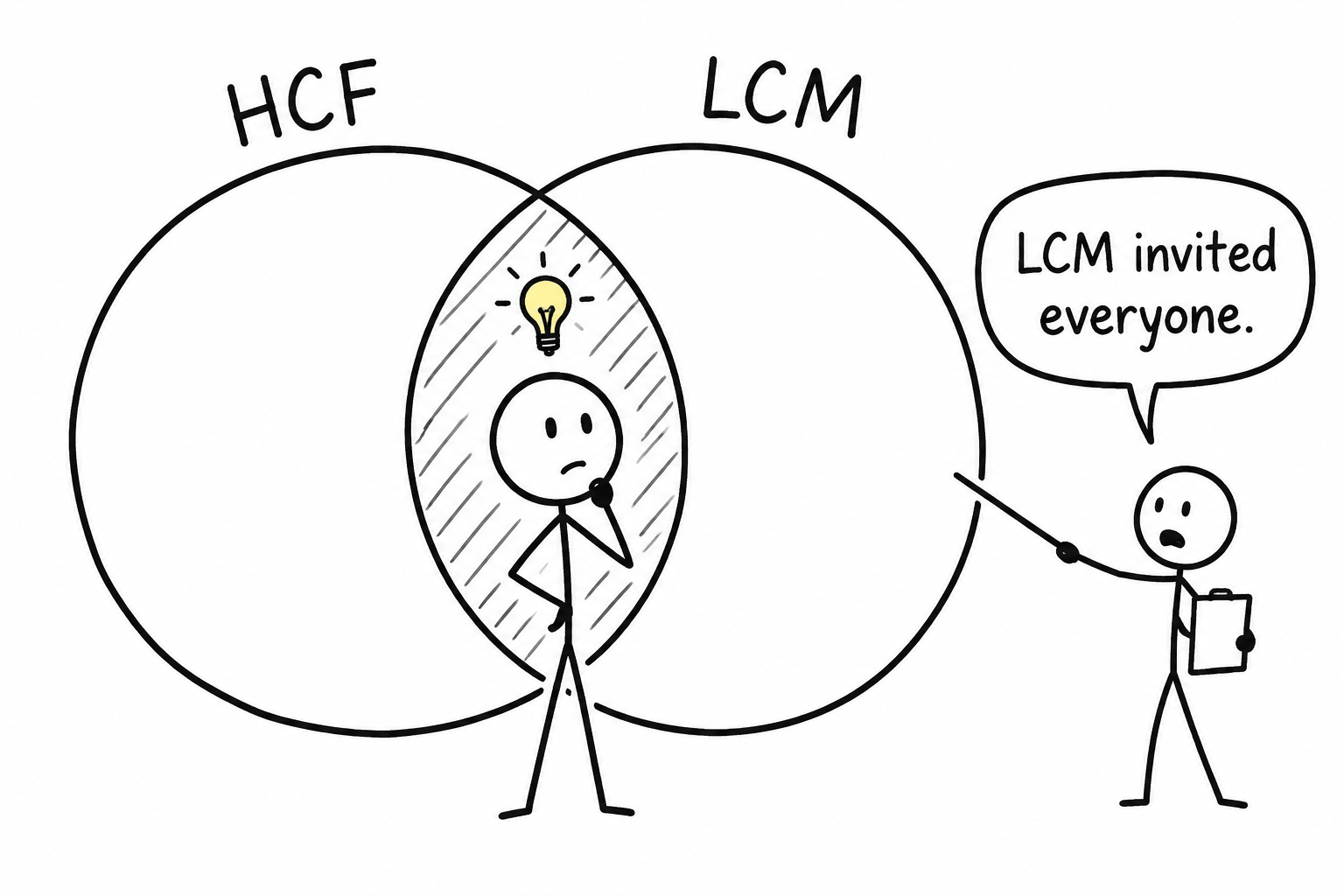 A student realises that the LCM includes every region of the Venn diagram
This is Maya's turning point. She stops treating the middle as the answer to every question. The intersection answers the HCF question; the whole diagram answers the LCM question.
Worked example with repeated factors
Find the HCF and LCM of 606060 and 848484.
Begin with prime factor decompositions:
60=2×2×3×560=2\times2\times3\times560=2×2×3×5 84=2×2×3×7.84=2\times2\times3\times7.84=2×2×3×7.Both numbers contain two factors of 222 and one factor of 333. Therefore:
- 606060 only: 555
- intersection: 2,2,32,2,32,2,3
- 848484 only: 777
The HCF is:
HCF=2×2×3=12.\text{HCF}=2\times2\times3=12.HCF=2×2×3=12.The LCM uses every factor in the diagram:
LCM=5×2×2×3×7=420.\text{LCM}=5\times2\times2\times3\times7=420.LCM=5×2×2×3×7=420.The important detail is that both factors of 222 belong in the intersection. Matching only one pair would make the HCF too small and the LCM too large.
The same method applies across the main GCSE exam boards. Maths Genie provides dedicated topic material for AQA Prime Factors, HCF and LCM, Edexcel Prime Factors, HCF and LCM and Eduqas Prime Factors, HCF and LCM.
How to decide whether a question needs HCF or LCM
Some exam questions do not say “find the HCF” or “find the LCM”. Instead, they describe a situation.
HCF is usually connected to splitting or grouping. Look for the greatest possible equal size, the largest identical group or the longest equal piece. You are dividing the original quantities without leaving a remainder.
LCM is usually connected to repeating events. Look for the first time two schedules coincide, when flashing lights next appear together or the smallest quantity that can be arranged in either group size.
Ask yourself:
- Am I dividing quantities into the largest equal groups? Use HCF.
- Am I finding the first shared multiple or repeat? Use LCM.
The Venn diagram calculation stays the same. The context tells you which part to multiply.
Common mistakes that cost marks
Putting all common-looking factors in the middle
Factors must be matched in pairs. If one number contains three factors of 222 and the other contains one, only one factor of 222 from each number contributes to the intersection.
Using the original numbers in the circles
The entries should be prime factors. Putting 181818 in one circle and 242424 in the other does not show their shared building blocks.
Multiplying only the outside regions for the LCM
The LCM includes the intersection as well as both outside regions. It is the product of the complete union.
Forgetting repeated prime factors
If the decomposition is 23×52^3\times523×5, write three factors of 222 and one factor of 555. Each copy matters.
Giving the diagram but not the requested value
A correct diagram may show useful working, but complete the calculation and state the HCF or LCM clearly. Maths Genie's exam-style question with a worked solution and mark scheme helps you see how the final marks are awarded.
HCF and LCM using Venn diagrams questions
Try these without looking back at the examples. For each pair, write the prime factors, organise the Venn diagram and find both values.
Question A
Find the HCF and LCM of 363636 and 909090.
36=22×32,90=2×32×536=2^2\times3^2,\qquad 90=2\times3^2\times536=22×32,90=2×32×5The intersection contains 2,3,32,3,32,3,3.
HCF=18,LCM=180.\text{HCF}=18,\qquad \text{LCM}=180.HCF=18,LCM=180.Question B
Find the HCF and LCM of 484848 and 180180180.
48=24×3,180=22×32×548=2^4\times3,\qquad 180=2^2\times3^2\times548=24×3,180=22×32×5The intersection contains 2,2,32,2,32,2,3.
HCF=12,LCM=720.\text{HCF}=12,\qquad \text{LCM}=720.HCF=12,LCM=720.Question C
Two bells ring every 181818 minutes and every 242424 minutes. They ring together now. After how many minutes will they next ring together?
This is a repeating-event question, so calculate the LCM:
LCM(18,24)=72.\text{LCM}(18,24)=72.LCM(18,24)=72.They next ring together after 727272 minutes.
For a more sustained test, continue with another Prime Factors, HCF and LCM Question Bank problem.
Make the method stick
Maya's improvement does not come from memorising more definitions. It comes from pausing before multiplication and asking one question: “Do I need the overlap or the whole diagram?” Knowing that rule is the first step; applying it accurately under exam conditions takes deliberate practice.
Your turn. Start the Maths Genie Lessons and Question Bank to practise choosing the intersection for HCF and the complete diagram for LCM.















