

HCF and LCM GCSE Maths Explained
HCF and LCM GCSE maths made clear with simple methods, worked examples, common mistakes and exam-style questions for confident revision.
A student can know every times table and still confuse HCF with LCM. It often happens because the methods arrive before the meanings. Two sets of lists appear on the page, the letters blur together, and the choice becomes a guess.
That was the pattern for our hypothetical student. Every question began with the same thought: “Do I multiply, divide or list everything?” The breakthrough came when they stopped treating HCF and LCM as mysterious procedures.
Here is the short answer. In HCF and LCM GCSE maths questions, the highest common factor is the largest factor shared by the numbers. The lowest common multiple is the smallest positive multiple shared by them. Understand that distinction and the methods become much easier to remember.
The HCF and LCM checklist
Before calculating anything, ask:
- Is the question looking for the largest amount that divides exactly? Find the HCF.
- Is it asking when repeating events will next happen together? Find the LCM.
- Are the numbers fairly small? List factors or multiples.
- Are the numbers large or already written as products of primes? Use prime factorisation.
- Have you checked that your HCF divides both numbers and your LCM is a multiple of both?
That final check takes seconds and catches many errors.
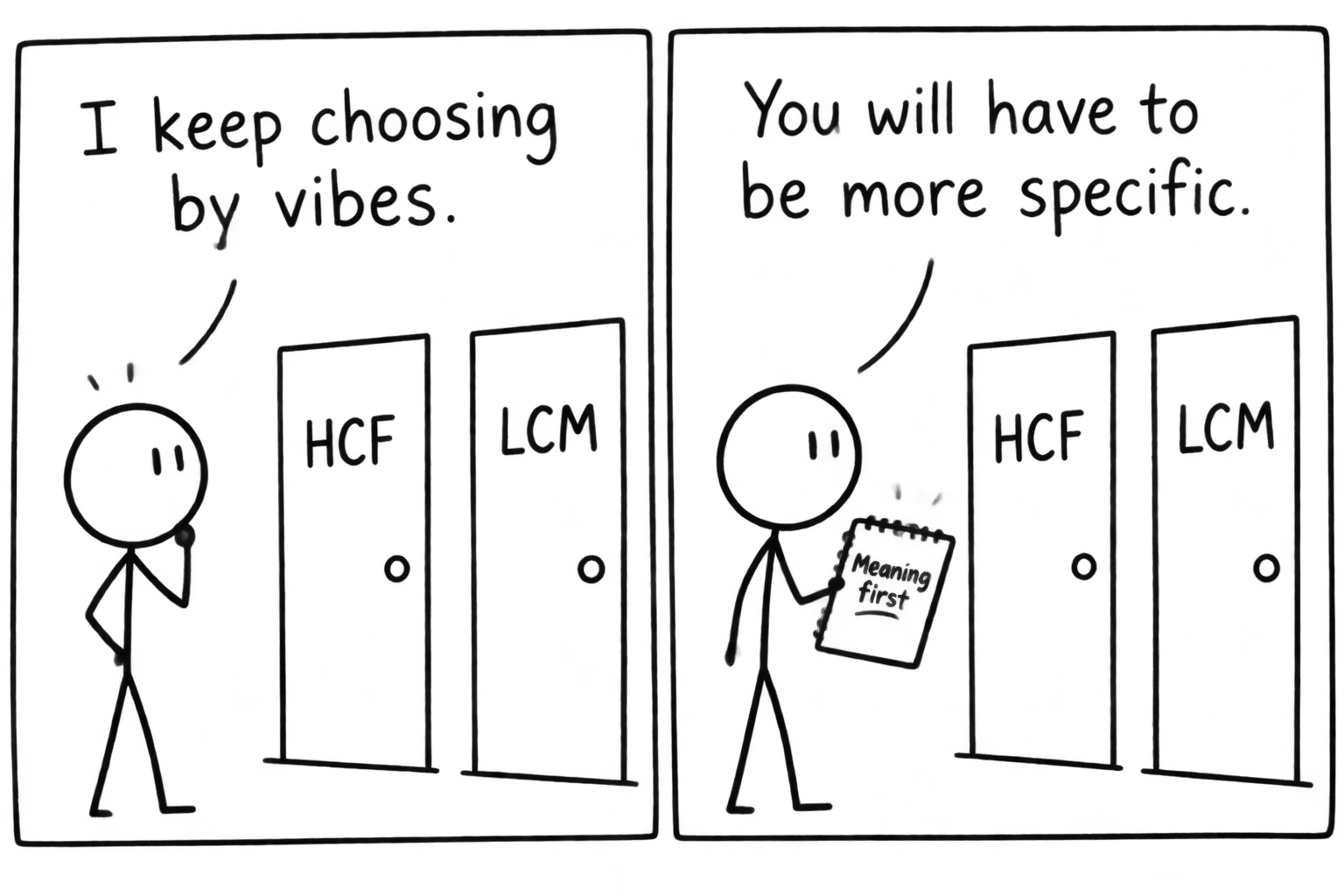 A student stops choosing between HCF and LCM by guesswork
What are factors and multiples?
A factor divides into a number exactly, leaving no remainder. For example, the factors of 121212 are:
1,2,3,4,6,121, 2, 3, 4, 6, 121,2,3,4,6,12A multiple is produced by multiplying a number by an integer. The positive multiples of 121212 begin:
12,24,36,48,60,…12, 24, 36, 48, 60, \ldots12,24,36,48,60,…Notice the direction of travel. Factors usually stay at or below the original number. Positive multiples begin at the number and continue without end.
This gave our student a useful memory prompt:
- HCF: factors go into numbers.
- LCM: multiples come from numbers.
The words “highest” and “lowest” then tell you which shared value to select.
HCF and LCM worked examples using lists
Listing is often the clearest method when the numbers are small. It also makes the meaning visible, rather than hiding it inside a rule.
Finding the HCF of two numbers
Find the HCF of 181818 and 303030.
First list every factor of each number:
Factors of 18:1,2,3,6,9,18\text{Factors of }18: 1, 2, 3, 6, 9, 18Factors of 18:1,2,3,6,9,18 Factors of 30:1,2,3,5,6,10,15,30\text{Factors of }30: 1, 2, 3, 5, 6, 10, 15, 30Factors of 30:1,2,3,5,6,10,15,30The common factors are 111, 222, 333 and 666. The highest is therefore:
HCF(18,30)=6\operatorname{HCF}(18,30)=6HCF(18,30)=6Check it: both 18÷618 \div 618÷6 and 30÷630 \div 630÷6 give integers.
Finding the LCM of two numbers
Find the LCM of 888 and 121212.
List multiples until the first shared value appears:
Multiples of 8:8,16,24,32,…\text{Multiples of }8: 8, 16, 24, 32, \ldotsMultiples of 8:8,16,24,32,… Multiples of 12:12,24,36,…\text{Multiples of }12: 12, 24, 36, \ldotsMultiples of 12:12,24,36,…The first positive common multiple is 242424, so:
LCM(8,12)=24\operatorname{LCM}(8,12)=24LCM(8,12)=24You do not need to keep listing after finding the first common value. Because the multiples are in ascending order, the first match is the lowest one.
Once the list method makes sense, use the Maths Genie GCSE revision lessons and Question Bank to practise choosing HCF or LCM without relying on guesswork.
Using prime factorisation
For larger numbers, long lists become inefficient. Prime factorisation gives a structured alternative.
Suppose we want the HCF and LCM of 727272 and 120120120. Write each number as a product of prime factors:
72=23×3272=2^3\times3^272=23×32 120=23×3×5120=2^3\times3\times5120=23×3×5For the HCF, take each prime shared by both numbers with its smaller power:
HCF(72,120)=23×3=24\operatorname{HCF}(72,120)=2^3\times3=24HCF(72,120)=23×3=24For the LCM, include every prime that appears, using its larger power:
LCM(72,120)=23×32×5=360\operatorname{LCM}(72,120)=2^3\times3^2\times5=360LCM(72,120)=23×32×5=360Why does this work? The HCF cannot contain more copies of a prime than either original number contains. The LCM must contain enough copies to be divisible by both numbers.
This is more reliable than memorising “small powers for HCF, large powers for LCM” in isolation. The rule makes sense once you connect it to divisibility.
How to recognise HCF and LCM questions
Many exam questions do not explicitly say “find the HCF” or “calculate the LCM”. Instead, the situation reveals which operation is needed.
Choose HCF when dividing into equal groups
Imagine 484848 red counters and 606060 blue counters are placed into identical packs. Every counter must be used, and each pack must contain the same number of each colour.
The greatest possible number of packs is:
HCF(48,60)=12\operatorname{HCF}(48,60)=12HCF(48,60)=12Each pack contains:
48÷12=448\div12=448÷12=4red counters and:
60÷12=560\div12=560÷12=5blue counters.
Words such as greatest, largest, equal groups and no items left over often suggest HCF.
Choose LCM when cycles meet again
One light flashes every 666 seconds and another flashes every 888 seconds. If they flash together now, the time until they next flash together is:
LCM(6,8)=24\operatorname{LCM}(6,8)=24LCM(6,8)=24They will next coincide after 242424 seconds.
Words such as next, together again, repeats and at the same time often suggest LCM. These clues help, but always consider what the problem is actually asking.
Common mistakes with HCF and LCM
Selecting the wrong common value
In an HCF question, students sometimes stop at the first common factor they notice. Write all factors, then choose the highest common one.
For LCM, begin with positive multiples and choose the first shared value. Although 000 is mathematically a multiple of every integer, GCSE questions asking for the LCM expect the least positive common multiple.
Mixing up factors and multiples
A factor divides into a number exactly. A multiple belongs to its multiplication sequence. If your proposed HCF is larger than either positive number, something has gone wrong.
Multiplying the numbers automatically
The product of two positive integers is always a common multiple, but it may not be the lowest one. For 888 and 121212:
8×12=968\times12=968×12=96Yet their LCM is 242424. Multiplying directly only gives the LCM when the numbers have no common factor greater than 111.
Using incomplete prime factorizations
Every factor in a prime factorisation must be prime. For example, this is not finished:
60=6×1060=6\times1060=6×10A complete prime factorisation is:
60=22×3×560=2^2\times3\times560=22×3×5Giving a value without answering the context
A calculation may be only part of the solution. If the question concerns packs, include the number of packs and, where requested, the contents of each pack. If it concerns repeating events, attach the correct time unit.
Exam-style HCF and LCM questions
Try these without looking back at the examples:
- Find the HCF of 424242 and 707070.
- Find the LCM of 151515 and 181818.
- Write 848484 and 126126126 as products of prime factors, then find their HCF and LCM.
- A bell rings every 141414 minutes and another rings every 202020 minutes. They ring together at 09:0009{:}0009:00. At what time will they next ring together?
- A teacher has 545454 pencils and 727272 rulers. They make the greatest possible number of identical equipment sets with nothing left over. How many sets can they make, and what goes in each set?
Answers:
- 141414
- 909090
- HCF(84,126)=42\operatorname{HCF}(84,126)=42HCF(84,126)=42 and LCM(84,126)=252\operatorname{LCM}(84,126)=252LCM(84,126)=252
- 11:2011{:}2011:20, because LCM(14,20)=140\operatorname{LCM}(14,20)=140LCM(14,20)=140 minutes
- 181818 sets, with 333 pencils and 444 rulers in each set
After checking these, practise mixed topics through the Maths Genie GCSE Maths resources. You can also apply the method under timed conditions with GCSE past papers and mark schemes and use Maths Genie predicted papers as broader exam practice.
Turn understanding into accurate answers
Our student’s progress did not come from learning a longer trick. It came from pausing before every question: dividing exactly means HCF; meeting again means LCM. Knowing that distinction is the first step, but following it consistently takes deliberate practice.
Your turn. Start the matching lesson in the Maths Genie GCSE Lessons and Question Bank, then answer HCF and LCM questions until choosing the correct method feels automatic.















