

HCF and LCM Exam Questions: GCSE Guide
HCF and LCM exam questions explained through three GCSE examples. Learn prime-factor methods, identify question types and secure valuable method marks.

A student can know what HCF and LCM mean, then lose marks because the question never says which one to use. It talks about identical bags, flashing lights or repeating bus times instead.
That is the real challenge with HCF and LCM exam questions. You must translate the situation before doing the calculation. HCF finds the largest factor shared by numbers. LCM finds the smallest multiple shared by them. Once you recognise which idea the question is testing, prime factorisation gives you a reliable method and visible working that can earn method marks.
This guide follows one student through three GCSE questions of rising difficulty. The mark breakdowns are illustrative because exact allocations vary between exam boards and individual mark schemes, but they show why clear working matters.
The HCF and LCM method checklist
Before calculating anything, ask what the question wants.
- Use the highest common factor when dividing quantities into the largest identical groups with nothing left over.
- Use the lowest common multiple when finding when repeating events will next happen together.
- Write each number as a product of prime factors.
- For HCF, select common primes using their lowest powers.
- For LCM, include every prime using its highest power.
- Show the final multiplication rather than jumping straight to the answer.
- Add units and interpret the result in its original context.
You can review this method in the matching Prime Factors, HCF and LCM lesson, including the explanations and practice materials for the topic.
If setting up all the practice feels like another task, use the HCF and LCM Question Bank to move directly from this checklist to exam-style questions with worked solutions and mark schemes.
Question one: finding an HCF
The student begins with a direct question.
Find the highest common factor of 848484 and 126126126.
First, write both numbers as products of prime factors:
84=22×3×784 = 2^2 \times 3 \times 784=22×3×7 126=2×32×7126 = 2 \times 3^2 \times 7126=2×32×7For an HCF, use only primes appearing in both expressions. Choose the lowest available power of each common prime:
HCF=2×3×7\operatorname{HCF} = 2 \times 3 \times 7HCF=2×3×7 HCF=42\operatorname{HCF} = 42HCF=42Where the method marks may come from
A typical mark scheme could reward:
- a correct prime factor decomposition of both numbers;
- selecting the common prime factors correctly;
- reaching the answer 424242.
This is why an unsupported answer is risky. If the student makes one arithmetic slip at the end but has shown correct prime factors, some method marks may still be available.
Question two: finding an LCM
The next question looks similar but reverses one crucial decision.
Find the lowest common multiple of 606060 and 848484.
The student starts with prime factorisation again:
60=22×3×560 = 2^2 \times 3 \times 560=22×3×5 84=22×3×784 = 2^2 \times 3 \times 784=22×3×7For an LCM, every prime required by either number must be included. Use the highest power of each:
LCM=22×3×5×7\operatorname{LCM} = 2^2 \times 3 \times 5 \times 7LCM=22×3×5×7 LCM=420\operatorname{LCM} = 420LCM=420The student checks the answer by confirming that 420420420 is divisible by both original numbers:
420÷60=7420 \div 60 = 7420÷60=7 420÷84=5420 \div 84 = 5420÷84=5Both results are whole numbers, so 420420420 is a common multiple. The prime-factor method ensures it is the lowest one.
Where the method marks may come from
Marks may be available for:
- expressing 606060 and 848484 as products of prime factors;
- choosing the highest required powers;
- evaluating the product to obtain 420420420.
The important difference is now visible. For HCF, the student chose what the numbers shared. For LCM, the student collected everything needed to contain both numbers.
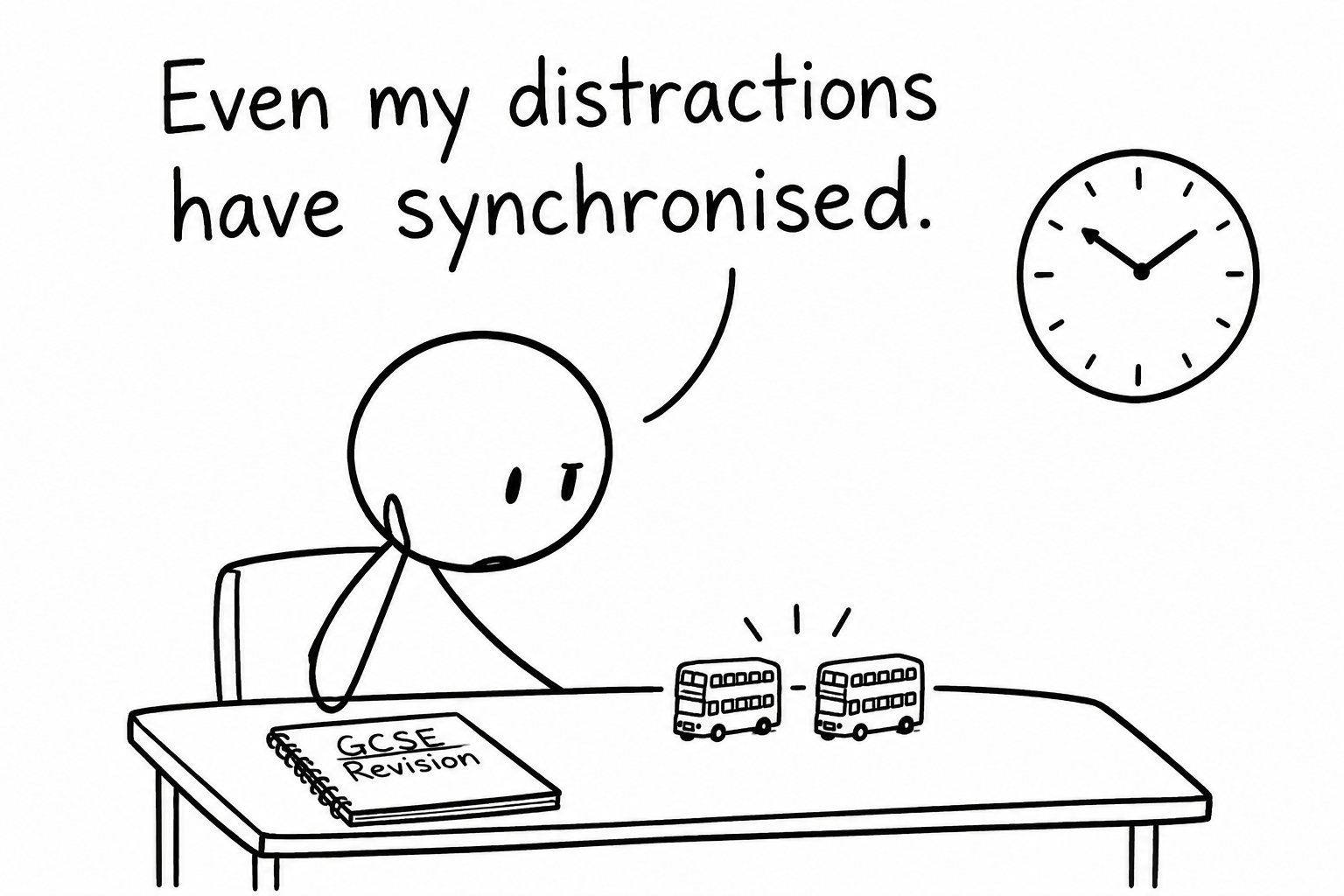 A student notices that even their toy bus distractions have synchronised
Question three: an LCM problem in context
The final question does not use the term LCM at all.
Three lights flash every 181818 seconds, 242424 seconds and 303030 seconds. They flash together at 14:35:0014{:}35{:}0014:35:00. At what time will they next flash together?
The phrase “next flash together” signals a repeating-event problem. The student needs the LCM of the three intervals.
18=2×3218 = 2 \times 3^218=2×32 24=23×324 = 2^3 \times 324=23×3 30=2×3×530 = 2 \times 3 \times 530=2×3×5Select the highest power of every prime present:
LCM=23×32×5\operatorname{LCM} = 2^3 \times 3^2 \times 5LCM=23×32×5 LCM=8×9×5=360\operatorname{LCM} = 8 \times 9 \times 5 = 360LCM=8×9×5=360The lights next flash together after 360360360 seconds. However, the question asks for a time, not a number of seconds. Convert the interval:
360÷60=6360 \div 60 = 6360÷60=6So the next simultaneous flash is 666 minutes after 14:35:0014{:}35{:}0014:35:00:
14:35:00+6 minutes=14:41:0014{:}35{:}00 + 6\text{ minutes} = 14{:}41{:}0014:35:00+6 minutes=14:41:00Answer: 14:41:0014{:}41{:}0014:41:00.
Where the method marks may come from
A mark scheme might reward the student for:
- recognising that an LCM calculation is needed;
- finding the correct prime factorizations;
- obtaining an interval of 360360360 seconds;
- converting the interval and giving the correct clock time.
Stopping at 360360360 would not fully answer the question. In contextual problems, the final mark often depends on interpreting the calculation correctly. The Prime Factors, HCF and LCM video lessons provide further walkthroughs of the reasoning behind these choices.
How to recognise the question type
HCF questions often describe:
- making the largest possible identical groups;
- cutting lengths into the longest equal pieces;
- sharing quantities equally with no remainder;
- finding the greatest number that divides each value.
LCM questions often involve:
- events happening together again;
- repeating schedules or cycles;
- the first common time or quantity;
- the smallest number divisible by all the given values.
These clues are helpful, but do not rely on a single word. Think about the structure. Dividing into the largest equal units suggests HCF. Waiting for cycles to coincide suggests LCM.
Students following Eduqas can also use the Eduqas Prime Factors, HCF and LCM revision lesson. The underlying mathematics stays the same, although question wording and mark schemes can vary by exam board.
Common mistakes in the HCF and LCM GCSE exam
Choosing the wrong operation
The most common mistake happens before any arithmetic. A student sees two numbers and calculates an HCF automatically. Write a brief note such as “repeating events, so LCM” before starting.
Using the wrong powers
For HCF, take the lowest powers shared by every number. For LCM, take the highest powers appearing anywhere. Mixing these rules can produce a plausible-looking but incorrect answer.
Incomplete prime factorisation
An expression such as 84=4×2184 = 4 \times 2184=4×21 is not a product of prime factors because 444 and 212121 are composite. Continue until every factor is prime:
84=22×3×784 = 2^2 \times 3 \times 784=22×3×7Giving the calculation instead of the answer
An interval of 360360360 seconds is useful working, but it is not a clock time. Read the final sentence again and give the requested unit, quantity or time.
Hiding useful working
Correct working can matter when an answer goes wrong. Keep factor trees, prime decompositions and selected powers visible. You can compare your presentation with the Maths Genie HCF and LCM answer booklet.
Exam-style practice that improves the method
Do not practise only direct instructions such as “find the HCF”. Mix them with grouping and repeating-event problems. That forces you to decide which calculation is appropriate, just as you must in HCF and LCM past paper questions.
After each attempt, check three things: whether you selected HCF or LCM correctly, whether the prime powers were accurate, and whether the final answer addressed the context. A question-specific worked HCF and LCM solution can also show how complete working is organised.
Turn the method into marks
The student in these examples improved the answer each time by making the reasoning visible: identify the question type, use prime factors, select the correct powers and interpret the result. Knowing that sequence is the first step; applying it repeatedly under exam conditions is what makes it dependable.
Start with the Maths Genie HCF and LCM Lessons and Question Bank and practise showing exactly where each method mark comes from.















